2012 Peugeot Partner Tepee lock
[x] Cancel search: lockPage 79 of 240

77
EASE OF USE
andCOMFOR
T
3
Seats
Adjusting the angle of the seat back
- Operate the control and adjust the
angle.
Placing the seat in the table position
- Lower the head restraint fully.
- Operate the control to fold the seat
back onto the seat cushion.
Returning the seat back to the
sitting position
- Release the seat back by pulling
the control, then return it to its
original position.
Ensure that the entire seat is anchored
securely.
Placing the seat in the fully folded
position
- Place the seat in the table position.
- Pull the red strap, located behind
the seat, to release the feet of the
seat from their anchorage on the
fl oor.
- Tilt the entire seat forwards.
Row 2 seat adjustments
Returning the seat to its original
position
- Fold back the entire seat.
Before folding the seat, ensure
that:
- in row 3, no passenger's foot is at
one of the seat anchorages on the
fl oor,
- the seat is locked securely on the
fl oor,
- the seat belt is available for the
passenger.
Page 80 of 240
78
Seats
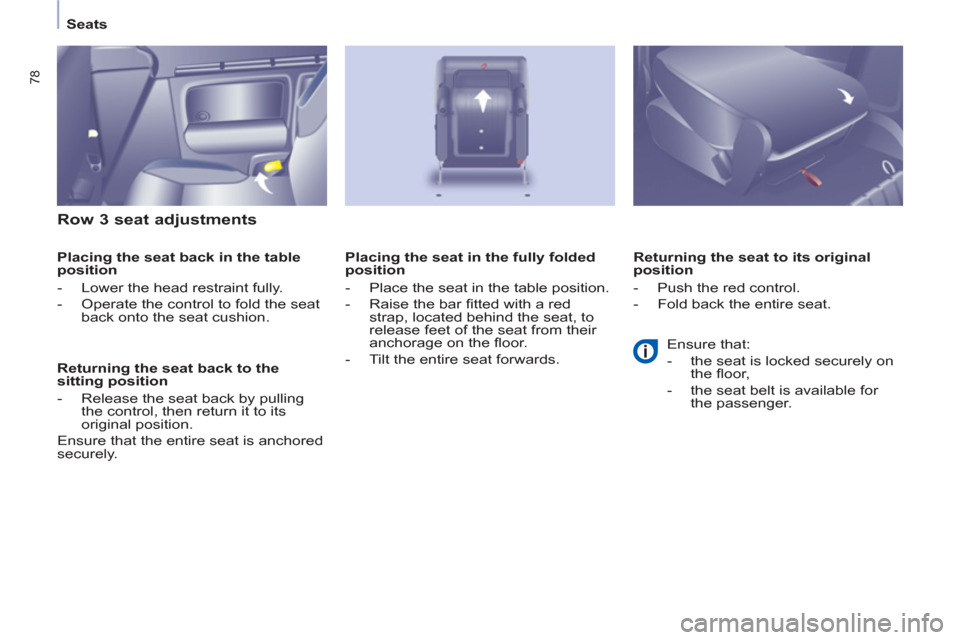
Row 3 seat adjustments
Placing the seat back in the table
position
- Lower the head restraint fully.
- Operate the control to fold the seat
back onto the seat cushion.
Returning the seat back to the
sitting position
- Release the seat back by pulling
the control, then return it to its
original position.
Ensure that the entire seat is anchored
securely.
Returning the seat to its original
position
- Push the red control.
- Fold back the entire seat.
Placing the seat in the fully folded
position
- Place the seat in the table position.
- Raise the bar fi tted with a red
strap, located behind the seat, to
release feet of the seat from their
anchorage on the fl oor.
- Tilt the entire seat forwards.
Ensure that:
- the seat is locked securely on
the fl oor,
- the seat belt is available for
the passenger.
Page 82 of 240

80
Seats
Removing the seat
- If necessary, move the front seats
forward.
- Lower the head restraint.
- Place the seat in the fully folded
position.
- Tilt the entire seat forwards then
lift it.
Repositioning the seat
The label on the seat indicates the
position in which it must be installed.
- Place the hooks of the front feet
between the two bars.
- Fold back the seat to fi x the rear
anchoring points.
- Operate the control to raise the
seat back to its initial position.
- Raise the head restraint.
Ensure that no object or foot of
a passenger seated in the rear
is obstructing the anchoring
recesses or preventing correct locking
of the seat.
Handling the Row 2 seat
Page 93 of 240

91
EASE OF USE
andCOMFOR
T
3
Practical information
Replacing a cartridge
The scented air freshener refi ll consists
of a cartridge B and its sealing case C .
- Remove the protective fi lm D .
- Place the head of the cartridge B
on the button A of the scented air
freshener.
- Turn it a quarter of a turn to lock it
on the button and remove the case.
- Insert the scented air freshener in
its location.
You can change the cartridges at any
time and store cartridges which have
already been started in their original
case.
The scented air freshener button A is
independent of the cartridge.
The cartridges are supplied without the
button A .
Inserting the scented air
freshener
After fi tting or changing the cartridge:
- Put the scented air freshener back
in place in its location.
- Turn it a quarter of a turn to the
right.
Good practice
As a safety precaution, only use the
cartridges provided for this purpose.
Do not dismantle the cartridges.
Keep the cartridge sealing cases
which are used as packaging when the
cartridges are not in use.
Never try to refi ll the cartridges
with fragrances other than those
recommended by the PEUGEOT
network.
Keep out of reach of children and
animals. Avoid contact with the skin
and eyes. If swallowed, consult a
doctor and show him the packaging or
product label. The scented air freshener button A can
only be fi xed on the multifunction roof
console with a cartridge.
Therefore, always retain button A and
a cartridge.
The cartridges are available from
PEUGEOT dealers.
Page 96 of 240

94
Practical information
Automatic switching on/off
The front courtesy lamp comes on
when the key is removed from the
ignition, when the vehicle is unlocked,
when one of the front doors is opened
and for location of the vehicle using the
remote control.
It goes off gradually after the ignition
is switched on and when the vehicle is
locked. Front seats: comes on when
one of the front doors is
opened. These are switched on and off by
means of a manual switch, with
the ignition on.
Rear seats: comes on when
one of the rear doors is
opened.
If the doors remain open for
a few minutes, the courtesy
lamps go off.
Permanently off. Permanently on, ignition on.
Front courtesy lamp
COURTESY LAMPS
Rear courtesy lamp
Front individual reading lamps
Page 104 of 240

102
Mirrors and windows
SURVEILLANCE MIRROR
This mirror, placed on top of the
central mirror, enables the driver or
front passenger to observe all the rear
seats.
Fitted on its own ball joint, it's manual
adjustment is simple and provides a
view of the rear interior of the vehicle.
It can also be adjusted for improved
visibility during manoeuvres or when
overtaking.
Areas for toll cards/car park
tickets
The athermic windscreen has two non-
refl ective zones located either side of
the base of the interior mirror.
They are intended for affi xing toll cards
and/or car park tickets.
REAR WINDOWS
To partially open the rear windows, tilt
the lever and push it fully to lock the
windows in the open position.
Manual rear view mirror
The rear view mirror has two positions:
- day (normal),
- night (anti-dazzle).
To change from one to the other, push
or pull the lever on the lower edge of
the mirror.
Page 109 of 240

ABS
ABS
107
Driving safely
SAFETY
4
ANTI-LOCK BRAKING SYSTEM
(ABS - EBFD)
The ABS and EBFD (electronic brake
force distribution) systems improve the
stability and manoeuvrability of your
vehicle on braking, in particular on
poor or slippery surfaces.
The ABS prevents locking of the
wheels, the EBFD provides control of
the braking pressure wheel by wheel. If this warning lamp comes
on, accompanied by an
audible signal and a message
in the screen, it indicates a
malfunction of the ABS which
could result in a loss of control of the
vehicle on braking.
If this warning lamp comes
on, together with the brake
and STOP warning lamps,
accompanied by an audible
signal and a message in the
screen, it indicates a malfunction of
the electronic brake force distribution
which could result in a loss of control of
the vehicle on braking.
EMERGENCY BRAKING
ASSISTANCE SYSTEM
(EBA)
In an emergency, this system enables
the optimum braking pressure to be
reached more quickly, press the pedal
fi rmly without releasing it.
It is triggered by the speed at which the
brake pedal is activated.
This alters the resistance of the brake
pedal under your foot.
To prolong the operation of the
emergency braking assistance system:
keep your foot on the brake pedal.
Good practice
The anti-lock braking system comes
into operation automatically when
there is a risk of wheel lock. It does not
reduce the braking distance.
On very slippery surfaces (ice, oil,
etc...) the ABS may increase the
braking distance. When braking in
an emergency, do not hesitate to
press the brake pedal fi rmly, without
releasing the pressure, even on a
slippery surface, you will then be able
to continue to manoeuvre the vehicle
to avoid an obstacle.
Normal operation of the ABS may be
felt by slight vibration of the brake
pedal.
When changing wheels (tyres
and rims), ensure that these are
recommended by PEUGEOT.
Stop
as soon as it is safe to do so
.
In both cases, contact a PEUGEOT
dealer or a qualifi ed workshop.
Page 114 of 240

11 2 11 2
Seat belts
Recommendations for children:
- use a suitable child seat if the
passenger is less than 12 years old
or shorter than one metre fi fty,
- never allow a child to travel on
your lap, even with the seat belt
fastened.
For more information on child
seats, refer to the "Children on
board" section of chapter 4.
Clean the seat belt straps with
soapy water or a textile cleaning
product, sold by PEUGEOT
dealers.
In accordance with current safety
regulations, your PEUGEOT dealer
can guarantee all work or any checks,
from testing to maintenance, on your
seat belt equipment.
Have the seat belts checked regularly
(even after a minor impact) by a
PEUGEOT dealer or a qualifi ed
workshop: they must not show any
signs of wear, cutting or fraying
and they must not be converted or
modifi ed. The force limiter reduces the pressure
of the seat belt against the body of the
occupants.
The pretensioning seat belts are active
when the ignition is switched on.
The inertia reels are fi tted with a device
which automatically locks the strap in
the event of a collision or emergency
braking or if the vehicle rolls over.
You can unfasten the seat belt by
pressing the red button on the buckle.
Guide the seat belt after unfastening.
The airbag warning lamp comes on
if the pretensioners are deployed.
Contact a PEUGEOT dealer or a
qualifi ed workshop.
In order to be effective, a seat belt
must:
- restrain one person only,
- must not be twisted, check by
pulling in front of you with an even
movement,
- be tightened as close to the body
as possible.
The upper part of the seat belt should
be positioned in the hollow of the
shoulder.
The lap part should be placed as low
as possible on the pelvis.
Do not invert the seat belt buckles as
they will not fulfi l their role completely.
If the seats are fi tted with armrests, the
lap part of the seat belt should always
pass under the armrest.
Check that the seat belt is fastened
correctly by pulling the strap fi rmly.
Front seat belts
The front seats are fi tted with
pretensioners and force limiters.
Rear seat belts
(5 seat version)
The rear seats are fi tted with
three-point inertia reel seat belts.