Page 61 of 340
CO
59
The air conditioning system
does not contain chlorine and
does not present any danger
to the ozone layer.
Recommendations for ventilation and air conditioning
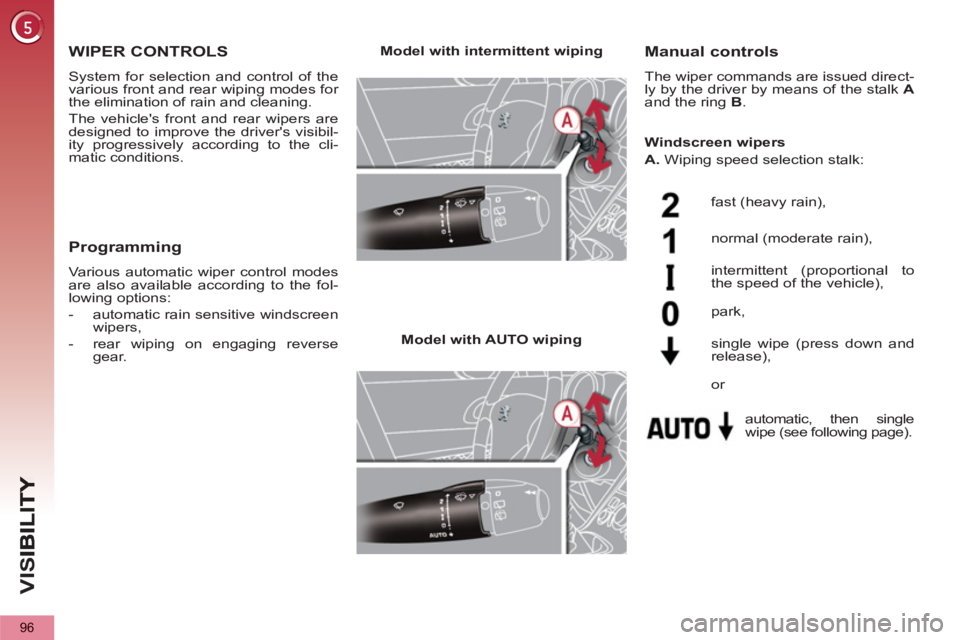
REAR VENTILATION
ADJUSTMENT
After pressing the "REAR" button, turn
the adjustment dial of the rear side
vents to decrease or increase the fl ow
of air.
Take care not to obstruct the side vents
and the air outlets on the fl oor.
To shut off the fl ow of air, close the vents
and set the dial to 0. In order for these systems to be fully effective, follow the operation and mainte-
nance guidelines below:
)
If the interior temperature remains very high after the vehicle has been
parked in the sun for a considerable time, fi rst ventilate the passenger com-
partment for a few minutes.
Place the air fl ow control at a suffi cient level to provide an adequate renewal
of air in the passenger compartment.
)
To obtain an even air distribution, take care not to obstruct the exterior air
intake grilles located at the base of the windscreen, the nozzles, the vents
and the air outlets, as well as the air extractor located in the boot.
)
Use in preference the intake of exterior air as prolonged use of the air recir-
culation may cause misting of the windows and side windows.
)
Do not cover the sunshine sensor, located on the dashboard; this is used for
regulation of the automatic air conditioning system.
)
Operate the air conditioning system for 5 to 10 minutes, once or twice a
month to keep it in good working order.
)
Ensure that the passenger compartment fi lter is in good condition and have
the fi lter elements replaced regularly (refer to the "Checks" section).
We recommend the use of a combined passenger compartment fi lter. Thanks
to its second special active fi lter, it contributes to the purifi cation of the air
breathed by the occupants and the cleanliness of the passenger compartment
(reduction of allergic symptoms, bad odours and greasy deposits).
)
The air conditioning uses power from the engine while operating. This results
in an increase in the vehicle's fuel consumption.
When towing at or near maximum capacity or on steep slopes in high ambient
temperatures, switching off the air conditioning saves engine power and so
improves towing capacity.
Condensation created by the air conditioning results in a discharge of water
under the vehicle when stationary, which is perfectly normal.
)
To ensure correct operation of the air conditioning system, you are also advised
to have it checked regularly.
)
If the system does not produce cold air, do not use it and contact a PEUGEOT
dealer or a qualifi ed workshop.
Page 98 of 340
VIS
96
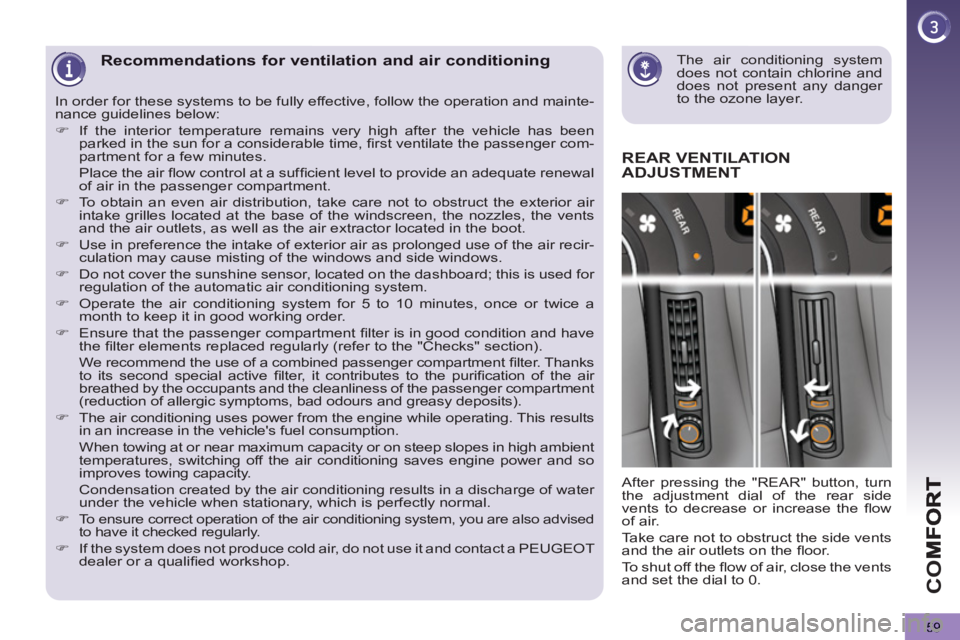
WIPER CONTROLS
System for selection and control of the
various front and rear wiping modes for
the elimination of rain and cleaning.
The vehicle's front and rear wipers are
designed to improve the driver's visibil-
ity progressively according to the cli-
matic conditions.
Manual controls
The wiper commands are issued direct-
ly by the driver by means of the stalk A
and the ring B
.
Model with intermittent wiping
Model with AUTO wiping
fast (heavy rain),
normal (moderate rain),
intermittent (proportional to
the speed of the vehicle),
automatic, then single
wipe (see following page). park,
single wipe (press down and
release),
Windscreen wipers
A.
Wiping speed selection stalk:
or
Programming
Various automatic wiper control modes
are also available according to the fol-
lowing options:
- automatic rain sensitive windscreen
wipers,
- rear wiping on engaging reverse
gear.
Page 100 of 340
VIS
98
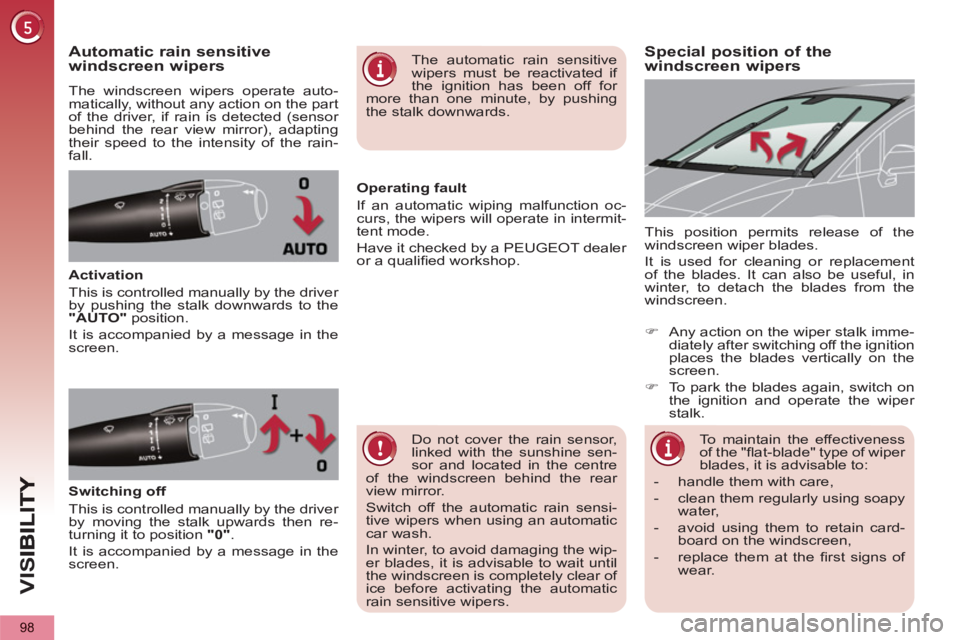
Special position of the
windscreen wipersAutomatic rain sensitive
windscreen wipers
The windscreen wipers operate auto-
matically, without any action on the part
of the driver, if rain is detected (sensor
behind the rear view mirror), adapting
their speed to the intensity of the rain-
fall.
Activation
This is controlled manually by the driver
by pushing the stalk downwards to the
"AUTO"
position.
It is accompanied by a message in the
screen. This position permits release of the
windscreen wiper blades.
It is used for cleaning or replacement
of the blades. It can also be useful, in
winter, to detach the blades from the
windscreen.
Do not cover the rain sensor,
linked with the sunshine sen-
sor and located in the centre
of the windscreen behind the rear
view mirror.
Switch off the automatic rain sensi-
tive wipers when using an automatic
car wash.
In winter, to avoid damaging the wip-
er blades, it is advisable to wait until
the windscreen is completely clear of
ice before activating the automatic
rain sensitive wipers.
The automatic rain sensitive
wipers must be reactivated if
the ignition has been off for
more than one minute, by pushing
the stalk downwards.
Switching off
This is controlled manually by the driver
by moving the stalk upwards then re-
turning it to position "0"
.
It is accompanied by a message in the
screen.
Operating fault
If an automatic wiping malfunction oc-
curs, the wipers will operate in intermit-
tent mode.
Have it checked by a PEUGEOT dealer
or a qualifi ed workshop.
To maintain the effectiveness
of the "fl at-blade" type of wiper
blades, it is advisable to:
- handle them with care,
- clean them regularly using soapy
water,
- avoid using them to retain card-
board on the windscreen,
- replace them at the fi rst signs of
wear.
)
Any action on the wiper stalk imme-
diately after switching off the ignition
places the blades vertically on the
screen.
)
To park the blades again, switch on
the ignition and operate the wiper
stalk.