2012 NISSAN XTERRA clutch
[x] Cancel search: clutchPage 224 of 341
When the vehicle is stuck,● Set the 4WD shift switch to 4H or 4LO.
● Use the Electronic Locking Rear Differential
(E-Lock) system (if so equipped) . Turn the
switch ON while the vehicle is stationary and
apply the throttle to try to free the vehicle.
● If it is difficult to free the vehicle, rock the
vehicle back and forth between reverse and
drive gears.
● If the vehicle is stuck deep in mud, place
stones or wooden blocks under the tires.
Then try the recovery procedures above. Tire
chains may be effective.
CAUTION
● Do not spin the tires excessively. Tires
will sink deep into the mud, making it
difficult to free the vehicle.
● Avoid shifting gears with the engine
running at high speeds as this may
cause malfunction.
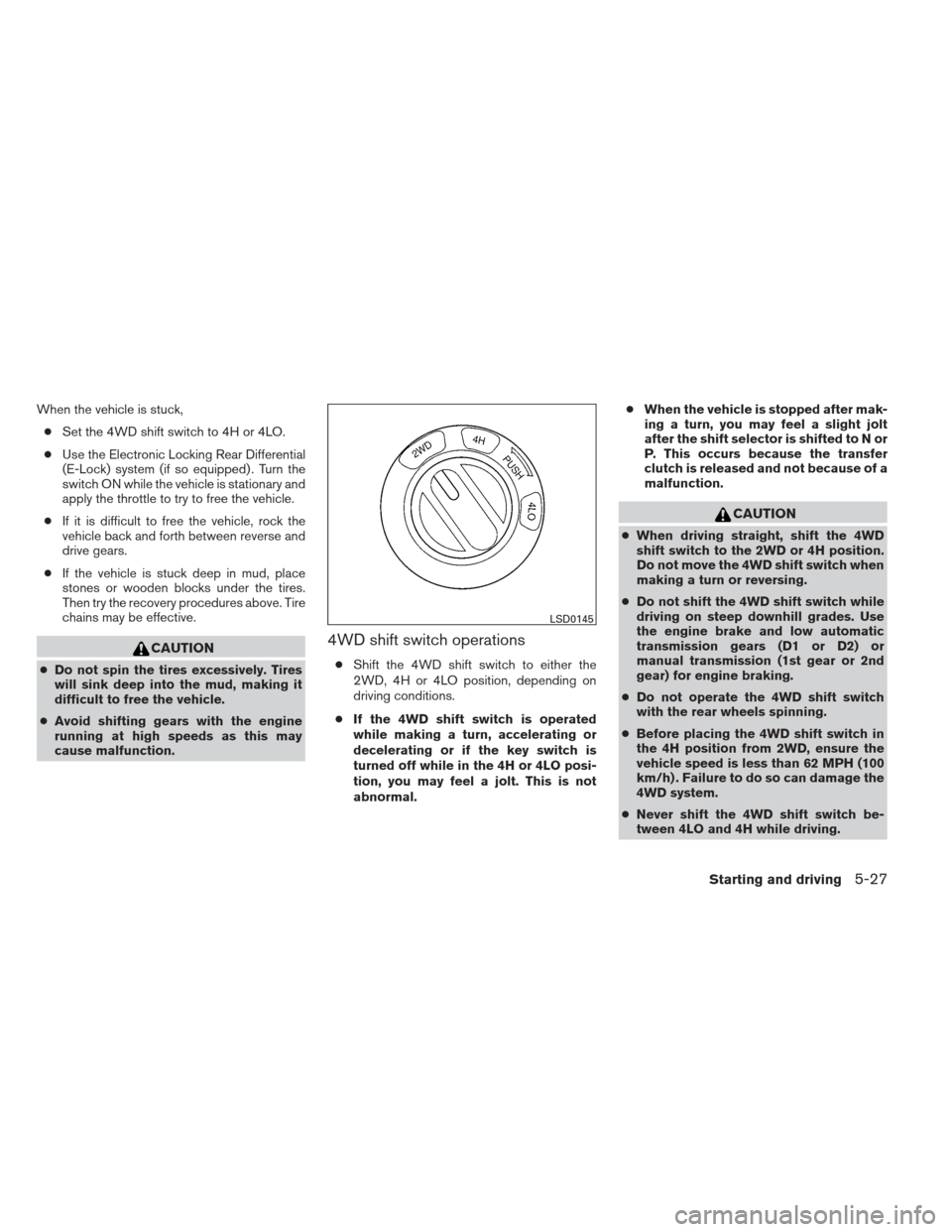
4WD shift switch operations
● Shift the 4WD shift switch to either the
2WD, 4H or 4LO position, depending on
driving conditions.
● If the 4WD shift switch is operated
while making a turn, accelerating or
decelerating or if the key switch is
turned off while in the 4H or 4LO posi-
tion, you may feel a jolt. This is not
abnormal. ●
When the vehicle is stopped after mak-
ing a turn, you may feel a slight jolt
after the shift selector is shifted to N or
P. This occurs because the transfer
clutch is released and not because of a
malfunction.
CAUTION
● When driving straight, shift the 4WD
shift switch to the 2WD or 4H position.
Do not move the 4WD shift switch when
making a turn or reversing.
● Do not shift the 4WD shift switch while
driving on steep downhill grades. Use
the engine brake and low automatic
transmission gears (D1 or D2) or
manual transmission (1st gear or 2nd
gear) for engine braking.
● Do not operate the 4WD shift switch
with the rear wheels spinning.
● Before placing the 4WD shift switch in
the 4H position from 2WD, ensure the
vehicle speed is less than 62 MPH (100
km/h) . Failure to do so can damage the
4WD system.
● Never shift the 4WD shift switch be-
tween 4LO and 4H while driving.
LSD0145
Starting and driving5-27
Page 226 of 341
●When the warning light comes on, the
2WD mode may be engaged even if the
4WD shift switch is in 4H. Be especially
careful when driving. If corresponding
parts are malfunctioning, the 4WD
mode will not be engaged even if the
4WD shift switch is shifted.
● Do not drive the vehicle in the 4H or 4LO
position on dry hard surface roads. Driv-
ing on dry, hard surfaces in 4H or 4LO
may cause unnecessary noise, tire wear
and increased fuel consumption.
If the 4WD warning light turns on when
you are driving on dry hard surface
roads:
– in the 4H position, shift the 4WD shift switch to 2WD.
– in the 4LO position for automatic transmission vehicles, stop the ve-
hicle and shift the shift selector to
the N position with the brake pedal
depressed and shift the 4WD shift
switch to 2WD. – in the 4LO position for manual trans-
mission vehicles, stop the vehicle
and shift the shift selector to the N
position with the clutch pedal de-
pressed and shift the 4WD shift
switch to 2WD.
● If the warning light is still on after the
above operation, have your vehicle
checked by a NISSAN dealer as soon as
possible.
● The transfer case may be damaged if
you continue driving with the warning
light blinking. The E-Lock system can provide additional trac-
tion and should only be used when a vehicle has
become or is becoming stuck. This system oper-
ates by electronically “locking” the two rear drive
wheels together, allowing them to turn at the
same speed. The system is used when it is not
possible to free a stuck vehicle even when using
the 4LO position (4 wheel drive vehicles) .
When added traction is required, activate the
E-Lock system by pushing the switch ON. See
“Electronic locking rear differential (E-Lock) sys-
tem switch” in the “Instruments and Controls”
section. Once the system fully engages, the indi-
cator light in the instrument panel will remain ON.
When the system is activated, both rear wheels
will engage, providing added traction.
The rear wheels may momentarily slip or move to
engage the system, and the system will only
engage up to approximately 4 MPH (7 km/h) .
Once the vehicle is free, the system should be
turned OFF and driving resumed.
The Anti-Lock Brake (ABS) system is disabled
and the ABS light illuminates when the E-Lock
system is ON. Also, the Vehicle Dynamic Control
(VDC) system is disabled and the VDC light
illuminates when the E-Lock system is ON.
ELECTRONIC LOCKING REAR
DIFFERENTIAL (E-Lock) SYSTEM (if
so equipped)
Starting and driving5-29
Page 260 of 341
8 Maintenance and do-it-yourself
Maintenance requirements..........................8-2
General maintenance ..............................8-2
Explanation of general maintenance items .........8-2
Maintenance precautions ...........................8-5
Engine compartment check locations ................8-6
Engine cooling system .............................8-7
Checking engine coolant level ...................8-8
Changing engine coolant ........................8-8
Engine oil .........................................8-9
Checking engine oil level ........................8-9
Changing engine oil ........................... 8-10
Changing engine oil filter .......................8-11
5-speed automatic transmission fluid
(if so equipped) .................................. 8-11
Power steering fluid ............................... 8-12
Brake and clutch (if so equipped) fluid ..............8-12
Brake fluid .................................... 8-13
Clutch fluid (if so equipped) ....................8-13
Windshield-washer fluid ........................... 8-13
Windshield-washer fluid reservoir ...............8-13
Battery .......................................... 8-14
Jump starting ................................. 8-15
Variable voltage control system .....................8-16Drive belt
........................................ 8-16
Spark plugs ...................................... 8-17
Replacing spark plugs ......................... 8-17
Air cleaner ....................................... 8-18
In-cabin microfilter (if so equipped) ..............8-18
Windshield wiper blades .......................... 8-19
Cleaning ..................................... 8-19
Replacing .................................... 8-20
Brakes .......................................... 8-22
Fuses ........................................... 8-22
Engine compartment ........................... 8-23
Passenger compartment .......................8-24
Battery replacement .............................. 8-26
Keyfob ....................................... 8-26
Lights ........................................... 8-27
Headlights .................................... 8-27
Exterior
and interior lights ....................... 8-29
Wheels and tires ................................. 8-32
Tire pressure . . . ............................... 8-32
Tire labeling ................................... 8-36
Types of tires .................................. 8-38
Tire chains .................................... 8-39
Changing wheels and tires .....................8-39
Page 263 of 341
Seat beltsCheck that all parts of the seat belt
system (for example, buckles, anchors, adjusters
and retractors) operate properly and smoothly,
and are installed securely. Check the belt web-
bing for cuts, fraying, wear or damage.
Steering wheel Check for changes in the steer-
ing system, such as excessive freeplay, hard
steering or strange noises.
Warning lights and chimes Make sure all
warning lights and chimes are operating properly.
Windshield wiper and washer* Check that
the wipers and washer operate properly and that
the wipers do not streak.
Windshield defroster Check that the air
comes out of the defroster outlets properly and in
sufficient quantity when operating the heater or
air conditioner.
Under the hood and vehicle
The maintenance items listed here should be
checked periodically (for example, each time you
check the engine oil or refuel) .
Battery* Check the fluid level in each cell. It
should be between the MAX and MIN lines. Ve-
hicles operated in high temperatures or under
severe conditions require frequent checks of the
battery fluid level. Brake and clutch (if so equipped) fluid lev-
els*
Make sure that the brake and clutch fluid
level is between the MIN and MAX lines on the
reservoir.
Engine coolant level* Check the coolant level
when the engine is cold.
Engine drive belts* Make sure the drive belts
are not frayed, worn, cracked or oily.
Engine oil level* Check the level after parking
the vehicle on a level surface with the engine off.
Wait more than 10 minutes for the oil to drain
back into the oil pan.
Exhaust system Make sure there are no loose
supports, cracks or holes. If the sound of the
exhaust seems unusual or there is a smell of
exhaust fumes, immediately have the exhaust
system inspected by a NISSAN dealer. See the
carbon monoxide warning in the “Starting and
driving” section of this manual.
Fluid leaks Check under the vehicle for fuel, oil,
water or other fluid leaks after the vehicle has
been parked for a while. Water dripping from the
air conditioner after use is normal. If you should
notice any leaks or if gasoline fumes are evident,
check for the cause and have it corrected imme-
diately. Power steering fluid level* and lines
Check
the level when the fluid is cold, with the engine
off. Check the lines for proper attachment, leaks,
cracks, etc.
Radiator and hoses Check the front of the
radiator and clean off any dirt, insects, leaves,
etc., that may have accumulated. Make sure the
hoses have no cracks, deformation, rot or loose
connections.
Underbody The underbody is frequently ex-
posed to corrosive substances such as those
used on icy roads or to control dust. It is very
important to remove these substances from the
underbody, otherwise rust may form on the floor
pan, frame, fuel lines and exhaust system. At the
end of winter, the underbody should be thor-
oughly flushed with plain water, in those areas
where mud and dirt may have accumulated. See
the “Appearance and care” section of this
manual.
Windshield-washer fluid* Check that there is
adequate fluid in the reservoir.
8-4Maintenance and do-it-yourself
Page 265 of 341
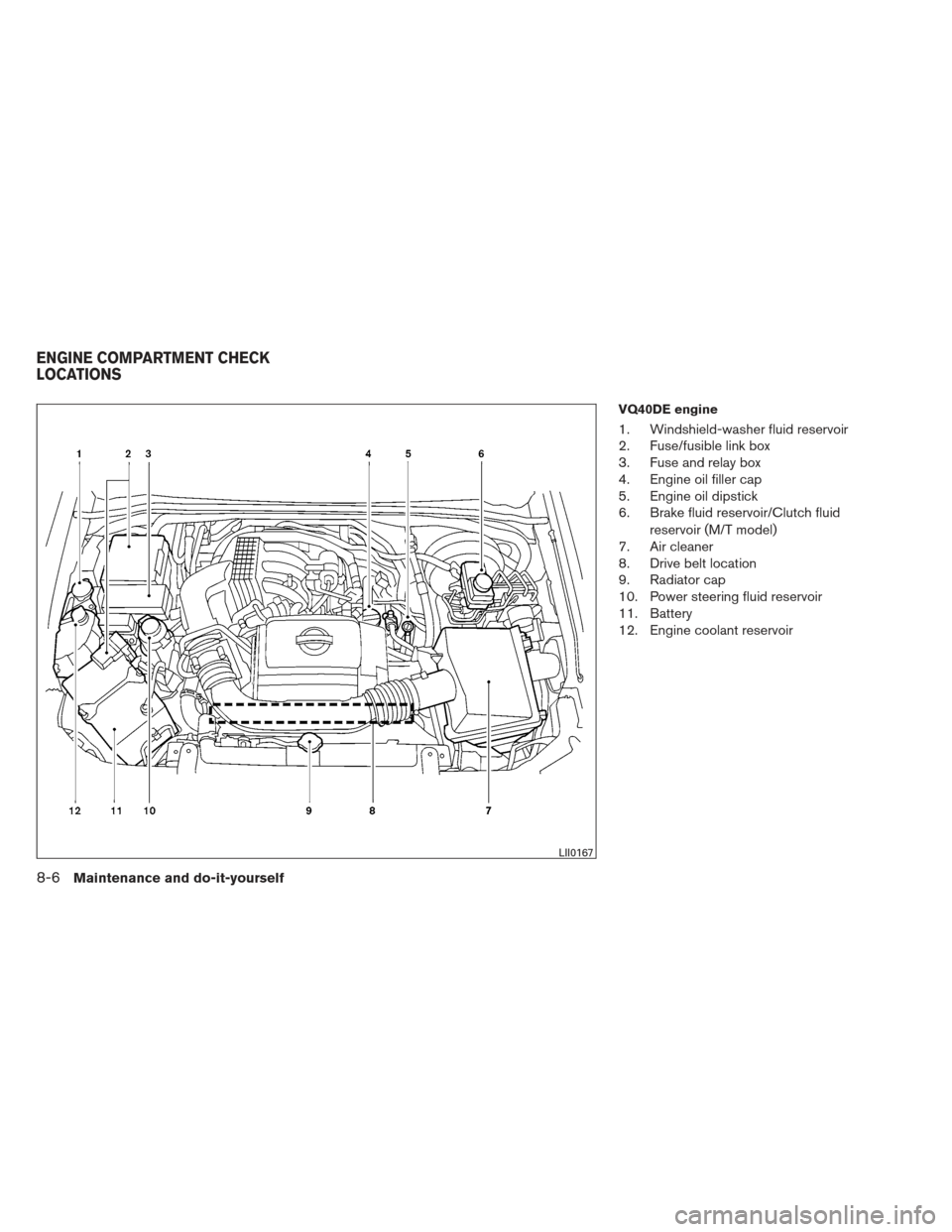
VQ40DE engine
1. Windshield-washer fluid reservoir
2. Fuse/fusible link box
3. Fuse and relay box
4. Engine oil filler cap
5. Engine oil dipstick
6. Brake fluid reservoir/Clutch fluidreservoir (M/T model)
7. Air cleaner
8. Drive belt location
9. Radiator cap
10. Power steering fluid reservoir
11. Battery
12. Engine coolant reservoir
LII0167
ENGINE COMPARTMENT CHECK
LOCATIONS
8-6Maintenance and do-it-yourself
Page 271 of 341
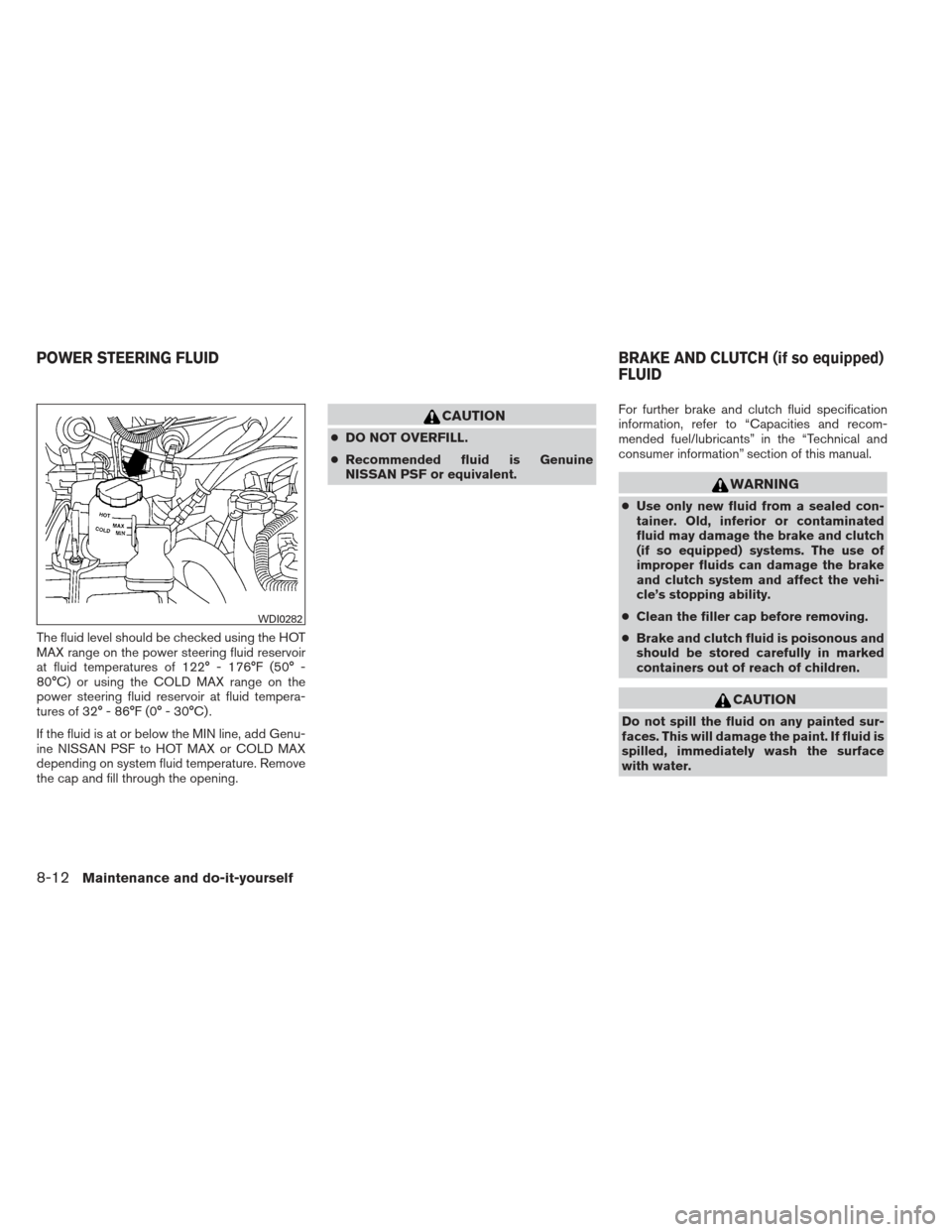
The fluid level should be checked using the HOT
MAX range on the power steering fluid reservoir
at fluid temperatures of 122° - 176°F (50° -
80°C) or using the COLD MAX range on the
power steering fluid reservoir at fluid tempera-
tures of 32° - 86°F (0° - 30°C) .
If the fluid is at or below the MIN line, add Genu-
ine NISSAN PSF to HOT MAX or COLD MAX
depending on system fluid temperature. Remove
the cap and fill through the opening.
CAUTION
●DO NOT OVERFILL.
● Recommended fluid is Genuine
NISSAN PSF or equivalent. For further brake and clutch fluid specification
information, refer to “Capacities and recom-
mended fuel/lubricants” in the “Technical and
consumer information” section of this manual.
WARNING
●
Use only new fluid from a sealed con-
tainer. Old, inferior or contaminated
fluid may damage the brake and clutch
(if so equipped) systems. The use of
improper fluids can damage the brake
and clutch system and affect the vehi-
cle’s stopping ability.
● Clean the filler cap before removing.
● Brake and clutch fluid is poisonous and
should be stored carefully in marked
containers out of reach of children.
CAUTION
Do not spill the fluid on any painted sur-
faces. This will damage the paint. If fluid is
spilled, immediately wash the surface
with water.
WDI0282
POWER STEERING FLUID BRAKE AND CLUTCH (if so equipped)
FLUID
8-12Maintenance and do-it-yourself
Page 272 of 341
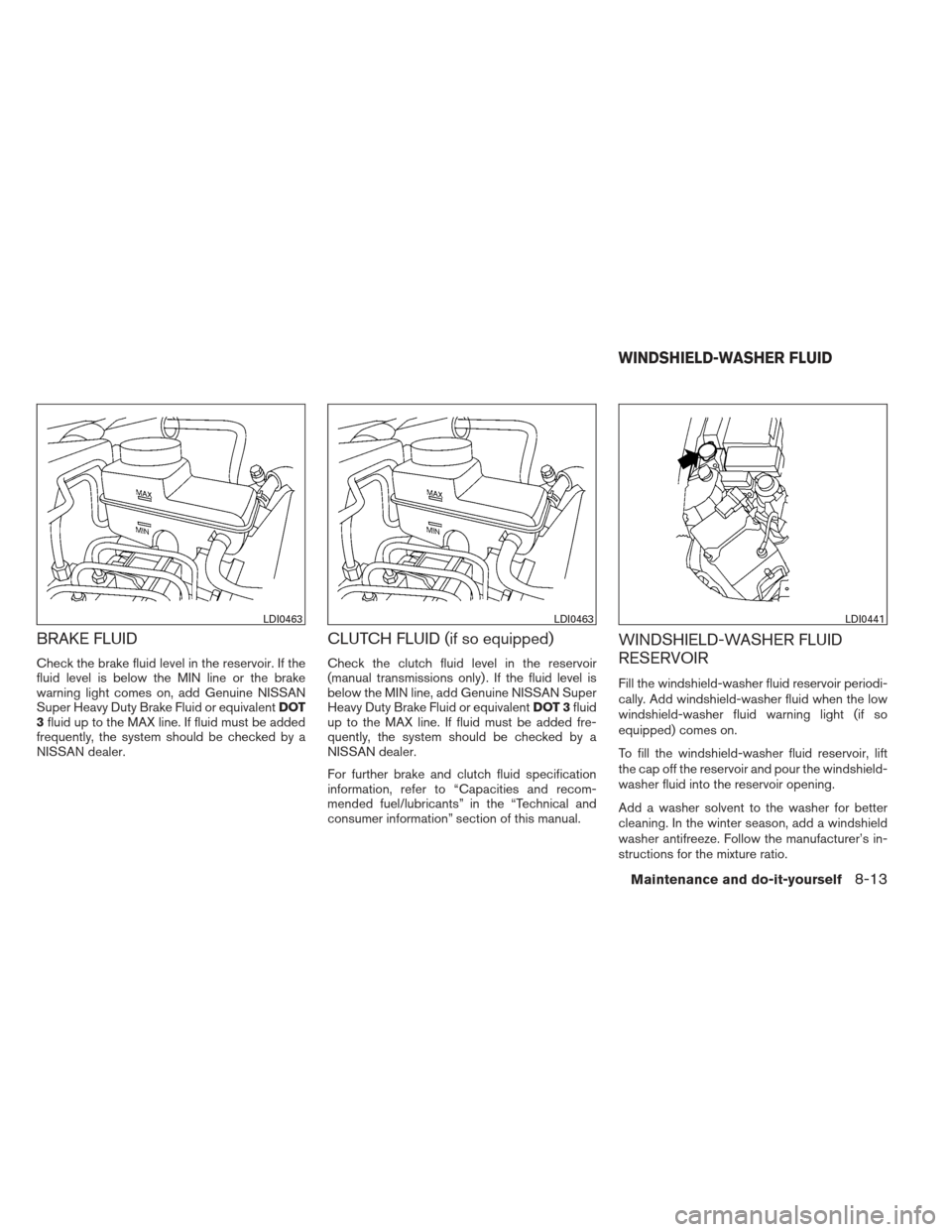
BRAKE FLUID
Check the brake fluid level in the reservoir. If the
fluid level is below the MIN line or the brake
warning light comes on, add Genuine NISSAN
Super Heavy Duty Brake Fluid or equivalentDOT
3 fluid up to the MAX line. If fluid must be added
frequently, the system should be checked by a
NISSAN dealer.
CLUTCH FLUID (if so equipped)
Check the clutch fluid level in the reservoir
(manual transmissions only) . If the fluid level is
below the MIN line, add Genuine NISSAN Super
Heavy Duty Brake Fluid or equivalent DOT 3fluid
up to the MAX line. If fluid must be added fre-
quently, the system should be checked by a
NISSAN dealer.
For further brake and clutch fluid specification
information, refer to “Capacities and recom-
mended fuel/lubricants” in the “Technical and
consumer information” section of this manual.
WINDSHIELD-WASHER FLUID
RESERVOIR
Fill the windshield-washer fluid reservoir periodi-
cally. Add windshield-washer fluid when the low
windshield-washer fluid warning light (if so
equipped) comes on.
To fill the windshield-washer fluid reservoir, lift
the cap off the reservoir and pour the windshield-
washer fluid into the reservoir opening.
Add a washer solvent to the washer for better
cleaning. In the winter season, add a windshield
washer antifreeze. Follow the manufacturer’s in-
structions for the mixture ratio.
LDI0463LDI0463LDI0441
WINDSHIELD-WASHER FLUID
Maintenance and do-it-yourself8-13
Page 303 of 341
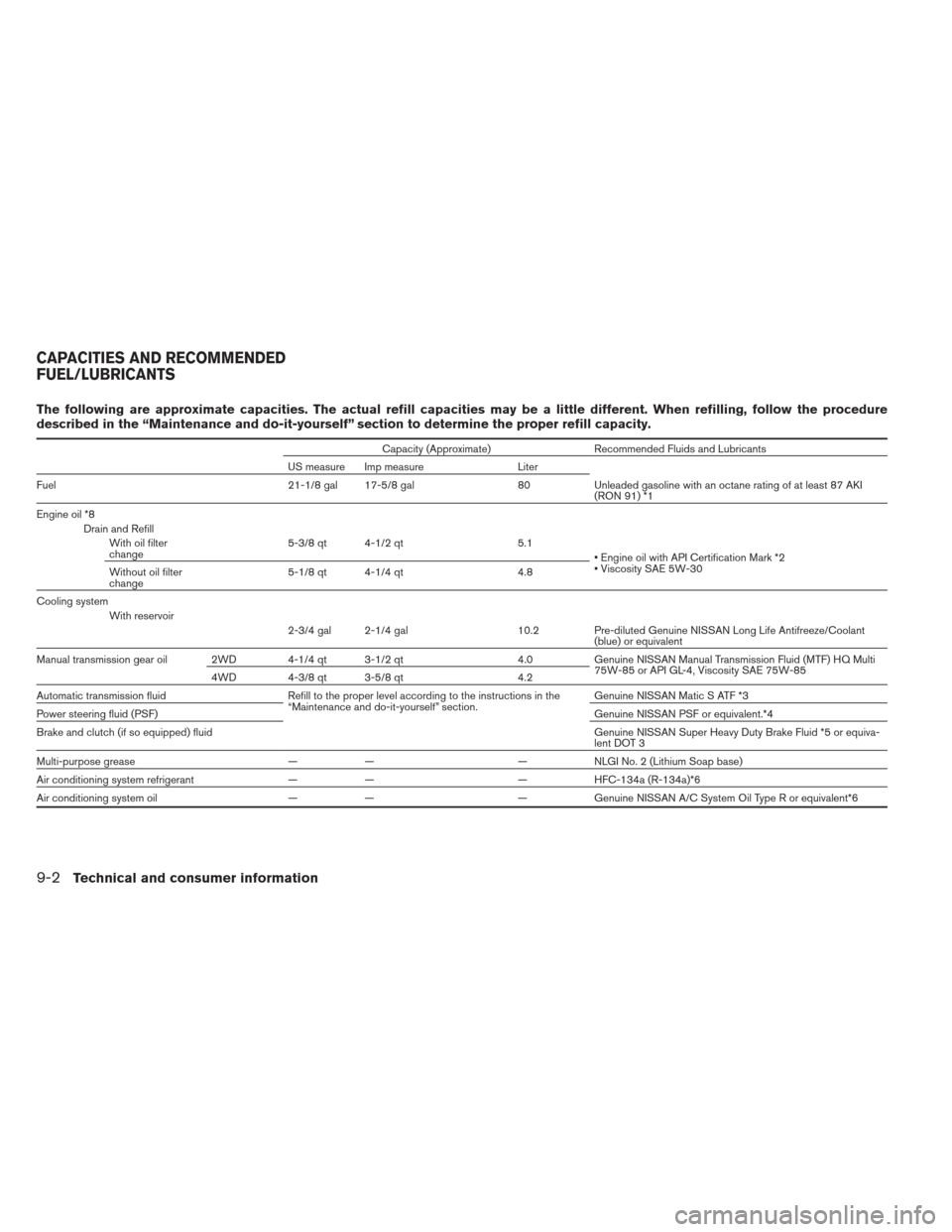
The following are approximate capacities. The actual refill capacities may be a little different. When refilling, follow the procedure
described in the “Maintenance and do-it-yourself” section to determine the proper refill capacity.
Capacity (Approximate)Recommended Fluids and Lubricants
US measure Imp measure Liter
Fuel 21-1/8 gal 17-5/8 gal80Unleaded gasoline with an octane rating of at least 87 AKI
(RON 91) *1
Engine oil *8 Drain and RefillWith oil filter
change 5-3/8 qt 4-1/2 qt
5.1
Engine oil with API Certification Mark *2
Viscosity SAE 5W-30
Without oil filter
change 5-1/8 qt 4-1/4 qt
4.8
Cooling system With reservoir 2-3/4 gal 2-1/4 gal 10.2Pre-diluted Genuine NISSAN Long Life Antifreeze/Coolant
(blue) or equivalent
Manual transmission gear oil 2WD 4-1/4 qt 3-1/2 qt 4.0Genuine NISSAN Manual Transmission Fluid (MTF) HQ Multi
75W-85 or API GL-4, Viscosity SAE 75W-85
4WD 4-3/8 qt 3-5/8 qt 4.2
Automatic transmission fluid Refill to the proper level according to the instructions in the
“Maintenance and do-it-yourself” section. Genuine NISSAN Matic S ATF *3
Power steering fluid (PSF) Genuine NISSAN PSF or equivalent.*4
Brake and clutch (if so equipped) fluid Genuine NISSAN Super Heavy Duty Brake Fluid *5 or equiva-
lent DOT 3
Multi-purpose grease —— —NLGI No. 2 (Lithium Soap base)
Air conditioning system refrigerant —— —HFC-134a (R-134a)*6
Air conditioning system oil —— —Genuine NISSAN A/C System Oil Type R or equivalent*6
CAPACITIES AND RECOMMENDED
FUEL/LUBRICANTS
9-2Technical and consumer information