Page 240 of 293
Rear window wiper blade
Contact a NISSAN dealer if checking or replace-
ment is required.If the brakes do not operate properly, have the
brakes checked by a NISSAN dealer.Self-adjusting brakes
Your vehicle is equipped with self-adjusting
brakes.
The front disc-type brakes self-adjust every time
the brake pedal is applied. The rear drum-type
brakes self-adjust every time the parking brake is
applied.
Page 247 of 293
CAUTION
●High-pressure halogen gas is sealed in-
side the bulb. The bulb may break if the
glass envelope is scratched or the bulb
is dropped.
● Aiming should not be necessary after
replacing the H4 bulb. When aiming ad-
justment is necessary, contact a
NISSAN dealer.
● Do not leave the headlight assembly
open without a bulb installed for a long
period of time. Dust, moisture, smoke,
etc. entering the headlight body may
affect bulb performance. Remove the
bulb from the headlight assembly just
before a replacement bulb is installed.
● Only touch the base when handling the
bulb. Never touch the glass envelope.
Touching the glass could significantly
affect bulb life and/or headlight
performance.
● Use the same number and wattage as
shown in the chart.
1. Disconnect the battery negative cable.
2. Disconnect the electrical connector
�Afrom
the rear end of the bulb. 3. Pull off the rubber cap
�B.
4. Push and turn the retaining pin
�Cto loosen
it.
5. Remove the headlight bulb. Do not shake or rotate the bulb when removing it.
6. Install the new bulb in the reverse order of removal.
Fog may temporarily form inside the lens of the
exterior lights in the rain or in a car wash. A
temperature difference between the inside and
the outside of the lens causes the fog. This is not
a malfunction. If large drops of water collect
inside the lens, contact a NISSAN dealer.
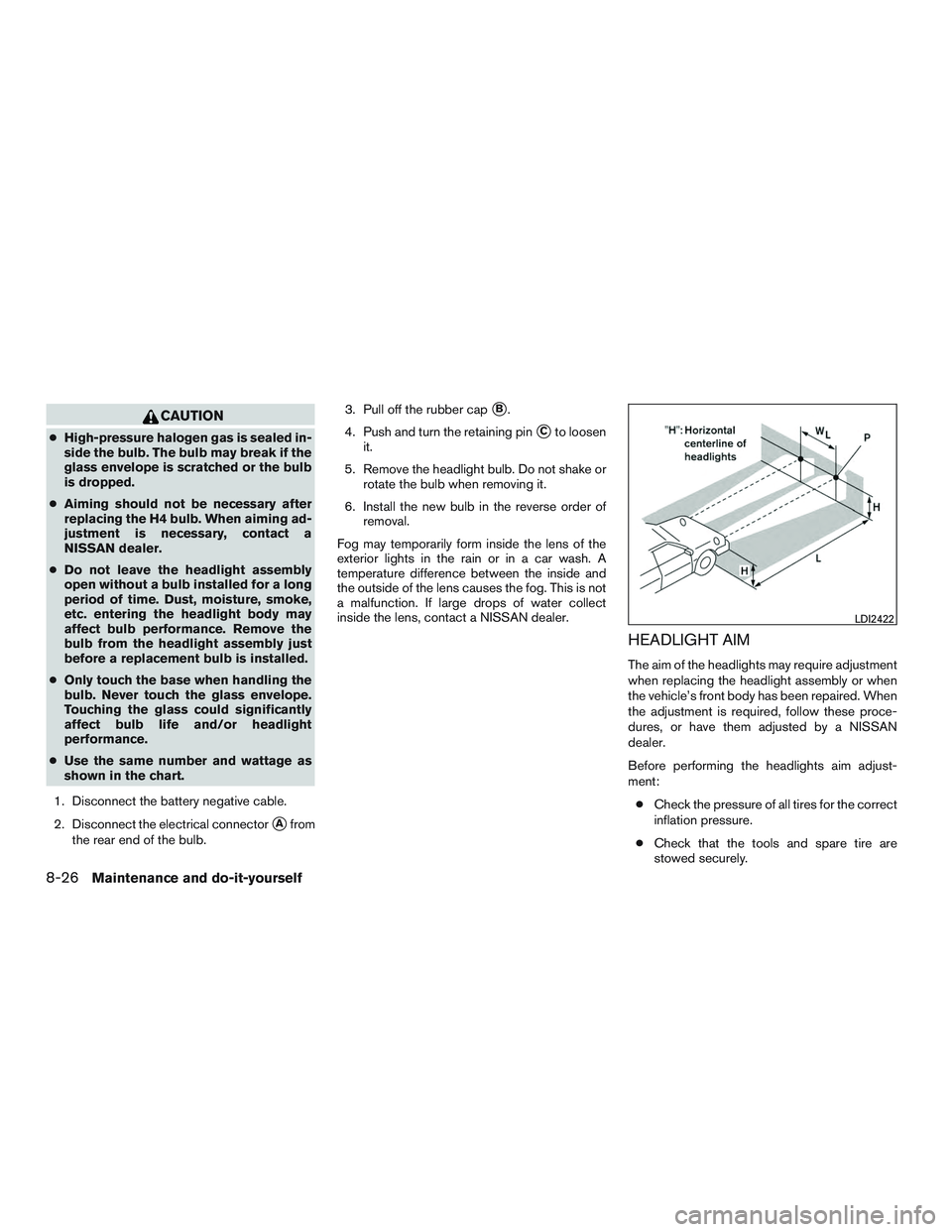
HEADLIGHT AIM
The aim of the headlights may require adjustment
when replacing the headlight assembly or when
the vehicle’s front body has been repaired. When
the adjustment is required, follow these proce-
dures, or have them adjusted by a NISSAN
dealer.
Before performing the headlights aim adjust-
ment:
● Check the pressure of all tires for the correct
inflation pressure.
● Check that the tools and spare tire are
stowed securely.
Page 255 of 293
If you have a flat tire, refer to “Flat tire” in
the “In case of emergency” section of this
manual for additional information.
TIRE PRESSURE
Tire inflation pressure
Check the tire pressures (including the
spare) often and always prior to long dis-
tance trips. The recommended tire pres-
sure specifications are shown on the tire
placard under the “Cold Tire Inflation
Pressure” heading. The tire placard (if so
equipped) is affixed to the driver side cen-
ter pillar. Tire pressures should be
checked regularly because:● Most tires naturally lose air over time.
● Tires can lose air suddenly when
driven over potholes or other objects
or if the vehicle strikes a curb while
parking.
The tire pressures should be checked
when the tires are cold. The tires are
considered COLD after the vehicle has been parked for 3 or more hours or driven
less than 1.6 km (1 mile) at moderate
speeds.
Incorrect tire pressure, including un-
der inflation, may adversely affect
tire life and vehicle handling.
Page 281 of 293
●Overloading and improper load-
ing not only can shorten the life
of your vehicle and the tire, but
can also cause unsafe vehicle
handling and longer braking dis-
tances. This may cause a prema-
ture tire failure which could result
in a serious accident and per-
sonal injury. Failures caused by
overloading are not covered by
the vehicle’s warranty.
MEASUREMENT OF WEIGHTS
Secure loose items to prevent weight
shifts that could affect the balance of your
vehicle. When the vehicle is loaded, drive
to a scale and weigh the front and the rear
wheels separately to determine axle
loads. Individual axle loads should not ex-
ceed either of the gross axle weight rat-
ings (GAWR) . The total of the axle loads
should not exceed the gross vehicle
weight rating (GVWR) . These ratings are
given on the vehicle certification label. If
weight ratings are exceeded, move or re-
move items to bring all weights below the
ratings.
Do not tow a trailer with your vehicle.
FLAT TOWING
Towing your vehicle with all four wheels on the
ground is sometimes called flat towing. This
method is sometimes used when towing a vehicle
behind a recreational vehicle, such as a motor
home.
Page 282 of 293
DOT (Department of Transportation) Quality
Grades: All passenger car tires must conform to
federal safety requirements in addition to these
grades.
Quality grades can be found where applicable on
the tire sidewall between tread shoulder and
maximum section width. For example:
Treadwear 200 Traction AA Temperature A
Treadwear
The treadwear grade is a comparative rating
based on the wear rate of the tire when tested
under controlled conditions on a specified gov-
ernment test course. For example, a tire graded
150 would wear one and one-half (1 1/2) times
as well on the government course as a tire graded
100. The relative performance of tires depends
upon the actual conditions of their use, however,
and may depart significantly from the norm due to
variations in driving habits, service practices and
differences in road characteristics and climate.
Traction AA, A, B and C
The traction grades, from highest to lowest, are
AA, A, B, and C. Those grades represent the
tire’s ability to stop on wet pavement as mea-
sured under controlled conditions on specified
government test surfaces of asphalt and con-
crete. A tire marked C may have poor traction
performance.
Page 287 of 293
Child restraints.......1-16,1-17,1-18,1-20
LATCH (Lower Anchors and Tethers for
CHildren) System ..............1-20
Precautions on child
restraints.........1-18,1-25,1-31,1-36
Top tether strap anchor point locations . .1-22
Child safety rear door lock ............3-5
Chimes, audible reminders ...........2-12
Cleaningexteriorandinterior...........7-2
Clock.......................4-33 (models without navigation system) ....4-33
Clockset.....................4-33
Clock set/adjustment ..............4-33
Clutch Clutch fluid ..................8-12
C.M.V.S.S. certification label ..........9-11
Cold weather driving ...............5-24
Compact disc (CD) player ........4-34,4-38
Controls Audiocontrols(steeringwheel).......4-44
Heater and air conditioner controls . .4-7, 4-15
Coolant Capacities and recommended
fuel/lubricants .................9-2
Changing engine coolant ...........8-8
Checking engine coolant level ........8-8
Corrosionprotection ...............7-5
Cruisecontrol..................5-15
Cupholders................2-22,2-23
Curtain side-impact air bag system
(See supplemental side air bag and curtain
side-impact air bag system) ...........1-52 D
Daytime light system ...............2-18
Defroster switch Rear window defroster switch .......2-16
Dimensionsandweights.............9-9
Dimmer switch for instrument panel ......2-18
Door locks .....................3-3
Door open warning light .............2-8
Drive belt .....................8-15
Driving Cold weather driving .............5-24
Driving with automatic transmission .....5-8
Driving with manual transmission ......5-12
Precautions when starting and driving ....5-2
Driving the vehicle .................5-8
E
Economy - fuel ..................5-17
Emission control information label .......9-11
Emission control system warranty .......9-18
Engine Before starting the engine ..........5-7
Block heater .................5-25
Capacities and recommended
fuel/lubricants .................9-2
Changingenginecoolant...........8-8
Changingengineoil.............8-10
Changing engine oil filter ..........8-11
Checking engine coolant level ........8-8
Checking engine oil level ...........8-9
Engine compartment check locations ....8-6
Engine cooling system ............8-7 Engineoil ...................8-9
Engine oil and oil filter recommendation . . .9-6
Engine oil pressure warning light
.......2-8
Engine oil viscosity ..............9-6
Engine serial number ............9-11
Engine specifications .............9-8
Starting the engine ..............5-7
Event data recorders ..............9-19
Exhaust gas (Carbon monoxide) .........5-2
Explanation of maintenance items ........8-2
Extended
storage switch ............8-23
F
Flashers (See hazard warning flasher switch) . .6-2
Flat tire .......................6-2
Floor mat positioning aid .............7-5
Fluid Automatic transmission fluid (ATF) .....8-11
Brake fluid ..................8-12
Capacities and recommended
fuel/lubricants.................9-2
Clutch fluid ..................8-12
Enginecoolant.................8-7
Engineoil ...................8-9
Front air bag system
(See supplemental restraint system) ......1-47
Frontseats.....................1-2
Fuel Capacities and recommended
fuel/lubricants.................9-2
Fuel economy ................5-17
Fuel-filler cap .................3-11
Fuel-filler door lock opener lever ......3-11
Fuel-filler lid .................3-11
10-2
Page:
< prev 1-8 9-16 17-24