2012 NISSAN CUBE child restraint
[x] Cancel search: child restraintPage 65 of 331
a fire. Care should be taken not to inhale it, as it
may cause irritation and choking. Those with a
history of a breathing condition should get fresh
air promptly.
Front air bags, along with the use of seat belts,
help to cushion the impact force on the head
and chest of the front occupants. They can help
save lives and reduce serious injuries. However,
an inflating front air bag may cause facial
abrasions or other injuries. Front air bags do
not provide restraint to the lower body.
Even with NISSAN Advanced Air Bags, seat
belts should be correctly worn and the driver
and passenger seated upright as far as practical
away from the steering wheel or instrument
panel. The front air bags inflate quickly in order
to help protect the front occupants. Because of
this, the force of the front air bag inflating can
increase the risk of injury if the occupant is too
close to, or is against, the air bag module during
inflation.
The front air bags deflate quickly after a collision.
The front air bags operate only when the
ignition switch is in the ON position.
After the ignition is placed in the ON
position, the supplemental air bag warning
light illuminates. The supplemental air bag
warning light will turn off after about 7
seconds if the system is operational.
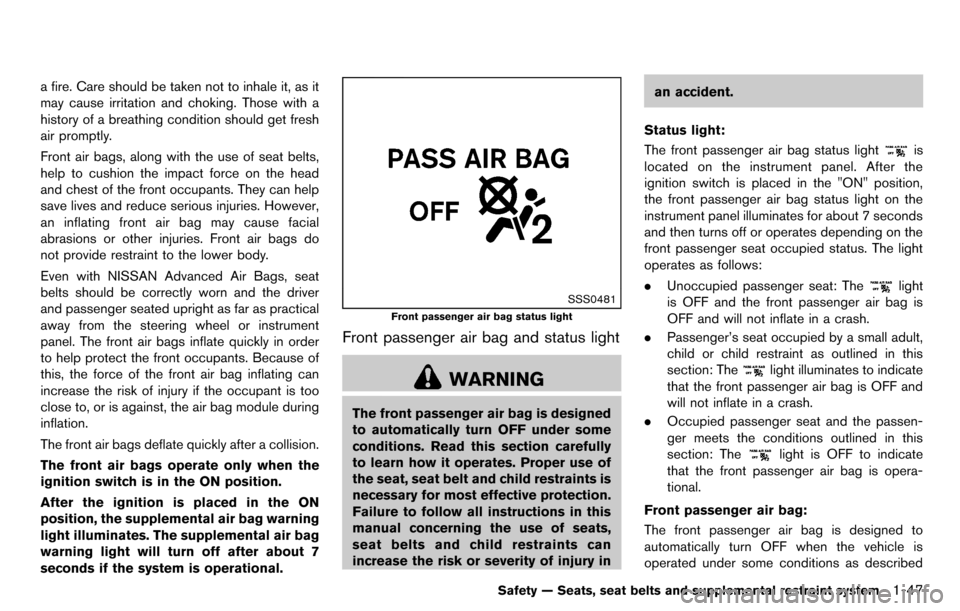
SSS0481
Front passenger air bag status light
Front passenger air bag and status light
WARNING
The front passenger air bag is designed
to automatically turn OFF under some
conditions. Read this section carefully
to learn how it operates. Proper use of
the seat, seat belt and child restraints is
necessary for most effective protection.
Failure to follow all instructions in this
manual concerning the use of seats,
seat belts and child restraints can
increase the risk or severity of injury inan accident.
Status light:
The front passenger air bag status light
is
located on the instrument panel. After the
ignition switch is placed in the "ON" position,
the front passenger air bag status light on the
instrument panel illuminates for about 7 seconds
and then turns off or operates depending on the
front passenger seat occupied status. The light
operates as follows:
. Unoccupied passenger seat: The
light
is OFF and the front passenger air bag is
OFF and will not inflate in a crash.
. Passenger’s seat occupied by a small adult,
child or child restraint as outlined in this
section: The
light illuminates to indicate
that the front passenger air bag is OFF and
will not inflate in a crash.
. Occupied passenger seat and the passen-
ger meets the conditions outlined in this
section: The
light is OFF to indicate
that the front passenger air bag is opera-
tional.
Front passenger air bag:
The front passenger air bag is designed to
automatically turn OFF when the vehicle is
operated under some conditions as described
Safety — Seats, seat belts and supplemental restraint system1-47
Page 66 of 331

1-48Safety — Seats, seat belts and supplemental restraint system
below as permitted by U.S. regulations. If the
front passenger air bag is OFF, it will not inflate
in a crash. The driver air bag and other air bags
in your vehicle are not part of this system.
The purpose of the regulation is to help reduce
the risk of injury or death from an inflating air bag
to certain front passenger seat occupants, such
as children, by requiring the air bag to be
automatically turned OFF.
The occupant classification sensors (weight
sensors) are on the seat cushion frame under
the front passenger seat and are designed to
detect an occupant and objects on the seat. For
example, if a child is in the front passenger seat,
the Advanced Air Bag System is designed to
turn the passenger air bag OFF in accordance
with the regulations. Also, if a child restraint of
the type specified in the regulations is on the
seat, the occupant classification sensors can
detect it and cause the air bag to turn OFF.
Front passenger seat adult occupants who are
properly seated and using the seat belt as
outlined in this manual should not cause the
passenger air bag to be automatically turned
OFF. For small adults it may be turned OFF,
however, if the occupant does not sit in the seat
properly (for example, by not sitting upright, by
sitting on an edge of the seat, or by otherwise
being out of position) , this could cause thesensors to turn the air bag OFF. Always be sure
to be seated and wearing the seat belt properly
for the most effective protection by the seat belt
and supplemental air bag.
NISSAN recommends that pre-teens and chil-
dren be properly restrained in a rear seat.
NISSAN also recommends that appropriate
child restraints and booster seats be properly
installed in a rear seat. If this is not possible, the
occupant classification sensors are designed to
operate as described above to turn the front
passenger air bag OFF for specified child
restraints. Failing to properly secure child
restrains and to use the Automatic Locking
Retractor (ALR) mode (child restraint mode)
may allow the restraint to tip or move in an
accident or sudden stop. This can also result in
the passenger air bag inflating in a crash instead
of being OFF. (See “Child restraints” (P.1-21)
for proper use and installation.)
If the front passenger seat is not occupied, the
passenger air bag is designed not to inflate in a
crash. However, heavy objects placed on the
seat could result in air bag inflation, because of
the object being detected by the occupant
classification sensors. Other conditions could
also result in air bag inflation, such as if a child is
standing on the seat, or if two children are on the
seat, contrary to the instructions in this manual.
Always be sure that you and all vehicleoccupants are seated and restrained properly.
Using the passenger air bag status light, you can
monitor when the front passenger air bag is
automatically turned OFF with the seat occu-
pied. The light will not illuminate when the front
passenger seat is unoccupied.
If an adult occupant is in the seat but the
passenger air bag status light is illuminated
(indicating that the air bag is OFF) , it could be
that the person is a small adult, or is not sitting
on the seat properly.
If a child restraint must be used in the front seat,
the passenger air bag status light may or may
not be illuminated, depending on the size of the
child and the type of child restraint being used. If
the air bag status light is not illuminated
(indicating that the air bag might inflate in a
crash) , it could be that the child restraint or seat
belt is not being used properly. Make sure that
the child restraint is installed properly, the seat
belt is used properly and the occupant is
positioned properly. If the air bag status light is
not illuminated, reposition the occupant or child
restraint in a rear seat.
If the passenger air bag status light will not
illuminate even though you believe that the child
restraint, the seat belts and the occupant are
properly positioned, the system may be sensing
an unoccupied seat (in which case the air bag is
Page 67 of 331
OFF). Your NISSAN dealer can check that the
system is OFF by using a special tool. However,
until you have confirmed with your dealer that
your air bag is working properly, reposition the
occupant or child restraint in a rear seat.
The air bag system and passenger air bag status
light will take a few seconds to register a change
in the passenger seat status. However, if the
seat becomes unoccupied, the air bag status
light will remain off.
If a malfunction occurs in the front passenger air
bag system, the supplemental air bag warning
light
, located in the meter and gauges area,
will blink. Have the system checked by a
NISSAN dealer.
Other supplemental front-impact air bag
precautions
WARNING
. Do not place any objects on the
steering wheel pad or on the instru-
ment panel. Also, do not place any
objects between any occupant and
the steering wheel or instrument
panel. Such objects may become
dangerous projectiles and cause
injury if the front air bags inflate. .
Do not place objects with sharp
edges on the seat. Also, do not
place heavy objects on the seat that
will leave permanent impressions in
the seat. Such objects can damage
the seat or occupant classification
sensors (weight sensors) . This can
affect the operation of the air bag
system and result in serious perso-
nal injury.
. Do not use water or acidic cleaners
(hot steam cleaners) on the seat.
This can damage the seat or occu-
pant classification sensors. This can
also affect the operation of the air
bag system and result in serious
personal injury.
. Immediately after inflation, several
front air bag system components
will be hot. Do not touch them; you
may severely burn yourself.
. No unauthorized changes should be
made to any components or wiring
of the supplemental air bag system.
This is to prevent accidental infla-
tion of the supplemental air bag or
damage to the supplemental air bag
system. .
Do not make unauthorized changes
to your vehicle’s electrical system,
suspension system or front end
structure. This could affect proper
operation of the front air bag sys-
tem.
. Tampering with the front air bag
system may result in serious perso-
nal injury. Tampering includes
changes to the steering wheel and
the instrument panel assembly by
placing material over the steering
wheel pad and above the instrument
panel or by installing additional trim
material around the air bag system.
. Removing or modifying the front
passenger seat may affect the func-
tion of the air bag system and result
in serious personal injury.
. Modifying or tampering with the
front passenger seat may result in
serious personal injury. For exam-
ple, do not change the front seats by
placing material on the seat cushion
or by installing additional trim ma-
terial, such as seat covers, on the
seat that is not specifically designed
to assure proper air bag operation.
Additionally, do not stow any ob-
Safety — Seats, seat belts and supplemental restraint system1-49
Page 106 of 331
2-34Instruments and controls
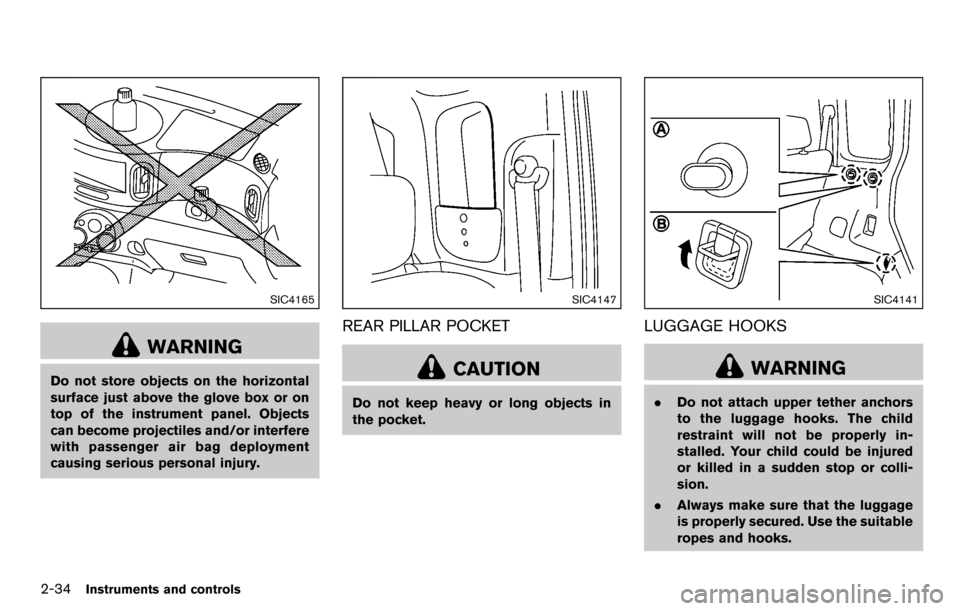
SIC4165
WARNING
Do not store objects on the horizontal
surface just above the glove box or on
top of the instrument panel. Objects
can become projectiles and/or interfere
with passenger air bag deployment
causing serious personal injury.
SIC4147
REAR PILLAR POCKET
CAUTION
Do not keep heavy or long objects in
the pocket.
SIC4141
LUGGAGE HOOKS
WARNING
.Do not attach upper tether anchors
to the luggage hooks. The child
restraint will not be properly in-
stalled. Your child could be injured
or killed in a sudden stop or colli-
sion.
. Always make sure that the luggage
is properly secured. Use the suitable
ropes and hooks.
Page 316 of 331
9-14Technical and consumer information
4. The resulting figure equals the availableamount of cargo and luggage load
capacity. For example, if the XXX
amount equals 1400 lbs. and there will
be five 150 lb. passengers in your
vehicle, the amount of available cargo
and luggage load capacity is 650 lbs.
(1400 −750 (5 x 150) = 650 lbs) or
(640 −340 (5 x 70) = 300 kg.)
5. Determine the combined weight of luggage and cargo being loaded on
the vehicle. That weight may not safely
exceed the available cargo and luggage
load capacity calculated in Step 4.
Before driving a loaded vehicle, confirm
that you do not exceed the Gross Vehicle
Weight Rating (GVWR) or the Gross Axle
Weight Rating (GAWR) for your vehicle.
(See “Measurement of weights” (P.9-15) .)
Also check tires for proper inflation pres-
sures. See the Tire and Loading Information
label.
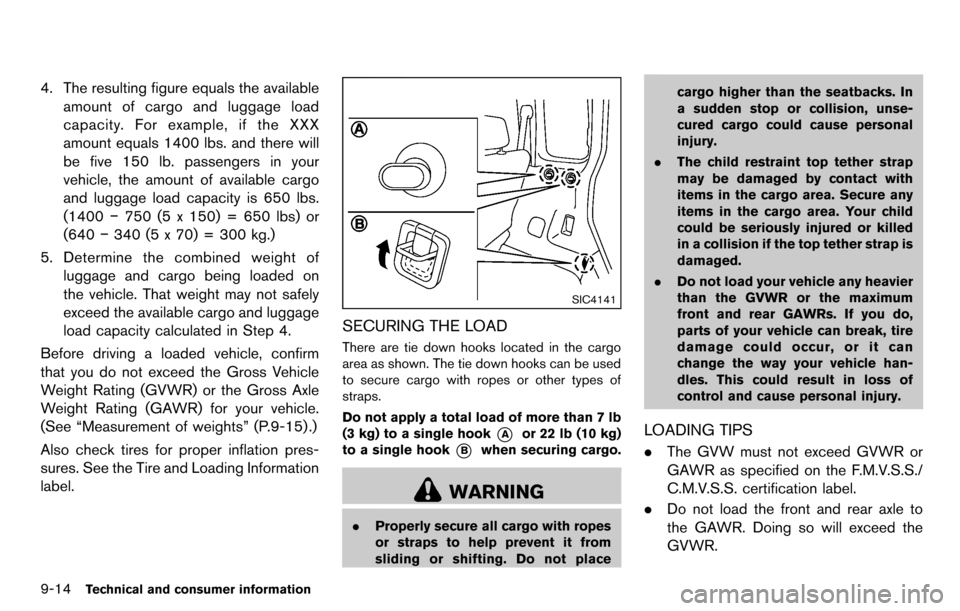
SIC4141
SECURING THE LOAD
There are tie down hooks located in the cargo
area as shown. The tie down hooks can be used
to secure cargo with ropes or other types of
straps.
Do not apply a total load of more than 7 lb
(3 kg) to a single hook
*Aor 22 lb (10 kg)
to a single hook
*Bwhen securing cargo.
WARNING
. Properly secure all cargo with ropes
or straps to help prevent it from
sliding or shifting. Do not place cargo higher than the seatbacks. In
a sudden stop or collision, unse-
cured cargo could cause personal
injury.
. The child restraint top tether strap
may be damaged by contact with
items in the cargo area. Secure any
items in the cargo area. Your child
could be seriously injured or killed
in a collision if the top tether strap is
damaged.
. Do not load your vehicle any heavier
than the GVWR or the maximum
front and rear GAWRs. If you do,
parts of your vehicle can break, tire
damage could occur, or it can
change the way your vehicle han-
dles. This could result in loss of
control and cause personal injury.
LOADING TIPS
.The GVW must not exceed GVWR or
GAWR as specified on the F.M.V.S.S./
C.M.V.S.S. certification label.
. Do not load the front and rear axle to
the GAWR. Doing so will exceed the
GVWR.
Page 323 of 331
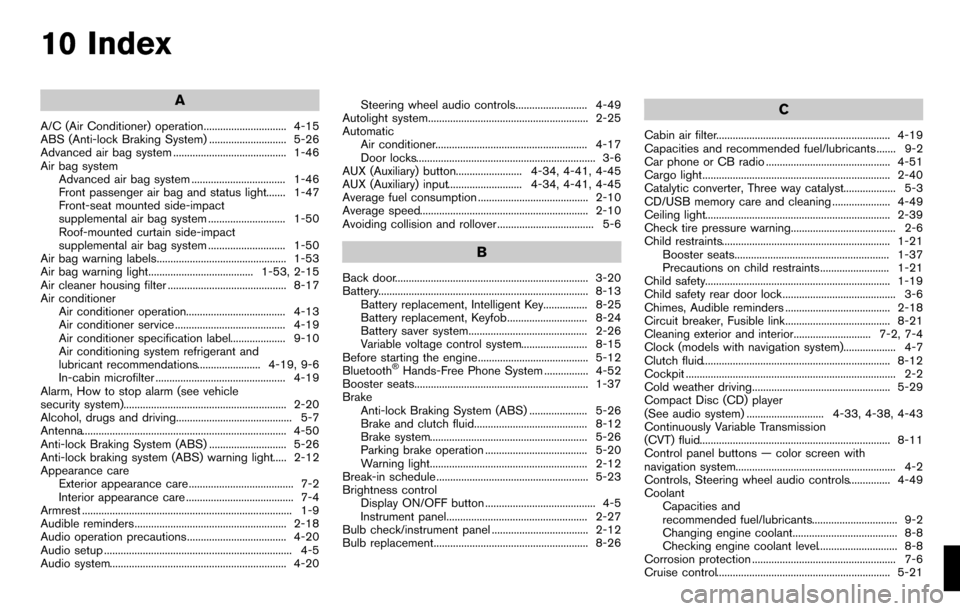
10 Index
A
A/C (Air Conditioner) operation.............................. 4-15
ABS (Anti-lock Braking System) ............................ 5-26
Advanced air bag system ......................................... 1-46
Air bag system Advanced air bag system .................................. 1-46
Front passenger air bag and status light....... 1-47
Front-seat mounted side-impact
supplemental air bag system ............................ 1-50
Roof-mounted curtain side-impact
supplemental air bag system ............................ 1-50
Air bag warning labels............................................... 1-53
Air bag warning light...................................... 1-53, 2-15
Air cleaner housing filter ........................................... 8-17
Air conditioner Air conditioner operation.................................... 4-13
Air conditioner service ........................................ 4-19
Air conditioner specification label.................... 9-10
Air conditioning system refrigerant and
lubricant recommendations....................... 4-19, 9-6
In-cabin microfilter ............................................... 4-19
Alarm, How to stop alarm (see vehicle
security system)........................................................... 2-20
Alcohol, drugs and driving.......................................... 5-7
Antenna.......................................................................... 4-50
Anti-lock Braking System (ABS) ............................ 5-26
Anti-lock braking system (ABS) warning light..... 2-12
Appearance care Exterior appearance care ...................................... 7-2
Interior appearance care ....................................... 7-4
Armrest ............................................................................ 1-9
Audible reminders....................................................... 2-18
Audio operation precautions.................................... 4-20
Audio setup .................................................................... 4-5
Audio system................................................................ 4-20 Steering wheel audio controls.......................... 4-49
Autolight system.......................................................... 2-25
Automatic Air conditioner....................................................... 4-17
Door locks................................................................. 3-6
AUX (Auxiliary) button........................ 4-34, 4-41, 4-45
AUX (Auxiliary) input........................... 4-34, 4-41, 4-45
Average fuel consumption ........................................ 2-10
Average speed............................................................. 2-10
Avoiding collision and rollover ................................... 5-6
B
Back door...................................................................... 3-20
Battery............................................................................ 8-13 Battery replacement, Intelligent Key................ 8-25
Battery replacement, Keyfob............................. 8-24
Battery saver system........................................... 2-26
Variable voltage control system........................ 8-15
Before starting the engine........................................ 5-12
Bluetooth
®Hands-Free Phone System ................ 4-52
Booster seats............................................................... 1-37
Brake Anti-lock Braking System (ABS) ..................... 5-26
Brake and clutch fluid......................................... 8-12
Brake system......................................................... 5-26
Parking brake operation ..................................... 5-20
Warning light......................................................... 2-12
Break-in schedule ....................................................... 5-23
Brightness control Display ON/OFF button ........................................ 4-5
Instrument panel................................................... 2-27
Bulb check/instrument panel ................................... 2-12
Bulb replacement........................................................ 8-26
C
Cabin air filter............................................................... 4-19
Capacities and recommended fuel/lubricants ....... 9-2
Car phone or CB radio ............................................. 4-51
Cargo light.................................................................... 2-40
Catalytic converter, Three way catalyst................... 5-3
CD/USB memory care and cleaning ..................... 4-49
Ceiling light................................................................... 2-39
Check tire pressure warning...................................... 2-6
Child restraints............................................................. 1-21 Booster seats........................................................ 1-37
Precautions on child restraints......................... 1-21
Child safety................................................................... 1-19
Child safety rear door lock ......................................... 3-6
Chimes, Audible reminders ...................................... 2-18
Circuit breaker, Fusible link...................................... 8-21
Cleaning exterior and interior............................ 7-2, 7-4
Clock (models with navigation system)................... 4-7
Clutch fluid.................................................................... 8-12
Cockpit ............................................................................ 2-2
Cold weather driving.................................................. 5-29
Compact Disc (CD) player
(See audio system) ............................ 4-33, 4-38, 4-43
Continuously Variable Transmission
(CVT) fluid..................................................................... 8-11
Control panel buttons — color screen with
navigation system.......................................................... 4-2
Controls, Steering wheel audio controls............... 4-49
Coolant Capacities and
recommended fuel/lubricants............................... 9-2
Changing engine coolant...................................... 8-8
Checking engine coolant level............................. 8-8
Corrosion protection .................................................... 7-6
Cruise control............................................................... 5-21
Page 325 of 331
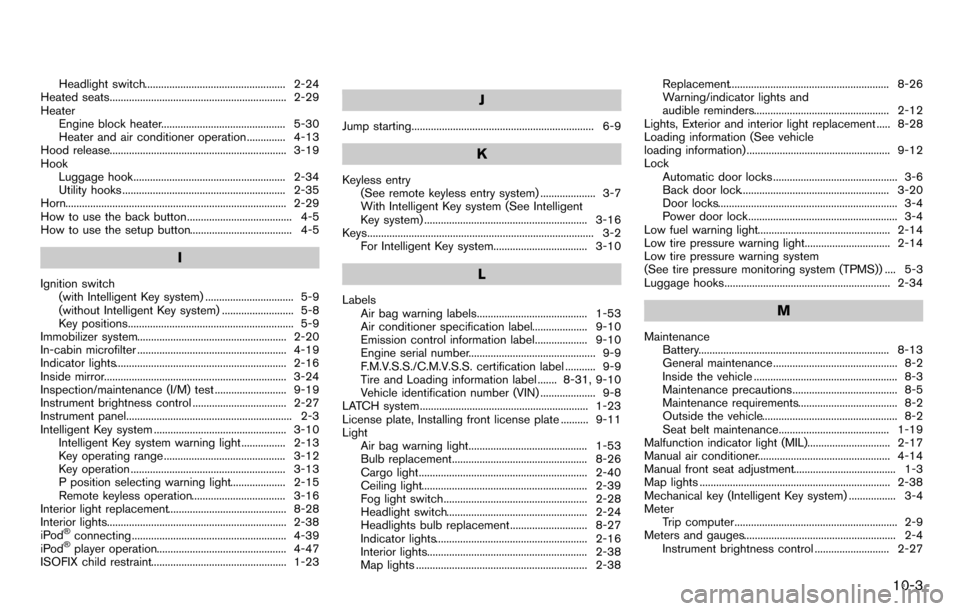
Headlight switch................................................... 2-24
Heated seats................................................................ 2-29
Heater Engine block heater............................................. 5-30
Heater and air conditioner operation.............. 4-13
Hood release................................................................ 3-19
Hook Luggage hook....................................................... 2-34
Utility hooks ........................................................... 2-35
Horn................................................................................ 2-29
How to use the back button...................................... 4-5
How to use the setup button..................................... 4-5
I
Ignition switch (with Intelligent Key system) ................................ 5-9
(without Intelligent Key system) .......................... 5-8
Key positions............................................................ 5-9
Immobilizer system...................................................... 2-20
In-cabin microfilter ...................................................... 4-19
Indicator lights.............................................................. 2-16
Inside mirror.................................................................. 3-24
Inspection/maintenance (I/M) test .......................... 9-19
Instrument brightness control .................................. 2-27
Instrument panel............................................................ 2-3
Intelligent Key system ................................................ 3-10 Intelligent Key system warning light................ 2-13
Key operating range ............................................ 3-12
Key operation ........................................................ 3-13
P position selecting warning light.................... 2-15
Remote keyless operation.................................. 3-16
Interior light replacement........................................... 8-28
Interior lights................................................................. 2-38
iPod
®connecting........................................................ 4-39
iPod®player operation............................................... 4-47
ISOFIX child restraint................................................. 1-23
J
Jump starting.................................................................. 6-9
K
Keyless entry (See remote keyless entry system) .................... 3-7
With Intelligent Key system (See Intelligent
Key system) ........................................................... 3-16
Keys.................................................................................. 3-2 For Intelligent Key system.................................. 3-10
L
LabelsAir bag warning labels........................................ 1-53
Air conditioner specification label.................... 9-10
Emission control information label................... 9-10
Engine serial number.............................................. 9-9
F.M.V.S.S./C.M.V.S.S. certification label ........... 9-9
Tire and Loading information label ....... 8-31, 9-10
Vehicle identification number (VIN) .................... 9-8
LATCH system............................................................. 1-23
License plate, Installing front license plate .......... 9-11
Light Air bag warning light........................................... 1-53
Bulb replacement................................................. 8-26
Cargo light............................................................. 2-40
Ceiling light............................................................ 2-39
Fog light switch.................................................... 2-28
Headlight switch................................................... 2-24
Headlights bulb replacement............................ 8-27
Indicator lights....................................................... 2-16
Interior lights.......................................................... 2-38
Map lights .............................................................. 2-38 Replacement.......................................................... 8-26
Warning/indicator lights and
audible reminders................................................. 2-12
Lights, Exterior and interior light replacement ..... 8-28
Loading information (See vehicle
loading information) .................................................... 9-12
Lock Automatic door locks ............................................. 3-6
Back door lock...................................................... 3-20
Door locks................................................................. 3-4
Power door lock...................................................... 3-4
Low fuel warning light................................................ 2-14
Low tire pressure warning light............................... 2-14
Low tire pressure warning system
(See tire pressure monitoring system (TPMS)) .... 5-3
Luggage hooks............................................................ 2-34M
Maintenance Battery..................................................................... 8-13
General maintenance ............................................. 8-2
Inside the vehicle .................................................... 8-3
Maintenance precautions...................................... 8-5
Maintenance requirements.................................... 8-2
Outside the vehicle................................................. 8-2
Seat belt maintenance........................................ 1-19
Malfunction indicator light (MIL).............................. 2-17
Manual air conditioner................................................ 4-14
Manual front seat adjustment..................................... 1-3
Map lights ..................................................................... 2-38
Mechanical key (Intelligent Key system) ................. 3-4
Meter Trip computer........................................................... 2-9
Meters and gauges....................................................... 2-4 Instrument brightness control ........................... 2-27
10-3
Page 326 of 331
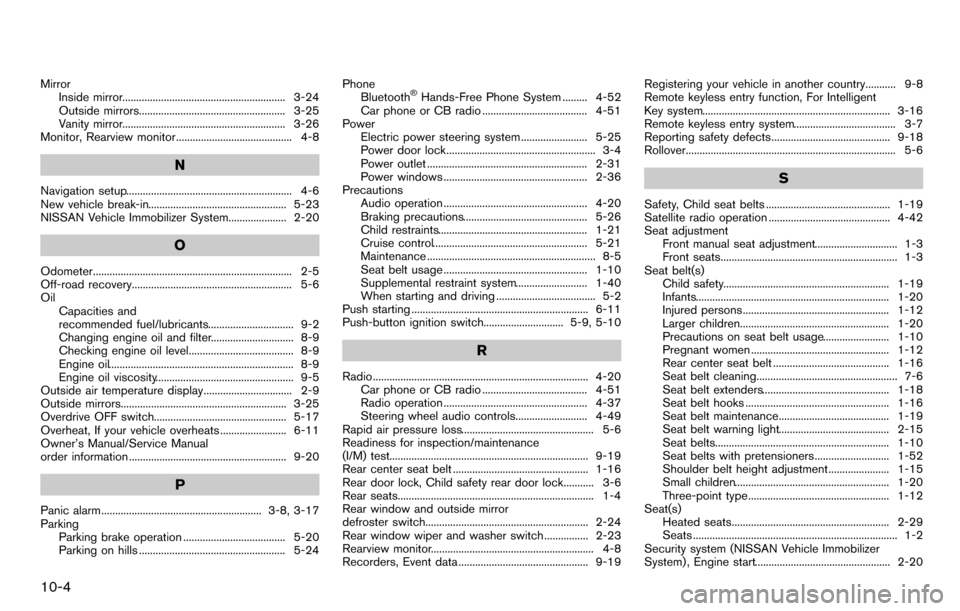
10-4
MirrorInside mirror........................................................... 3-24
Outside mirrors..................................................... 3-25
Vanity mirror........................................................... 3-26
Monitor, Rearview monitor.......................................... 4-8
N
Navigation setup............................................................ 4-6
New vehicle break-in.................................................. 5-23
NISSAN Vehicle Immobilizer System..................... 2-20
O
Odometer........................................................................ 2-5
Off-road recovery.......................................................... 5-6
Oil Capacities and
recommended fuel/lubricants............................... 9-2
Changing engine oil and filter.............................. 8-9
Checking engine oil level...................................... 8-9
Engine oil................................................................... 8-9
Engine oil viscosity.................................................. 9-5
Outside air temperature display................................ 2-9
Outside mirrors............................................................ 3-25
Overdrive OFF switch................................................ 5-17
Overheat, If your vehicle overheats ........................ 6-11
Owner’s Manual/Service Manual
order information ......................................................... 9-20
P
Panic alarm.......................................................... 3-8, 3-17
Parking Parking brake operation ..................................... 5-20
Parking on hills ..................................................... 5-24 Phone
Bluetooth
®Hands-Free Phone System ......... 4-52
Car phone or CB radio ...................................... 4-51
Power Electric power steering system ........................ 5-25
Power door lock...................................................... 3-4
Power outlet .......................................................... 2-31
Power windows .................................................... 2-36
Precautions Audio operation .................................................... 4-20
Braking precautions............................................. 5-26
Child restraints...................................................... 1-21
Cruise control........................................................ 5-21
Maintenance ............................................................. 8-5
Seat belt usage .................................................... 1-10
Supplemental restraint system.......................... 1-40
When starting and driving .................................... 5-2
Push starting ................................................................ 6-11
Push-button ignition switch............................. 5-9, 5-10
R
Radio.............................................................................. 4-20 Car phone or CB radio ...................................... 4-51
Radio operation .................................................... 4-37
Steering wheel audio controls.......................... 4-49
Rapid air pressure loss................................................ 5-6
Readiness for inspection/maintenance
(I/M) test........................................................................ 9-19
Rear center seat belt ................................................. 1-16
Rear door lock, Child safety rear door lock........... 3-6
Rear seats....................................................................... 1-4
Rear window and outside mirror
defroster switch........................................................... 2-24
Rear window wiper and washer switch ................ 2-23
Rearview monitor........................................................... 4-8
Recorders, Event data ............................................... 9-19 Registering your vehicle in another country........... 9-8
Remote keyless entry function, For Intelligent
Key system.................................................................... 3-16
Remote keyless entry system..................................... 3-7
Reporting safety defects........................................... 9-18
Rollover............................................................................ 5-6
S
Safety, Child seat belts ............................................. 1-19
Satellite radio operation ............................................ 4-42
Seat adjustment Front manual seat adjustment.............................. 1-3
Front seats................................................................ 1-3
Seat belt(s) Child safety............................................................ 1-19
Infants...................................................................... 1-20
Injured persons..................................................... 1-12
Larger children...................................................... 1-20
Precautions on seat belt usage........................ 1-10
Pregnant women .................................................. 1-12
Rear center seat belt .......................................... 1-16
Seat belt cleaning................................................... 7-6
Seat belt extenders.............................................. 1-18
Seat belt hooks .................................................... 1-16
Seat belt maintenance........................................ 1-19
Seat belt warning light........................................ 2-15
Seat belts............................................................... 1-10
Seat belts with pretensioners........................... 1-52
Shoulder belt height adjustment...................... 1-15
Small children........................................................ 1-20
Three-point type................................................... 1-12
Seat(s) Heated seats......................................................... 2-29
Seats .......................................................................... 1-2
Security system (NISSAN Vehicle Immobilizer
System) , Engine start................................................. 2-20