2012 NISSAN CUBE heater
[x] Cancel search: heaterPage 235 of 331
4. Plug the extension cord into a Ground FaultInterrupt (GFI) protected, grounded 110-
volt AC (VAC) outlet.
5. The engine block heater must be plugged in for at least 2 - 4 hours, depending on
outside temperatures, to properly warm the
engine coolant. Use an appropriate timer to
turn the engine block heater on.
6. Before starting the engine, unplug and properly store the cord to keep it away from
moving parts.
WARNING
.Do not use your engine block heater
with an ungrounded electrical sys-
tem or a 2-pronged adapter. You can
be seriously injured by an electrical
shock if you use an ungrounded
connection.
. Disconnect and properly store the
engine block heater cord before
starting the engine. Damage to the
cord could result in an electrical
shock and can cause serious injury.
. Use a heavy-duty 3-wire, 3-pronged
extension cord rated for at least
10A. Plug the extension cord into a Ground Fault Interrupt (GFI) pro-
tected, grounded 110-VAC outlet.
Failure to use the proper extension
cord or a grounded outlet can result
in a fire or electrical shock and
cause serious personal injury.
Starting and driving5-31
Page 246 of 331
6-10In case of emergency
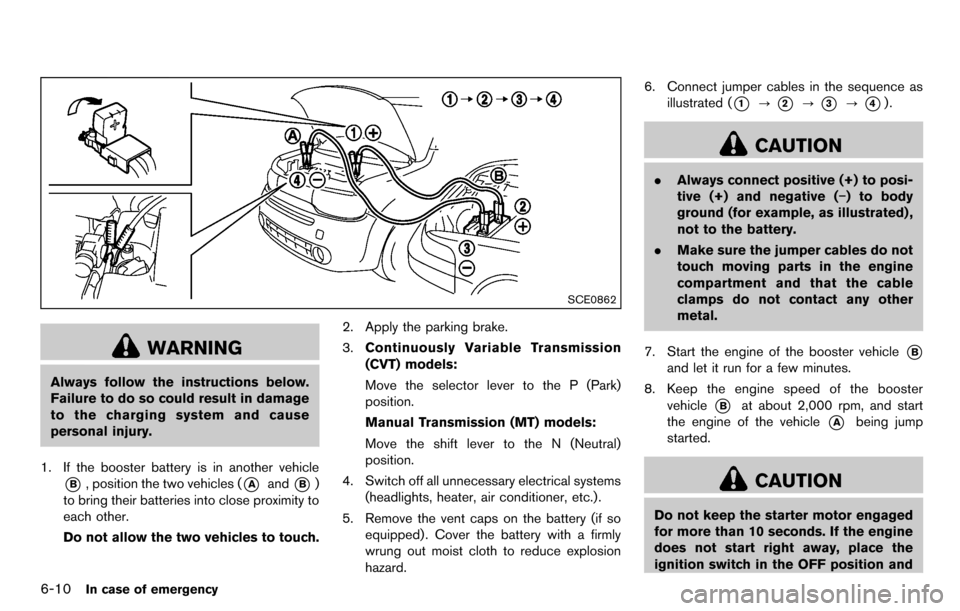
SCE0862
WARNING
Always follow the instructions below.
Failure to do so could result in damage
to the charging system and cause
personal injury.
1. If the booster battery is in another vehicle
*B, position the two vehicles (*Aand*B)
to bring their batteries into close proximity to
each other.
Do not allow the two vehicles to touch. 2. Apply the parking brake.
3.
Continuously Variable Transmission
(CVT) models:
Move the selector lever to the P (Park)
position.
Manual Transmission (MT) models:
Move the shift lever to the N (Neutral)
position.
4. Switch off all unnecessary electrical systems (headlights, heater, air conditioner, etc.).
5. Remove the vent caps on the battery (if so equipped) . Cover the battery with a firmly
wrung out moist cloth to reduce explosion
hazard. 6. Connect jumper cables in the sequence as
illustrated (
*1?*2?*3?*4).
CAUTION
.Always connect positive (+) to posi-
tive (+) and negative (−) to body
ground (for example, as illustrated) ,
not to the battery.
. Make sure the jumper cables do not
touch moving parts in the engine
compartment and that the cable
clamps do not contact any other
metal.
7. Start the engine of the booster vehicle
*B
and let it run for a few minutes.
8. Keep the engine speed of the booster vehicle
*Bat about 2,000 rpm, and start
the engine of the vehicle
*Abeing jump
started.
CAUTION
Do not keep the starter motor engaged
for more than 10 seconds. If the engine
does not start right away, place the
ignition switch in the OFF position and
Page 248 of 331
6-12In case of emergency
position.
Do not stop the engine.
3. Turn off the air conditioner (if so equipped) . Open all the windows, move the heater or air
conditioner temperature control to maximum
hot and fan control to high speed.
4. Get out of the vehicle. Look and listen for steam or coolant escaping from the radiator
before opening the hood. (If steam or
coolant is escaping, turn off the engine.)
Do not open the hood further until no steam
or coolant can be seen.
5. Open the engine hood.
WARNING
If steam or water is coming from the
engine, stand clear to prevent getting
burned.
6. Visually check the drive belt for damage or looseness. Also check if the cooling fan is
running. The radiator hoses and radiator
should not leak water. If coolant is leaking or
the cooling fan does not run, stop the
engine.
WARNING
Be careful not to allow your hands, hair,
jewelry or clothing to come into contact
with, or get caught in, engine belts or
the engine cooling fan. The engine
cooling fan can start at any time.
7. After the engine cools down, check the coolant level in the reservoir with the engine
running. Add coolant to the reservoir if
necessary. Have your vehicle repaired at a
NISSAN dealer. When towing your vehicle, all State (Provincial in
Canada) and local regulations for towing must
be followed. Incorrect towing equipment could
damage your vehicle. Towing instructions are
available from a NISSAN dealer. Local service
operators are familiar with the applicable laws
and procedures for towing. To assure proper
towing and to prevent accidental damage to
your vehicle, NISSAN recommends that you
have a service operator tow your vehicle. It is
advisable to have the service operator carefully
read the following precautions.
WARNING
.
Never ride in a vehicle that is being
towed.
. Never get under your vehicle after it
has been lifted by a tow truck.
CAUTION
.When towing, make sure that the
transmission, axles, steering system
and powertrain are in working con-
dition. If any unit is damaged, dol-
lies must be used.
TOWING YOUR VEHICLE
Page 266 of 331
8-4Maintenance and do-it-yourself
Windshield defroster:Check that the air
comes out of the defroster outlets properly and
in sufficient quantity when operating the heater
or air conditioner.
Windshield wiper and washer*: Check that
the wipers and washers operate properly and
that the wipers do not streak.
Under the hood and vehicle
The maintenance items listed here should be
checked periodically (for example, each time you
check the engine oil or refuel) .
Battery*: Check the fluid level in each cell.
It should be between the MAX and MIN lines.
Vehicles operated in high temperatures or under
severe condition require frequent checks of the
battery fluid level.
Brake and clutch fluid level*: Make sure that
the brake and clutch fluid level is between the
MAX and MIN lines on the reservoir.
Engine coolant level*: Check the coolant level
when the engine is cold.
Engine drive belt*: Make sure that the drive
belt is not frayed, worn, cracked or oily.
Engine oil level*: Check the level after parking
the vehicle on a level surface and turning off the
engine. Wait more than 10 minutes for the oil to
drain back into the oil pan. Exhaust system:
Make sure there are no loose
supports, cracks or holes. If the sound of the
exhaust seems unusual or there is a smell of
exhaust fumes, immediately have the exhaust
system inspected by a NISSAN dealer. (See
“Precautions when starting and driving” (P.5-2)
for exhaust gas (carbon monoxide) .)
Fluid leaks: Check under the vehicle for fuel,
oil, water or other fluid leaks after the vehicle has
been parked for a while. Water dripping from the
air conditioner after use is normal. If you should
notice any leaks or if gasoline fumes are evident,
check for the cause and have it corrected
immediately.
Radiator and hoses: Check the front of the
radiator and clean off any dirt, insects, leaves,
etc., that may have accumulated. Make sure the
hoses have no cracks, deformation, rot or loose
connections.
Underbody: The underbody is frequently ex-
posed to corrosive substances such as those
used on icy roads or to control dust. It is very
important to remove these substances, other-
wise rust will form on the floor pan, frame, fuel
lines and around the exhaust system. At the end
of winter, the underbody should be thoroughly
flushed with plain water, being careful to clean
those areas where mud and dirt may accumu-
late. For additional information, see “Cleaning exterior” (P.7-2).
Windshield washer fluid*:
Check that there is
adequate fluid in the reservoir.
Page 270 of 331
8-8Maintenance and do-it-yourself
.The life expectancy of the factory-fill
coolant is 105,000 miles (168,000
km) or 7 years. Mixing any other
type of coolant other than Genuine
NISSAN Long Life Antifreeze/Cool-
ant (blue) , including Genuine
NISSAN Long Life Antifreeze/Cool-
ant (green) , or the use of non-
distilled water will reduce the life
expectancy of the factory-fill cool-
ant. Refer to the NISSAN Service
and Maintenance Guide for more
details.
SDI2385
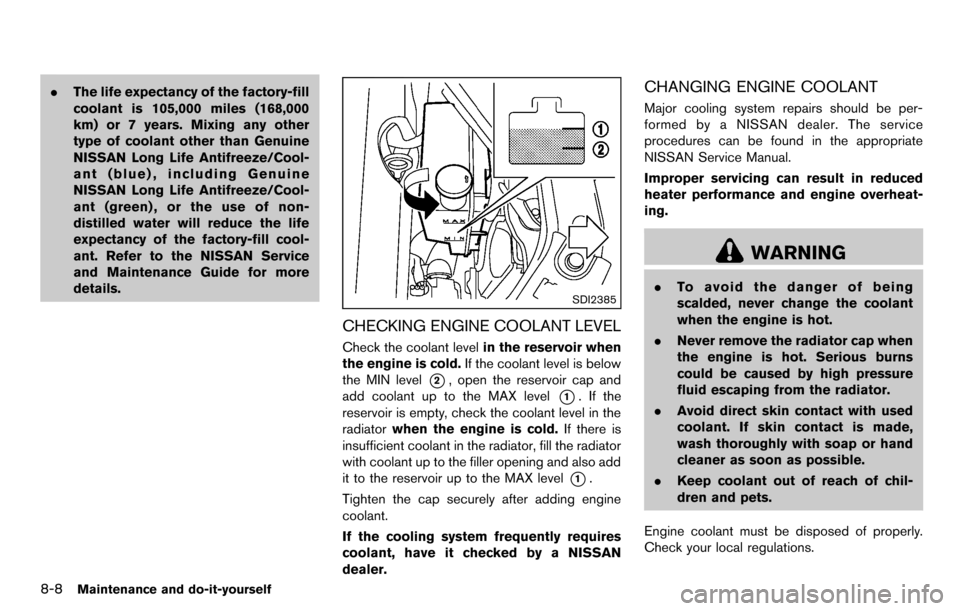
CHECKING ENGINE COOLANT LEVEL
Check the coolant level in the reservoir when
the engine is cold. If the coolant level is below
the MIN level
*2, open the reservoir cap and
add coolant up to the MAX level
*1. If the
reservoir is empty, check the coolant level in the
radiator when the engine is cold. If there is
insufficient coolant in the radiator, fill the radiator
with coolant up to the filler opening and also add
it to the reservoir up to the MAX level
*1.
Tighten the cap securely after adding engine
coolant.
If the cooling system frequently requires
coolant, have it checked by a NISSAN
dealer.
CHANGING ENGINE COOLANT
Major cooling system repairs should be per-
formed by a NISSAN dealer. The service
procedures can be found in the appropriate
NISSAN Service Manual.
Improper servicing can result in reduced
heater performance and engine overheat-
ing.
WARNING
. To avoid the danger of being
scalded, never change the coolant
when the engine is hot.
. Never remove the radiator cap when
the engine is hot. Serious burns
could be caused by high pressure
fluid escaping from the radiator.
. Avoid direct skin contact with used
coolant. If skin contact is made,
wash thoroughly with soap or hand
cleaner as soon as possible.
. Keep coolant out of reach of chil-
dren and pets.
Engine coolant must be disposed of properly.
Check your local regulations.
Page 324 of 331
10-2
Cup holders.................................................................. 2-31
CVT, Driving with CVT (Continuously
Variable Transmission) ...................................... 5-8, 5-14
D
Daytime running light system................................... 2-26
Defroster switch, Rear window and outside mirror
defroster switch........................................................... 2-24
Dimensions and weights............................................. 9-8
Door open warning light............................................ 2-13
Drive belt....................................................................... 8-15
Driving Cold weather driving........................................... 5-29
Driving with CVT (Continuously
Variable Transmission) ............................... 5-8, 5-14
Driving with manual transmission............ 5-9, 5-18
Precautions when starting and driving .............. 5-2
E
Economy, Fuel.............................................................. 5-23
Electric power steering system ............................... 5-25
Electric power steering warning light .................... 2-13
Emission control information label.......................... 9-10
Emission control system warranty........................... 9-17
Engine Before starting the engine................................. 5-12
Break-in schedule ................................................ 5-23
Capacities and
recommended fuel/lubricants............................... 9-2
Changing engine coolant...................................... 8-8
Changing engine oil and filter.............................. 8-9
Checking engine coolant level............................. 8-8
Checking engine oil level...................................... 8-9
Coolant temperature gauge ................................. 2-7
Emergency engine shut off................................ 5-11 Engine block heater............................................. 5-30
Engine compartment check locations................ 8-6
Engine cooling system........................................... 8-7
Engine oil................................................................... 8-9
Engine oil and oil filter recommendation........... 9-5
Engine oil viscosity.................................................. 9-5
Engine serial number.............................................. 9-9
Engine specifications ............................................. 9-7
If your vehicle overheats..................................... 6-11
Starting the engine .............................................. 5-13
Event Data Recorders (EDR)................................... 9-19
Exhaust gas (carbon monoxide)................................ 5-2
F
F.M.V.S.S./C.M.V.S.S. certification label ................. 9-9
Filter Air cleaner housing filter .................................... 8-17
Changing engine oil and filter.............................. 8-9
Flashers (See hazard warning flasher switch)..... 2-28
Flat tire............................................................................. 6-2
Flat towing .................................................................... 9-16
Floor mat cleaning ........................................................ 7-5
Fluid Brake and clutch fluid......................................... 8-12
Capacities and
recommended fuel/lubricants............................... 9-2
Continuously Variable Transmission
(CVT) fluid.............................................................. 8-11
Engine coolant......................................................... 8-7
Engine oil................................................................... 8-9
Window washer fluid .......................................... 8-12
FM-AM radio with Compact Disc
(CD) player ....................................................... 4-31, 4-35
FM-AM-SAT radio with Compact Disc
(CD) player ................................................................... 4-42
Fog light switch........................................................... 2-28 Front manual seat adjustment.................................... 1-3
Front passenger air bag and status light.............. 1-47
Front seat, Front seat adjustment............................. 1-3
Front-seat active head restraints .............................. 1-8
Fuel Capacities and
recommended fuel/lubricants............................... 9-2
Distance to empty................................................... 2-9
Fuel economy........................................................ 5-23
Fuel octane rating ................................................... 9-3
Fuel recommendation............................................. 9-3
Fuel-filler cap......................................................... 3-21
Fuel-filler door....................................................... 3-21
Gauge ........................................................................ 2-8
Fuses.............................................................................. 8-20
Fusible links.................................................................. 8-21
G
Gas cap......................................................................... 3-21
Gauge .............................................................................. 2-4 Engine coolant temperature gauge .................... 2-7
Fuel gauge................................................................ 2-8
Odometer.................................................................. 2-5
Speedometer............................................................ 2-5
Tachometer ............................................................... 2-7
Trip computer........................................................... 2-9
General maintenance ................................................... 8-2
Glove box...................................................................... 2-33
H
Hands-Free Phone System, Bluetooth®............... 4-52
Hazard warning flasher switch................................. 2-28
Head restraints .............................................................. 1-6
Headlights Bulb replacement................................................. 8-27
Page 325 of 331
Headlight switch................................................... 2-24
Heated seats................................................................ 2-29
Heater Engine block heater............................................. 5-30
Heater and air conditioner operation.............. 4-13
Hood release................................................................ 3-19
Hook Luggage hook....................................................... 2-34
Utility hooks ........................................................... 2-35
Horn................................................................................ 2-29
How to use the back button...................................... 4-5
How to use the setup button..................................... 4-5
I
Ignition switch (with Intelligent Key system) ................................ 5-9
(without Intelligent Key system) .......................... 5-8
Key positions............................................................ 5-9
Immobilizer system...................................................... 2-20
In-cabin microfilter ...................................................... 4-19
Indicator lights.............................................................. 2-16
Inside mirror.................................................................. 3-24
Inspection/maintenance (I/M) test .......................... 9-19
Instrument brightness control .................................. 2-27
Instrument panel............................................................ 2-3
Intelligent Key system ................................................ 3-10 Intelligent Key system warning light................ 2-13
Key operating range ............................................ 3-12
Key operation ........................................................ 3-13
P position selecting warning light.................... 2-15
Remote keyless operation.................................. 3-16
Interior light replacement........................................... 8-28
Interior lights................................................................. 2-38
iPod
®connecting........................................................ 4-39
iPod®player operation............................................... 4-47
ISOFIX child restraint................................................. 1-23
J
Jump starting.................................................................. 6-9
K
Keyless entry (See remote keyless entry system) .................... 3-7
With Intelligent Key system (See Intelligent
Key system) ........................................................... 3-16
Keys.................................................................................. 3-2 For Intelligent Key system.................................. 3-10
L
LabelsAir bag warning labels........................................ 1-53
Air conditioner specification label.................... 9-10
Emission control information label................... 9-10
Engine serial number.............................................. 9-9
F.M.V.S.S./C.M.V.S.S. certification label ........... 9-9
Tire and Loading information label ....... 8-31, 9-10
Vehicle identification number (VIN) .................... 9-8
LATCH system............................................................. 1-23
License plate, Installing front license plate .......... 9-11
Light Air bag warning light........................................... 1-53
Bulb replacement................................................. 8-26
Cargo light............................................................. 2-40
Ceiling light............................................................ 2-39
Fog light switch.................................................... 2-28
Headlight switch................................................... 2-24
Headlights bulb replacement............................ 8-27
Indicator lights....................................................... 2-16
Interior lights.......................................................... 2-38
Map lights .............................................................. 2-38 Replacement.......................................................... 8-26
Warning/indicator lights and
audible reminders................................................. 2-12
Lights, Exterior and interior light replacement ..... 8-28
Loading information (See vehicle
loading information) .................................................... 9-12
Lock Automatic door locks ............................................. 3-6
Back door lock...................................................... 3-20
Door locks................................................................. 3-4
Power door lock...................................................... 3-4
Low fuel warning light................................................ 2-14
Low tire pressure warning light............................... 2-14
Low tire pressure warning system
(See tire pressure monitoring system (TPMS)) .... 5-3
Luggage hooks............................................................ 2-34M
Maintenance Battery..................................................................... 8-13
General maintenance ............................................. 8-2
Inside the vehicle .................................................... 8-3
Maintenance precautions...................................... 8-5
Maintenance requirements.................................... 8-2
Outside the vehicle................................................. 8-2
Seat belt maintenance........................................ 1-19
Malfunction indicator light (MIL).............................. 2-17
Manual air conditioner................................................ 4-14
Manual front seat adjustment..................................... 1-3
Map lights ..................................................................... 2-38
Mechanical key (Intelligent Key system) ................. 3-4
Meter Trip computer........................................................... 2-9
Meters and gauges....................................................... 2-4 Instrument brightness control ........................... 2-27
10-3