Page 22 of 453
WARNING
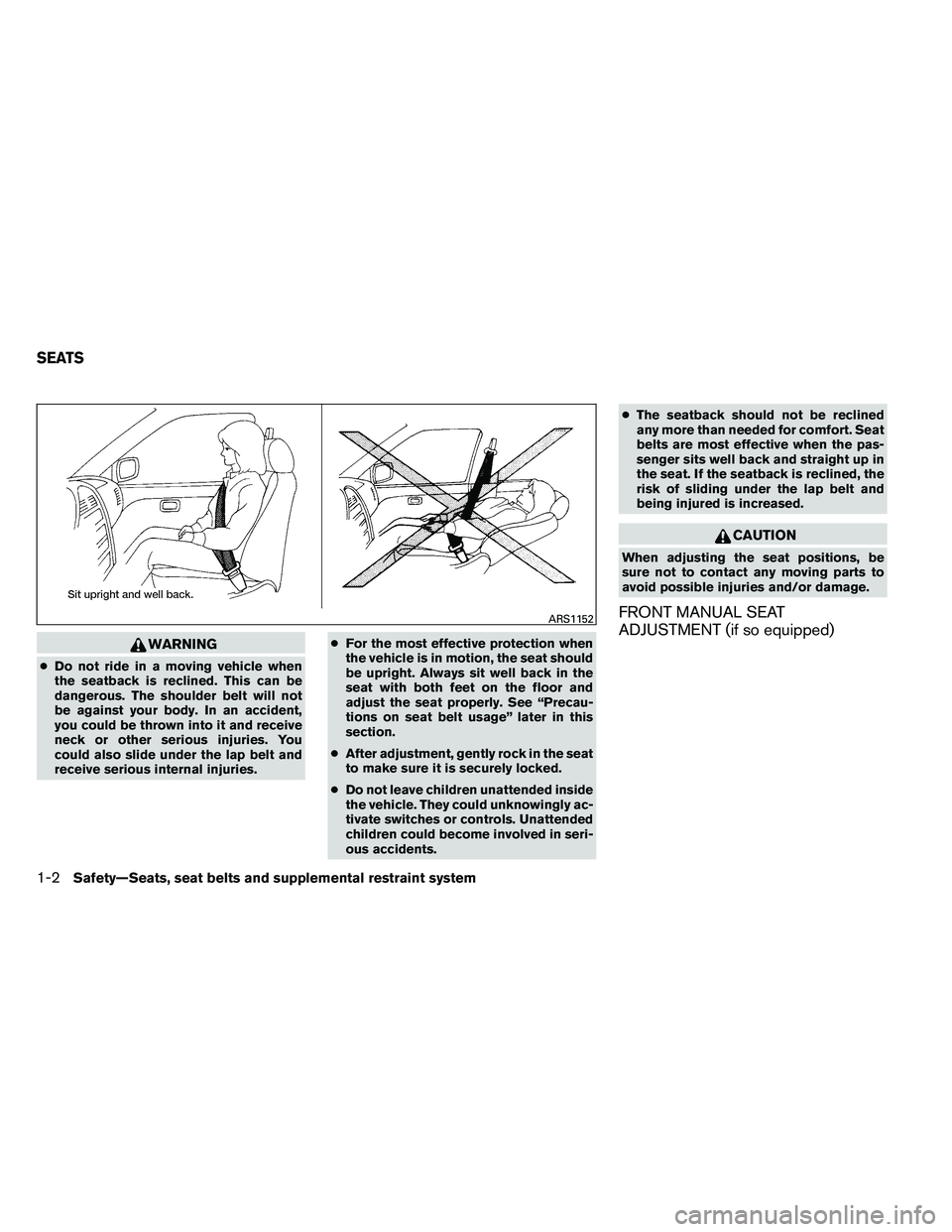
●Do not ride in a moving vehicle when
the seatback is reclined. This can be
dangerous. The shoulder belt will not
be against your body. In an accident,
you could be thrown into it and receive
neck or other serious injuries. You
could also slide under the lap belt and
receive serious internal injuries. ●
For the most effective protection when
the vehicle is in motion, the seat should
be upright. Always sit well back in the
seat with both feet on the floor and
adjust the seat properly. See “Precau-
tions on seat belt usage” later in this
section.
● After adjustment, gently rock in the seat
to make sure it is securely locked.
● Do not leave children unattended inside
the vehicle. They could unknowingly ac-
tivate switches or controls. Unattended
children could become involved in seri-
ous accidents. ●
The seatback should not be reclined
any more than needed for comfort. Seat
belts are most effective when the pas-
senger sits well back and straight up in
the seat. If the seatback is reclined, the
risk of sliding under the lap belt and
being injured is increased.
Page 23 of 453
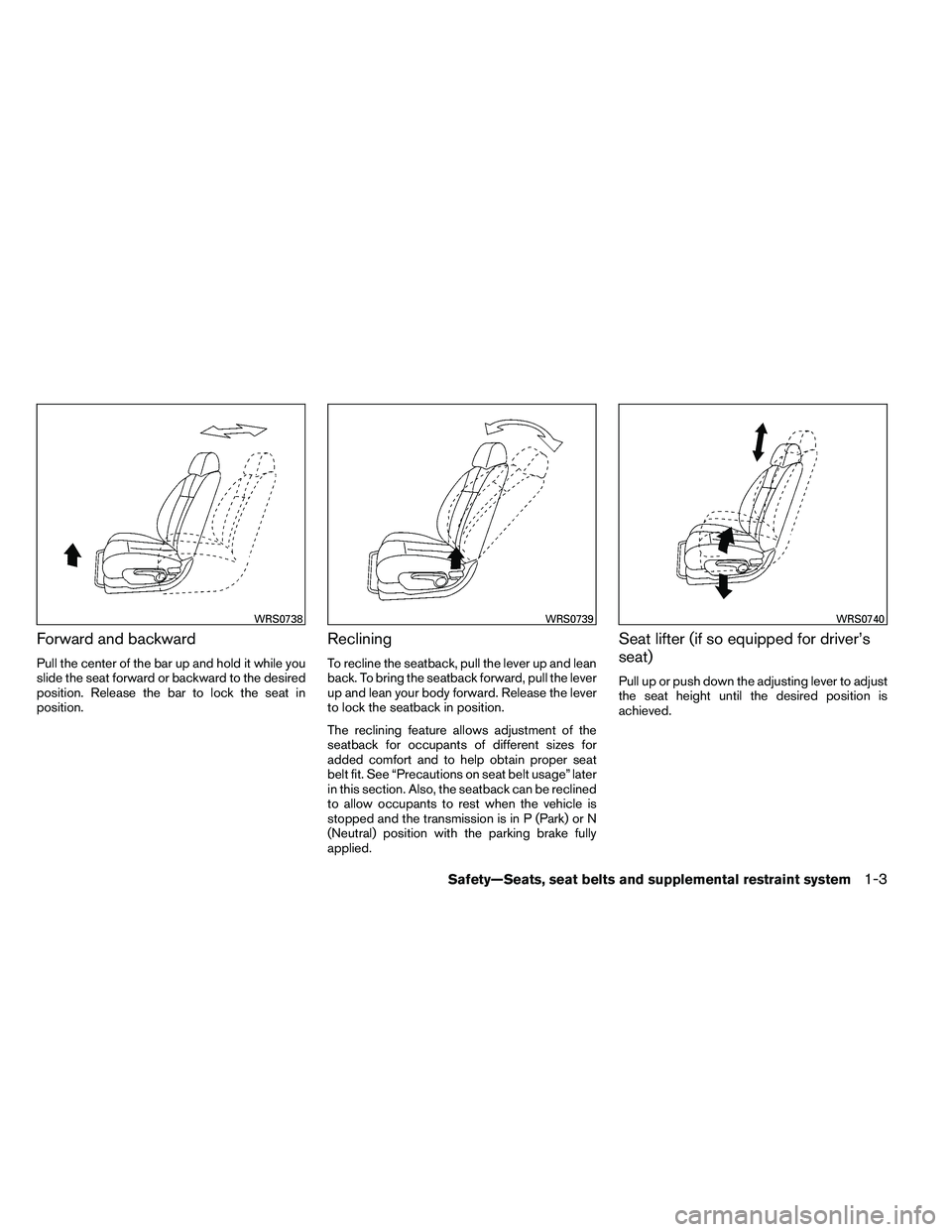
Forward and backward
Pull the center of the bar up and hold it while you
slide the seat forward or backward to the desired
position. Release the bar to lock the seat in
position.
Reclining
To recline the seatback, pull the lever up and lean
back. To bring the seatback forward, pull the lever
up and lean your body forward. Release the lever
to lock the seatback in position.
The reclining feature allows adjustment of the
seatback for occupants of different sizes for
added comfort and to help obtain proper seat
belt fit. See “Precautions on seat belt usage” later
in this section. Also, the seatback can be reclined
to allow occupants to rest when the vehicle is
stopped and the transmission is in P (Park) or N
(Neutral) position with the parking brake fully
applied.
Seat lifter (if so equipped for driver’s
seat)
Pull up or push down the adjusting lever to adjust
the seat height until the desired position is
achieved.
Page 24 of 453
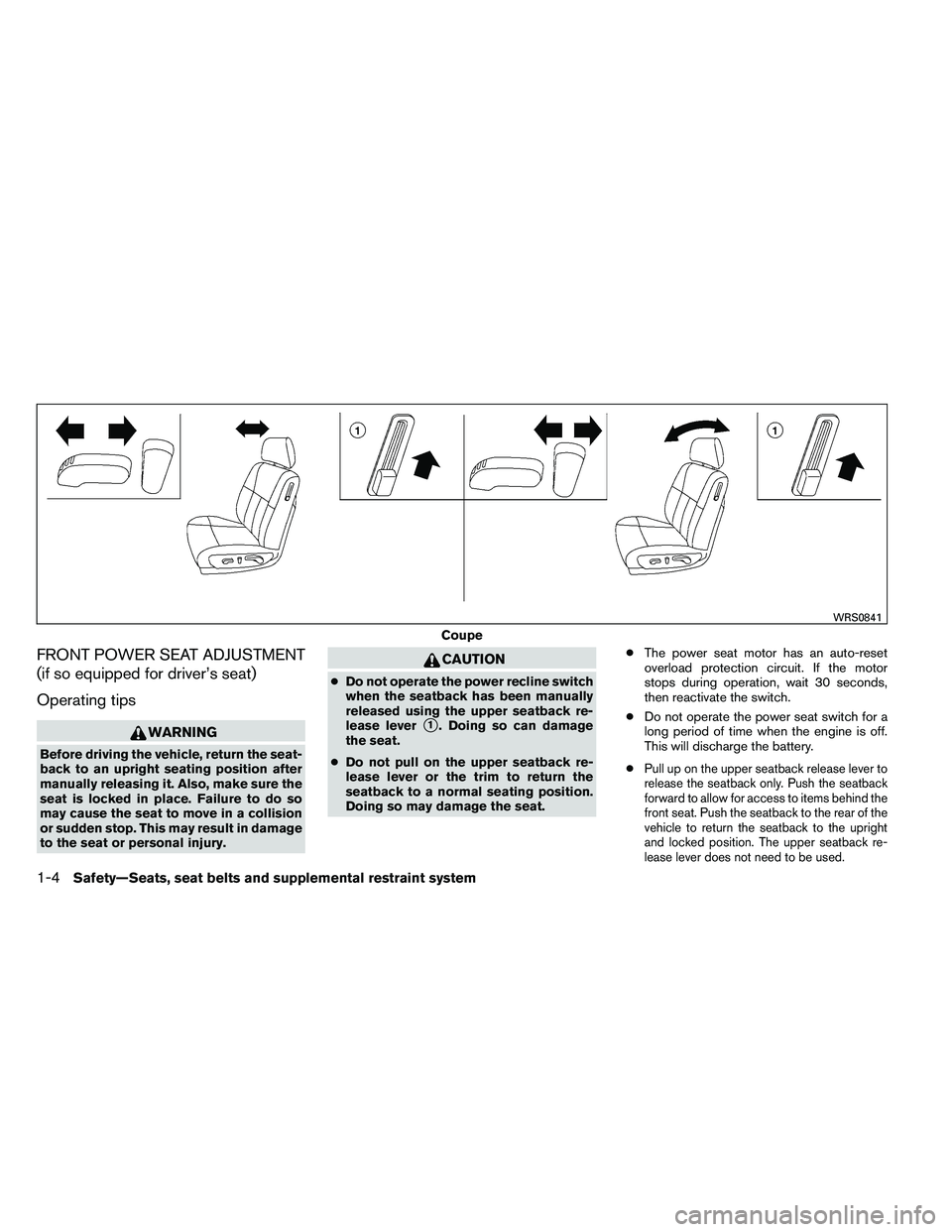
FRONT POWER SEAT ADJUSTMENT
(if so equipped for driver’s seat)
Operating tips
Page 25 of 453
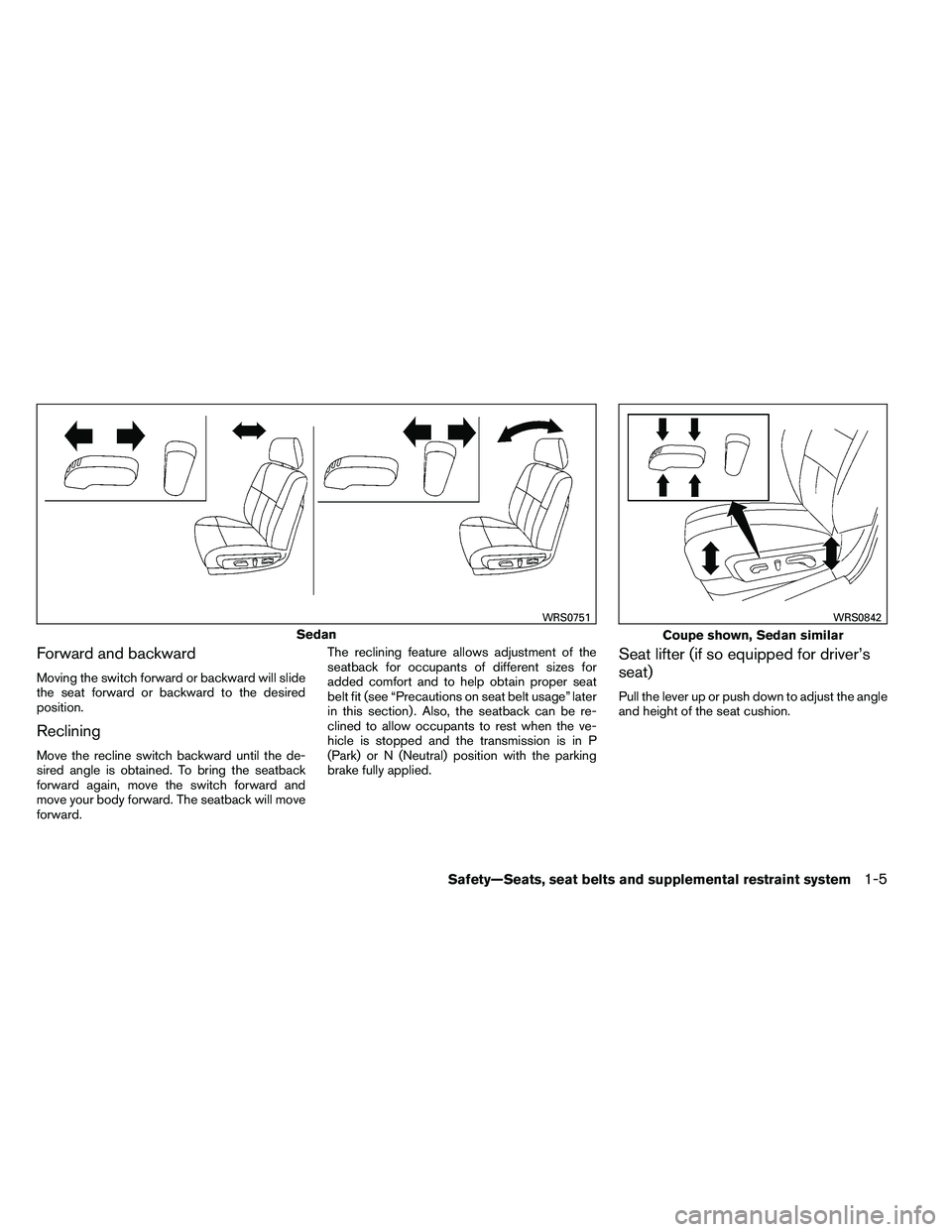
Forward and backward
Moving the switch forward or backward will slide
the seat forward or backward to the desired
position.
Reclining
Move the recline switch backward until the de-
sired angle is obtained. To bring the seatback
forward again, move the switch forward and
move your body forward. The seatback will move
forward.The reclining feature allows adjustment of the
seatback for occupants of different sizes for
added comfort and to help obtain proper seat
belt fit (see “Precautions on seat belt usage” later
in this section) . Also, the seatback can be re-
clined to allow occupants to rest when the ve-
hicle is stopped and the transmission is in P
(Park) or N (Neutral) position with the parking
brake fully applied.
Seat lifter (if so equipped for driver’s
seat)
Pull the lever up or push down to adjust the angle
and height of the seat cushion.
Page 29 of 453
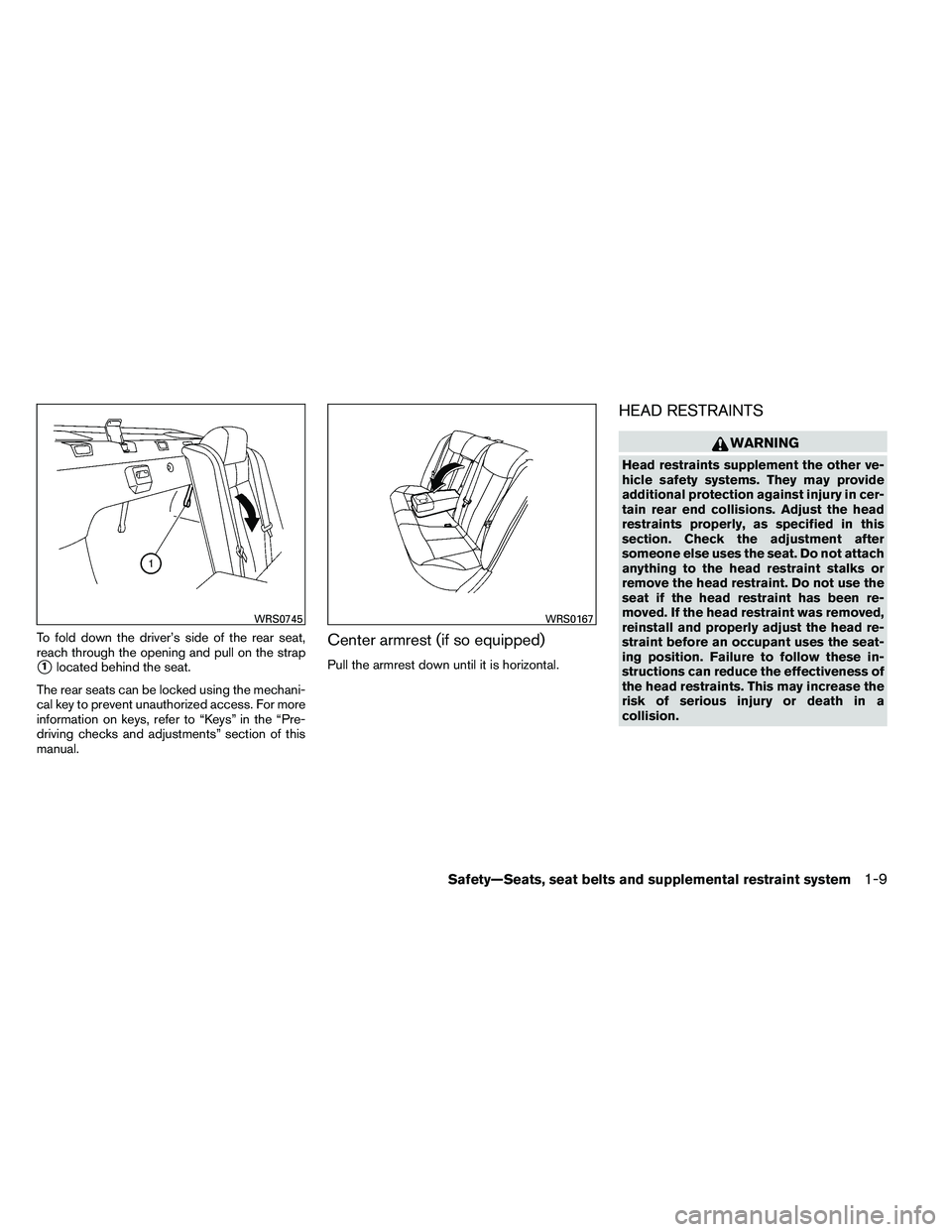
To fold down the driver’s side of the rear seat,
reach through the opening and pull on the strap
�1located behind the seat.
The rear seats can be locked using the mechani-
cal key to prevent unauthorized access. For more
information on keys, refer to “Keys” in the “Pre-
driving checks and adjustments” section of this
manual.
Center armrest (if so equipped)
Pull the armrest down until it is horizontal.
HEAD RESTRAINTS
Page 30 of 453
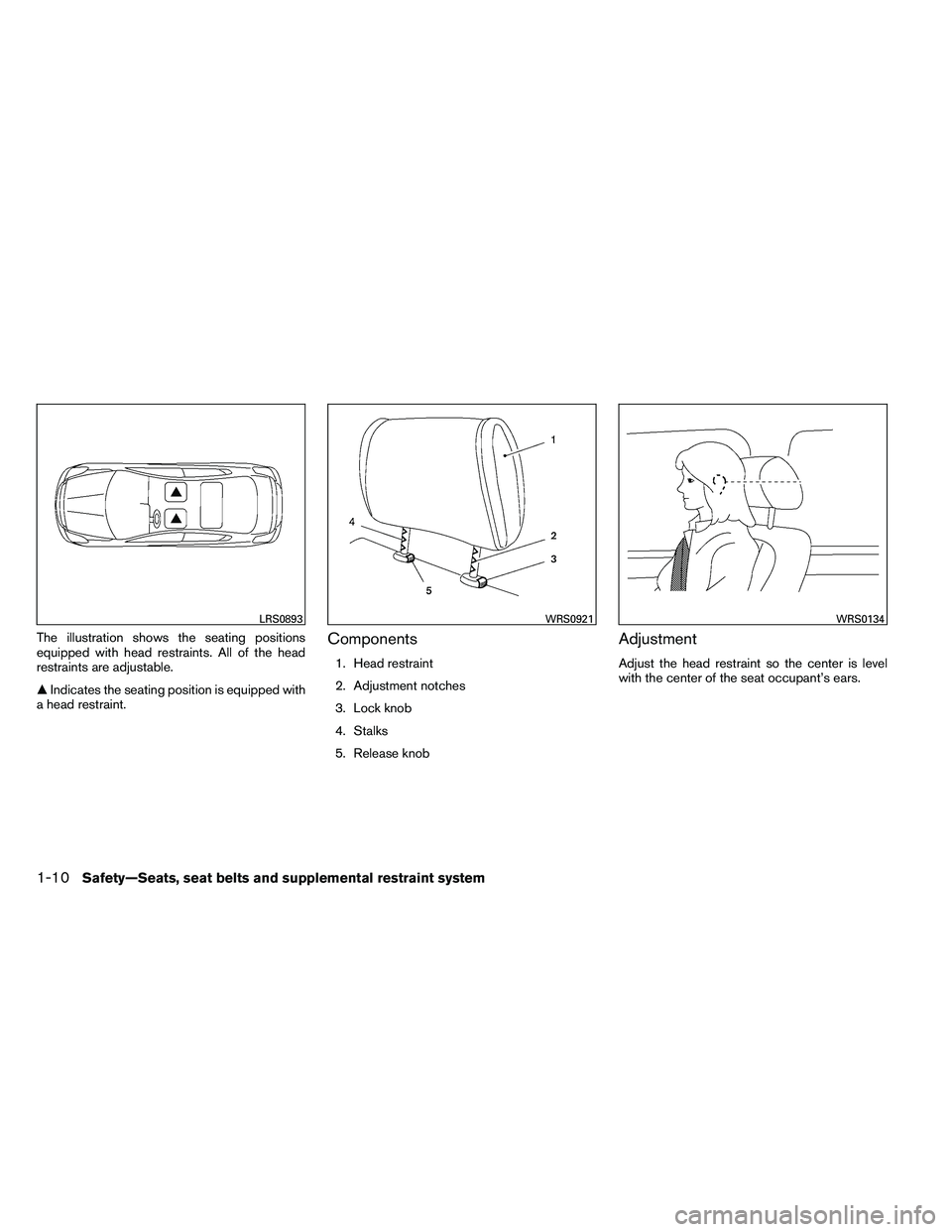
The illustration shows the seating positions
equipped with head restraints. All of the head
restraints are adjustable.
�Indicates the seating position is equipped with
a head restraint.Components
1. Head restraint
2. Adjustment notches
3. Lock knob
4. Stalks
5. Release knob
Adjustment
Adjust the head restraint so the center is level
with the center of the seat occupant’s ears.
Page 38 of 453
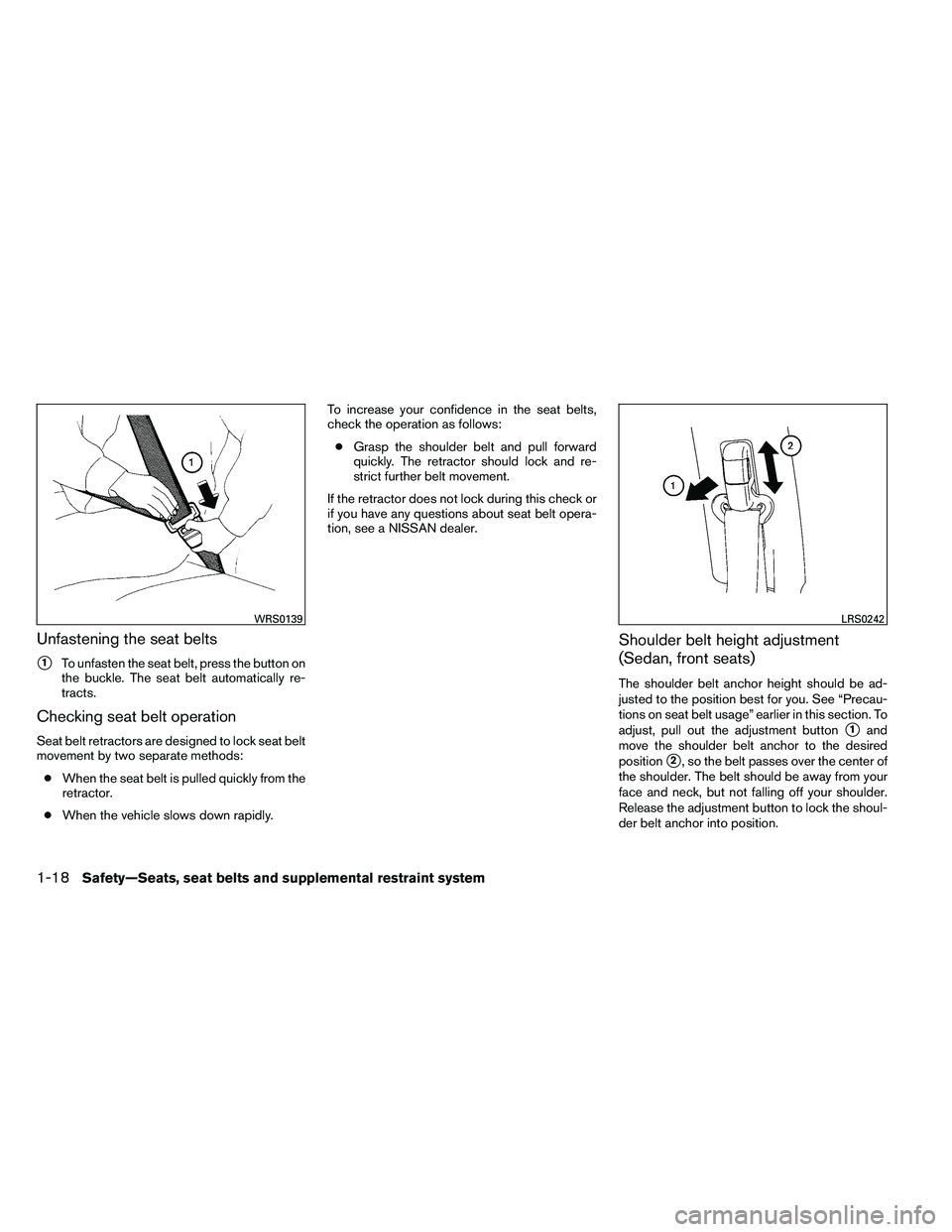
Unfastening the seat belts
�1To unfasten the seat belt, press the button on
the buckle. The seat belt automatically re-
tracts.
Checking seat belt operation
Seat belt retractors are designed to lock seat belt
movement by two separate methods:
● When the seat belt is pulled quickly from the
retractor.
● When the vehicle slows down rapidly. To increase your confidence in the seat belts,
check the operation as follows:
● Grasp the shoulder belt and pull forward
quickly. The retractor should lock and re-
strict further belt movement.
If the retractor does not lock during this check or
if you have any questions about seat belt opera-
tion, see a NISSAN dealer.
Shoulder belt height adjustment
(Sedan, front seats)
The shoulder belt anchor height should be ad-
justed to the position best for you. See “Precau-
tions on seat belt usage” earlier in this section. To
adjust, pull out the adjustment button
�1and
move the shoulder belt anchor to the desired
position
�2, so the belt passes over the center of
the shoulder. The belt should be away from your
face and neck, but not falling off your shoulder.
Release the adjustment button to lock the shoul-
der belt anchor into position.
Page 39 of 453
WARNING
●After adjustment, release the adjust-
ment button and try to move the shoul-
der belt anchor up and down to make
sure it is securely fixed in position.
● The shoulder belt anchor height should
be adjusted to the position best for you.
Failure to do so may reduce the effec-
tiveness of the entire restraint system
and increase the chance or severity of
injury in an accident.
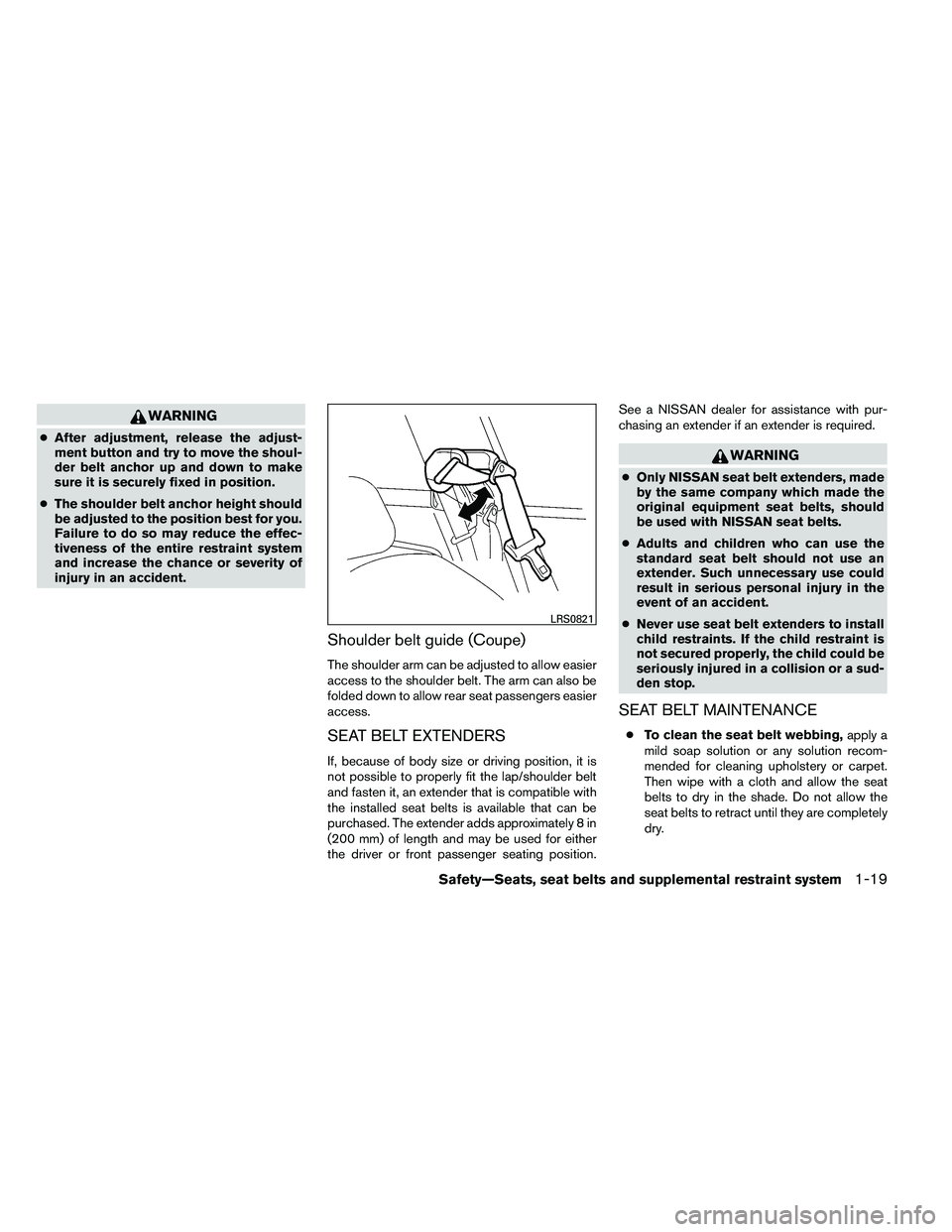
Shoulder belt guide (Coupe)
The shoulder arm can be adjusted to allow easier
access to the shoulder belt. The arm can also be
folded down to allow rear seat passengers easier
access.
SEAT BELT EXTENDERS
If, because of body size or driving position, it is
not possible to properly fit the lap/shoulder belt
and fasten it, an extender that is compatible with
the installed seat belts is available that can be
purchased. The extender adds approximately 8 in
(200 mm) of length and may be used for either
the driver or front passenger seating position. See a NISSAN dealer for assistance with pur-
chasing an extender if an extender is required.