2012 NISSAN 370Z COUPE fog light
[x] Cancel search: fog lightPage 95 of 427
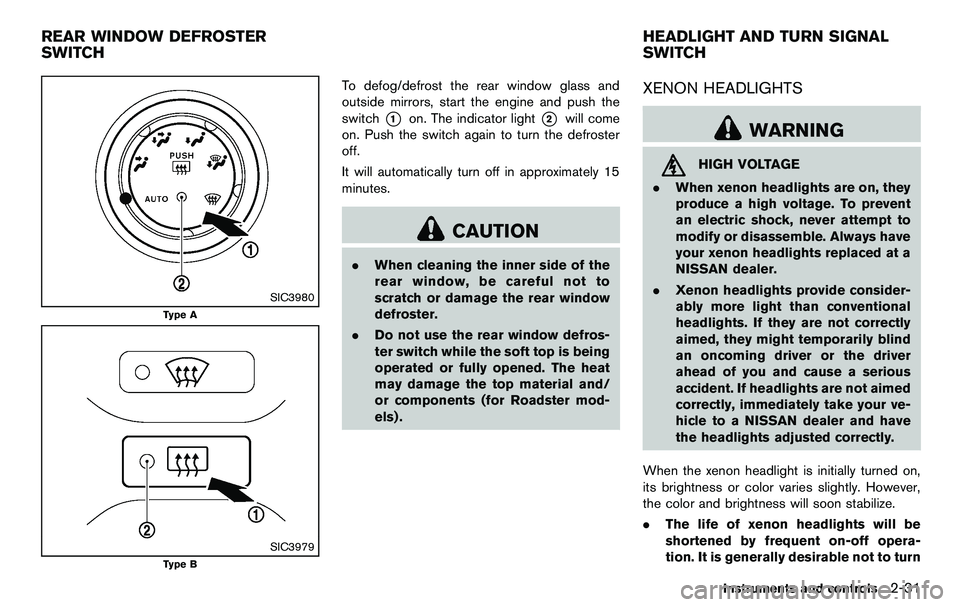
SIC3980
Type A
SIC3979
Type B
To defog/defrost the rear window glass and
outside mirrors, start the engine and push the
switch
*1on. The indicator light*2will come
on. Push the switch again to turn the defroster
off.
It will automatically turn off in approximately 15
minutes.
CAUTION
. When cleaning the inner side of the
rear window, be careful not to
scratch or damage the rear window
defroster.
. Do not use the rear window defros-
ter switch while the soft top is being
operated or fully opened. The heat
may damage the top material and/
or components (for Roadster mod-
els) .
XENON HEADLIGHTS
WARNING
HIGH VOLTAGE
. When xenon headlights are on, they
produce a high voltage. To prevent
an electric shock, never attempt to
modify or disassemble. Always have
your xenon headlights replaced at a
NISSAN dealer.
. Xenon headlights provide consider-
ably more light than conventional
headlights. If they are not correctly
aimed, they might temporarily blind
an oncoming driver or the driver
ahead of you and cause a serious
accident. If headlights are not aimed
correctly, immediately take your ve-
hicle to a NISSAN dealer and have
the headlights adjusted correctly.
When the xenon headlight is initially turned on,
its brightness or color varies slightly. However,
the color and brightness will soon stabilize.
. The life of xenon headlights will be
shortened by frequent on-off opera-
tion. It is generally desirable not to turn
Instruments and controls2-31
REAR WINDOW DEFROSTER
SWITCH HEADLIGHT AND TURN SIGNAL
SWITCH
Page 99 of 427
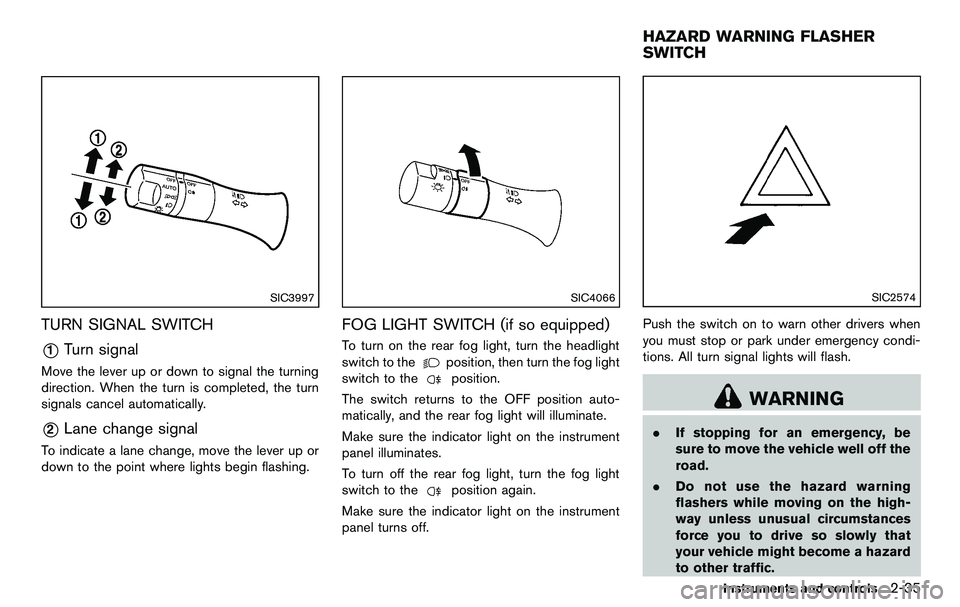
SIC3997
TURN SIGNAL SWITCH
*1Turn signal
Move the lever up or down to signal the turning
direction. When the turn is completed, the turn
signals cancel automatically.
*2Lane change signal
To indicate a lane change, move the lever up or
down to the point where lights begin flashing.
SIC4066
FOG LIGHT SWITCH (if so equipped)
To turn on the rear fog light, turn the headlight
switch to the
position, then turn the fog light
switch to the
position.
The switch returns to the OFF position auto-
matically, and the rear fog light will illuminate.
Make sure the indicator light on the instrument
panel illuminates.
To turn off the rear fog light, turn the fog light
switch to the
position again.
Make sure the indicator light on the instrument
panel turns off.
SIC2574
Push the switch on to warn other drivers when
you must stop or park under emergency condi-
tions. All turn signal lights will flash.
WARNING
. If stopping for an emergency, be
sure to move the vehicle well off the
road.
. Do not use the hazard warning
flashers while moving on the high-
way unless unusual circumstances
force you to drive so slowly that
your vehicle might become a hazard
to other traffic.
Instruments and controls2-35
HAZARD WARNING FLASHER
SWITCH
Page 182 of 427
4-26Center display, heater, air conditioner, audio, phone and voice recognition systems
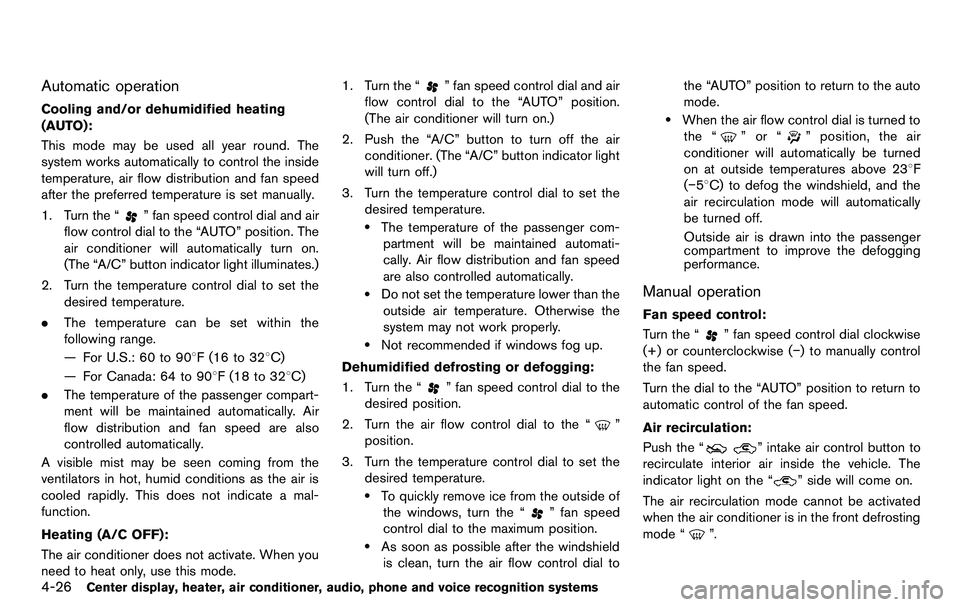
Automatic operation
Cooling and/or dehumidified heating
(AUTO):
This mode may be used all year round. The
system works automatically to control the inside
temperature, air flow distribution and fan speed
after the preferred temperature is set manually.
1. Turn the “
” fan speed control dial and air
flow control dial to the “AUTO” position. The
air conditioner will automatically turn on.
(The “A/C” button indicator light illuminates.)
2. Turn the temperature control dial to set the desired temperature.
. The temperature can be set within the
following range.
— For U.S.: 60 to 908F (16 to 328C)
— For Canada: 64 to 908F (18 to 328C)
. The temperature of the passenger compart-
ment will be maintained automatically. Air
flow distribution and fan speed are also
controlled automatically.
A visible mist may be seen coming from the
ventilators in hot, humid conditions as the air is
cooled rapidly. This does not indicate a mal-
function.
Heating (A/C OFF):
The air conditioner does not activate. When you
need to heat only, use this mode. 1. Turn the “
” fan speed control dial and air
flow control dial to the “AUTO” position.
(The air conditioner will turn on.)
2. Push the “A/C” button to turn off the air conditioner. (The “A/C” button indicator light
will turn off.)
3. Turn the temperature control dial to set the desired temperature.
.The temperature of the passenger com-partment will be maintained automati-
cally. Air flow distribution and fan speed
are also controlled automatically.
.Do not set the temperature lower than theoutside air temperature. Otherwise the
system may not work properly.
.Not recommended if windows fog up.
Dehumidified defrosting or defogging:
1. Turn the “
” fan speed control dial to the
desired position.
2. Turn the air flow control dial to the “
”
position.
3. Turn the temperature control dial to set the desired temperature.
.To quickly remove ice from the outside ofthe windows, turn the “
” fan speed
control dial to the maximum position.
.As soon as possible after the windshield is clean, turn the air flow control dial to the “AUTO” position to return to the auto
mode.
.When the air flow control dial is turned to
the “
”or“” position, the air
conditioner will automatically be turned
on at outside temperatures above 238F
(−58C) to defog the windshield, and the
air recirculation mode will automatically
be turned off.
Outside air is drawn into the passenger
compartment to improve the defogging
performance.
Manual operation
Fan speed control:
Turn the “
” fan speed control dial clockwise
(+) or counterclockwise (−) to manually control
the fan speed.
Turn the dial to the “AUTO” position to return to
automatic control of the fan speed.
Air recirculation:
Push the “
” intake air control button to
recirculate interior air inside the vehicle. The
indicator light on the “
” side will come on.
The air recirculation mode cannot be activated
when the air conditioner is in the front defrosting
mode “
”.
Page 185 of 427
.Do not set the temperature lower than the
outside air temperature. Otherwise the
system may not work properly.
. Not recommended if windows fog up.
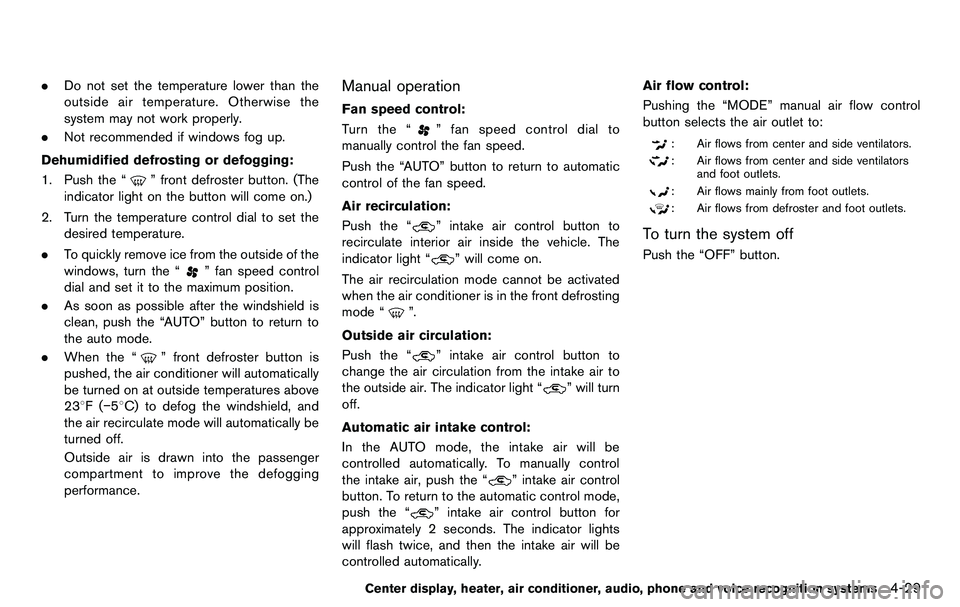
Dehumidified defrosting or defogging:
1. Push the “
” front defroster button. (The
indicator light on the button will come on.)
2. Turn the temperature control dial to set the desired temperature.
. To quickly remove ice from the outside of the
windows, turn the “
” fan speed control
dial and set it to the maximum position.
. As soon as possible after the windshield is
clean, push the “AUTO” button to return to
the auto mode.
. When the “
” front defroster button is
pushed, the air conditioner will automatically
be turned on at outside temperatures above
238F( −58C) to defog the windshield, and
the air recirculate mode will automatically be
turned off.
Outside air is drawn into the passenger
compartment to improve the defogging
performance.
Manual operation
Fan speed control:
Turn the “
” fan speed control dial to
manually control the fan speed.
Push the “AUTO” button to return to automatic
control of the fan speed.
Air recirculation:
Push the “
” intake air control button to
recirculate interior air inside the vehicle. The
indicator light “
” will come on.
The air recirculation mode cannot be activated
when the air conditioner is in the front defrosting
mode “
”.
Outside air circulation:
Push the “
” intake air control button to
change the air circulation from the intake air to
the outside air. The indicator light “
” will turn
off.
Automatic air intake control:
In the AUTO mode, the intake air will be
controlled automatically. To manually control
the intake air, push the “
” intake air control
button. To return to the automatic control mode,
push the “
” intake air control button for
approximately 2 seconds. The indicator lights
will flash twice, and then the intake air will be
controlled automatically. Air flow control:
Pushing the “MODE” manual air flow control
button selects the air outlet to:
: Air flows from center and side ventilators.
: Air flows from center and side ventilators and foot outlets.
: Air flows mainly from foot outlets.
: Air flows from defroster and foot outlets.
To turn the system off
Push the “OFF” button.
Center display, heater, air conditioner, audio, phone and voice recognition systems4-29
Page 379 of 427
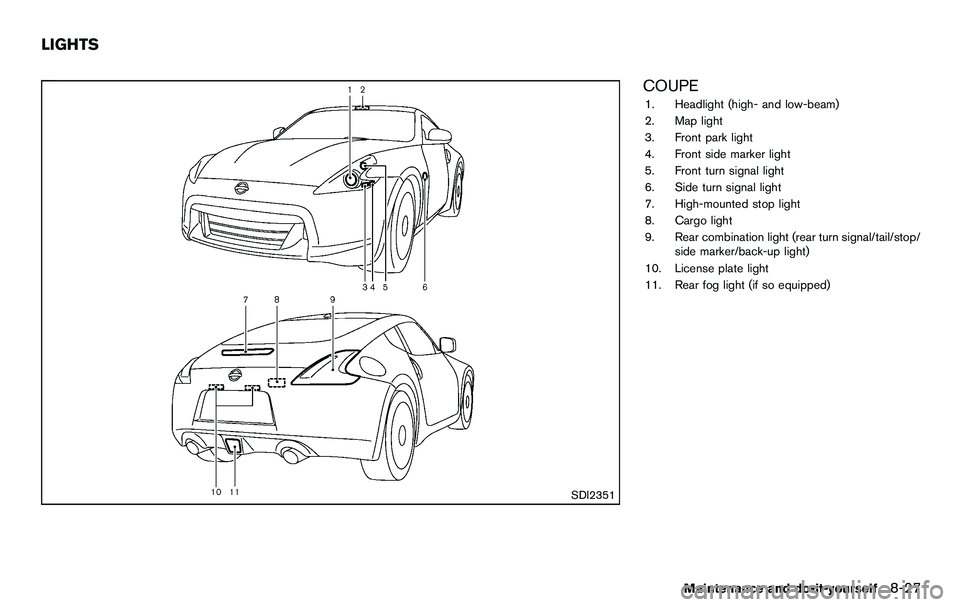
SDI2351
COUPE
1. Headlight (high- and low-beam)
2. Map light
3. Front park light
4. Front side marker light
5. Front turn signal light
6. Side turn signal light
7. High-mounted stop light
8. Cargo light
9. Rear combination light (rear turn signal/tail/stop/side marker/back-up light)
10. License plate light
11. Rear fog light (if so equipped)
Maintenance and do-it-yourself8-27
LIGHTS
Page 380 of 427
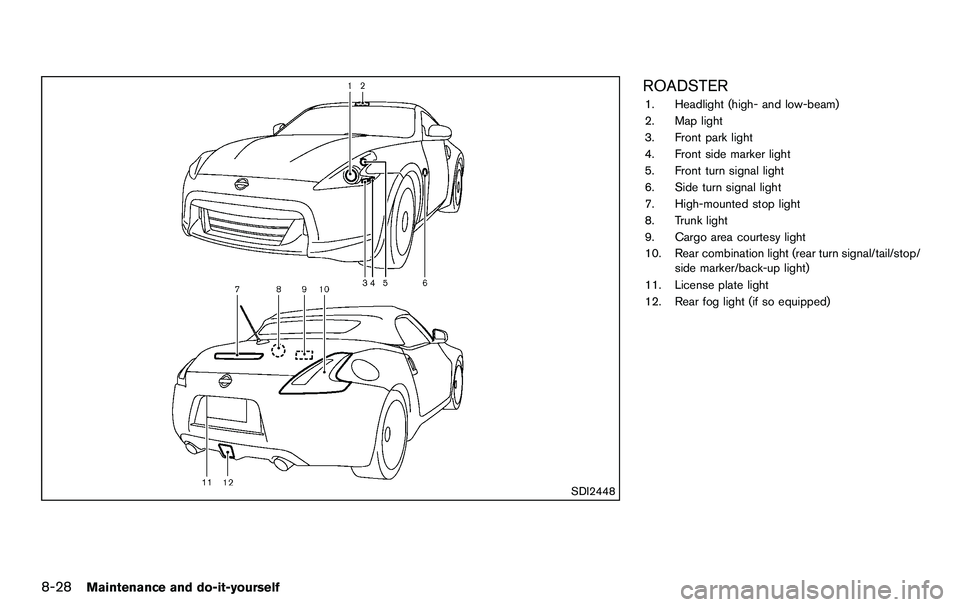
8-28Maintenance and do-it-yourself
SDI2448
ROADSTER
1. Headlight (high- and low-beam)
2. Map light
3. Front park light
4. Front side marker light
5. Front turn signal light
6. Side turn signal light
7. High-mounted stop light
8. Trunk light
9. Cargo area courtesy light
10. Rear combination light (rear turn signal/tail/stop/side marker/back-up light)
11. License plate light
12. Rear fog light (if so equipped)
Page 381 of 427
HEADLIGHTS
Fog may temporarily form inside the lens of the
exterior lights in the rain or in a car wash. A
temperature difference between the inside and
the outside of the lens causes the fog. This is
not a malfunction. If large drops of water collect
inside the lens, contact a NISSAN dealer.
Replacing
WARNING
HIGH VOLTAGE
When xenon headlights are on, they
produce a high voltage. To prevent an
electric shock, never attempt to modify
or disassemble. Always have your xe-
non headlights replaced at a NISSAN
dealer. For additional information, see
“Headlight and turn signal switch” (P.2-
31) .
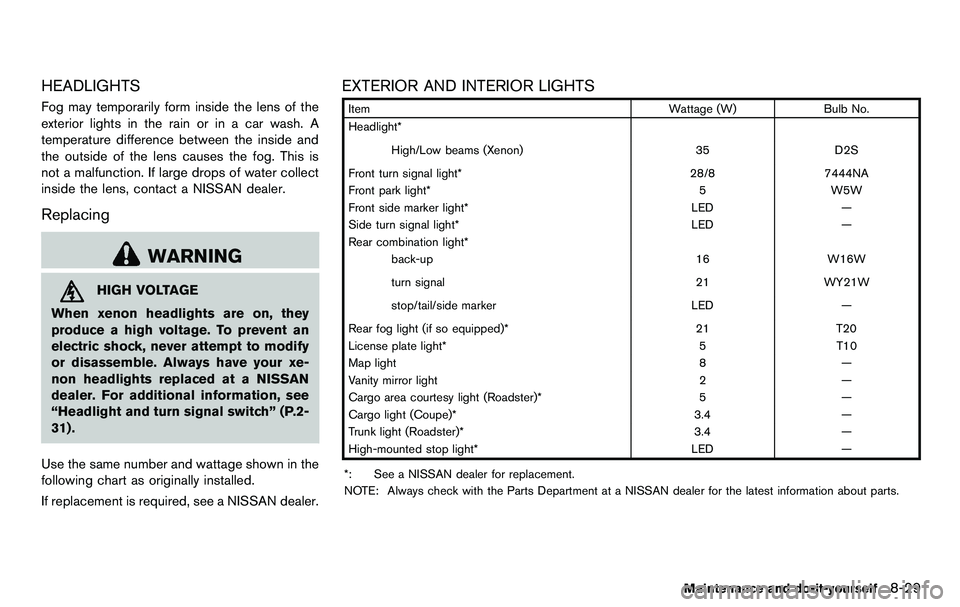
Use the same number and wattage shown in the
following chart as originally installed.
If replacement is required, see a NISSAN dealer.
EXTERIOR AND INTERIOR LIGHTS
Item Wattage (W)Bulb No.
Headlight*
High/Low beams (Xenon) 35D2S
Front turn signal light* 28/87444NA
Front park light* 5W5W
Front side marker light* LED—
Side turn signal light* LED—
Rear combination light* back-up 16W16W
turn signal 21WY21W
stop/tail/side marker LED—
Rear fog light (if so equipped)* 21T20
License plate light* 5T10
Map light 8—
Vanity mirror light 2—
Cargo area courtesy light (Roadster)* 5—
Cargo light (Coupe)* 3.4—
Trunk light (Roadster)* 3.4—
High-mounted stop light* LED—
*: See a NISSAN dealer for replacement.
NOTE: Always check with the Parts Department at a NISSAN dealer for the latest information about parts.
Maintenance and do-it-yourself8-29
Page 420 of 427
10-2
Console box ................................................................. 2-42
CoolantCapacities and
recommended fuel/lubricants............................... 9-2
Changing engine coolant................................... 8-10
Checking engine coolant level.......................... 8-10
Corrosion protection .................................................... 7-8
Cover, Cargo cover.................................................... 2-43
Cruise control............................................................... 5-21
Cup holders.................................................................. 2-40
D
Dampers, Performance dampers ............................ 5-30
Daytime running light system................................... 2-34
Defroster switch, Rear window
defroster switch........................................................... 2-31
Dimensions ................................................................... 9-10
Drive belts..................................................................... 8-18
Driving Cold weather driving........................................... 5-31
Driving with automatic transmission................ 5-12
Driving with manual transmission..................... 5-16
Precautions when starting and driving .............. 5-2
DVD player operation................................................. 4-56
E
Economy, Fuel.............................................................. 5-23
Elapsed time................................................................. 2-23
Emergency tire puncture repair kit ........................... 6-8
Emission control information label.......................... 9-12
Emission control system warranty........................... 9-22
Engine Before starting the engine................................. 5-11
Break-in schedule ................................................ 5-23 Capacities and
recommended fuel/lubricants............................... 9-2
Changing engine coolant................................... 8-10
Changing engine oil and filter........................... 8-11
Checking engine coolant level.......................... 8-10
Checking engine oil level................................... 8-11
Coolant temperature gauge ................................. 2-7
Emergency engine shut off................................ 5-10
Engine block heater............................................. 5-32
Engine compartment check locations................ 8-8
Engine cooling system........................................... 8-9
Engine oil................................................................ 8-11
Engine oil and oil filter recommendation........... 9-6
Engine oil replacement indicator...................... 2-21
Engine oil temperature gauge.............................. 2-8
Engine oil viscosity.................................................. 9-6
Engine serial number........................................... 9-12
Engine specifications ............................................. 9-8
Engine start operation indicator ....................... 2-18
Engine start operation indicator (Manual
Transmission models) ......................................... 2-19
If your vehicle overheats..................................... 6-16
Starting the engine .............................................. 5-11
Event Data Recorders (EDR)................................... 9-23
Exhaust gas (carbon monoxide)................................ 5-2
F
F.M.V.S.S./C.M.V.S.S. certification label ............... 9-12
Filter Air cleaner housing filter .................................... 8-19
Changing engine oil and filter........................... 8-11
Flashers (See hazard warning flasher switch)..... 2-35
Flat tire............................................................................. 6-2 Repairing flat tire (with emergency tire
puncture repair kit) ................................................. 6-8 Flat towing .................................................................... 9-20
Floor mat cleaning ........................................................ 7-6
Fluid Automatic transmission fluid (ATF).................. 8-13
Brake and clutch fluid......................................... 8-14
Brake fluid.............................................................. 8-14
Capacities and
recommended fuel/lubricants............................... 9-2
Engine coolant......................................................... 8-9
Engine oil................................................................ 8-11
Power steering fluid............................................. 8-13
Window washer fluid .......................................... 8-15
FM-AM radio with Compact Disc (CD) player.... 4-43
FM-AM-SAT radio with compact disc (CD)
changer (models without navigation system) ...... 4-47
FM-AM-SAT radio with compact disc (CD)
player (models with navigation system) ................ 4-52
Fog light switch........................................................... 2-35
Front manual seat adjustment.................................... 1-4
Front passenger air bag and status light.............. 1-35
Front power seat adjustment ..................................... 1-2
Front seat, Front seat adjustment............................. 1-2
Fuel Capacities and
recommended fuel/lubricants............................... 9-2
Fuel economy........................................................ 5-23
Fuel economy information (display).................... 4-9
Fuel octane rating ................................................... 9-4
Fuel recommendation............................................. 9-4
Fuel-filler cap......................................................... 3-34
Fuel-filler door....................................................... 3-34
Gauge ........................................................................ 2-7
LOOSE FUEL CAP warning ............................. 3-35
Fuses.............................................................................. 8-22
Fusible links.................................................................. 8-23