Page 352 of 610
Features and controls
3-255
3
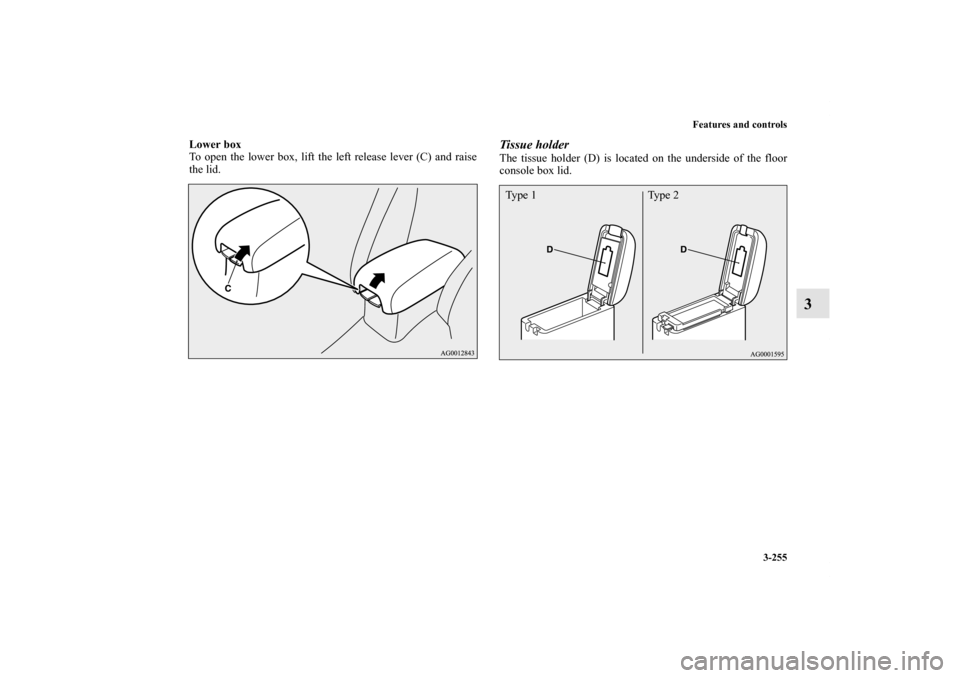
Lower box
To open the lower box, lift the left release lever (C) and raise
the lid.
Tissue holderThe tissue holder (D) is located on the underside of the floor
console box lid.Type 1 Type 2
BK0140300US.book 255 ページ 2011年6月28日 火曜日 午後5時18分
Page 353 of 610
3-256 Features and controls
3Cup holders
N00527300322
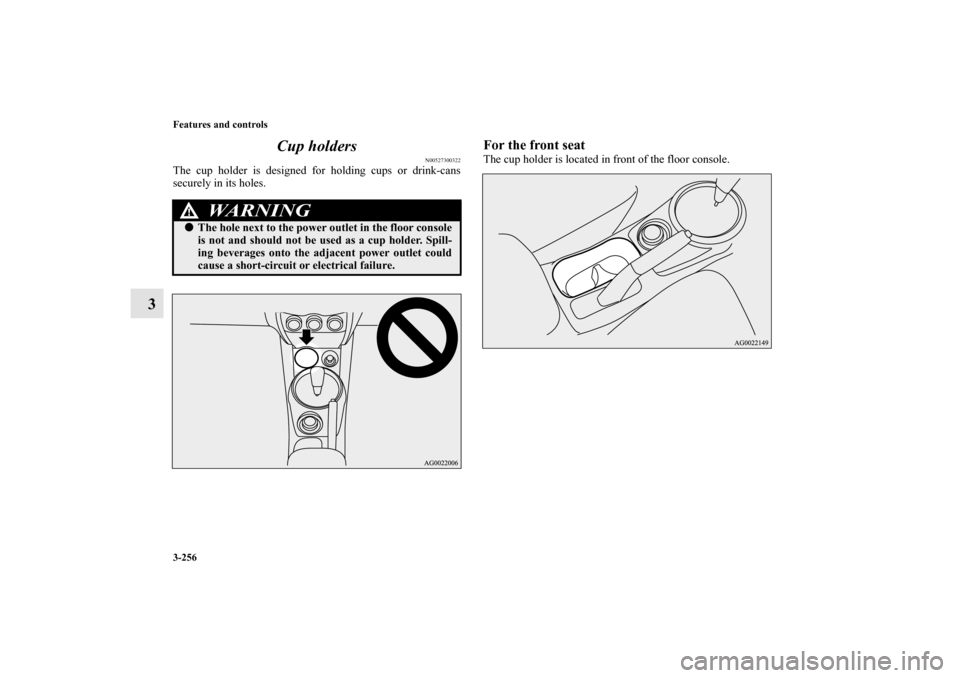
The cup holder is designed for holding cups or drink-cans
securely in its holes.
For the front seatThe cup holder is located in front of the floor console.
WA R N I N G
!�The hole next to the power outlet in the floor console
is not and should not be used as a cup holder. Spill-
ing beverages onto the adjacent power outlet could
cause a short-circuit or electrical failure.
BK0140300US.book 256 ページ 2011年6月28日 火曜日 午後5時18分
Page 354 of 610
Features and controls
3-257
3
For the rear seat
(if so equipped)
N00537000133
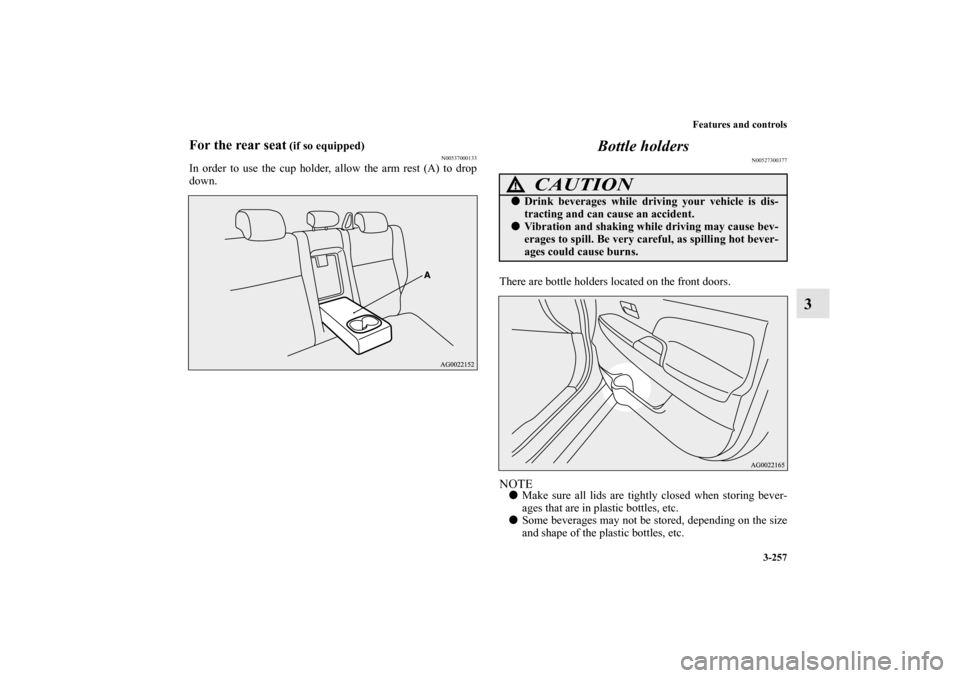
In order to use the cup holder, allow the arm rest (A) to drop
down.
Bottle holders
N00527300377
There are bottle holders located on the front doors.NOTE�Make sure all lids are tightly closed when storing bever-
ages that are in plastic bottles, etc.
�Some beverages may not be stored, depending on the size
and shape of the plastic bottles, etc.
CAUTION
!�Drink beverages while driving your vehicle is dis-
tracting and can cause an accident.�Vibration and shaking while driving may cause bev-
erages to spill. Be very careful, as spilling hot bever-
ages could cause burns.
BK0140300US.book 257 ページ 2011年6月28日 火曜日 午後5時18分
Page 355 of 610
3-258 Features and controls
3Cargo area cover
(if so equipped)
N00528300130
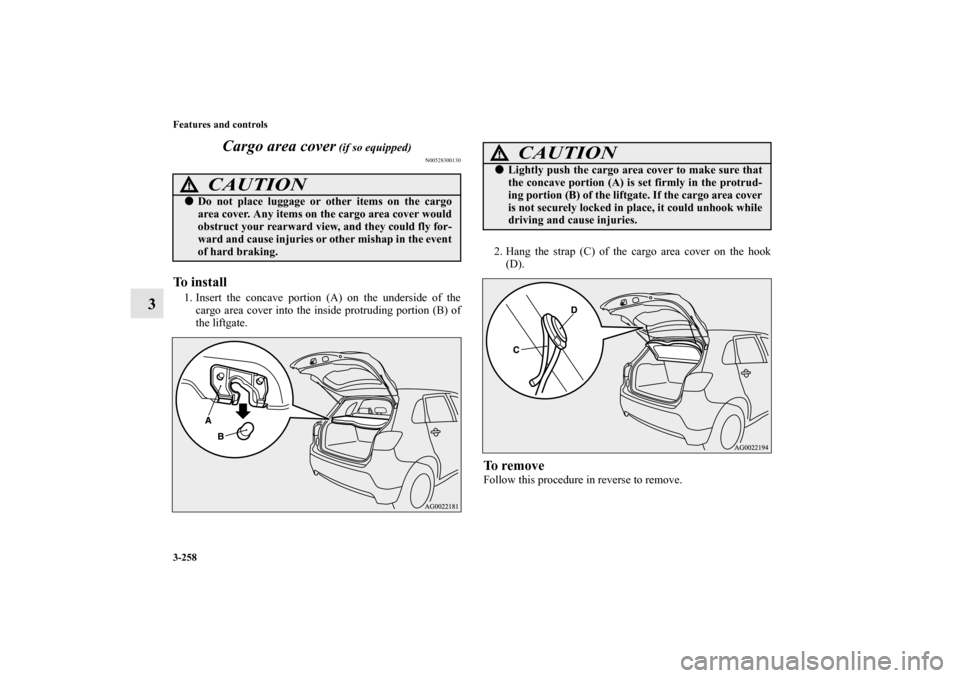
To install1. Insert the concave portion (A) on the underside of the
cargo area cover into the inside protruding portion (B) of
the liftgate.2. Hang the strap (C) of the cargo area cover on the hook
(D).
To removeFollow this procedure in reverse to remove.
CAUTION
!�Do not place luggage or other items on the cargo
area cover. Any items on the cargo area cover would
obstruct your rearward view, and they could fly for-
ward and cause injuries or other mishap in the event
of hard braking.
CAUTION
!�Lightly push the cargo area cover to make sure that
the concave portion (A) is set firmly in the protrud-
ing portion (B) of the liftgate. If the cargo area cover
is not securely locked in place, it could unhook while
driving and cause injuries.
BK0140300US.book 258 ページ 2011年6月28日 火曜日 午後5時18分
Page 356 of 610
Features and controls
3-259
3 Assist grips
N00559000061
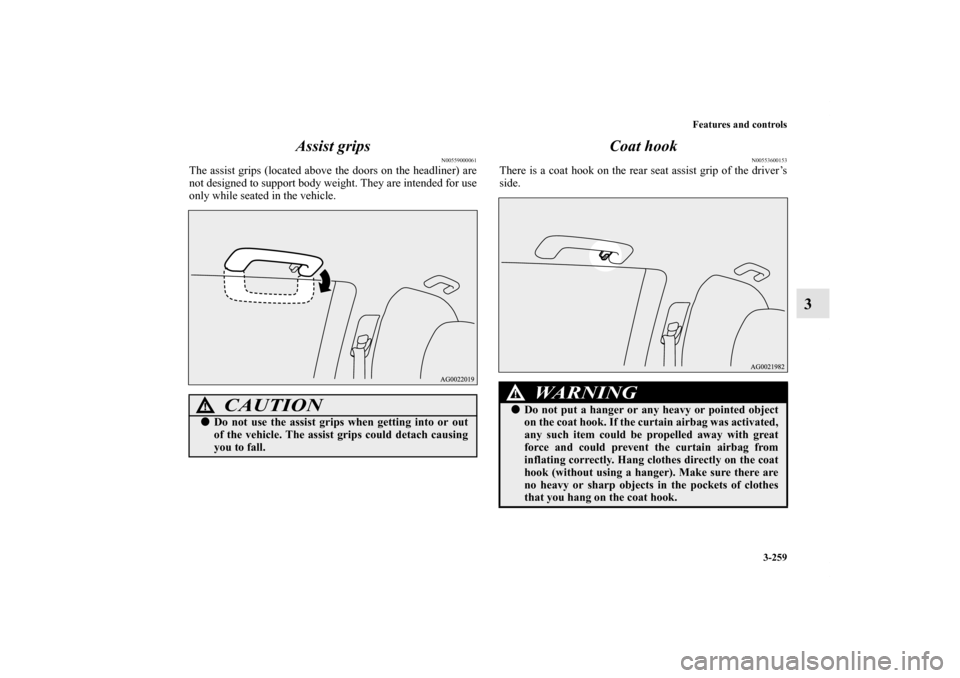
The assist grips (located above the doors on the headliner) are
not designed to support body weight. They are intended for use
only while seated in the vehicle.
Coat hook
N00553600153
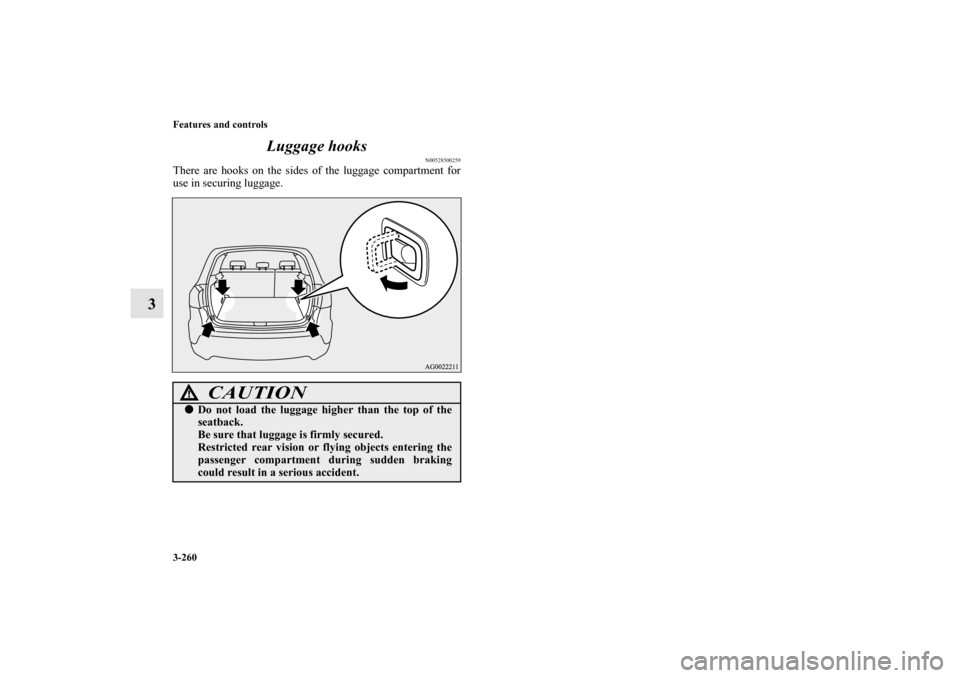
There is a coat hook on the rear seat assist grip of the driver’s
side.
CAUTION
!�Do not use the assist grips when getting into or out
of the vehicle. The assist grips could detach causing
you to fall.
WA R N I N G
!�Do not put a hanger or any heavy or pointed object
on the coat hook. If the curtain airbag was activated,
any such item could be propelled away with great
force and could prevent the curtain airbag from
inflating correctly. Hang clothes directly on the coat
hook (without using a hanger). Make sure there are
no heavy or sharp objects in the pockets of clothes
that you hang on the coat hook.
BK0140300US.book 259 ページ 2011年6月28日 火曜日 午後5時18分
Page 357 of 610
3-260 Features and controls
3Luggage hooks
N00528500259
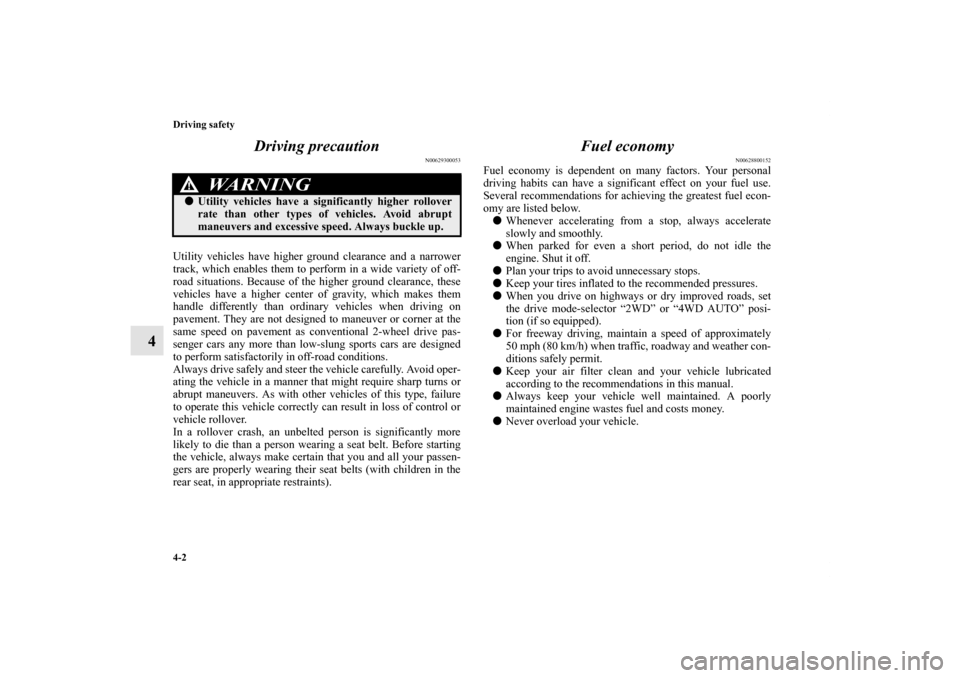
There are hooks on the sides of the luggage compartment for
use in securing luggage.
CAUTION
!�Do not load the luggage higher than the top of the
seatback.
Be sure that luggage is firmly secured.
Restricted rear vision or flying objects entering the
passenger compartment during sudden braking
could result in a serious accident.
BK0140300US.book 260 ページ 2011年6月28日 火曜日 午後5時18分
Page 361 of 610
4-2 Driving safety
4Driving precaution
N00629300053
Utility vehicles have higher ground clearance and a narrower
track, which enables them to perform in a wide variety of off-
road situations. Because of the higher ground clearance, these
vehicles have a higher center of gravity, which makes them
handle differently than ordinary vehicles when driving on
pavement. They are not designed to maneuver or corner at the
same speed on pavement as conventional 2-wheel drive pas-
senger cars any more than low-slung sports cars are designed
to perform satisfactorily in off-road conditions.
Always drive safely and steer the vehicle carefully. Avoid oper-
ating the vehicle in a manner that might require sharp turns or
abrupt maneuvers. As with other vehicles of this type, failure
to operate this vehicle correctly can result in loss of control or
vehicle rollover.
In a rollover crash, an unbelted person is significantly more
likely to die than a person wearing a seat belt. Before starting
the vehicle, always make certain that you and all your passen-
gers are properly wearing their seat belts (with children in the
rear seat, in appropriate restraints).
Fuel economy
N00628800152
Fuel economy is dependent on many factors. Your personal
driving habits can have a significant effect on your fuel use.
Several recommendations for achieving the greatest fuel econ-
omy are listed below.
�Whenever accelerating from a stop, always accelerate
slowly and smoothly.
�When parked for even a short period, do not idle the
engine. Shut it off.
�Plan your trips to avoid unnecessary stops.
�Keep your tires inflated to the recommended pressures.
�When you drive on highways or dry improved roads, set
the drive mode-selector “2WD” or “4WD AUTO” posi-
tion (if so equipped).
�For freeway driving, maintain a speed of approximately
50 mph (80 km/h) when traffic, roadway and weather con-
ditions safely permit.
�Keep your air filter clean and your vehicle lubricated
according to the recommendations in this manual.
�Always keep your vehicle well maintained. A poorly
maintained engine wastes fuel and costs money.
�Never overload your vehicle.
WA R N I N G
!�Utility vehicles have a significantly higher rollover
rate than other types of vehicles. Avoid abrupt
maneuvers and excessive speed. Always buckle up.
BK0140300US.book 2 ページ 2011年6月28日 火曜日 午後5時18分
Page 364 of 610
Driving safety
4-5
4 Vehicle preparation before driving
N00629000669
For a safer and more enjoyable trip, always check for the fol-
lowing:Seat belts and seats�Before starting the vehicle, make certain that you and all
passengers are seated and wearing their seat belts properly
(with children in the rear seat, in appropriate restraints),
and that all the doors and liftgate are locked.
�Move the driver’s seat as far backward as possible, while
still keeping good visibility, and good control of the steer-
ing wheel, brakes, accelerator, and controls. Check the
instrument panel indicators and multi-information display
for any possible problem.
�In the same way, the front passenger seat should also be
moved as far back as possible.
�Make sure that infants and small children are properly
restrained in accordance with all laws and regulations.DefrostersCheck these by selecting the defroster mode, and set the blower
switch on high. You should be able to feel the air blowing
against the windshield.
Refer to “Defrosting or defogging (windshield, door win-
dows)” on page 5-14, 5-23, 5-33, 5-43.
WA R N I N G
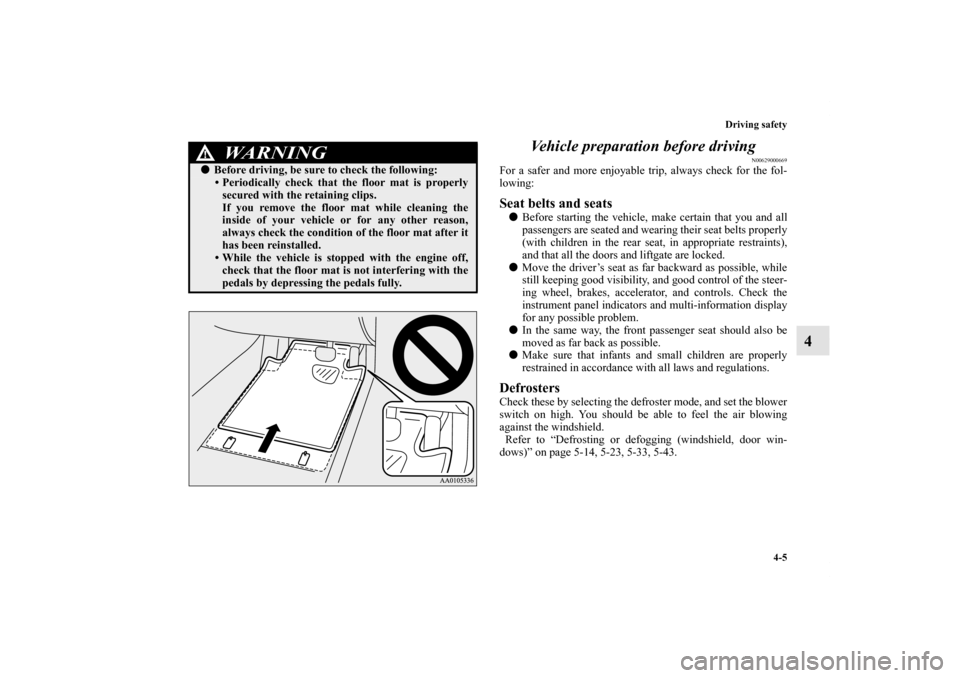
!�Before driving, be sure to check the following:
• Periodically check that the floor mat is properly
secured with the retaining clips.
If you remove the floor mat while cleaning the
inside of your vehicle or for any other reason,
always check the condition of the floor mat after it
has been reinstalled.
• While the vehicle is stopped with the engine off,
check that the floor mat is not interfering with the
pedals by depressing the pedals fully.
BK0140300US.book 5 ページ 2011年6月28日 火曜日 午後5時18分