Vehicle care and maintenance
7-33
7
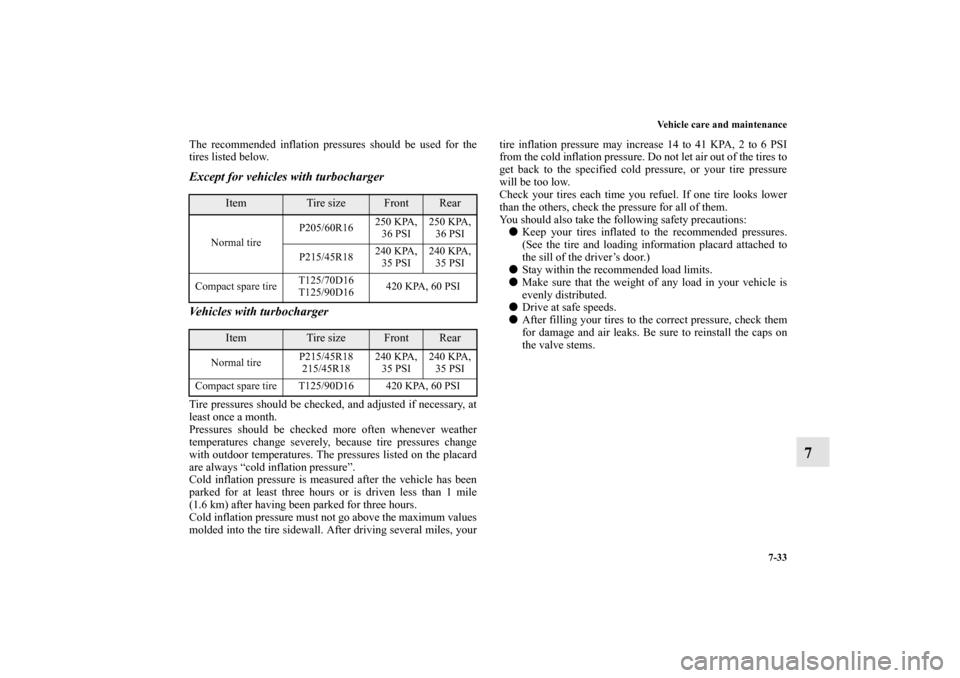
The recommended inflation pressures should be used for the
tires listed below.Except for vehicles with turbocharger
Vehicles with turbochargerTire pressures should be checked, and adjusted if necessary, at
least once a month.
Pressures should be checked more often whenever weather
temperatures change severely, because tire pressures change
with outdoor temperatures. The pressures listed on the placard
are always “cold inflation pressure”.
Cold inflation pressure is measured after the vehicle has been
parked for at least three hours or is driven less than 1 mile
(1.6 km) after having been parked for three hours.
Cold inflation pressure must not go above the maximum values
molded into the tire sidewall. After driving several miles, yourtire inflation pressure may increase 14 to 41 KPA, 2 to 6 PSI
from the cold inflation pressure. Do not let air out of the tires to
get back to the specified cold pressure, or your tire pressure
will be too low.
Check your tires each time you refuel. If one tire looks lower
than the others, check the pressure for all of them.
You should also take the following safety precautions:
�Keep your tires inflated to the recommended pressures.
(See the tire and loading information placard attached to
the sill of the driver’s door.)
�Stay within the recommended load limits.
�Make sure that the weight of any load in your vehicle is
evenly distributed.
�Drive at safe speeds.
�After filling your tires to the correct pressure, check them
for damage and air leaks. Be sure to reinstall the caps on
the valve stems.
Item
Tire size
Front
Rear
Normal tireP205/60R16250 KPA,
36 PSI250 KPA,
36 PSI
P215/45R18240 KPA,
35 PSI240 KPA,
35 PSI
Compact spare tire T125/70D16
T125/90D16420 KPA, 60 PSI
Item
Tire size
Front
Rear
Normal tireP215/45R18
215/45R18240 KPA,
35 PSI240 KPA,
35 PSI
Compact spare tire T125/90D16 420 KPA, 60 PSI
BK0138600US.book 33 ページ 2011年7月17日 日曜日 午後2時32分
8-2 Customer assistance/Reporting Safety Defects
8Consumer information (For vehicles sold in
U.S.A.)
N01047100100
This information is provided in compliance with the require-
ments of the National Highway Traffic Safety Administration,
Department of Transportation. It provides the purchasers
and/or prospective purchasers with information on reporting
safety defects. Uniform tire quality gradingDOT quality grades - All passenger vehicle tires must conform
to Federal Safety Requirements in addition to these grades. The
specific grade rating in each grade category is shown on the
side wall of the tires on your vehicle. Treadwear The treadwear grade is a comparative rating based on the wear
rate of the tire when tested under controlled conditions on a
specified government test course. For example, a tire graded
150 would wear one and one-half (1
1/2) times as well on the
government course as a tire graded 100. The relative perfor-
mance of tires depends upon the actual conditions of their use,
however, and may depart significantly from the norm due to
variations in driving habits, service practices and differences in
road characteristics and climate.
Traction AA, A, B, C The traction grades, from highest to lowest, are AA, A, B and
C. Those grades represent the tire’s ability to stop on wet pave-
ment as measured under controlled conditions on specified
government test surfaces of asphalt and concrete. A tire
marked C may have poor traction performance.
Temperature A, B, CThe temperature grades are A (the highest), B and C, represent-
ing the tire’s resistance to the generation of heat and its ability
to dissipate heat when tested under controlled conditions on a
specified indoor laboratory test wheel. Sustained high tempera-
ture can cause the material of the tire to degenerate and reduce
tire life, and excessive temperature can lead to sudden tire fail-
ure. The grade C corresponds to a level of performance which
all passenger car tires must meet under the Federal Motor Vehi-
cle Safety Standard No. 109. Grades B and A represent higher
levels of performance on the laboratory test wheel than the
minimum required by law.
WA R N I N G
!�The traction grade assigned to this tire is based on
straight-ahead braking traction tests, and does not
include acceleration, cornering, hydroplaning, or
peak traction characteristics.
WA R N I N G
!�The temperature grade for this tire is established for
a tire that is properly inflated and not overloaded.
Excessive speed, underinflation, or excessive load-
ing, either separately or in combination, can cause
heat buildup and possible tire failure.
BK0138600US.book 2 ページ 2011年7月17日 日曜日 午後2時32分
Alphabetical index
6Rear window defogger switch 3-254
Rear-view camera 3-172
Rearview mirror
Inside 3-80
Outside 3-83
Refrigerant (air conditioning) 9-10
Replacement of light bulbs 7-55
Replacing tires and wheels 7-34
Reporting Safety Defects 8-3
Roof antenna 5-148
S
Safe driving techniques 4-6
Seat 2-2
Arm rest 2-9
Front seats 2-3
Heated seats 2-7
Rear seats 2-8
Seats and restraint systems 2-3
Seat belt 2-13
Adjustable seat belt shoulder anchor 2-19
Child restraint 2-23
Driver’s seat belt reminder/warning 2-18
Force limiter 2-23
Front passenger seat belt warning light 2-19
Maintenance and inspection 2-34
Pre-tensioner 2-21
Seat belt extender 2-20
Seat belt instructions 2-14Seat belt use during pregnancy 2-21
Service brake 3-143
Service precautions 7-2
Snow tires 7-37
Spark plugs 7-41
Steering
Power steering fluid 7-22
,9-10
Tilt lock lever 3-79
Wheel lock 3-30
,3-88
Storage spaces 3-296
Sun visors 3-288
Supplemental Restraint System 2-34
How the Supplement Restraint System works 2-38
Servicing 2-57
Warning light/display 2-43
T
Tank capacity 1-5
,9-10
Theft-alarm system
System 3-63
Tire pressure monitoring system 3-166
Warning light/display 3-167
Tires 7-29
How to change a tire 6-9
Inflation pressure 7-32
Maintenance 7-34
Quality grading 8-2
Replacing tires and wheels 7-34
Rotation 7-35
BK0138600US.book 6 ページ 2011年7月17日 日曜日 午後2時32分