2012 MITSUBISHI L200 tow
[x] Cancel search: towPage 286 of 370

Six wheel nutsCAUTION
l
Never
use your foot or a pipe extension
for extra force in the wheel nut wrench.
If you do so, you will tighten the nut too
much.
13. Lower
and remove the jack, then store the jack, jack handle, wheel nut wrench, flat
tyre, and chocks. Have your damaged tyre re-
paired as soon as possible.
14. Check your tyre inflation pressure. The cor- rect pressures are shown on the door label.
See the illustration. CAUTION
l
The
tyre pressure should be periodically
checked and maintained at the specified
pressure while the tyre is stowed.
l After changing the tyre and driving the ve-
hicle about 1,000 km (620 miles), retight-
en the wheel nuts to make sure that they
have not come loose.
l If the steering wheel vibrates when driv-
ing after changing the tyre, we recom-
mend you to have the tyres checked for
balance.
l Do not mix one type of tyre with another
or use a different size from the one listed.
This would cause early wear and poor han-
dling. Towing
E00801503640
If your vehicle needs to be towed
If
towing is necessary, we recommend you to have
it done by your MITSUBISHI MOTORS Author-
ized Service Point or a commercial tow truck service.
In the following cases, transport the vehicle using a
tow truck.
l The engine runs but the vehicle does not
move or abnormal noise is produced.
l Inspection of the vehicle’s underside reveals
that oil or some other fluid is leaking.
If a wheel gets stuck in a ditch, do not try to tow
the vehicle. Please contact your MITSUBISHI
MOTORS Authorized Service Point or a commer-
cial tow truck service for assistance.
Only when you cannot receive a towing service
from a MITSUBISHI MOTORS Authorized Serv-
ice Point or commercial tow truck service, tow
your vehicle carefully in accordance with the in-
structions given in “Emergency towing” in this part. For emergencies
6-20
6
OCRE12E1
Page 287 of 370
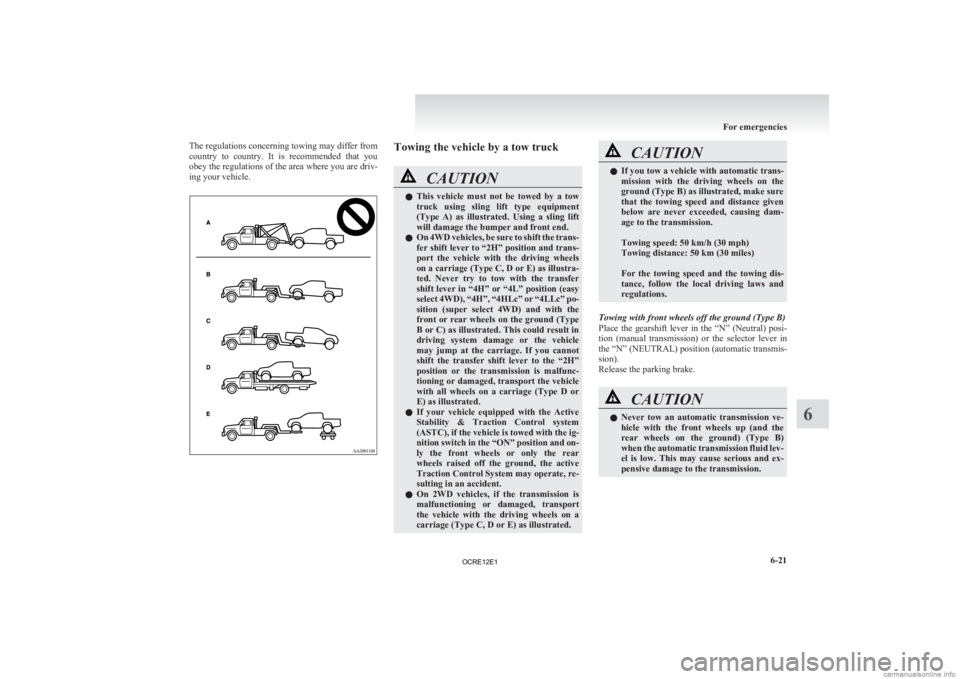
The regulations concerning towing may differ from
country
to country. It is recommended that you
obey the regulations of the area where you are driv-
ing your vehicle. Towing the vehicle by a tow truck
CAUTION
l
This
vehicle must not be towed by a tow
truck using sling lift type equipment
(Type A) as illustrated. Using a sling lift
will damage the bumper and front end.
l On 4WD vehicles, be sure to shift the trans-
fer shift lever to “2H” position and trans-
port the vehicle with the driving wheels
on a carriage (Type C, D or E) as illustra-
ted. Never try to tow with the transfer
shift lever in “4H” or “4L” position (easy
select 4WD), “4H”, “4HLc” or “4LLc” po-
sition (super select 4WD) and with the
front or rear wheels on the ground (Type
B or C) as illustrated. This could result in
driving system damage or the vehicle
may jump at the carriage. If you cannot
shift the transfer shift lever to the “2H”
position or the transmission is malfunc-
tioning or damaged, transport the vehicle
with all wheels on a carriage (Type D or
E) as illustrated.
l If your vehicle equipped with the Active
Stability & Traction Control system
(ASTC), if the vehicle is towed with the ig-
nition switch in the “ON” position and on-
ly the front wheels or only the rear
wheels raised off the ground, the active
Traction Control System may operate, re-
sulting in an accident.
l On 2WD vehicles, if the transmission is
malfunctioning or damaged, transport
the vehicle with the driving wheels on a
carriage (Type C, D or E) as illustrated. CAUTION
l
If
you tow a vehicle with automatic trans-
mission with the driving wheels on the
ground (Type B) as illustrated, make sure
that the towing speed and distance given
below are never exceeded, causing dam-
age to the transmission.
Towing speed: 50 km/h (30 mph)
Towing distance: 50 km (30 miles)
For the towing speed and the towing dis-
tance, follow the local driving laws and
regulations.
Towing with front wheels off the ground (Type B)
Place
the gearshift lever in the “N” (Neutral) posi-
tion (manual transmission) or the selector lever in
the “N” (NEUTRAL) position (automatic transmis-
sion).
Release the parking brake. CAUTION
l
Never
tow an automatic transmission ve-
hicle with the front wheels up (and the
rear wheels on the ground) (Type B)
when the automatic transmission fluid lev-
el is low. This may cause serious and ex-
pensive damage to the transmission. For emergencies
6-21 6
OCRE12E1
Page 288 of 370

Towing with rear wheels off the ground (Type C)
Place
the gearshift lever in the “N” (Neutral) posi-
tion (manual transmission) or the selector lever in
the “N” (NEUTRAL) position (automatic transmis-
sion). Turn the ignition key to the “ACC” position
and secure the steering wheel in a straight ahead po-
sition with a rope or tie-down strap. Never place
the ignition switch in the “LOCK” position when
towing.
Emergency towing
If towing service is not available in an emergency,
your vehicle may be temporarily towed by a cable
or chain secured to the towing hook.
If your vehicle is to be towed by another vehicle,
pay careful attention to the following points.
If your vehicle is to be towed by anoth-
er vehicle
1. The front towing hooks (A) and rear towinghook (B) are located as shown in the illustra-
tion. Secure the tow rope to the towing hook.
Front (2WD vehicles with 15 inch wheels) Front (2WD vehicles with 16 inch wheels and
4WD vehicles)
Rear*
NOTE
l Using
any part other than the designated tow-
ing hooks could result in damage to the vehi-
cle body.
l Using a wire rope or metal chain can result
in damage to the vehicle body. It is best to
use a non-metallic rope. If you use a wire
rope or metal chain, wrap it with cloth at any
point where it touches the vehicle body. l
Take
care that the tow rope is kept as horizon-
tal as possible. An angled tow rope can dam-
age the vehicle body.
l Secure the tow rope to the same side towing
hook, to keep the tow rope as straight as pos-
sible.
2. Keep the engine running. If the engine is not running, turn the ignition
key to the “ACC” or “ON” position to un-
lock the steering wheel. CAUTION
l
When
the engine is not running, the
brake booster and power steering pump
do not operate. This means higher brake
depression force and higher steering ef-
fort are required. Therefore, vehicle oper-
ation is more difficult than usual.
l Do not leave the key in the “LOCK” posi-
tion. The steering wheel will lock, causing
loss of control.
3. Place
the gearshift lever in the “N” (Neutral) position (manual transmission) or the selec-
tor lever in the “N” (NEUTRAL) position (au-
tomatic transmission).
4. On 4WD vehicles, the transfer shift lever to “2H” position.
5. Turn on the hazard warning lamps if required by law.
(Follow the local driving laws and regula-
tions.)
6. During towing make sure that close contact is maintained between the drivers of both ve-
hicles, and that the vehicles travel at low
speed. For emergencies
6-22
6
OCRE12E1
Page 289 of 370

WARNING
l To prevent entry of exhaust gas from the
towing vehicle, set your air selection lever
to the recirculation position.
l Avoid sudden braking, sudden accelera-
tion and sharp turning; such operation
could cause damage to the towing hooks
or the tow rope.
People in the vicinity could be injured as
a result.
l When towing or being towed down a long
slope, the brakes may overheat reducing
the effectiveness. In this situation, have
your vehicle transported by a tow truck.
l When the vehicle with automatic trans-
mission is to be towed by another vehicle
with all the wheels on the ground, make
sure that the towing speed and distance
given below are never exceeded, causing
damage to the transmission.
Towing speed: 50 km/h (30 mph)
Towing distance: 50 km (30 miles)
For the towing speed and the towing dis-
tance, follow the local driving laws and
regulations.
If your vehicle tows another vehicle (vehicles with
rear towing hook only)
The
rear towing hook is located as shown in the il-
lustration. Secure the tow rope to the rear towing
hook. NOTE
l Using
any part other than the designated tow-
ing hook could result in damage to the vehi-
cle body. CAUTION
l
On
vehicles with super select 4WD, when
you are going to tow another vehicle,
move the transfer shift lever to “4H” posi-
tion.
Selecting “2H” drive may increase the dif-
ferential oil temperature, resulting in pos-
sible damage to the driving system.
Further, the drive train will be subjected
to excessive loading possibly leading to oil
leakage, component seizure, or other seri-
ous faults. NOTE
l Your
vehicle should only be used to tow an-
other vehicle if the weight of the other vehi-
cle is less than the weight of your vehicle. For emergencies
6-23 6
OCRE12E1
Page 301 of 370

The catalytic converter itself gets hot quickly, and
may
be damaged if overheated. The following
points should be noted in order to prevent the igni-
tion of unburned fuel within the catalytic converter.
l Do not drive with an extremely low fuel lev-
el; running out of fuel could cause damage to
the catalytic converter.
l Do not switch OFF the ignition switch while
driving.
l Do not attempt to start the engine by pushing
the vehicle. If the battery is weak or dis-
charged, use another battery to start the en-
gine.
l Do not idle the engine for prolonged periods
during very rough idle or malfunctioning op-
erating conditions.
l Do not race the engine when turning off the
ignition switch. This will cause the catalytic
converter to be damaged due to contact with
unburnt fuel.
l Stop driving the vehicle if you think the per-
formance is noticeably low, or if the engine
has a malfunction such as with the ignition,
etc.
If it is impractical to stop driving immediate-
ly, reduce the speed and drive for only a
short time. We recommend you to have your
vehicle inspected as soon as possible.
l In unusual situations involving major engine
problems, a burnt smell may indicate severe
and abnormal catalyst overheating.
If this occurs, the vehicle should be stopped
in a safe place, the engine switched off and
the vehicle allowed to cool. Once the engine
is cool, a service, including a tune-up to man-
ufacturer’s specifications, should be obtained
immediately. Bonnet
E01000302281
To open
Pull
the release lever towards you to unlock the bon-
net. Raise the bonnet while pressing the safety lock.
NOTE
l Only
open the bonnet when the wipers are in
the parked position. Failure to do so may
cause damage to the bonnet, wiper arms or
front windscreen.
Support the bonnet by inserting the support bar in
its slot. Maintenance
8-03 8LHD RHD
OCRE12E1
Page 310 of 370

Tyre inflation pressures
E01001402423Tyre size UP TO 3 PASSENGERS MAX. LOAD OR TRAILER TOWING
Front Rear Front Rear
195R15C 106/104R 8PR,
215/70R15C 109/107R *2.2 bar
(220 kPa) {32 psi} 2.2 bar
(220 kPa) {32 psi} 2.2 bar
(220 kPa) {32 psi} 4.5 bar
(450 kPa) {65 psi} 205R16C 110/108R 8PR
2.4 bar
(240 kPa) {35 psi} 2.4 bar
(240 kPa) {35 psi} 2.4 bar
(240 kPa) {35 psi} 4.5 bar
(450 kPa) {65 psi} 205/80R16 104S RF
2.2 bar
(220 kPa) {32 psi} 2.2 bar
(220 kPa) {32 psi} 2.2 bar
(220 kPa) {32 psi} 2.9 bar
(290 kPa) {42 psi} 245/70R16 111S RF
2.0 bar
(200 kPa) {29 psi} 2.0 bar
(200 kPa) {29 psi} 2.0 bar
(200 kPa) {29 psi} 2.9 bar
(290 kPa) {42 psi} 245/65R17 111S RF
2.0 bar
(200 kPa) {29 psi} 2.0 bar
(200 kPa) {29 psi} 2.0 bar
(200 kPa) {29 psi} 2.9 bar
(290 kPa) {42 psi}
* : On vehicles with 195 size tyres, this size of snow tyres can also be used instead. Check the tyre inflation pressure of all the tyres while they are cold; if insufficient or excessive, adjust to the specified value.
After the tyre inflation pressure has been adjusted, check the tyres for damage and air leaks. Be sure to put caps on the valves.Maintenance
8-12
8
OCRE12E1
Page 328 of 370

2. Remove the bulb (C) by turning it anticlock-
wise while pressing it inward. 3. To
install the bulb, perform the removal
steps in reverse.
Type 2 (Driver’s side only) 1. Remove the socket and bulb assemblies byturning it anticlockwise, and then remove the
bulb by pulling out. 2. To
install the bulb, perform the removal
steps in reverse. Rear combination lamps
E01004200763
1.
Open the rear gate.(Refer to “Rear gate” on page 1-13.)
2. Remove the screws (A) that hold the lamp unit. 3. Move
the lamp unit towards the rear of the ve-
hicle and remove the clips (B). 4. Remove
each socket and bulb assembly by
turning it anticlockwise. C- Rear turn-signal lamp
Remove the bulb by pulling it out.
D- Tail and stop lamp Remove the bulb from the socket by turn-
ing it anticlockwise while pressing in.
E- Reversing lamp Remove the bulb by pulling it out.
5. To
install the bulb, perform the removal steps in reverse.
NOTE l When mounting the lamp unit, align the pins
(F) and clip (G) on the lamp unit with the
holes (H) in the body. Maintenance
8-30
8
OCRE12E1
Page 342 of 370

Vehicle weight
E01100404900
Single cab Item 2WD 4WD
LHD RHD
Kerb weight Without optional parts
1,565 kg, 1,550 kg *1
1,780 kg 1,770 kg With full optional parts
1,595 kg, 1,600 kg *1
1,840 kg 1,810 kgMaximum gross vehicle weight
2,630 kg2,850 kg2,890 kgMaximum axle weight Front
1,030 kg1,260 kg Rear
1,700 kg1,800 kgMaximum towable weight With brake
1,800 kg *2
2,700 kg Without brake
750 kg *2 Maximum trailer-nose weight
77 kg *2
115 kgMaximum gross combination weight
4,400 kg *2
5,500 kg 5,540 kgMaximum permissible weight of the coupling device
35 kg*2
45 kg*3 Seating capacity (including a driver)
2 persons, 3 persons*4
*1 : Vehicles for Morocco
*2 : Except for vehicles for Morocco
*3 : Crossmember (weight = 10 kg) must be dismounted
*4 : Vehicles equipped with bench seat NOTE
l Trailer specifications indicate the manufacturer’s recommendation.
l When loading luggage and/or towing a trailer, make sure not to exceed any of the above maximum weights all the time. Specifications
9-10
9
OCRE12E1