2012 MERCEDES-BENZ SPRINTER warning lights
[x] Cancel search: warning lightsPage 118 of 292

vehicle. Otherwise, the vehicle could roll
away.
Driving the vehicle
Exhaust gas aftertreatment
The exhaust gas aftertreatment requires a
reducing agent, Diesel
Exhaust Fluid (DEF), in
order to function correctly. Filling up the DEF
tank is usually part of the service scope. DEF
consumption depends on operational and
driving conditions; the supply does not have
to suffice until the next scheduled service. For
this reason, refill the DEF tank regularly
during vehicle operation, or, at the latest,
after the first warning message has been
received from the on-board computer.
To conform with emission regulations, you
must operate the vehicle with DEF and refill
the supply regularly. If you try to operate the
vehicle without DEF, with diluted DEF, or with
a different reduction agent, the engine
management detects this and issues a
warning message, after which the engine
cannot be restarted.
If the DEF supply drops below
1.5 US gal (5.5 l), you receive the first warning
message and you hear a warning tone. After
the first message appears, the remaining DEF
supply suffices for approximately 1000 miles
(1600 km) in normal driving conditions.
Then, the reserve range of 0.8 US gal (3.0 l)
is reached. Once the reserve range has been
reached, you receive the next warning
message and you hear a series of warning
tones. After the first message appears, the
DEF reserve suffices for approximately
1200 miles (1900 km). You can, however,
only start the engine another 16 times.
You should now, at the latest, fill up with at
least 2.0 US gal (7.6 l) of DEF (Y page 143)
or have the DEF tank filled at a qualified
specialist workshop. When the number of remaining engine starts
is 0, the engine management prevents the
engine from being started.
If the
00BB
check engine indicator lamp lights
up, the exhaust gas aftertreatment is faulty or
an emission-relevant malfunction has
occurred (Y page 195). You can then drive a
maximum of 50 miles (80 km) before the
engine management limits the number of
remaining engine starts.
If the exhaust gas aftertreatment is faulty,
have it checked and repaired at a qualified
specialist workshop. We recommend that you
use an authorized Sprinter Dealer for this
purpose.
You will find further information on DEF in the
"Service products" section (Y page 155).
Level indicator You will find further information about DEF
consumption in the "Driving tips" section
(Y
page 140).
Vehicles without steering wheel buttons
If the DEF supply is less than
1.5 US gal (5.5 l), the 00E4 indicator lamp in
the instrument cluster lights up and the
009BdEF Chk message appears in the
display.
If the DEF supply drops below the reserve
level of 0.8 US gal (3.0 l), the 00E4 indicator
lamp in the instrument cluster lights up and
the 009BStArtS RE
xx
message is shown in
the display. xx refers to the number of
remaining engine starts (from 16 to 0).
Vehicles with steering wheel buttons
If the DEF supply is less than
1.5 US gal (5.5 l), the Check Diesel
Exhaust Fluid See Operator's Manual
message appears in the display.
If the DEF supply drops below the reserve
level of 0.8 US gal (3.0 l), the 00E4xx
starts remaining message appears in the
display. xx refers to the number of remaining
engine starts (from 16 to 0).116
Driving the vehicle
Controls
Page 120 of 292
Cruise control
General notes Cruise control maintains the speed of the
vehicle for you.
Use cruise control if road and traffic
conditions make it appropriate to maintain a
steady speed
for
a prolonged period. You can
set any speed from 20 mph upwards in
increments of 1 mph.
i If you have set km/h as the unit for the
digital speedometer , you can set any speed
from 30 km/h upwards in increments of
1 km/h. G
Warning
Cruise control is unable to take account of
road and traffic conditions.
Always pay attention
to the traffic conditions,
even when cruise control is activated.
Cruise control is only an aid designed to assist
driving. You are always responsible for the
vehicle's speed and for braking in good time.
If there is a change of drivers, make sure that
you inform the new driver about the set cruise
speed. Otherwise, sudden acceleration or
braking could endanger you or others. G
Warning
Do not use cruise control:
R in road and traffic conditions which do not
allow you to
maintain a constant speed (e.g.
heavy traffic or winding roads). You could
otherwise cause an accident.
R on slippery roads. Braking or accelerating
could cause the drive wheels to lose
traction and the vehicle could then skid.
R when there is poor visibility, e.g. due to fog,
heavy rain or snow
i Cruise control may not be able to
maintain the stored speed on uphill or
downhill gradients. The stored speed is
resumed if the gradient evens out and the
vehicle's speed does not fall below 20 mph
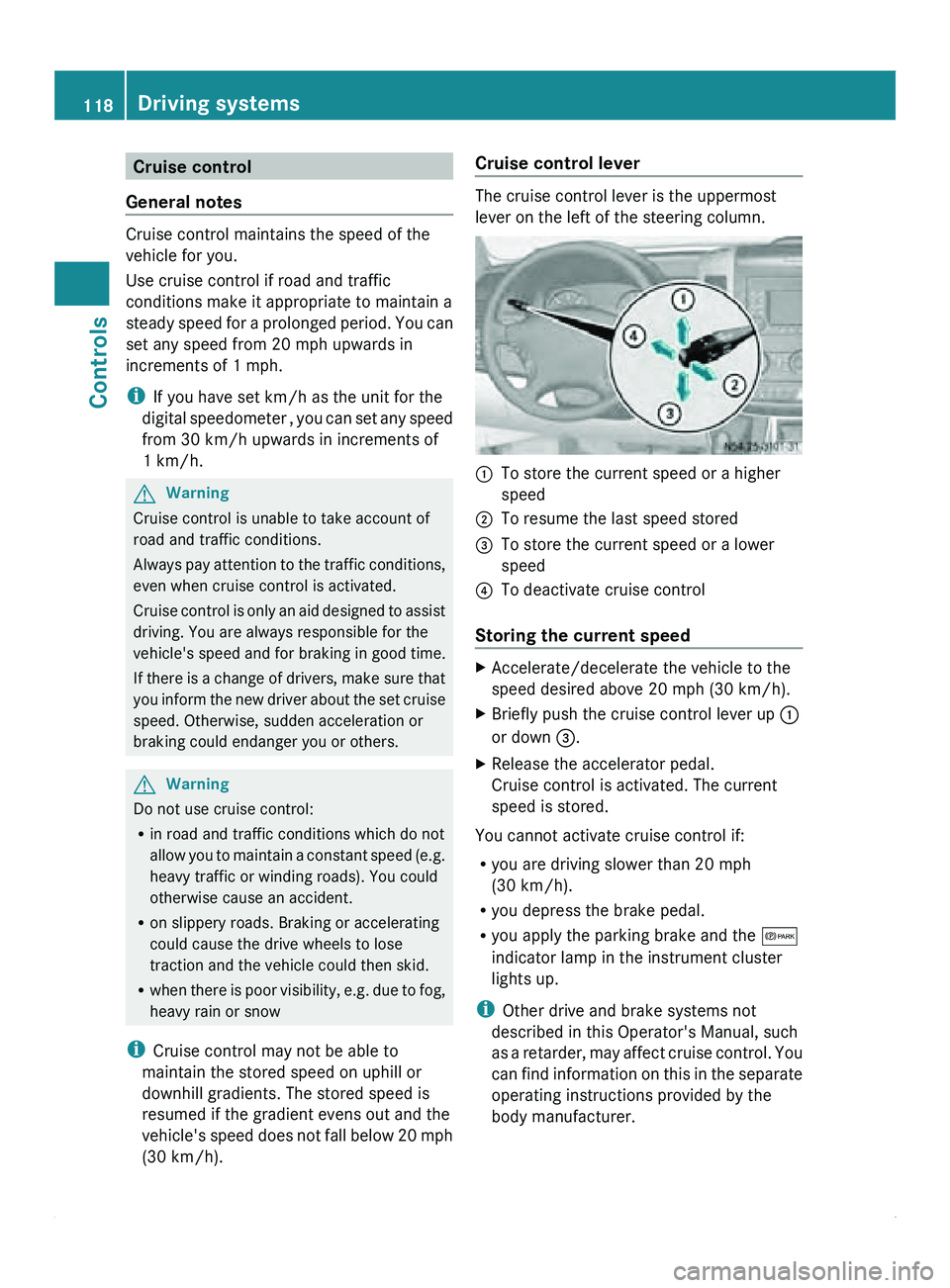
(30 km/h). Cruise control lever The cruise control lever is the uppermost
lever on the left of the steering column.
0046
To store the current speed or a higher
speed
0047 To resume the last speed stored
008A To store the current speed or a lower
speed
0088 To deactivate cruise control
Storing the current speed X
Accelerate/decelerate the vehicle to the
speed desired above 20 mph
(30 km/h).
X Briefly push the cruise control lever up 0046
or down 008A
.
X Release the accelerator pedal.
Cruise control is activated. The current
speed is stored.
You cannot activate cruise control if:
R you are driving slower than 20 mph
(30 km/h).
R you depress the brake pedal.
R you apply the parking brake and the 0066
indicator lamp in the instrument cluster
lights up.
i Other drive and brake systems not
described in this Operator's Manual, such
as a
retarder,
may affect cruise control. You
can find information on this in the separate
operating instructions provided by the
body manufacturer. 118
Driving systems
Controls
Page 121 of 292
Resuming the stored speed
G
Warning
Only select a stored speed if you know what
that speed is
and whether it is suitable for the
current driving and traffic situation. You can
otherwise endanger yourself and others by
unintentionally triggering sudden
acceleration or braking.
X Briefly pull the cruise control lever in the
direction of arrow 0047.
X Release the accelerator pedal.
Cruise control is
activated and resumes the
vehicle's speed to the last speed stored.
i When you first move the cruise control
lever in the direction of arrow 0047 after
starting the engine, cruise control is
activated and the current road speed is
stored.
Setting the speed G
Warning
The rate at which you increase the speed in
increments of 1 mph (1 km/h) may be faster
than your vehicle is able to accelerate. Your
vehicle may
then continue to accelerate up to
the newly set speed even after you have
released the cruise control lever.
Only increase the speed as the prevailing
conditions permit. Sudden acceleration could
otherwise endanger you and others.
X Briefly push the cruise control lever
upwards 0046 to increase the speed or
downwards 008A to reduce the speed.
The last speed stored is increased/
reduced in increments of 1 mph
(1 km/h
).
or
X Press and hold the cruise control lever
up 0046 or down 008A until the desired speed
has been reached.
X Release the cruise control lever.
The current speed is stored. i
Cruise control is not deactivated if you
depress the accelerator pedal. If you
accelerate briefly, e.g. to overtake, and
then ease off the accelerator pedal again,
cruise control adjusts the vehicle's speed
to the last speed stored.
Deactivating cruise control There are various ways to deactivate cruise
control:
X
Briefly push the cruise control lever
forwards 0088.
or
X Apply the brakes.
The last speed set remains stored.
i The last speed set is deleted when you
switch off the engine.
i Cruise control is deactivated
automatically when:
R you apply the brakes.
R you apply the parking brake and the
0066 indicator lamp in the instrument
cluster lights up.
R you are driving slower than 20 mph
(30 km/h).
R ESP ®
or ASR intervenes.
R you shift the automatic transmission to
neutral position N while the vehicle is in
motion.
R there is a malfunction in the ESP ®
, ASR
or ABS system. PARKTRONIC
General notes G
Warning
PARKTRONIC is only an aid and may not
detect all obstacles. It is not a substitute for
attentive driving.
You are always responsible for safety and
must continue to pay attention to your Driving systems
119
Controls
Z
Page 124 of 292

Roll-back warning
PARKTRONIC automatically monitors the
area behind the vehicle if the vehicle begins
to roll backwards without reverse gear
engaged, e.g. after stopping on an uphill
gradient.
If PARKTRONIC recognizes an obstacle at a
distance of at most 31 in (80 cm), all the
segments in the warning display light up. A
continuous warning tone also sounds as the
vehicle approaches the obstacle and for a
further two seconds after the vehicle has
come to a halt.
Activating/deactivating PARKTRONIC You can activate/deactivate PARKTRONIC
manually.
X
Press button 0046.
If PARKTRONIC is deactivated, the
indicator lamp in the switch lights up.
Towing a trailer If your vehicle is equipped with the electric
wiring required for towing a trailer and you
attach a trailer, PARKTRONIC is deactivated
for the rear area as soon as you have
established an
electrical
connection between
your vehicle and the trailer. If you use an
adapter for the socket, remove it from the
socket after detaching the trailer. Otherwise,
PARKTRONIC remains deactivated for the
rear area.
If the trailer coupling is detachable, remove it
when it is no longer required. PARKTRONIC measures the minimum detection range to an
obstacle from the bumper, not the ball
coupling.
Rear view camera
The rear view camera is a visual parking aid.
It shows you
the area behind the vehicle on a
separate monitor on the center console.
The rear view camera is activated when you
engage reverse gear.
The camera is in the middle of the roof above
the high-mounted brake lamp ( Y page 163). 0046
Monitor for rear view camera G
Warning
The rear-view camera is only a driving aid and
may display obstacles as foreshortened,
incorrectly or not
at all. It cannot replace your
attentiveness.
The rear-view camera cannot display all
objects located very near and/or under the
rear bumper. It does not warn you of a
collision, persons or objects.
You are responsible for safety at all times and
must continue to pay attention to your
immediate surroundings during parking and
maneuvering. This applies not only to the area
behind, but also to the area in front of and
beside your vehicle.
You may otherwise not recognize people or
objects, if any, and by driving onwards, injure
people or damage objects and the vehicle. We
recommend also using PARKTRONIC at all
times during parking. 122
Driving systems
Controls
Page 192 of 292
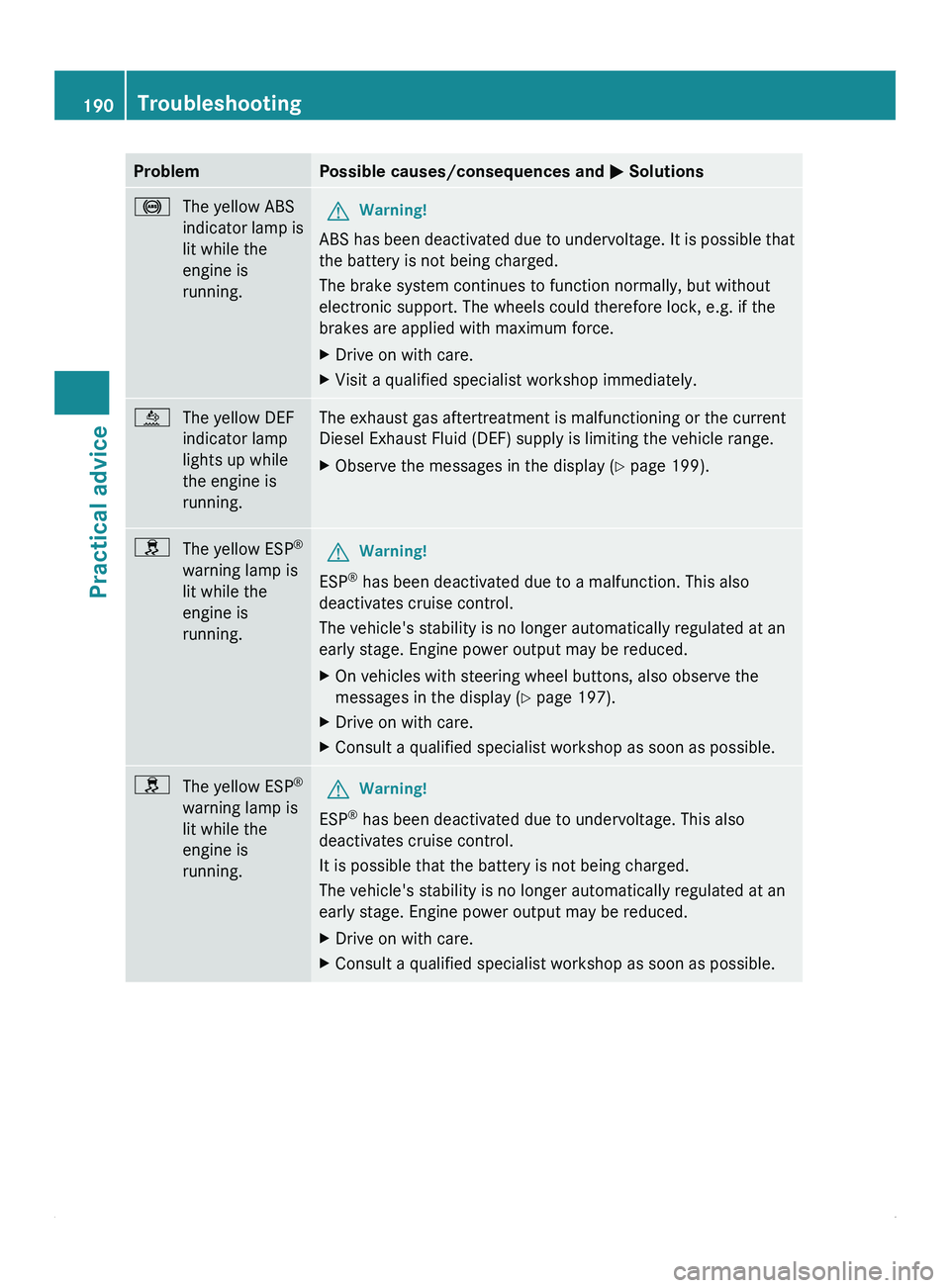
Problem Possible causes/consequences and
0050 Solutions0031
The yellow ABS
indicator lamp is
lit while the
engine is
running. G
Warning!
ABS has been deactivated due to undervoltage. It is possible that
the battery is not being charged.
The brake system continues to function normally, but without
electronic support. The wheels could therefore lock, e.g. if the
brakes are applied with maximum force.
X Drive on with care.
X Visit a qualified specialist workshop immediately. 00E4
The yellow DEF
indicator lamp
lights up while
the engine is
running. The exhaust gas aftertreatment is malfunctioning or the current
Diesel Exhaust Fluid (DEF) supply is limiting the vehicle range.
X
Observe the messages in the display ( Y page 199).009E
The yellow ESP ®
warning lamp is
lit while the
engine is
running. G
Warning!
ESP ®
has been deactivated due to a malfunction. This also
deactivates cruise control.
The vehicle's stability is no longer automatically regulated at an
early stage. Engine power output may be reduced.
X On vehicles with steering wheel buttons, also observe the
messages in the display ( Y page 197).
X Drive on with care.
X Consult a qualified specialist workshop as soon as possible. 009E
The yellow ESP ®
warning lamp is
lit while the
engine is
running. G
Warning!
ESP ®
has been deactivated due to undervoltage. This also
deactivates cruise control.
It is possible that the battery is not being charged.
The vehicle's stability is no longer automatically regulated at an
early stage. Engine power output may be reduced.
X Drive on with care.
X Consult a qualified specialist workshop as soon as possible.190
TroubleshootingPractical advice
Page 193 of 292

Problem Possible causes/consequences and
0050 Solutions008A
The red SRS
indicator lamp
does not go out
approximately
four seconds
after switching
on the ignition,
or lights up
again. G
Warning!
The restraint systems have malfunctioned. The air bags or belt
tensioners could be triggered unintentionally or might not be
triggered at all in the event of an accident.
X Drive on with care.
X Visit a qualified specialist workshop immediately. 003F
The red battery
charge indicator
lamp lights up
while the engine
is running. G
Warning!
The battery is not being charged. Possible causes are a defective
alternator or a torn poly-V-belt.
X Stop the vehicle as soon as possible, paying attention to road
and traffic conditions.
X Check the poly-V-belt.
If it is torn: do not drive on. Consult the nearest qualified
specialist workshop.
If it is not damaged: have the vehicle checked at a qualified
specialist workshop. 003F
The red battery
charge indicator
lamp lights up
while the engine
is running. G
Warning!
The battery is faulty.
X Stop the vehicle as soon as possible, paying attention to road
and traffic conditions.
X Do not continue driving under any circumstances.
X Contact a breakdown service, e.g. an authorized Sprinter
Dealer. 0026
The yellow brake
pad wear
indicator lamp
lights up after
the engine is
started or while
the vehicle is in
motion. G
Warning!
The brake pads/linings have reached their wear limit.
X Have the brake pads/linings replaced as soon as possible at a
qualified specialist workshop. Troubleshooting
191Practical advice Z
Page 194 of 292

Problem Possible causes/consequences and
0050 Solutions00B4
The yellow
engine oil level
warning lamp
lights up after
the engine is
started or while
the vehicle is in
motion. The oil level has dropped to the minimum level.
X
Check the engine oil level and top up at the nearest gas station
(Y page 171).
X If there is visible oil loss from the engine, have the malfunction
rectified immediately at a qualified specialist workshop. 00B4
The yellow
engine oil level
warning lamp
flashes, the
-2.0 qts
(Canada: –2.0
ltr) engine oil
level message,
for example,
appears in the
display and the
warning buzzer
sounds after the
engine is started
or while the
vehicle is in
motion. There is not enough or no oil in the engine.
There is a danger of engine damage.
X
Stop the vehicle as soon as possible, paying attention to road
and traffic conditions.
X Check the oil level using the oil dipstick ( Y page 172).
If the engine oil level is correct: have the malfunction rectified
immediately at a qualified specialist workshop.
If the engine oil level is too low: have the vehicle towed to a
qualified specialist workshop. 00B4
The yellow
engine oil level
warning lamp
lights up, the HI
engine oil level
message, for
example,
appears in the
display and the
warning buzzer
sounds after the
engine is
started
or while the
vehicle is in
motion. The engine oil level is above the maximum level.
X
Check the oil level. If the oil level is too high, have engine oil
siphoned off at the nearest gas station (Y page 173).
You could otherwise damage the engine or the catalytic
converter.
If the oil
level is correct, have the malfunction rectified as soon
as possible at a qualified specialist workshop. 192
Troubleshooting
Practical advice
Page 195 of 292

Problem Possible causes/consequences and
0050 Solutions00B4
The yellow
engine oil level
warning lamp
lights up
repeatedly while
the vehicle is in
motion. There is a malfunction in the engine oil level display.
X
Have the vehicle checked immediately at a qualified specialist
workshop. 0041
The yellow
coolant level
warning lamp
lights up while
the engine is
running. The coolant level is too low.
Never run the engine if the coolant level is too low. The engine
could overheat and be damaged.
X
Stop the vehicle as soon as possible, paying attention to road
and traffic conditions.
X Switch off the engine and let it cool down.
X Add coolant and be sure to observe the warning notes
(Y page 169).
X If you need to add coolant frequently, have the cooling system
checked at a qualified specialist workshop. 00AE
The red coolant
warning lamp
lights up while
the engine is
running. The coolant temperature is too high.
X
Stop the vehicle as soon as possible, paying attention to road
and traffic conditions.
X Consult a qualified specialist workshop. 00AE
The red coolant
warning lamp
lights up while
the engine is
running. The coolant temperature is too high.
If the vehicle is stopped after being subjected to extreme loads
(e.g. driving in mountainous terrain, trailer towing), the coolant
warning lamp may
light up when the ignition is switched on or the
engine is restarted.
X Run the engine for approximately one minute at idling speed.
X Consult a qualified specialist workshop if the coolant warning
lamp remains lit. 00B7
0080
The yellow
reserve fuel
warning lamp
lights up while
driving. The fuel level has fallen into the reserve range.
X
Refuel at the nearest gas station ( Y page 142). Troubleshooting
193
Practical advice Z