2012 MERCEDES-BENZ SLK350 sport
[x] Cancel search: sportPage 17 of 334

Notes
............................................. 264
Service messages ..........................264
Service menu (on-board computer) .191
Service products Brake fluid ..................................... 327
Coolant (engine) ............................ 327
Engine oil ....................................... 326
Fuel ................................................ 325
Important safety notes ..................324
Washer fluid .................................. .328
Settings
Factory (on-board computer) .........195
On-board computer .......................191
Setting the air distribution ...............123
Setting the airflow ............................123
SETUP (on-board computer) .............196
Side impact air bag .............................40
Side marker lamp (display
message) ............................................ 215
Side windows Convenience closing feature ............81
Important safety information ...........80
Opening/closing (all) .......................80
Opening/closing (front) ...................80
Problem (malfunction) .....................82
Resetting ......................................... 82
SmartKey
Changing the battery .......................71
Changing the programming .............70
Checking the battery .......................71
Convenience opening feature ..........81
Display message ............................ 226
Door central locking/unlocking .......68
Important safety notes ....................68
Loss ................................................. 73
Mechanical key ................................ 70
Opening/closing the roof ................84
Positions (ignition lock) .................131
Problem (malfunction) .....................73
Starting the engine ........................133
Snow chains ...................................... 297
Sockets Center console .............................. 248
Points to observe before use .........247
Under the armrest .........................248
Spare wheel
Notes/data .................................... 318Storage location
............................ 274
Stowing .......................................... 275
see Emergency spare wheel
Specialist workshop ............................ 23
Speed, controlling see Cruise control
Speedometer
Activating/deactivating the
additional speedometer .................192
Digita l............................................ 186
In the Instrument cluster .................27
Segments ...................................... 181
Selecting the unit of
measurement ................................ 191
see Instrument cluster
SPORT handling mode
Activating/deactivating (AMG
vehicles) .......................................... 60
Warning lamp ................................. 232
SRS (Supplemental Restraint
System)
Display message ............................ 208
Introduction ..................................... 36
Warning lamp ................................. 233
Warning lamp (function) ................... 36
Standing lamps
Changing bulbs .............................. 112
Display message ............................ 215
Switching on/off ........................... 104
Starting (engine) ................................ 132
Station see Radio
Steering (display message) ..............225
Steering wheel Adjusting (electrically). ....................97
Adjusting (manually). .......................97
Button overview ............................... 29
Buttons (on-board
computer) ...................................... 181
Cleaning ......................................... 270
Important safety notes ....................96
Paddle shifters ............................... 142
Storing settings (memory
function) ........................................ 100
Steering wheel paddle shifters ........142
Stopwatch (RACETIMER) ................... 196
Stowage areas ................................... 242 Index
15
Page 19 of 334
Distributio
nofthe vehicle
occupants (definition) ....................315
DOT, Tire Identification Number
(TIN) .............................................. .311
DOT (Department of
Transportation) (definition) ............312
GAWR (Gross Axle Weight Rating)
(definition) ..................................... 313
GVW (Gross Vehicle Weight)
(definition) ..................................... 313
GVWR (Gross Vehicle Weight
Rating) (definition) .........................313
Important safety notes ..................294
Increased vehicle weight due to
optional equipment (definition) ......313
Kilopascal (kPa) (definition) ...........314
Labeling (overview )........................ 309
Load bearing index (definition) ......315
Load index ..................................... 311
Load index (definition) ...................314
Maximum loaded vehicle weight
(definition) ..................................... 313
Maximum load on a tire
(definition) ..................................... 314
Maximum permissible tire
pressure (definition) ....................... 314
Maximum tire loa d......................... 307
Maximum tire load (definition) .......314
Optional equipment weight
(definition) ..................................... 314
PSI (pounds per square inch)
(definition) ..................................... 314
Replacing ....................................... 315
Service life ..................................... 295
Sidewall (definition) .......................314
Speed rating (definition) ................313
Storing ........................................... 316
Structure and characteristics
(definition) ..................................... 312
Temperature .................................. 308
TIN (Tire Identification Number)
(definition) ..................................... 315
Tire bea d(definition) ...................... 314
Tire pressure (definition) ................314
Tire pressures (recommended )...... 313
Tire size (data) ............................... 316
Tire size designation, load-bearing
capacity, speed rating .................... 309 Tire tread
....................................... 295
Tire tread (definition) .....................314
Total load limit (definition) .............315
Traction ......................................... 308
Traction (definition) .......................315
Trea dwear ..................................... 308
Uniform Tire Quality Grading
Standard s...................................... 307
Uniform Tire Quality Grading
Standard s(definition) .................... 313
Unladen weight (definition) ............314
Wea rindicato r(definition) .............315
Whee lrim (definition ).................... 313
see Flat tire
Towing
Important safety guidelines ...........287
Installing the towing eye ................287
Removing the towing eye. ..............288
With the rear axle raised ................288
Towing away
With both axles on the ground .......288
Tow-starting
Emergency engine starting ............289
Important safety notes ..................287
Installing the towing eye ................287
Removing the towing eye. ..............288
Transmission
see Automatic transmission
see Manual transmission
Transporting the vehicle ..................289
Trim pieces (cleaning instructions) .270
Trip computer (on-board
computer) .......................................... 185
Trip meter see Trip odometer
Trip odometer
Calling up ....................................... 185
Resetting (on-board computer) ......186
Trunk
Emergency release ..........................79
Important safety notes ....................77
Locking separatel y........................... 78
Opening (automatically from
outside) ............................................ 78
Trunk lid
Display message ............................ 224
Opening/closing .............................. 77 Index
17
Page 20 of 334

Trunk partition
Display message ............................ 225
General notes .................................. 85
Opening/closing .............................. 85
Turn signals
Changing bulbs (front) ...................112
Display message ............................ 213
Switching on/off ........................... 107
Type identification plate
see Vehicle identification plate U
Unlocking Emergency unlocking .......................76
From inside the vehicle (central
unlocking button) ............................. 75V
Vanity mirror (in the sun visor) ........246
Vehicle Correct use ...................................... 23
Data acquisition ............................... 24
Display message ............................ 224
Emergency unlocking .......................76
Equipment ....................................... 20
Individua lsettings .......................... 191
Limited Warranty ............................. 24
Loading .......................................... 304
Locking (in an emergency) ...............76
Locking (SmartKey) .......................... 68
Lowering ........................................ 281
Maintenance .................................... 21
Parking for a long period ................ 151
Pulling away ................................... 133
Raising ........................................... 277
Reporting problems .........................23
Towing away .................................. 287
Tow-starting ................................... 287
Transporting .................................. 289
Unlocking (in an emergency) ...........76
Unlocking (SmartKey) ......................68
Vehicle data ................................... 329
Vehicle battery
see Battery (vehicle)
Vehicle data ....................................... 329
Vehicle dimensions ...........................329Vehicle emergency locking
................76
Vehicle identification number see VIN
Vehicle identification plate ..............323
Vehicle tool kit .................................. 274
Video (DVD) ........................................ 189
VIN ...................................................... 323 W
Warning and indicator lamps ABS ................................................ 230
Brakes ........................................... 229
Check Engine ................................. 234
Coolant .......................................... 235
Distance warning ........................... 237
DISTRONI CPLUS ........................... 237
ESP ®
.............................................. 231
ESP ®
OFF ....................................... 232
Fuel tank ........................................ 234
Overview .......................................... 28
PASSENGER AIR BAG OFF
indicator lamp .................................. 42
Reserve fuel ................................... 234
Seat bel t........................................ 228
SPORT handling mode ...................232
SRS ................................................ 233
Tire pressure monitor ....................238
Warranty ............................................ 323
Washer fluid Display message ............................ 226
Wheel bol ttightening torque ...........281
Wheel chock ...................................... 276
Wheels Changing awheel .......................... 276
Checking ........................................ 295
Cleaning ......................................... 266
Important safety notes ..................294
Interchanging/changing ................315
Mounting anew wheel ................... 279
Removing awheel .......................... 279
Storing ........................................... 316
Tightening torque ........................... 281
Whee lsize/tir esize ....................... 316
Windows
Cleaning ......................................... 268
see Side windows 18
Index
Page 30 of 334

Warning and indicator lamps
Function Page
0002
0009
Low-beam
headlamps 105
0003
0008
High-beam
headlamps 107
0023
000B
ESP® 231
0022
Electric parking brake (red) 229
0005
(USA only) 000A
(Canada only) 0020
000A
Electric parking brake
(yellow) 229
0021
000C
Distance warning 237
0014
00070006
Turn signals 107
0015
0015
Tire pressure monitor 238
0016
0019
SRS 233 Function Page
0017
001A
Seat belt 228
0018
0002
SPORT handling
mode in AMG vehicles 232
0019
000C
Coolant 235
001A
000C
Rearfog lamp 106
001B
000A
Front fog lamps 106
001C
000E
Engine Check 234
001E
0010
Reserve fuel 234
001F
0012
ESP®
OFF 231
0025
0014
ABS 230
0026
Brakes 229
000D
(USA only) 0006
(Canada only) 28
Instrument clusterAt a glance
Page 32 of 334
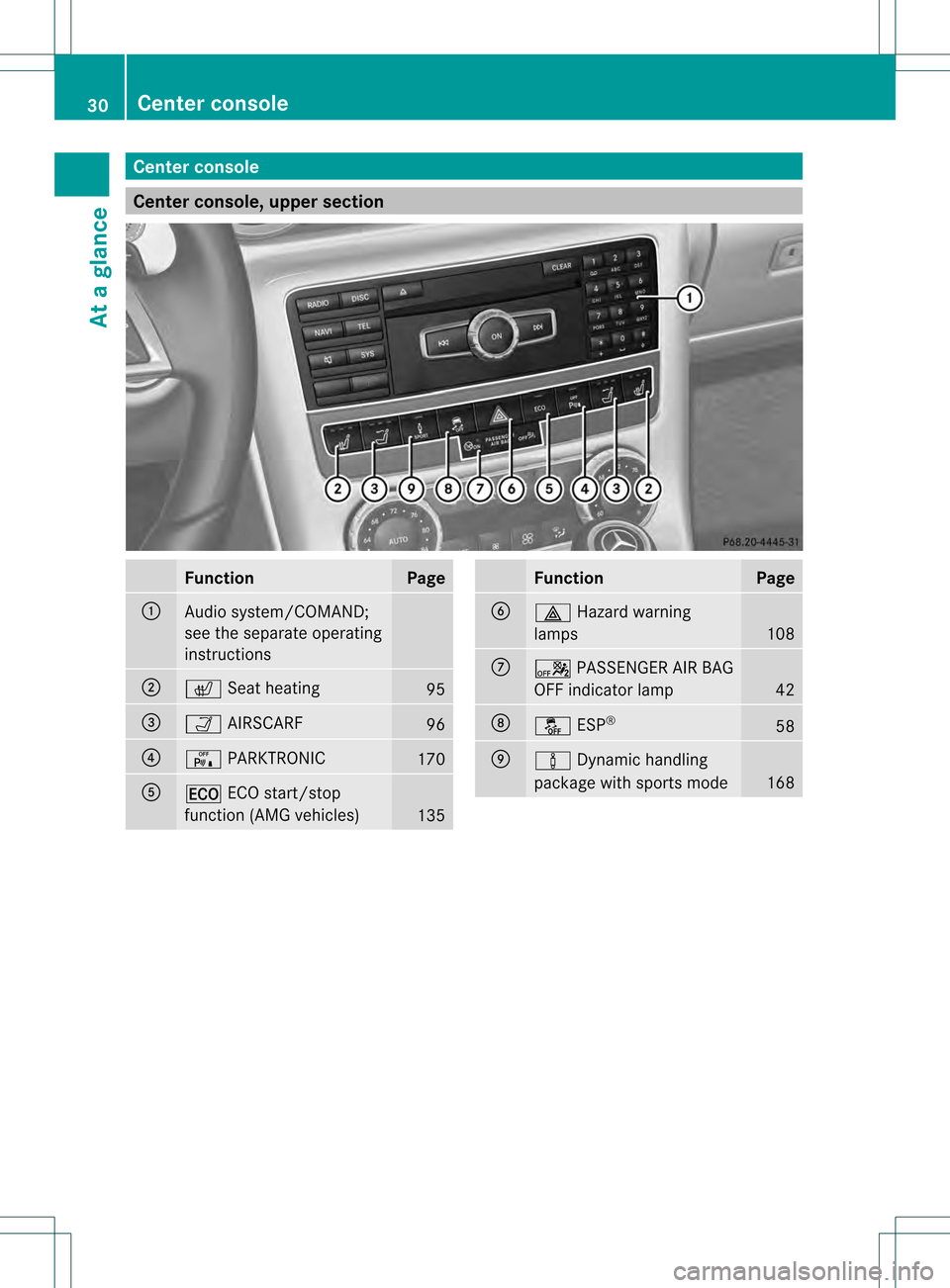
Center console
Center console, upper section
Function Page
0002
Audio system/COMAND;
see the separate operating
instructions
0003
000E
Seat heating 95
0023
0002
AIRSCARF 96
0022
0006
PARKTRONIC 170
0020
000E
ECO start/stop
function (AMG vehicles) 135 Function Page
0021
0016
Hazard warning
lamps 108
0014
0005
PASSENGER AI RBAG
OFF indicator lamp 42
0015
0012
ESP® 58
0016
000B
Dynamic handling
package with sports mode 16830
Cente
rconsoleAt a glance
Page 48 of 334
Problems with the Occupant Classification System
Problem Possible causes/consequences and
0001 Solutions
The
00030005
indicator lamp
illuminates and
remains illuminated.
The person on the
front-passenger seat:
R has the weight of a
typical adult
R has been determined
by the system not to
be a child The OCS is malfunctioning.
X
Have the OCS checked as soon as possible at an authorized
Mercedes-Benz Center.
X Observe the additional display messages in the multifunction
display (Y page 211). G
WARNING
If the 0015 PASSENGER AIR BAG OFF indicator lamp illuminates and remains illuminated when
the weight of a typical adult or an individual that is the size of a typical adult has been detected
on the front-passenger seat, do not allow any occupant to use the front-passenger seat until the
system has been repaired. Problem Possible causes/consequences and
0001 Solutions
The
00030005
indicator lamp does not
illuminate and/or does
not remain illuminated.
The front-passenger
seat is:
R unoccupied
R occupied with a
weight up to that of a
typical twelve-
month-old child in a
standard child
restraint system The OCS is malfunctioning.
X
Make sure there is nothing between the seat cushion and the
child seat.
X Check the installation of the child restraint system.
X Make sure that no objectsa re applying additional weight onto
the seat.
X If the 00030005 indicator lamp does not illuminate, have the
OCS checked as soon as possible at an authorized Mercedes-
Benz Center. Do not transport a child on the front-passenger
seat as long as the OCS is not functioning.
X Observe the additional display messages in the multifunction
display (Y page 211). G
WARNING
If the 0015 PASSENGER AIR BAG OFF indicator lamp does not illuminate or remains out with the
weight of a typical 12-month-old child in a standard child restraint or less, or is unoccupied, on
the front-passenge rseat, do not transport a child on the front-passenger seat until the system
has been repaired. 46
Occupant safetySafety
Page 55 of 334
Children in the vehicle
Child restraint systems
Important safety notes We recommend that all infants and children
be properly secured in an infant or child
restraint system at all times while the vehicle
is in motion.
The use of seat belts and infant and child
restraint systems is required by law in all 50
states, the District of Columbia, the U.S.
territories and all Canadian provinces.
Infants and childre nmust always be seated in
an appropriate infant or child restraint system
recommended for the size and weigh tofthe
child. The infant or child restraint system
must be properly secured with a three-point
seat belt in accordance with the
manufacturer's instructions. All infant or
child restraint systems must comply with U.S.
Federal Motor Vehicle Safety Standards 213
and 225 and CanadianM otor Vehicle Safety
Standards 213 and 210.2.
An information label on the child restraint
system indicates whether it meets these
standards. This information is also provided
in the installation instructions supplied with
the child restraint system.
Always read and follow the manufacturer's
instructions when using an infant or child
restraint system or booster seat.
Observe all warning signs in the vehicle
interior and on the infant or child restraint. G
WARNING
Children 12 years old and under must be
seated and properly secured in an appropriate
infant restraint, toddler restraint, or booster
seat recommended for the size and weight of
the child.
The infant or child restraint system must be
correctly secured using the vehicle's seat belt
in complete accordance with the child seat
manufacturer's instructions.
Occupants, in particular children, must sit as
upright as possible, fasten the seat belt correctly and use a suitable infant restraint
system, child restraint system or booster seat
suitable for the size and weight of the child.
Children can be seriously or even fatally
injured by an air bag deploying. Observe the
following information:
R
Your vehicle is equipped with air bag
technology designed to deactivate the
front-passenger front air bag in your vehicle
when the system senses the weight of a
typical 12-month-old child or less along
with the weight of a standard appropriate
child restraint on the passenger seat.
R Ac hild in a rearward-facing child restraint
system on the front-passenger seat could
be seriously injured or even killed if the
front-passenger air bag inflates in a
collision despite the air bag technology
installed in your vehicle, which could occur
under some circumstances.
R If you install a rearward-facing child
restraint on the front-passenger seat, make
sure that the 0015PASSENGER AIR BAG
OFF indicator lamp is illuminated,
indicating that the front-passenger front air
bag is deactivated. Should the 0015
PASSENGER AIR BAG OFF indicator lamp
not illuminate or go out while a rearward-
facing child restraint system is installed,
please check installation. Periodically
check the 0015PASSENGER AIR BAG OFF
indicator lamp while driving to make sure it
is illuminated. If the 0015PASSENGER AIR
BAG OFF indicator lamp goes out or
remains out, do not transport a child on the
front-passenger seat.
R Ac hild in a rearward-facing child restraint
system on the front-passenger seat can be
seriously injured or even killed if the front-
passenger air bag is deployed. Children in the vehicle
53Safety
Z
Page 62 of 334
X
To switch off: press button0002.
The 0012 ESP®
OFF warning lamp in the
instrument cluster lights up. G
WARNING
Whe nthe 0012 ESP®
OFF warning lamp is lit,
ESP ®
is deactivated.
If the 000B ESP®
warning lamp and the
0012 ESP®
OFF warning lamp remain lit,
ESP ®
is not available due to amalfunction.
When ESP ®
is deactivated or no toperational,
vehicle stability in standard driving
maneuvers is reduced.
Adapt your speed and driving to the prevailing
road conditions and to the non-operating
status of the ESP ®
.
! Avoid spinning the driven wheels for an
extended period with ESP ®
deactivated.
You could otherwise damage the drivetrain.
X To switch on: press button0002.
The 0012 ESP®
OFF warning lamp in the
instrument cluster goes out.
Deactivating/activating ESP ®
(AMG
vehicles) Activating/deactivating SPORT handling
mode
G
WARNING
The SPORT handling mode should not be
switched on during normal driving.
Switching on the SPORT handling mode will
result in the following:
R no restriction to the engine torque
R system supported traction control is
limited
The SPORT handling mode is designed for
driving on closed tracks when the vehicle's
own natural oversteer and understeer
characteristics are desired and requires a
highly skilled and experienced driver able to
handle these critical driving situations. You could lose control of your vehicle and
cause an accident.
Please be aware of these limits when you
switch on the SPORT handling mode.
Do not switch on the SPORT handling when a
spare wheel is mounted.
ESP ®
is activated automatically when the
engine is started.
i Vehicles with ECO start/stop function:
the ECO start/stop function switches the
engine off automatically when the vehicle
comes to a stop. The engine starts
automatically when the driver wants to pull
away again. ESP ®
remains in its previously
selected status. Example: if ESP ®
was
deactivated before the engin ewas
switched off, ESP ®
remains deactivated
when the engine is switched on again.
It may be best to activate SPORT handling
mode in the following situations:
R when using snow chains
R in deep snow
R on sand or gravel G
WARNING
Switch off the SPORT handling mode and
switch on the ESP ®
immediately if the
aforementioned circumstances do no tapply
anymore. Otherwise the SPORT handling
mode will only stabilize the vehicle to a limited
extent when it is starting to skid or a wheel is
spinning.
When SPORT handling mode is activated:
R ESP ®
only improves driving stability to a
limited degree.
R engine torque is only restricted to a limited
degree, and the drive wheels are able to
spin. The spinning wheels produce a
cutting effect for better traction.
R traction control is still activated.
R ESP ®
still provides support when you brake
firmly. 60
Driving safet
ysystemsSafety