2012 MERCEDES-BENZ SLK250 windshield
[x] Cancel search: windshieldPage 138 of 334
the accelerator pedal, the engine starts
automatically and the braking effect of the
HOL
Dfunction is deactivated. Depress the
accelerato rpedal carefully, as the engine
must be started first.
i If you shift the transmission from Rto D,
the ECO start/stop function is available
again once the 000Esymbol reappears in
the multifunction display.
i Automatic engine switch-off can take
place a maximum of three times
consecutively. The automatic engine
switch-off is then available again after the
border of the ECO symbol appears in the
multifunction display.
Automatic engine start The engine starts automatically if:
R
you deactivate the ECO start/stop function
by pressing the ECO button.
R you switch to drive program Sor M.
R you depress the accelerator pedal.
R the vehicle starts to roll.
R the brake system requires this.
R the system detects moisture on the
windshield when the air-conditioning
system is switched on.
R the charge level of the battery is too low.
R the driver's seat belt is removed or the
driver's door is opened.
R you shift the transmission from position D
to R.
R you engage reverse gear R.
R you release the brakes when in
transmission position Dor Nand when the
HOLD function is not active.
R you steer the vehicle.
i Shifting the transmission to position P
does not start the engine. Deactivating/activating the ECO start/
stop function
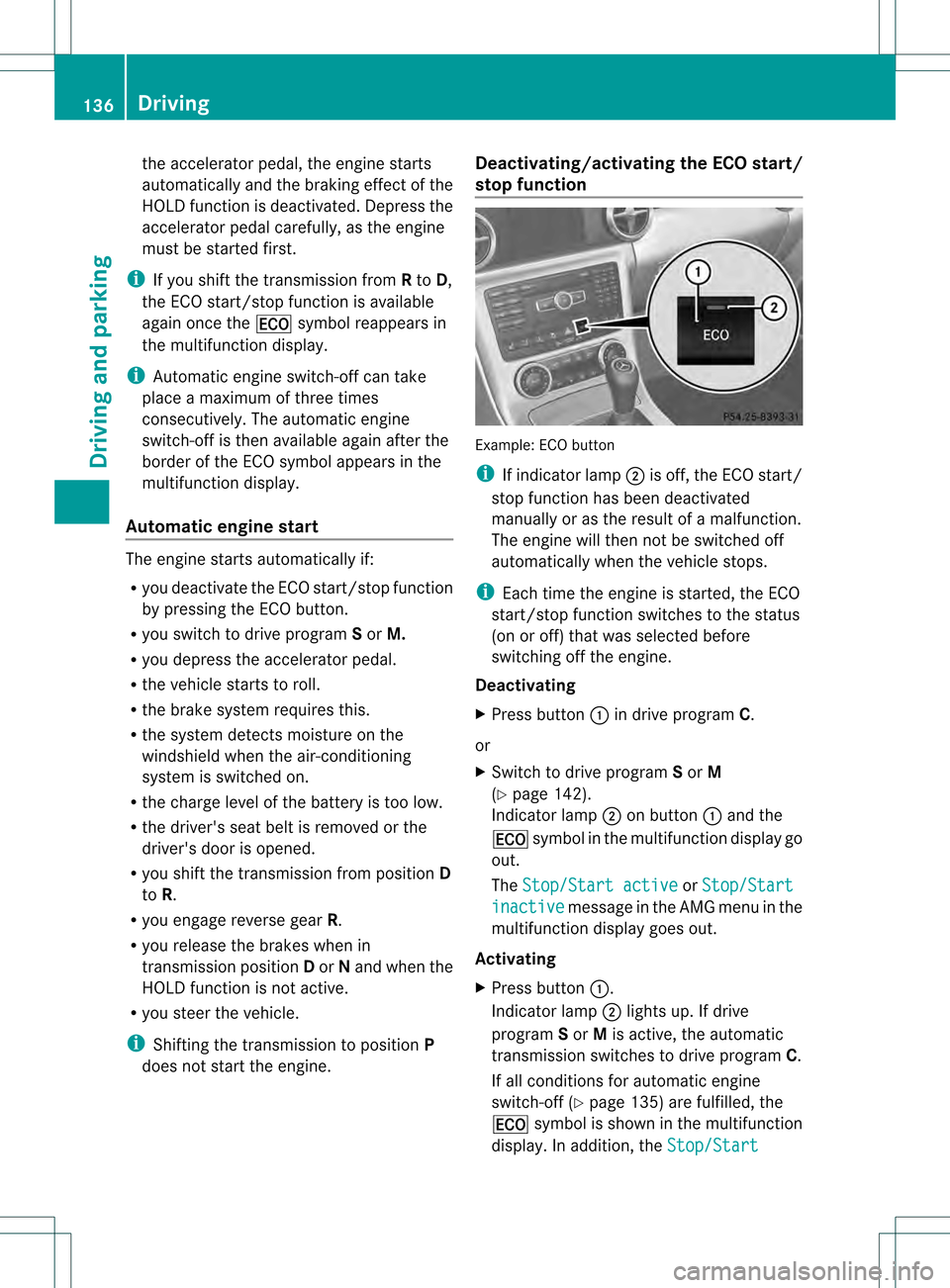
Example: ECO button
i
If indicator lamp 0003is off, the ECO start/
stop function has been deactivated
manually or as the result of a malfunction.
The engine will then not be switched off
automatically when the vehicle stops.
i Each time the engine is started, the ECO
start/stop function switches to the status
(on or off) that was selected before
switching off the engine.
Deactivating
X Press button 0002in drive program C.
or
X Switch to drive program Sor M
(Y page 142).
Indicator lamp 0003on button 0002and the
000E symbol in the multifunction display go
out.
The Stop/Start active or
Stop/Start inactive message in the AMG menu in the
multifunction display goes out.
Activating
X Press button 0002.
Indicator lamp 0003lights up. If drive
program Sor Mis active, the automatic
transmission switches to drive program C.
If all conditions for automatic engine
switch-off (Y page 135) are fulfilled, the
000E symbol is shown in the multifunction
display. In addition, the Stop/Start136
DrivingDriving and parking
Page 262 of 334

Useful information
i This Operator's Manual describes all
models and all standard and optional
equipment of your vehicle available at the
time of publication of the Operator's
Manual. Country-specific differences are
possible. Please note that your vehicle may
not be equipped with all features
described. This also applies to safety-
related systems and functions.
i Please read the information on qualified
specialist workshops (Y page 23).Engine compartment
Hood
Opening the hood G
WARNING
Do not pull the release lever while the vehicle
is in motion. Otherwise, the hood could be
forced open by passing air flow.
This could cause the hood to come loose and
injure you and/o rothers. G
WARNING
There is a ris kofinjury if the hood is open,
even if the engine is not running.
Some engine components can become very
hot.
To avoid the ris kofburns, only touch those
components described in th eOperator's
Manual and observe the relevant safety notes. G
WARNING
To avoid injury, stay clear of moving parts
when the hood is open and the engine is
running.
The radiator fan may continue to run for
approximately 30seconds or may even restart
after the engine has been switched off. For
this reason, you must not reach into the fan
rotation area. G
WARNING
The engine is equipped with a transistorized
ignition system. Because of the high voltage,
it is dangerous to touch any components
(ignition coils, spark plug sockets, diagnostic
socket) of the ignition system:
R with the engine running
R while starting the engine
R when the ignition is switched on and the
engine is turned manually
X Make sure that the windshield wipers are
switched off. G
WARNING
The windshield wipers and wiper linkage
could be set in motion.
When the hood is open, you or others could
be injured by the wiper linkage.
Make sure that the windshield wipers are
switched off. Remove the SmartKey or make
sure that no ignition position has been
selected with KEYLESS-GO. All indicator
lamps must be off in the instrument panel. X
Pull release lever 0002for the hood.
The hood is released.
! Make sure that the windshield wipers are
not folded away from the windshield. You
could otherwise damage the windshield
wipers or the hood. 260
Engine compartmentMaintenance and care
Page 265 of 334

R
using a rag, slowly tur nthe cap
approximately 1
/ 2 turn to relieve excess
pressure. If opened immediately, scalding
hot fluid and steam will be blown out under
pressure.
R do not spill antifreeze on hot engine parts.
Antifreeze contains ethylene glycol which
may burn if it comes into contact with hot
engine parts. X
Park the vehicle on a level surface.
Only check the coolant level when the
vehicle is on a level surface and the engine
has cooled down.
X Turn the SmartKey to position 2in the
ignition lock (Y page 131).
On vehicles with KEYLESS-GO, press the
Start/Stop button twice (Y page 131).
X Check the coolant temperature display in
the instrument cluster.
The coolant temperature must be below
158 ‡ (70 †).
X Turn the SmartKey to position
0(Y page 131) in the ignition lock.
X Slowly turn cap 0003half a turn counter-
clockwise to allow excess pressure to
escape.
X Turn cap 0003further counter-clockwise and
remove it.
If the coolant is at the level of marker bar
0023 in the filler neck when cold, there is
enough coolant in coolant expansion
tank 0002.
If the coolant level is approximately 0.6 in
(1.5 cm) above marker bar 0023in the filler neck when warm, there is enough coolant
in coolant expansion tank
0002.
X If necessary, add coolant that has been
tested and approved by Mercedes-Benz.
X Replace cap 0003and turn it clockwise as far
as it will go.
For further information on coolant, see
(Y page 327).
Adding washer fluid to the windshield
washer system/headlam pcleaning
system G
WARNING
Washer solvent/antifreeze is highly
flammable. Do not spill washer solvent/
antifreeze on hot engin eparts, because it may
ignite and burn .You could be seriously
burned. X
To open: pull cap0002upwards by the tab.
X Add the premixed washer fluid.
X To close: press cap 0002onto the filler neck
until it engages.
The washer fluid reservoir is used for both the
windshield washer system and the headlamp
cleaning system.
Further information on windshield washer
fluid/antifreeze (Y page 328).
Brake fluid level !
If the brake fluid level in the brake fluid
reservoir has fallen to the MIN mark or
below, check the brake system Engine compartment
263Maintenance and care Z
Page 268 of 334
cleaning agents. These cleaning agents can
damage the paintwork or plastic parts.
If the vehicle is very dirty, pre-wash it before
cleaning it in an automatic car wash.
! Make sure that the automatic
transmissio nis in position Nwhen washing
your vehicle in a tow-through car wash. The
vehicle could be damaged if the
transmission is in another position.
! Make sure that:
R the side windows and roof are
completely closed.
R the blower for the ventilation/heating is
switched off (OFF button is depressed/
airflow control is turned to position 0).
R the windshield wiper switch is at position
0.
The vehicle could otherwise be damaged.
After using an automatic car wash, wipe off
wax from the windshield and the wiper
blades. This will prevent smears and reduce
wiping noises caused by residue on the
windshield.
Washing by hand In some countries, washing by hand is only
allowed at specially equipped washing bays.
Observe the legal requirements in all
countries concerned.
X Do not use hot water and do not wash the
vehicle in direct sunlight.
X Use a soft sponge to clean.
X Use a mild cleaning agent, such as a car
shampoo approved by Mercedes-Benz.
X Thoroughly hose down the vehicle with a
gentle jet of water.
X Do not point the water jet directly towards
the air inlet.
X Use plenty of water and rinse out the
sponge frequently. X
Rinse the vehicle with clean water and dry
thoroughly with a chamois.
X Do not let the cleaning agent dry on the
paintwork.
When using the vehicle in winter, remove all
traces of road salt deposits carefully and as
soon as possible.
Powerw ashers G
WARNING
Do not use power washers with circular-jet
nozzles (dirt grinders) to clea nyour vehicle, in
particular the tires. You could otherwise
damage the tires and cause an accident.
! Always maintain a distance of at least
11.8 in (30 cm) between the vehicle and the
power washer nozzle. Information about
the correc tdistance is available fro mthe
equipment manufacturer.
Move the power washer nozzle around
when cleaning your vehicle.
Do not aim directly at any of the following:
R tires
R door gaps, roof gaps, joints, etc.
R electrical components
R battery
R connectors
R lights
R seals
R trim
R ventilation slots
Damaged seals or electrical components
can lead to leaks or failures.
! Do not use high-pressure cleaners if the
tank recess is open while you clean it. This
can cause damage to the seals or other
components.
Cleaning the wheels !
Do not use acidic wheel cleaning products
to remove brake dust. This could damage
wheel bolts and brake components. 266
CareMaintenance and care
Page 270 of 334
Cleaning the windows
G
WARNING
Before cleaning the windshield or wiper
blades, switch off the windshield wipers and
remove the SmartKey from the ignition lock.
On vehicles with KEYLESS-GO, press the
Start/Stop butto nrepeatedly until all
indicator lamps in the instrument cluster have
gone out. The windshield wipers could
otherwise move and injure you. G
WARNING
Do not clean the rear window with the
reatractable hardtop (vario-roof) in a position
other than the fully raised and closed position.
Otherwise, the retractable hardtop may move
unexpectedly which may result in personal
injury to you or others.
X Clean the inside and outside of the
windows with a damp cloth and a cleaning
agent that is recommended and approved
by Mercedes-Benz.
! Do not use dry cloths, abrasive products,
solvents or cleaning agents containing
solvents to clean the inside of the windows.
Do not touch the insides of the windows
with hard objects, e.g. an ice scraper or
ring. There is otherwise a risk of damaging
the windows.
! Clean the water drainage channels of the
windshield and the rear window at regular
intervals. Deposits such as leaves, petals
and pollen may under certain
circumstances prevent water from draining
away .This can lead to corrosion damage
and damage to electronic components.
Cleaning the wiper blades G
WARNING
Before cleaning the windshield or wiper
blades, switch off the windshield wipers and
remove the SmartKey from the ignition lock.
On vehicles with KEYLESS-GO, press the Start/Stop button repeatedly until all
indicator lamps in the instrumentc
luster have
gone out. The windshield wipers could
otherwise move and injure you.
! Do not pull the wiper blade. Otherwise,
the wiper blade could be damaged.
! Do not clean wiper blades too often and
do not rub the mtoo hard. Otherwise, the
graphite coating could be damaged. This
could cause wiper noise.
X Fold the wiper arms away from the
windshield.
X Carefully clean the wiper blades with a
damp cloth.
X Fold the windshield wipers back again
before switching on the ignition.
! Hold the wiper arm securely when folding
back. The windshield could be damaged if
the wiper arm smacks against it suddenly.
Cleaning the exterior lighting !
Only use cleaning agents or cleaning
cloths which are suitable for plastic light
lenses. Unsuitable cleaning agents or
cleaning cloths could scratch or damage
the plastic light lenses.
X Clean the plastic lenses of the exterior
lighting using a wet sponge and a mild
cleaning agent, e.g. Mercedes-Benz car
shampoo. Or clean the exterior lighting
with cleaning cloths.
Cleaning the mirror turns ignals !
Only use cleaning agents or cleaning
cloths that are suitable for plastic lenses.
Unsuitable cleaning agents or cleaning
cloths could scratch or damage the plastic
lenses of the mirror turn signals.
X Clean the plastic lenses of the mirror turn
signals using a wet sponge and a mild
cleaning agent, e.g. Mercedes-Ben zcar 268
CareMaintenance and care
Page 292 of 334

components on the circuit and thei
rfunctions
stop operating.
Blown fuses must be replace dwith fuses of
the same rating, which you can recognize by
the color and value. The fuse ratings are listed
in the fuse allocation chart.
If a newly inserted fuse also blows, have the
cause traced and rectified at a qualified
specialist workshop, e.g. an authorized
Mercedes-Ben zCenter.
! Only use fuses that have been approved
for Mercedes-Benzv ehicles and which
have the correct fuse rating for the system
concerned. Otherwise, components or
systems could be damaged. Before changing a fuse
X Park the vehicle and apply the electric
parking brake.
X Switch off all electrical consumers.
X Remove the SmartKey from the ignition
lock.
The fuses are located in various fuse boxes:
R fuse box in the engine compartment on the
left-hand side of the vehicle, when viewed
in the direction of travel
R fuse box in the trun kbehind the partition
trim
The fuse allocation chart is located in the
vehicle tool kit (Y page 274) in the stowage
compartment under the trunk floor. Fuse box in the engine compartment
X Make sure that the windshield wipers are
turned off. G
WARNING
Make sure that the windshield wipers are
switched off and that the SmartKey is
removed from the ignition lock before you
open the cover of the fuse box. Otherwise, the
windshield wipers and the wiper rods above the cover could be set in motion
.This could
lead to you or others being injured by the
wiper rods.
X Open the hood (Y page 260). X
Remove any existing moisture from the
fuse box using a dry cloth.
X To open: open clamps 0002.
X Remove fuse box cover 0003forwards.
! Make sure that no moisture can enter the
fuse box when the cover is open.
X To close: check whether the rubber seal is
lying correctly in cover 0003.
X Insert cover 0003at the rear of the fuse box
into the retainer.
X Fold down cover 0003and close clamps 0002.
! The cover must be seated properly,
otherwise moisture or dirt could impair the
function of the fuses.
X Close the hood (Y page 261). Fuse box in the trunk
The fuse box is located in the trunk behind the
partition covering.
X Open the trunk (Y page 77).290
FusesBreakdown assistance
Page 325 of 334
Warranty
The Service and Warranty Information
booklet contains detailed information about
the warranties covering you rvehicle.
Your authorized Mercedes-Benz Center will
exchange or repair any defective parts
originally installed in the vehicle in
accordance with the term softhe following
warranties:
R New Vehicle Limited Warranty
R Emission System Warranty
R Emission Performance Warranty
R California, Connecticut, Maine,
Massachusetts, New York, Pennsylvania,
Rhode Island and Vermont Emission
Control Systems Warranty
R State Warranty Enforcement Laws (Lemon
Laws)
Replacement parts and accessories are
covered by the Mercedes-Ben zParts and
Accessories warranties. You can obtain
informatio nabout this from any authorized
Mercedes-Benz Center.
i Should you lose your Service and
Warranty Information booklet, have an
authorized Mercedes-Benz Cente rarrange
for a replacement. It will be mailed to you. Identification plates
Vehicle identification plate with
vehicle identification number (VIN)
and paint code number X
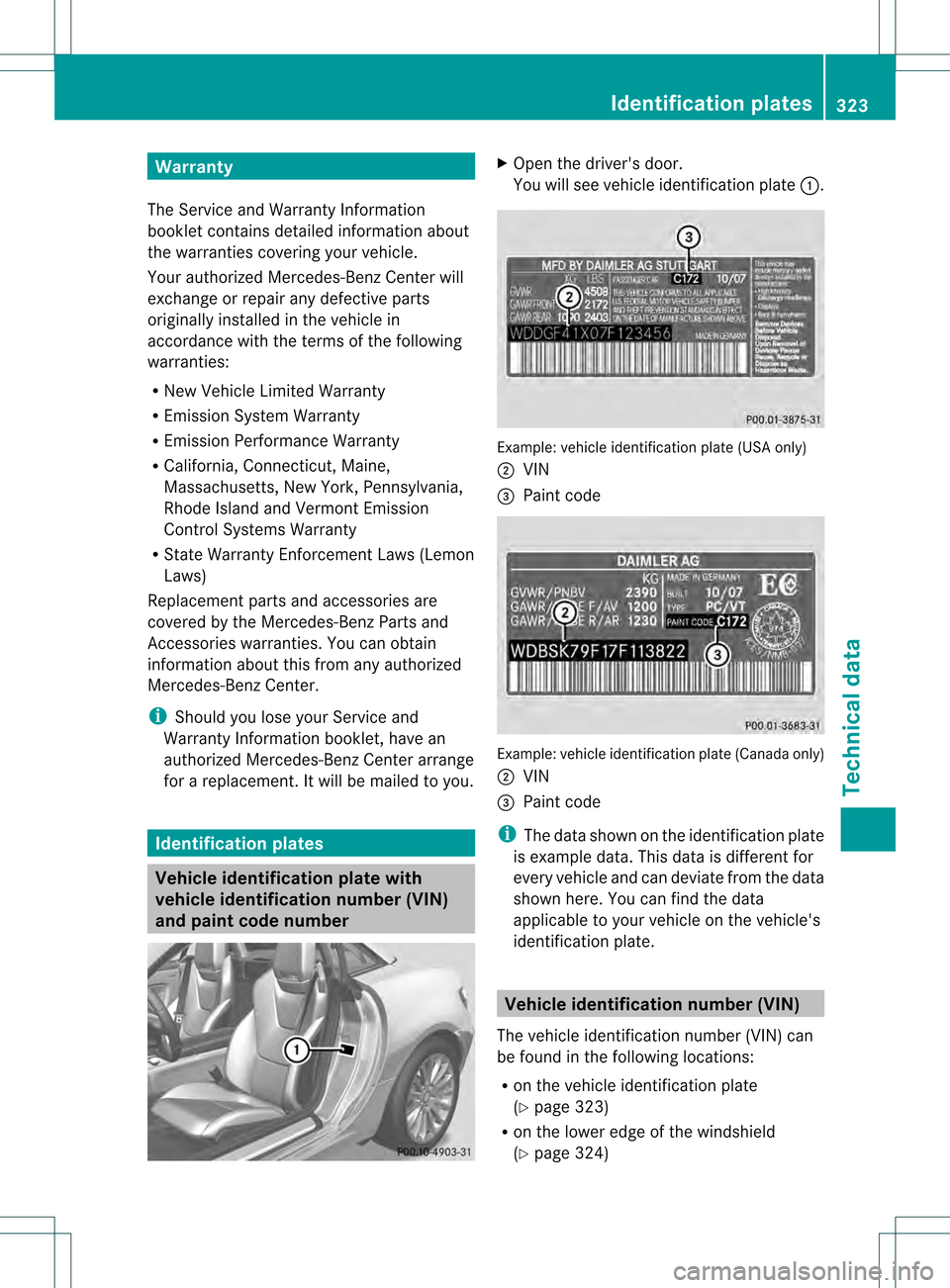
Open the driver's door.
You will see vehicle identification plate 0002. Example
:vehicle identification plate (USA only)
0003 VIN
0023 Paint code Example: vehicle identification plate (Canada only)
0003
VIN
0023 Paint code
i The data shown on the identification plate
is example data. This data is differen tfor
every vehicle and can deviate from the data
shown here. You can find the data
applicable to your vehicle on the vehicle's
identification plate. Vehicle identification number (VIN)
The vehicle identification number (VIN) can
be found in the following locations:
R on the vehicle identification plate
(Y page 323)
R on the lower edge of the windshield
(Y page 324) Identification plates
323Technical data Z
Page 326 of 334

In addition to being stamped on the vehicle
identification plate, the vehicle identification
number (VIN) is also stamped onto the vehicle
body.
It is located in the transmission tunnel on the
front-passenger side.
X
Slide the front-passenger seat to its
frontmost position.
X Fold trim 0002upwards.
You will see vehicle identification number
(VIN) 0003. Engine number
0002
Emission control information plate,
including the certification of both federal
and Californian emissions standards
0003 Engine number (stamped into the
crankcase)
0023 VIN (on the lowere dge of the windshield) Service products and filling
capacities
Important safety notes
G
WARNING
Comply with all valid regulations with respect
to handling, storing and disposing of service
fluids. Otherwise, you could endanger
persons or the environment.
Keep service fluids out of the reach of
children.
For health reasons, you should prevent
service fluids from coming into direct contact
with your skin or clothing.
If a service fluid is swallowed, contact a
physician immediately.
Service products include the following:
R fuels
R lubricants (e.g. engine oil, transmission oil)
R coolant
R brake fluid
R windshield washer fluid
R climate control system refrigerant
Vehicle components and their service
products must match. Therefore only use
products tested and approved by Mercedes-
Benz.
Information about tested and approved
products can be obtained from an authorized
Mercedes-Benz Center or on the Internet at
http://bevo.mercedes-benz.com.
You can recognize servic eproducts approved
by Mercedes-Benz by the following
inscription on the containers:
R MB-Freigabe (e.g. MB-Freigabe 229.51)
R MB Approval (e.g. MB Approval 229.51)
Other designations or recommendations
indicate a level of quality or a specificatio nin
accordance with an MB Sheet number (e.g.
MB 229.5). They have no tnecessarily been
approved by Mercedes-Benz. 324
Service products and filling capacitiesTechnical data