2012 MERCEDES-BENZ GLK-Class wheel size
[x] Cancel search: wheel sizePage 19 of 316
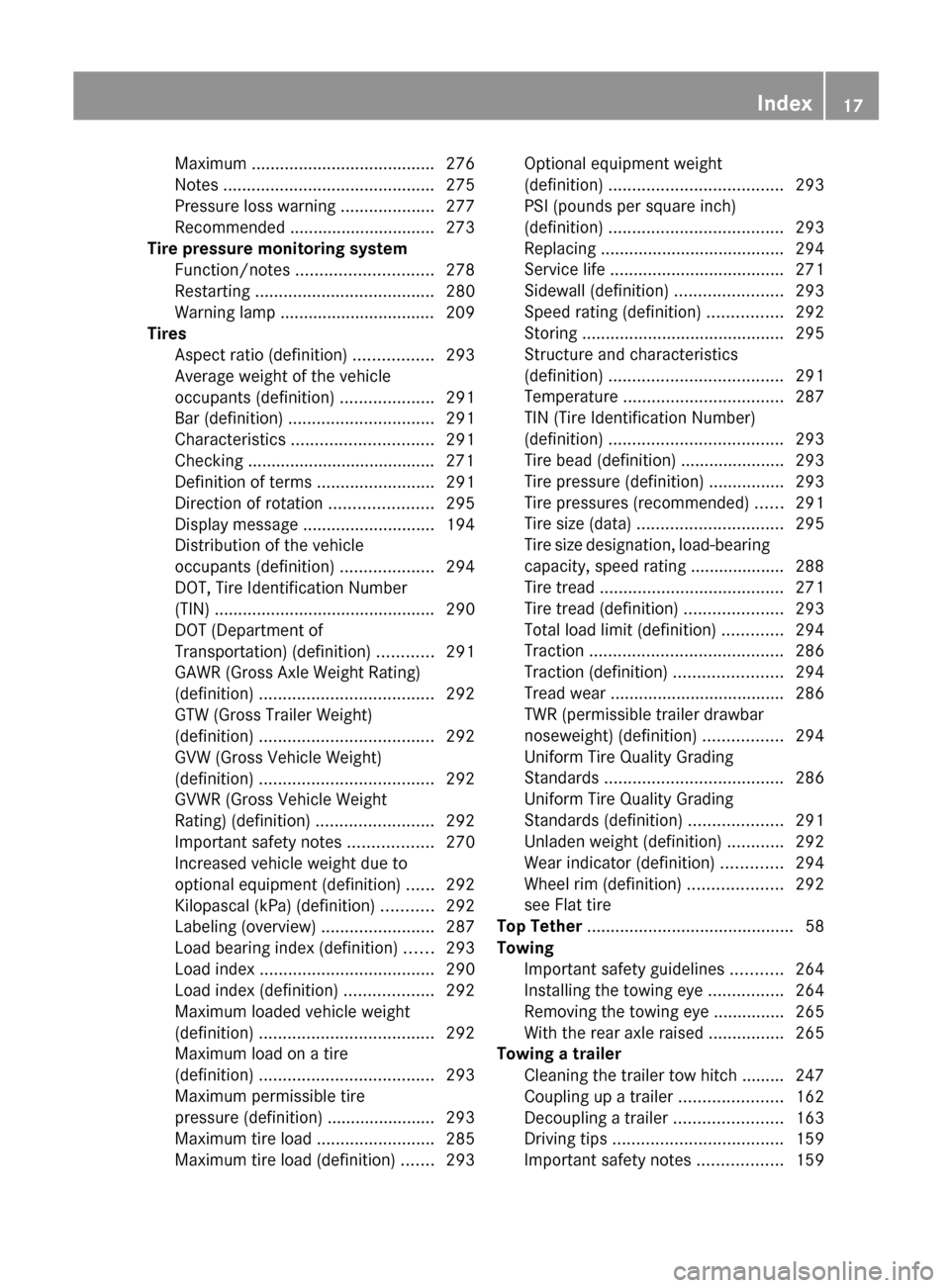
Maximum ....................................... 276
Notes ............................................. 275
Pressure loss warning ....................277
Recommended ............................... 273
Tire pressure monitoring system
Function/notes ............................. 278
Restarting ...................................... 280
Warning lamp ................................. 209
Tires
Aspect ratio (definition) .................293
Average weight of the vehicle
occupants (definition) ....................291
Bar (definition) ............................... 291
Characteristics .............................. 291
Checking ........................................ 271
Definition of terms .........................291
Direction of rotation ......................295
Display message ............................ 194
Distribution of the vehicle
occupants (definition) ....................294
DOT, Tire Identification Number
(TIN) ............................................... 290
DOT (Department of
Transportation) (definition) ............291
GAWR (Gross Axle Weight Rating)
(definition) ..................................... 292
GTW (Gross Trailer Weight)
(definition) ..................................... 292
GVW (Gross Vehicle Weight)
(definition) ..................................... 292
GVWR (Gross Vehicle Weight
Rating) (definition) .........................292
Important safety notes ..................270
Increased vehicle weight due to
optional equipment (definition) ......292
Kilopascal (kPa) (definition) ...........292
Labeling (overview) ........................287
Load bearing index (definition) ......293
Load index ..................................... 290
Load index (definition) ...................292
Maximum loaded vehicle weight
(definition) ..................................... 292
Maximum load on a tire
(definition) ..................................... 293
Maximum permissible tire
pressure (definition) ....................... 293
Maximum tire load .........................285
Maximum tire load (definition) .......293Optional equipment weight
(definition) ..................................... 293
PSI (pounds per square inch)
(definition) ..................................... 293
Replacing ....................................... 294
Service life ..................................... 271
Sidewall (definition) .......................293
Speed rating (definition) ................292
Storing ........................................... 295
Structure and characteristics
(definition) ..................................... 291
Temperature .................................. 287
TIN (Tire Identification Number)
(definition) ..................................... 293
Tire bead (definition) ......................293
Tire pressure (definition) ................293
Tire pressures (recommended) ......291
Tire size (data) ............................... 295
Tire size designation, load-bearing
capacity, speed rating .................... 288
Tire tread ....................................... 271
Tire tread (definition) .....................293
Total load limit (definition) .............294
Traction ......................................... 286
Traction (definition) .......................294
Tread wear ..................................... 286
TWR (permissible trailer drawbar
noseweight) (definition) .................294
Uniform Tire Quality Grading
Standards ...................................... 286
Uniform Tire Quality Grading
Standards (definition) ....................291
Unladen weight (definition) ............292
Wear indicator (definition) .............294
Wheel rim (definition) ....................292
see Flat tire
Top Tether ............................................ 58
Towing Important safety guidelines ...........264
Installing the towing eye ................264
Removing the towing eye ...............265
With the rear axle raised ................265
Towing a trailer
Cleaning the trailer tow hitch ......... 247
Coupling up a trailer ......................162
Decoupling a trailer .......................163
Driving tips .................................... 159
Important safety notes ..................159Index17
Page 21 of 316

W
Warning and indicator lamps ABS ................................................ 202
Brakes ........................................... 201
Check Engine ................................. 206
Coolant .......................................... 207
Cruise control ................................ 151
ESP ®
.............................................. 203
ESP ®
OFF ....................................... 204
Fuel tank ........................................ 206
Overview .......................................... 30
PASSENGER AIRBAG OFF
indicator lamp .................................. 44
Reserve fuel ................................... 206
Seat belt ........................................ 200
SRS ................................................ 205
Tire pressure monitor ....................209
Warranty ............................................ 301
Washer fluid Display message ............................ 198
see Windshield washer system
Wheel bolt tightening torque ........... 258
Wheel chock ...................................... 254
Wheels Changing a wheel .......................... 254
Checking ........................................ 271
Cleaning ......................................... 245
Important safety notes ..................270
Interchanging/changing ................294
Mounting a wheel .......................... 256
Removing a wheel ..........................256
Storing ........................................... 295
Tightening torque ........................... 258
Wheel size/tire size .......................295
Window curtain air bag
Display message ............................ 185
Operation ......................................... 44
Windows
Cleaning ......................................... 246
see Side windows
Windshield
Defrosting ...................................... 123
Windshield washer system .............. 241
Notes ............................................. 307
Windshield wipers
Problem (malfunction) ...................116
Rear window wiper ........................114Replacing the wiper blades ............114
Switching on/off ........................... 113
Winter driving
Important safety notes ..................272
Slippery road surfaces ...................149
Snow chains .................................. 272
Winter tires
M+S tires ....................................... 272
Wiper blades
Cleaning ......................................... 246
Important safety notes ..................114
Replacing (rear window) ................116
Replacing (windshield) ...................115
Wooden trim (cleaning
instructions) ...................................... 248Index19
Page 43 of 316

RAdjust the front-passenger seat as far back
as possible from the dashboard when the
seat is occupied.
R Occupants, especially children, should
never place their bodies or lean their heads
in the area of the door where the side
impact air bag inflates. This could result in
serious injuries or death should the side
impact air bag be deployed. Always sit as
upright as possible, wear the seat belt
properly and use an appropriately sized
child restraint, infant restraint or booster
seat recommended for the size and weight
of the child.
Failure to follow these instructions can result
in severe injuries to you or other occupants.
If you sell your vehicle, it is important that you
make the buyer aware of this safety
information. Be sure to give the buyer this
Operator's Manual.GWARNING
Accident research shows that the safest place
for children in an automobile is in a rear seat.
A side impact air bag related injury may occur
if occupants, especially children, are not
properly seated or restrained when next to a
side impact air bag which needs to deploy
rapidly in a side impact in order to do its job.
To help avoid the possibility of injury, please
follow these guidelines:
(1)Always sit as upright as possible
and use the seat belts properly.
Make sure that children 12 years
old and under use an appropriately
sized child restraint, infant
restraint, or booster seat
recommended for the size and
weight of the child.(2)Always wear seat belts properly.
The air bags are only deployed if the air bag
control unit detects the need for deployment.
Only in the event of such a situation will they
provide their supplemental protection.
The driver and passenger should always wear
their seat belts. Otherwise, it is not possible
for the air bags to provide their supplemental
protection.
In the event of other types of impacts and
impacts below air bag deployment
thresholds, the air bags will not deploy. The
driver and passengers will then be protected
to the extent possible by a properly fastened
seat belt. A properly fastened seat belt is also
needed to provide the best possible
protection in a rollover.
Air bags provide additional protection; they
are not, however, a substitute for seat belts.
All vehicle occupants must fasten their seat
belts regardless of whether your vehicle is
equipped with air bags or not.
It is important for your safety and that of your
passenger to have deployed air bags replaced
and to have any malfunctioning air bags
repaired. This will help to make sure the air
bags continue to perform their protective
function for the vehicle occupants in the
event of a crash.
Front air bags
The front air bags increase protection for the
driver's and front-passenger's head and
chest.
Driver's air bag : deploys in front of the
steering wheel; front-passenger front air
bag ; deploys in front of and above the glove
box.
Occupant safety41SafetyZ
Page 65 of 316

GWARNING
Never switch off the ESP when you see the
ESP warning lamp ä flashing in the
instrument cluster. In this case proceed as
follows:
R When driving off, apply as little throttle as
possible.
R While driving, ease up on the accelerator
pedal.
R Adapt your speed and driving style to the
prevailing road conditions.
Failure to observe these guidelines could
cause the vehicle to skid. The ESP cannot
prevent accidents resulting from excessive
speed.
! Vehicles without 4MATIC: switch the
ignition off when:
R the parking brake is being tested using a
dynamometer
R the vehicle is being towed with the front/
rear axle raised
Application of the brakes by ESP ®
may
otherwise destroy the brake system.
! Vehicles with 4MATIC: switch off the
ignition when the parking brake is being
tested on a brake dynamometer.
Application of the brakes by ESP ®
may
otherwise destroy the brake system.
! Vehicles with 4MATIC: function or
performance tests may only be carried out
on a 2-axle dynamometer. If you wish to
operate the vehicle on such a
dynamometer, please consult an
authorized Mercedes-Benz Center in
advance. You could otherwise damage the
drive train or the brake system.
i Only use wheels with the recommended
tire sizes. Only then will ESP ®
function
properly.
ETS/4ETS (Electronic Traction System)GWARNING
Observe "Important safety notes"
( Y page 61).
Traction control is part of ESP ®
.
Traction control brakes the drive wheels
individually if they spin. This enables you to
pull away and accelerate on slippery surfaces,
for example if the road surface is slippery on
one side. On vehicles with 4MATIC, more
drive torque is also transferred to the wheel
or wheels with traction.
Traction control remains active if you
deactivate ESP ®
.
Deactivating/activating ESP ®
i
Observe the "Important safety notes"
section ( Y page 61).
GWARNING
ESP ®
should not be deactivated during
normal driving other than in the
circumstances described below. Disabling
the system will reduce vehicle stability in
driving maneuvers.
Do not deactivate ESP ®
when the emergency
or spare wheel is mounted.
ESP ®
is activated automatically when the
engine is started.
It may be best to deactivate ESP ®
in the
following situations:
R when using snow chains
R in deep snow
R on sand or gravel
GWARNING
Switch on ESP ®
immediately if one of the
previously stated conditions is no longer met.
Otherwise, ESP ®
cannot stabilize the vehicle
if it begins to lurch or when a wheel spins.
Driving safety systems63SafetyZ
Page 93 of 316

(Y page 97) in such a way that you have
a good view of road and traffic conditions.XVehicles with a memory function: save
the seat, steering wheel and exterior mirror
settings ( Y page 100).
Seats
Important safety notes
GWARNING
In order to avoid possible loss of vehicle
control, all seat, head restraint, steering
wheel and rear view mirror adjustments, as
well as fastening of seat belts, must be done
before setting the vehicle in motion.
GWARNING
Do not adjust the driver's seat while driving.
Adjusting the seat while driving could cause
the driver to lose control of the vehicle.
Never travel in a moving vehicle with the seat
backrest in an excessively reclined position as
this can be dangerous. You could slide under
the seat belt in a collision. If you slide under
it, the seat belt would apply force at the
abdomen or neck. This could cause serious or
fatal injuries. The seat backrest and seat belts
provide the best restraint when the wearer is
in a position that is as upright as possible and
seat belts are properly positioned on the
body.
GWARNING
Your seat belt must be adjusted so that you
can correctly fasten your seat belt.
Observe the following points:
R adjust the seat backrest until your arms are
slightly angled when holding the steering
wheel.
R adjust the seat to a comfortable seating
position that still allows you to reach the
accelerator/brake pedal safely. The
position should be as far back as possible
with the driver still able to operate the
controls properly.
R adjust the head restraint so that it is as
close to the head as possible and the center
of the head restraint supports the back of
the head at eye level.
R never place hands under the seat or near
any moving parts while a seat is being
adjusted.
Failure to do so could result in an accident
and/or serious personal injury.GWARNING
The electrically adjustable seats can be
operated at any time. Therefore, do not leave
children unattended in the vehicle, or with
access to an unlocked vehicle. A child's
unsupervised access to a vehicle could result
in an accident and/or serious personal injury.
GWARNING
According to accident statistics, children are
safer when properly restrained in the rear
seating positions than in the front seating
position. Thus, we strongly recommend that
children be placed in the rear seats whenever
possible. Regardless of seating position,
children 12 years old and under must be
seated and properly secured in an
appropriately sized infant restraint, toddler
restraint, or booster seat recommended for
the size and weight of the child. For additional
information, see "Children in the vehicle".
A child's risk of serious or fatal injuries is
significantly increased if the child restraints
are not properly secured in the vehicle and/
or the child is not properly secured in the child
restraint.
GWARNING
For your protection, drive only with properly
positioned head restraints.
Adjust the head restraint so that it is as close
to the head as possible and the center of the
head restraint supports the back of the head
at eye level. This will reduce the potential for
Seats91Seats, steering wheel and mirrorsZ
Page 173 of 316

Resetting values
You can reset the values of the following
functions:
R Trip odometer
R Trip computer "From start"
R Trip computer "From reset"
XPress the = or ; button on the
steering wheel to select the Trip menu.XPress the 9 or : button to select the
function that you wish to reset.XPress a.
Resetting the trip computer "From start" (example)
XPress : to select Yes and press a
to confirm.
Navigation system menu
Displaying navigation instructions
In the Navi menu, the multifunction display
shows navigation instructions. For more
information, see the separate operating
instructions.
XSwitch on COMAND (see the separate
operating instructions).XPress the = or ; button on the
steering wheel to select the Navi menu.Route guidance inactive:Direction of travel;Current road
Route guidance active
No change of direction announced
:Distance to the destination;Distance to the next change of direction=Current road?Symbol for "follow the road's course"
Change of direction announced without a
lane recommendation
:Road into which the change of direction
leads;Distance to change of direction and visual
distance display=Symbol for change of direction
When a change of direction has been
announced, you will see visual distance
display ; next to the symbol for the change
of direction =. This decreases in size as you
approach the announced change of direction.
Menus and submenus171On-board computer and displaysZ
Page 211 of 316

GWARNING
Driving when your engine is overheated can cause some fluids which may have leaked into the
engine compartment to catch fire. You could be seriously burned.
Steam from an overheated engine can cause serious burns which can occur just by opening the
engine hood. Stay away from the engine if you see or hear steam coming from it.
Stop the vehicle in a safe location away from other traffic. Turn off the engine, get out of the
vehicle and do not stand near the vehicle until the engine has cooled down.
! If the coolant temperature exceeds 248 ‡(120 †) do not continue driving. The engine will
otherwise be damaged.
Tires
ProblemPossible causes/consequences and M Solutionsh
USA only:
The yellow tire pressure
monitor warning lamp
(pressure loss/
malfunction) is lit.GRisk of accident
The tire pressure monitor has detected a loss of pressure in at
least one of the tires.
XStop the vehicle without making any sudden steering or braking
maneuvers. Pay attention to the traffic conditions as you do so.XObserve the additional display messages in the multifunction
display.XCheck the tire pressure. If necessary, correct the tire pressure
( Y page 278).XIf necessary, change a wheel ( Y page 294).h
USA only:
The yellow tire pressure
monitor warning lamp
(pressure loss/
malfunction) flashes for
60 seconds and then
remains lit.The tire pressure monitor is defective.XObserve the additional display messages in the multifunction
display.XVisit a qualified specialist workshop.GWARNING
Each tire, including the spare (if provided), should be checked every other week when cold and
inflated to the inflation pressure recommended by the vehicle manufacturer on the Tire and
Loading Information placard on the driver's door B-pillar or, if available, the tire inflation pressure
label on the inside of the fuel filler flap. If your vehicle has tires of a different size than the size
indicated on the Tire and Loading Information placard or, if available, the tire inflation pressure
label, you should determine the proper tire inflation pressure for those tires.
As an added safety feature, your vehicle has been equipped with a tire pressure monitoring
system (TPMS) that illuminates a low tire pressure warning lamp when one or more of your tires
Warning and indicator lamps in the instrument cluster209On-board computer and displaysZ
Page 214 of 316

Useful information
i This Operator's Manual describes all
models and all standard and optional
equipment of your vehicle available at the
time of publication of the Operator's
Manual. Country-specific differences are
possible. Please note that your vehicle may
not be equipped with all features
described. This also applies to safety-
related systems and functions.
i Please read the information on qualified
specialist workshops ( Y page 23).
Loading guidelines
GWARNING
Always fasten items being carried as securely
as possible using cargo tie-down rings and
fastening materials appropriate for the weight
and size of the load.
In an accident, during hard braking or sudden
maneuvers, loose items will be thrown around
inside the vehicle. This can cause injury to
vehicle occupants unless the items are
securely fastened in the vehicle.
To help avoid personal injury during a collision
or sudden maneuver, exercise care when
transporting cargo. Do not pile luggage or
cargo higher than the seat backrests.
Never drive a vehicle with the tailgate open.
Deadly carbon monoxide (CO) gases may
enter vehicle interior resulting in
unconsciousness and death.
The gross vehicle weight (GVW) is the vehicle
weight including fuel, vehicle tool kit, spare
wheel, installed accessories, vehicle
occupants and luggage/cargo.
The gross load limit and the gross vehicle
weight rating (GVWR) for your vehicle must
never be exceeded. The gross load limit and
the GVWR are specified on the vehicle
identification plate on the B-pillar of the
driver's door ( Y page 281).
The load must also be distributed so that the
weight on each axle never exceeds the gross
axle weight rating (GAWR) for the front and
rear axles. The specifications for GVWR and
GAWR are on the vehicle identification plate
on the B-pillar of the driver's door
( Y page 281).
Further information can be found in the
"Loading the vehicle" section ( Y page 281).
The handling characteristics of a laden
vehicle are dependent on the distribution of
the load within the vehicle. For this reason,
you should observe the following notes when
transporting a load:
R position heavy loads as far forwards as
possible and as low down in the cargo
compartment as possible.
R the load must not protrude above the upper
edge of the seat backrests.
R always place the load against the rear or
front seat backrests. Make sure that the
seat backrests are securely locked into
place.
R hook in the cargo net when loading.
R always place the load behind unoccupied
seats if possible.
R secure the load with sufficiently strong and
wear-resistant tie down. pad sharp edges
for protection.
Stowage areas
Stowage compartments
Important safety notes
GWARNING
To help avoid personal injury during a collision
or sudden maneuver, exercise care when
storing objects in the vehicle. Put luggage or
cargo in the cargo compartment if possible.
Do not pile luggage or cargo higher than the
seat backrests.
212Stowage areasStowing and features