2012 MERCEDES-BENZ GL SUV keyless
[x] Cancel search: keylessPage 364 of 441
To avoi
dthe risk of burns, only touc hthose
component sdescribed in the Owner's Manual
and observ ethe relevant safety notes. G
WARNING
The radiator fa nbetween the radiator and the
engine can star tautomatically, even if the key
has been removed from the ignition lock. For
this reason, you must not reach into the fan
rotation area. You could otherwis ebeinjured.
Vehicles with apetrol engine: The elec-
tronic ignition system uses high voltage. For
this reason ,you must never touc hignition
system component s(ignition coil, ignition
cables, spark plug connectors or test socket)
while:
R the engine is running
R the engine is being started
R the ignition is switched on and the engine
is being cranked by hand
You could otherwise suffer an electric shock
and be seriously or even fatally injured.
Vehicles with adiesel engine: The elec-
tronic injection control uses high voltage. For
this reason ,you must never touc hinjection
system components while:
R the engi neis running
R the engin eisbeing started
R the ignition is switched on
You could otherwise suffer an electric shock
and be seriously or even fatally injured. G
WAR
NING
The winds creen wipers and wiper linkage
could be set in motion.
When the bonnet is open, you or others could
be injured by the wiper linkage.
Make sure that the windscreen wipers are
switched off .Remov ethe key or make sure
that no ignition position has been selected
with KEYLESS-GO. All indi cator lamps must be
off in the instrumen tpanel.
! Make sure that the windscreen wipers are
not folded away from the windscreen. Oth- er
wise ,you could damage the windscreen
wipers or the bonnet. X
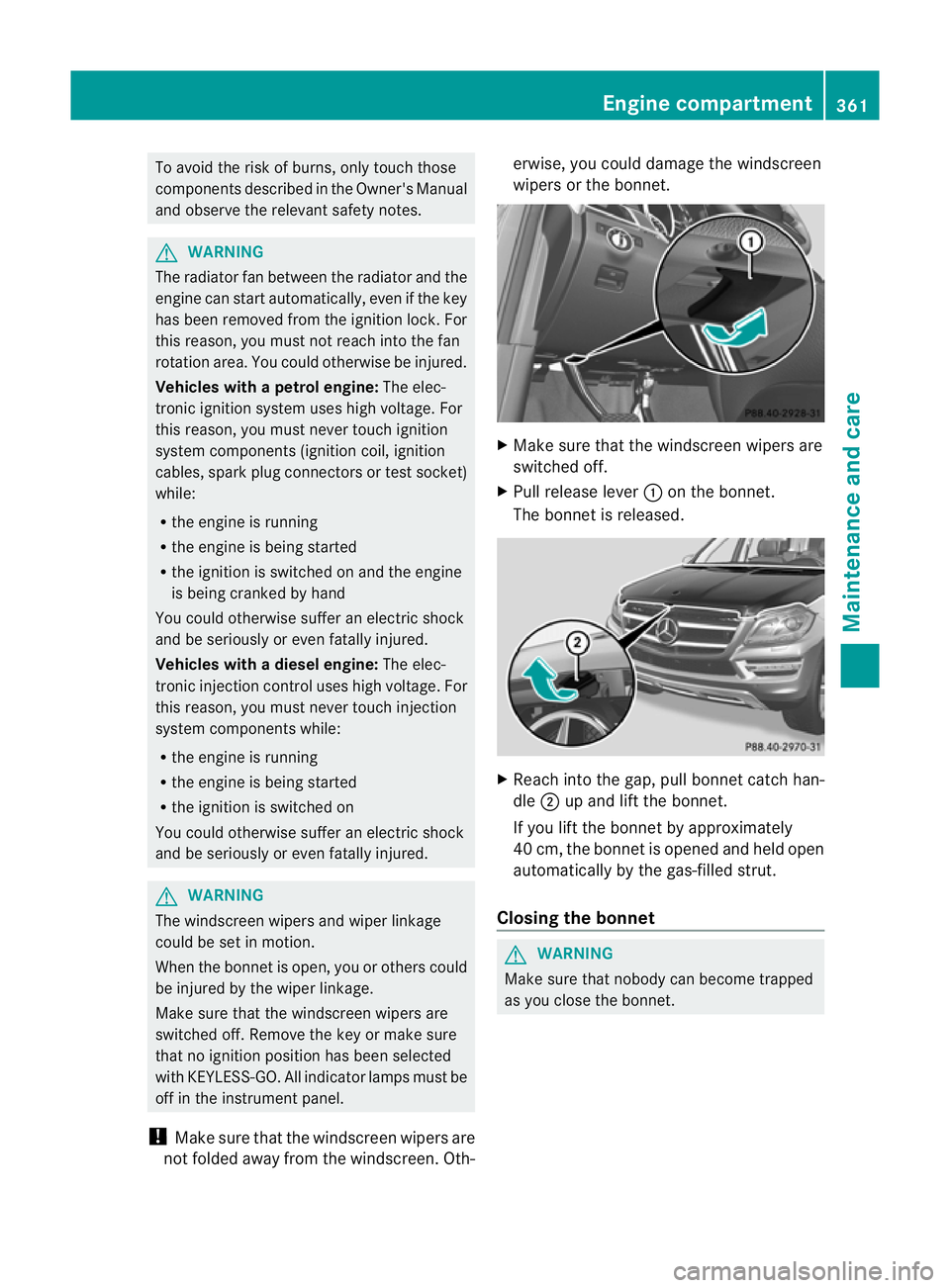
Make sure tha tthe windscreen wiper sare
switche doff.
X Pull release lever :on th ebonnet.
The bonnet is released. X
Reac hinto the gap ,pull bonnet catch han-
dle ;up and lift the bonnet.
If you lift the bonnet by approximately
40 cm, the bonnet is opened and held open
automatically by the gas-filled strut.
Closing the bonnet G
WARNING
Make sure that nobody can become trapped
as you close the bonnet. Eng
inecompartment
361Maintenance and care Z
Page 366 of 441

H
Environmenta
lnote
When toppin guptheoil, tak ecaren ot to spill
any .Ifo il enters th esoil or waterways, it is
harmful to th eenvironment.
! Only use engine oil sand oil filters that
have bee napproved for vehicles with a
servic esystem. You can obtain alist of the
engine oils and oil filters tested and
approved in accordance with the
Mercedes-Ben zSpecification sfor Service
Product satany Mercedes-Ben zService
Centre.
Damage to th eengine or exhaust sys temis
caused by the following:
R using engine oil sand oil filters that have
not bee nspecifically approved for the
servic esystem
R changing the engine oil and oil filter after
missing the change interval required by
the servic esystem
R using engine oil additives
! Do not add too muc hoil. Toppin gupwith
to om uche ngine oil can resul tindamage
to the engine or to the catalytic converter.
Hav eexcess engine oil siphoned off. Example: engine oil filler cap
X
Turn cap :anti-clockwis eand remove it.
X Top up the engine oil.
If the oil level is at or below the MIN mark
on the oil dipstick ,add 1. 0litreo fengine
oil. X
Replace cap :on the filler nec kand turn
clockwise.
Make sure that the cap locks securely into
place.
X Check the oil level agai nwith the oil dip-
stic k(Ypage 36 2).
For furthe rinformation on engine oil ,see
(Y page 42 8). Other service products
Checking th ecoolant level G
WARNING
The coolin gsystem is pressurised. Therefore,
only unscrew the cap onc ethe engine has
coole ddown. The coolan ttemperatur edis-
play must be less than 70 †. Otherwise, you
could be scalded if hot coolant escapes. X
Park the vehicle on alevel surface.
Only chec kthe coolant level if the vehicle
is on alevel surface and the engine has
cooled down.
X Turn the key to position 2in the ignition
lock (Y page 159).
On vehicles with KEYLESS-GO, press the
Start/Stop button twic e(Ypage 159).
X Check the coolant temperatur egauge in
the multifunction displ ay.
Th ec oolant temperatur emust be below
70 †.
X Turn the key to position 0(Y page 159 )in
the ignition lock. Eng
inecompartment
363Maintenance and care Z
Page 370 of 441

G
WARNING
Th ev ehicle is braked when the HOL Dfunction
or DISTRONIC PLUS is activated. Therefore,
deactivate the HOLD function and DISTRONIC
PLUS before the vehicl eiswashed in an auto-
matic car wash.
! Make sure that:
R the side windows and sliding sunroof are
closed completely.
R the blower for the ventilation/heating is
switched off (OFF button is depressed).
R the windscreen wiper switch is at posi-
tion 0.
The vehicl ecould otherwise be dam aged.
! In car washes with atowing mechanism,
make sure that the automatic transmission
is in transmission position N,otherwise the
vehicl ecould be dam aged.
R Vehicles with akey:
do not remove the key from the igniti on
lock. Do not open the driver's door or
front-passenge rdoor when the engin eis
switched off .Otherwise, the automatic
transmission selects park position P
automatically and locks the wheels. You
can prevent this by shiftin gthe auto-
matic transmission to Nbeforehand.
R Vehicles with KEYL ESS-GO:
do not ope nthe driver's door or front-
passenger door when the engin eis
switched off .Otherwise, the automatic
transmission selects park position P
automatically and locks the wheels.
Observe the following to make sure that the
automatic transmission stays in position N:
X Make sure the vehicle is statio naryand the
ignition is switched off.
X Turn the key to position 2(Y page 159 )in
the ignitio nlock.
Use the key instead of the Start/S topb ut-
ton on vehicles with KEYLESS-GO.
X Depress and hold the brake pedal. X
Shift the automatic transmissio ntoposi-
tion N.
X Release the brake pedal.
X Release the electric parkin gbrake.
X Switch off th eignition and leav ethe key in
the ignition lock.
You can wash the vehicle in an automatic car
wash from the ver ystart.
Wash off excess dirt before cleaning the vehi-
cle in an automatic car wash.
After using an automatic car wash ,wipe off
wax from the windscreen and the wiper
blades. This will prevent smears and reduce
wiping noises caused by residue on the wind-
screen.
Washing by hand In some countries, washing by hand is only
allowe
datspecially equipped washing bays.
Observe the legal requirement sfor each indi-
vidual coun try.
X Do not use hot water and do not wash the
vehicle in direct sunlight.
X Use asoft sponge to clean.
X Use amild cleaning agent, such as acar
shampoo approved by Mercedes-Benz.
X Thoroughly hos edown the vehicle with a
gentl ejet of water.
X Do not point the water jet directly towards
the air inlets.
X Use plenty of water and rinse out the
sponge frequently.
X Rinse the vehicle with clean water and dry
thoroughly with achamois.
X Do not let the cleanin gagent dry on the
paintwork.
When using the vehicle in winter, remove all
traces of roa dsalt deposits carefully and as
soon as possible. Care
367Maintenance and care Z
Page 372 of 441

i
The vehicle should preferably be washed
by hand using asoft sponge, car shampoo
and plent yofwater.
i Use only insect remover and car shampoo
from the range of recommended and
approved Mercedes -Benz care products. Cleaning vehicle parts
Cleaning the wheels !
Do not use acidic wheel cleaning products
to remove brake dust. Thi scould damage
wheel bolts and brake components.
! Do not par kupthe vehicle for an extended
period straight after cleanin git, particularly
after having cleaned the wheels with wheel
cleaner. Wheel cleaners could cause
increased corrosion of the brake discs and
brake pads/linings .For this reason, you
should drive for afew minutes after clean-
ing. Brakin gheats the brak ediscs and the
brake pads/linings, thus drying them. The
vehicle can then be parked up.
Cleaning the windows G
WARNING
Switc hoff the windscree nwipers and remove
the key from the ignition lock before cleaning
the windscreen or the wiper blades. On vehi-
cles with KEYL ESS-GO, pres sthe Start/S top
button repeatedly until all indicator lamps in
the instrumen tcluster have gone off. The
windscreen wipers could otherwise move and
injur eyou.
! Do not use dry cloths, abrasive products,
solven tsor cleanin gagents con taining sol-
vent stoc lean the inside of the windows.
Do not touch the insides of the windows
with hard objects, e.g. an ice scraper or
ring. There is otherwise arisk of damaging
the windows.
! Clean the water drainage channels of the
windscreen and the rear window at regular intervals. Deposits such as leaves, petals
and pollen may under certain circumstan-
ces prevent water from drainin
gaway. This
can lead to corrosion damage and damage
to electronic components.
X Clean the inside and outside of the win-
dows with adamp cloth and acleaning
agent that is recommended and approved
by Mercedes-Benz.
Cleanin gthe wiper blades G
WARNING
Switch off the windscree nwipers and remove
the key from the ignition lock before cleaning
the windscreen or the wiper blades. On vehi-
cles with KEYLESS-GO, press the Star t/Stop
butto nrepeatedly unti lall indicator lamps in
the instrumen tcluster have gone off. The
windscreen wipers could otherwise move and
injur eyou.
! Do not pull on the wiper blade. Otherwise,
the wiper blade could be damaged.
! Do not clean wiper blades too often and
do not rub them too hard. Otherwise, the
graphit ecoatin gcould be damaged. This
coul dcause wiper noise.
! Hold the wiper arm securely when folding
back. The windscreen could be damaged if
the wiper arm hits against it suddenly.
X Fold the wiper arms away from the wind-
screen.
X Clea nthe wiper blades carefully usin ga
damp cloth.
X Fold the windscreen wipers back again
befor eswitching on the ignition.
Cleanin gthe exterio rlighting !
Only use cleaning agents or cleaning
cloths that are suitable for plastic lenses.
Unsuitable cleaning agents or cleaning
cloths could scratc hordamage the plastic
lenses of the exterior lighting. Care
369Maintenance and care Z
Page 381 of 441

C
Warning triangle
D Wheel bolts
E Towing eye
X Lif tthe luggage compar tment floor up
(Y page 344). Flat ty
re Prep
aring the vehicle
Your vehicle may be equipped with:
R MOExtended tyres (tyres with run -flat char-
acteristics) (Y page 378)
R aT IREFIT kit (Y page 379)
R an emergency spare whee l(only for cer tain
countries) (Y page 414)
Information on changing/fitting awheel
(Y page 404).
Vehicle preparation is not necessar yonvehi-
cles with MOExtended tyres.
X Stop the vehicle as far away as possible
from traffic, on solid, non-slipper yand level
ground.
X Switch on the hazard warning lamps.
X Engag ethe electric parkin gbrake man-
ually.
X Bring th efront wheels into the straight-
ahead position.
X Move the DIRECT SELECT leve rtoP.
X Vehicle swith the ON&OFFROAD pack-
age: makesure that highway level is selec-
ted (Y page 207).
X Switch off the engine.
X Vehicles without KEYLESS-GO: remove
the key from the ignition lock.
X Vehicles with KEYLESS-GO: open the
driver' sdoor.
The on-boar delectronic shave status 0,
which is the same as the key having been
removed.
X Vehicles with KEYLESS-GO: remove the
Start/Stop button from the ignition lock
(Y page 159). X
All occupants must leave the vehicle. Make
sure that they are not endangered as they
do so.
X Make sure that no one is near the danger
area while awheel is being changed. Any-
one who is not directly assisting in the
wheel change should, for example, stand
behind the barrier.
X Get out of the vehicle. Pay attention to traf-
fic condition swhen doing so.
X Close the driver's door.
X Plac ethe warnin gtriangl easuitable dis-
tance away (Y page 376). Observe legal
requirements.
X Unload heavy luggage.
i Only operate the tyre inflation compres-
sor using a12Vs ocket,even if the ignition
is turned off (Y page 350).
An emergenc ycut-off ensures that the on-
board voltage does not drop too low. If the
on-board voltage is too low, the power to
the sockets is automatically cut. This
ensures that there is sufficient power to
start the engine. MOExtended tyres (tyres with run-flat
characteristics)
G
WARNING
When driving in emergenc ymode, the driving
characteristic sdeteriorate, e.g. when cor ner-
ing, accelerating quickly and when braking.
There is arisk of accident.
Do not exceed the stated maximum speed.
Avoid abrupt steering and drivin gmanoeu-
vres, and driving over obstacles (kerbs, pot-
holes ,off-road) .This applies in particular to a
laden vehicle.
Sto pdriving in emergency mod eif:
R you hear banging noises.
R the vehicl estart stos hake.
R you see smok eand smell rubber. 378
Flat tyreBreakdown assistance
Page 386 of 441

R
Make sur ethat the positive terminal of a
con nected battery doe snot com einto con-
tact with vehicl eparts.
R Never place metal objects or tools on abat-
tery.
R It is important that you observe the descri-
bed order of the battery terminals when
connectin gand disconnectin gabattery.
R When jump-starting, make sure that the
battery poles with identical polarity are
connected.
R It is particularly important to observe the
described order when connectin gand dis-
connectin gthe jum pleads.
R Never connect or disconnect the battery
terminals while the engine is running. G
WARNING
Bat tery acid is caustic. There is arisk of injury.
Avoid contact with the skin, eyes or clothing.
Do not inhale any battery gases. Do not lean
over the battery. Keep children away from
batteries. Wash battery acid immediately with
water and seek medical attention. H
Environmental note Batteries contain pollutants.
It is illegal to dispose of them
with the household rubbish.
They must be collected sep-
arately and dispose
dofinan
environmen tally responsible
recycling system. Dispose of batteries in an
environmentally responsible
manner
.Take discharged
batteries to aqualified spe-
cialist workshop or to acol-
lection point for used batter-
ies.
! Hav ethe battery chec kedr egularly at a
qualified specialist workshop.
Observ ethe service intervals in the Service
Booklet or con tact aq ualified specialist
worksho pfor mor einformation. !
You should have all work involving the
battery carried out at aqualified specialist
workshop. In the exceptional case that it is
necessar yfor you to disconnect th ebattery
yourself, mak esure that:
R you switc hoff the engine and remove the
key. On vehicles with KEYLESS-GO,
ensure that the ig nition is switched off.
Chec kthat all the indicator lamps in the
instrumen tcluster are off. Otherwise,
electronic components, such as the
alternator, may be damaged.
R you first remov ethe negativ eterminal
clam pand then the positive terminal
clamp. Never swap the terminal clamps.
Otherwise, the vehicle's electronic sys-
tem may be damaged.
R the transmissio nislocke dinp osition P
after disconnectin gthe battery .The vehi-
cle is secured against rolling away. You
can then no longer mov ethe vehicle.
The battery and the cover of the positive
termi nalclamp must be fitted securely dur-
ing operation.
Comply with safety precautions and take pro-
tective measures when handling batteries. WARNING
Fire, naked flames and smoking
are prohibited when handling the
battery
.Avoi dc reating sparks. Battery aci
discaustic. Avoid con-
tact with the skin, eyes or clothing.
Wear suitable protective clothing,
in particular gloves, an apron and
af ace mask.
Immediately rinse acid splashes
off with clean water. Consult adoc-
tor if necessary. Wear eye protection. Ba
ttery (vehicle)
383Breakdown assistance Z
Page 390 of 441

Do not us
earapid charging device to start the vehicle. If your vehicle' sbattery is discharg ed,
the engine can be jump-starte dfroma nothe rvehicle or fr omasecon dbattery using jump
leads. Observe the following points:
R the battery is not acce ssiblein allvehicles .Ifthe other vehicle' sbattery is not accessible,
jump-start the vehicle using asecond batter yorajump-star ting device.
R vehicles with apetrol engine: only jump-star tthe vehicle when the engin eand exhaust
system are cold.
R do not start the engine if the battery is frozen. Let the battery thaw first.
R jump-starting may only be performed from batteries with anominal voltage of 12 V.
R only use jum pleads that have asufficient cross-section and insulated terminal clamps.
R if the battery is fully discharged, leave the battery that is being used to jump-start connected
for afew minutes befor eattempting to start. Thi scharges the empty battery alittle.
R make sure that the two vehicles do not touch.
Make sure that:
R the jump leads are not damaged.
R non-insulated parts of the terminal clamps do not come into contact with other metal parts
while the jump leads are connected to the battery.
R the jump leads cannot come into contact with parts such as the V-belt pulle yorthe fan.
These parts mov ewhen the engin eisstarted and whil eitisr unning.
X Secure the vehicle by applying the electric parking brake.
X Shift the transmission to position P.
X Turn the key to position 0in the ignition lock and remove it (Y page 159). On vehicles with
KEYLESS-GO, make sure the ignition is switched off (Y page 159). All indicator lamps in the
instrumen tcluster must be off.
X Switch off all electrical consumer s(e.g. radio, blower, etc.).
X Open the bonnet (Y page 360).Position number
Bidentifies the charged batter yofthe other vehicle or an equivalent jump-
startin gdevice. Jump-starting
387Breakdown assistance Z
Page 395 of 441

The fuses in your vehicle serv
etoclose down
faulty circuits .Ifafuse blows, all the compo-
nen tson th ecircuit and their function sstop
operating.
Blown fuse smust be replaced with fuses of
the same rating, which you can recognise by
the colour and fuse rating. The fuse ratings
are listed in the fuse allocation chart.
If the newly inser tedf use also blows ,have the
cause traced and rectified at aqualified spe-
cialist workshop, e.g. aMercedes-Benz
Servic eCentre. Befor
ereplacing afuse
X Secure th evehicle against rollin gaway
(Y page 181).
X Switch off all electrical consumers.
X Turn the key to position 0in the ignition
lock and remove it (Y page 159). On vehi-
cles with KEYLESS-GO, mak esure the igni-
tion is switched off (Y page 159).
All indicator lamps in the instrumen tcluster
must be off.
The fuses are located in various fuse boxes:
R fuse box on the fron t-passenger side of the
dashboard
R fuse box in the engine compartmen tonthe
right-hand side of the vehicle, when viewed
in the direction of travel
R fuse box under the rea rbench seat
The fuse allocation char tisl ocated in the fuse
box under the rea rbench seat (Y page 393). Dashboar
dfuse box
! Do not us eapointed objec tsuch as a
screwdriver to open the cover in the dash-
board. You could damage the dashboard or
the cover.
! Make sure that no moisture can enter the
fuse box when the cover is open.
! When closing the cover, make sure that it
is lying correctly on the fuse box. Moisture seeping in or dirt could otherwis
eimpair
th eo peration of the fuses. X
To open: pull cover :outwards in the
direction of the arrow and remove it.
X To close: clip in cover :on the front of
the dashboard.
X Fold cover :inwards unti litengages. Fuse box in the engine compartment
! Make sure that no moisture can enter the
fuse box whe nthe cover is open.
! When closing the cover, make sur ethat it
is lyin gcorrectly on the fuse box. Moisture
seeping in or dir tcould otherwise impair
the operation of the fuses. X
Open the bonnet.
X Remove any existing moistur efrom the
fus eb ox using adry cloth.
X To open: open clamps ;.
X Fol dupc over:in the direction of the
arrow and remove it. 392
Electrical fusesBreakdown assistance