2012 MERCEDES-BENZ G-CLASS SUV key
[x] Cancel search: keyPage 46 of 357
cannot provide the intended level of protec-
tion. Do not use head restraint covers.
The NECK-PRO head restraints increase pro-
tectio nto the driver's and the front passeng-
er's head and neck.T he NECK-PRO head
restraints on the driver's and front-passenger
seats are moved forwards and upwards in the
event of a rear-end collision of a certain
severity. This provides better head support.
If the NECK-PRO head restraints have been
triggered in an accident, reset the NECK-PRO
head restraints on the driver’s and front-
passenger seat (Y page 43). Otherwise, the
additional protection will not be available in
the event of another rear-end collision. You
can recognise if NECK-PRO head restraints
have been triggered by the fact that they have
moved forwards and can no longer be adjus-
ted.
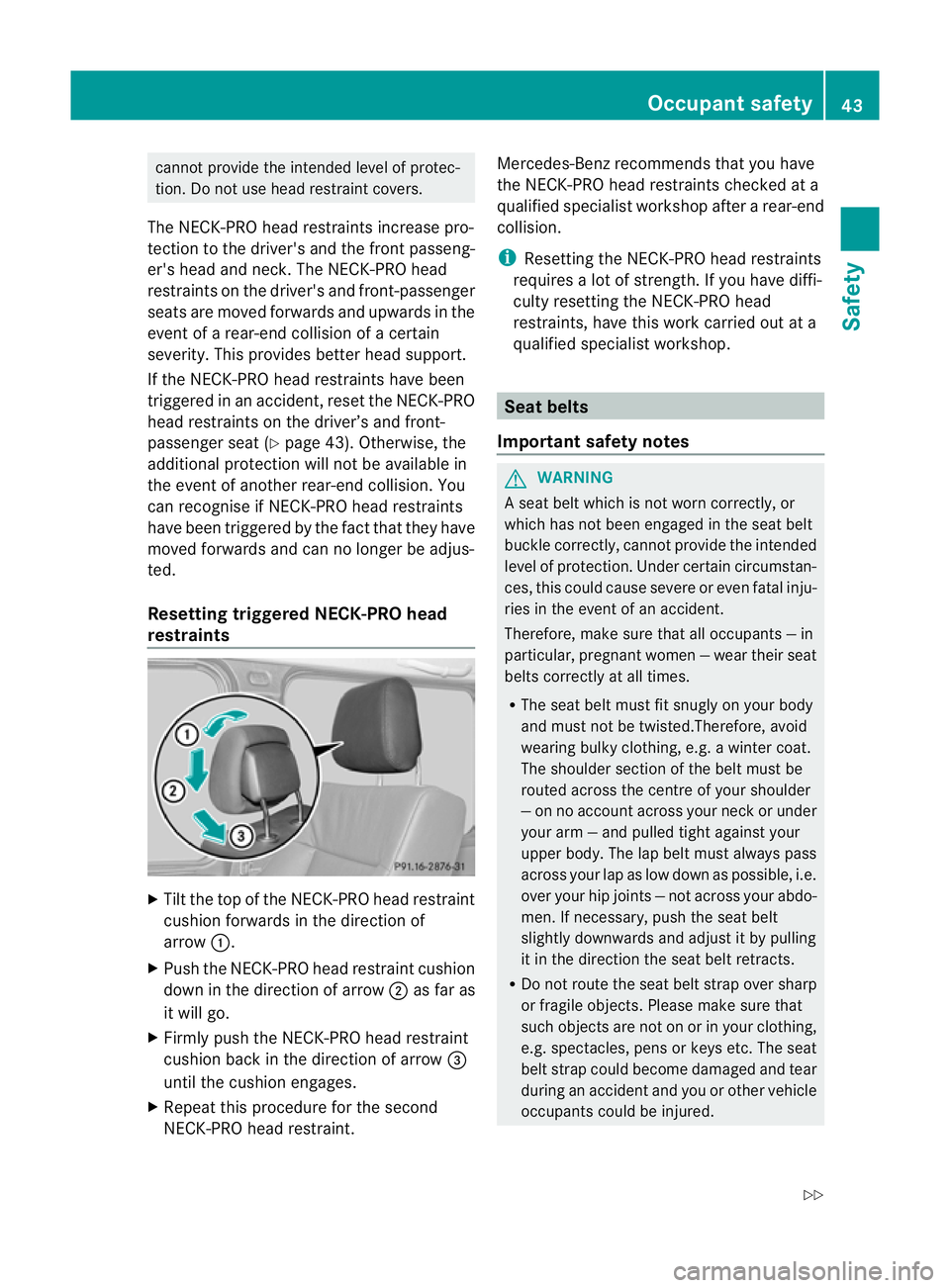
Resetting triggered NECK-PRO head
restraints X
Tilt the top of the NECK-PRO head restraint
cushion forwards in the direction of
arrow :.
X Push the NECK-PRO head restraint cushion
down in the direction of arrow ;as far as
it will go.
X Firmly push the NECK-PRO head restraint
cushion back in the direction of arrow =
until the cushion engages.
X Repeatt his procedure for the second
NECK-PRO head restraint. Mercedes-Ben
zrecommends that you have
the NECK-PRO head restraints checked at a
qualified specialist workshop after a rear-end
collision.
i Resetting the NECK-PRO head restraints
requires a lot of strength. If you have diffi-
culty resetting the NECK-PRO head
restraints, have this work carried out at a
qualified specialist workshop. Seat belts
Important safety notes G
WARNING
A seat belt which is not worn correctly, or
which has not been engaged in the seat belt
buckle correctly, cannot provide the intended
level of protection. Under certain circumstan-
ces, this could cause severe or even fatal inju-
ries in the event of an accident.
Therefore, make sure that all occupants —in
particular, pregnan twomen —wear their seat
belts correctly at all times.
R The seat belt must fit snugly on your body
and must not be twisted.Therefore, avoid
wearing bulky clothing, e.g. a winter coat.
The shoulder section of the belt must be
routed across the centre of your shoulder
—onn o account across your neck or under
your arm —and pulled tight against your
uppe rbody. The lap belt must always pass
across your lap as low down as possible, i.e.
over your hip joints —not across your abdo-
men. If necessary, push the seat belt
slightly downwards and adjust it by pulling
it in the direction the seat belt retracts.
R Do not route the seat belt strap over sharp
or fragile objects. Please make sure that
such objects are not on or in your clothing,
e.g. spectacles, pens or keys etc. The seat
belt strap could become damaged and tear
during an accident and you or other vehicle
occupants could be injured. Occupant safety
43Safety
Z
Page 51 of 357
Belt tensioners do not correct incorrect seat
positions or incorrectly fastened sea
tbelts.
Belt tensioners do not pull vehicle occupants
back towards the backrest.
If the seat belt is also fitted with a belt force
limiter and this is triggered, the force exerted
by the seat belt on the vehicle occupan tis
reduced.
The front beltf orce limiters are synchronised
with the front airbags, which take on a part of
the deceleration force. Thus, the force exer-
ted on the occupant is distributed over a
greater area.
The belt tensioners can only be activated if:
R the key is in position 1or 2in the ignition
lock.
R the restraint systems are operational; see
"SRS warning lamp" (Y page 39).
R for each three-point seat belt in front and
for the outer rear seats, the seat belt
tongue is engaged in the belt buckle.
R the front-passenger seat is occupied and
the belt tongue is engaged in the buckle on
the front-passenger side.
The belt tensioners are triggered depending
on the type and severity of an accident:
R if, in the event of a head-on or rear-end col-
lision, the vehicle decelerates or acceler-
ates rapidly in a longitudinal direction dur-
ing the initial stages of the impact
R if, in the event of a side impact, on the side
opposite the impact the vehicle deceler-
ates or accelerates rapidly in a lateral direc-
tion
R in certain situations where the vehicle over-
turns and the system determines that it can
provide additional protection
If the airbags are deployed, you will hear a
bang, and a small amount of powder may also
be released. Only in rare cases will the bang
affect your hearing. The powder that is
released generally does not constitute a
health hazard. The 6SRS warning lamp
lights up. Children in the vehicle
Child restraint systems
Important safety notes G
WARNING
To reduce the risk of serious or even fatal
injury to the child in the event of a sudden
change in direction, braking or an accident:
R children less than 1.50 m tall and under
twelve years of age must always be secured
in special child restraint systems on a suit-
able vehicle seat. This is necessary
because the seat belts are not designed for
children.
R do not secure children less than 1.50 m tall
and under twelve years of age on the front-
passenger seat. Exception: if the vehicle is
equipped with automatic child seat recog-
nition on the front-passenger seat and the
child is secured in a child restraint system
with transponders for automatic child seat
recognition
R if you secure a forward-facing child
restraint system to the front-passenger
seat, you must move the front-passenger
seat as far back as possible.
R children must never travel sitting on the lap
of another occupant. Due to the forces
which occur in the event of a sudden
change of direction, heavy braking or an
accident, it would not be possible to
restrain the child. The child could be thrown
against parts of the vehicle interior and be
seriously or even fatally injured. G
WARNING
The child restraint system cannot perform its
protective function if it is not correctly fitted
to a suitable vehicle seat. The child cannot be
restrained in the event of an accident, heavy
braking or sudden changes of direction .The
child could be seriously or even fatally injured.
For this reason, when fitting a child restraint
system, observe the manufacturer's installa- 48
Children in the vehicleSafety
Page 54 of 357

Signals from electronic equipment can cause
interference in the automatic child seat rec-
ognition sensor system. This can lead to a
system malfunction. This may cause the
4 PASSENGER AIRBAG OFF indicator
lamp to light up withou tthere being a child
seat with transponders for automatic child
seat recognition fitted. The front-passenger
airbag will not then deploy during an accident.
It is also possible that the 6SRS warning
lamp lights up and/or the 4PASSENGER
AIRBAG OFF indicator lamp does not light up
briefly when you turn the key in the ignition
lock to position 2. If the front-passenger seat of your vehicle
does not have automatic child seat recogni-
tion, this is indicated by a special sticker. The
sticker is affixed to the side of the dashboard
on the front-passenger side. The sticker is
visible when you open the front-passenger
door.
Vehicles without automatic child seat
recognition on the front-passenger seat: if
you turn the key to position 2inthe ignition
lock, the 4PASSENGER AIRBAG OFF indi-
cator lamp lights up briefly but has no func-
tion. It does not indicate that there is auto-
matic child seat recognition on the front-
passenger seat. The automatic child seat recognition sensor
system on the front-passenger seat detects
whether a special Mercedes-Ben
zchild seat
with automatic child seat recognition has
been fitted there. In such cases, 4
PASSENGER AIRBAG OFF indicator lamp :
lights up. The front-passenger front airbag is
disabled.
i If the front-passenger front airbag is dis-
abled by the automatic child seat recogni-
tion, the following remain enabled on the
front-passenger side:
R the windowbag
R the belt tensioner
ISOFIX child seat securing system for
the rear seats G
WARNING
Ac hild restraint system secured by the ISOFIX
child seat securing system does not provide
sufficient protection for children weighing
more than 22 kg. For this reason, do not
secure children weighing more than 22 kg in
a child restraint system secured by the ISOFIX
child seat securing system. If the child weighs
more than 22 kg, secure the child restraint
system with the vehicle seat belt as well. In
addition, when fitting a child restraint system,
be sure to observe the manufacturer's instal-
lation instructions and the instructions for
correct use of the child restraint system. Children in the vehicle
51Safety Z
Page 57 of 357
Problems with automatic child seat recognition
Problem Possible causes/consequences and
M Solutions
The
4 PASSENGER
AIRBAG OFF indicator
lamp on the centre con-
sole is lit. As
pecial Mercedes-Benz child seat with a transponder for auto-
matic child seat recognition has been fitted to the front-passenger
seat. The front-passenger fron tairbag has therefore been disabled
as desired. Problem Possible causes/consequences and
M Solutions
The
4 PASSENGER
AIRBAG OFF indicator
lamp on the centre con-
sole is lit.
or
The 6 warning lamp
lights up and/or the
4 PASSENGER AIR-
BAG OFF indicator
lamp does not light up
briefly when you switch
the ignition on. G
Risk of injury
There is no child seat fitted to the front-passenger seat .Automatic
child seat recognition is malfunctioning.
X Remove electronic equipmen tfrom the front-passenge rseat,
e.g.:
R laptop
R mobile phone
R cards with transponders, such as ski passes or access cards
If the 4 PASSENGER AIRBAG OFF indicator lamp is still lit:
X Visit a qualified specialist workshop. Suitable positioning of the child restraint systems
X
To fit a child restraint system on the front-passenger seat: move the front-passenger
seat to its rearmost and lowest position and the belt height adjustment to the lowest posi-
tion.
Key to the letters used in the following table:
XS eat which is unsuitable for children in this weight category.
US uitable for child restraint systems in the "Universal" category that are approved for use
in this weigh tcategory.
LS uitable for child restraint systems as recommended; see the following table of "Recom-
mended child restraint systems" (Y page 56).
Front-passenger seat Weight categories Front-passenger airbag is
not disabled: Front-passenger front air-
bag is disabled:
Category 0: up to 10 kg
X L
Group 0+: up to 13 kg
X L
Category I: 9 to 18 kg
L U54
Children in the vehicleSafety
Page 58 of 357
Weight categories Front-passenger airbag is
not disabled: Front-passenger front air-
bag is disabled:
Category II: 15 to 25 kg
L U
Group III: 22 to 36 kg
L U
Vehicles with automatic chil
dseat recognition in the front-passenger seat: a "Universal"
category child restrain tsystem with a transponder fo rautomatic child seat recognition must
be fitted when the front-passenger airbag is disabled. The 4PASSENGER AIRBAG OFF
indicator lamp must be lit.
Rear seats Weight categories Rear seat left, right
Category 0: up to 10 kg
U
Group 0+: up to 13 kg
U
Category I: 9 to 18 kg
U
Category II: 15 to 25 kg
U
Group III: 22 to 36 kg
U
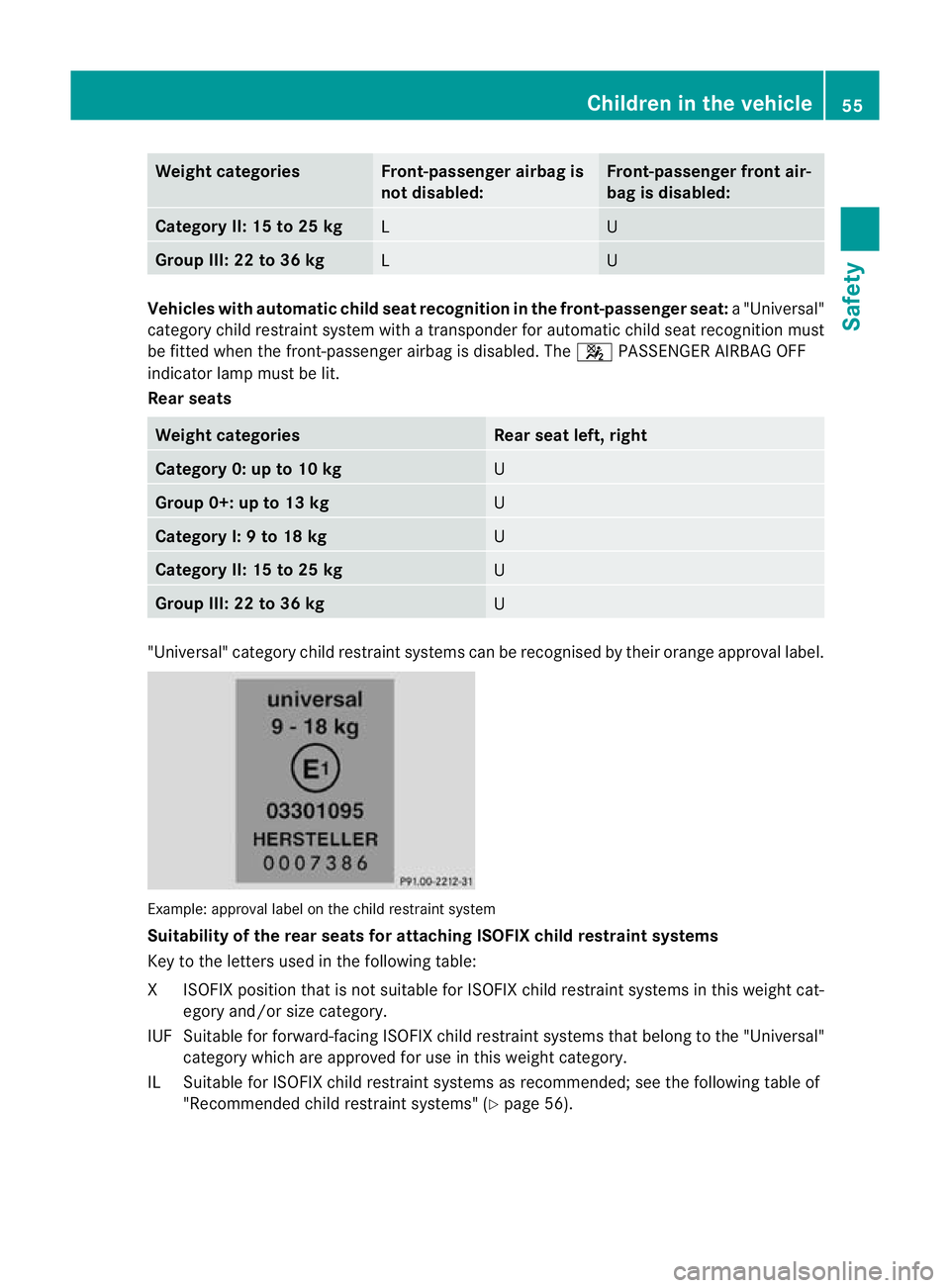
"Universal" category child restraint systems can be recognised by their orange approval label.
Example: approval label on the child restrain
tsystem
Suitability of the rear seats for attaching ISOFIX child restraint systems
Key to the letters used in the following table:
XI SOFIX position tha tis not suitable for ISOFIX child restraint systems in this weight cat-
egory and/or size category.
IUF Suitable for forward-facing ISOFIX child restraint systems that belong to the "Universal" category which are approved for use in this weight category.
IL Suitable for ISOFIX child restraint systems as recommended; see the following table of "Recommended child restraint systems" (Y page 56). Children in the vehicle
55Safety Z
Page 67 of 357

by braking and limiting the engine output until
the vehicle/trailer combination has stabi-
lised.
Trailer stabilisation is active above speeds of
about 60 km/h.
EBD (electronic brake force distribu-
tion)
i Observe the "Important safety notes" sec-
tion (Y page 60). G
WARNING
If EBDh as malfunctioned, the rear wheels can
still lock, e.g .unde rfull braking .This increa-
ses the risk of skidding and an accident.
You should therefore adapt your driving style
to the different handling characteristics. Have
the brake system checked at a qualified spe-
cialist workshop.
Observe information regarding indicator and
warning lamps (Y page 254) as well as dis-
play messages (Y page 231).
EBD monitors and controls the brake pres-
sure on the rear wheels to improve driving
stability while braking. ADAPTIVE BRAKE
ADAPTIVE BRAKE provides increased braking
safety. In addition to the braking function,
ADAPTIVE BRAKE also has the HOLD function
(Y page 196) and hill start assist
(Y page 145). Anti-theft systems
Immobiliser
X To activate: remove the key from the igni-
tion lock.
X To deactivate: switch on the ignition.
The immobiliser prevents your vehicle from
being started without the correct key. i
The immobiliser is always deactivated
when you start the engine. ATA (Anti-Theft Alarm system)
X
To prime: lock the vehicle with the key.
Indicator lamp :flashes. The alarm sys-
tem is primed after approximately
15 seconds.
X To deactivate: unlock the vehicle with the
key.
i If you then do not open a door or the rear
door, the alarm system switches back on
again after approximately 40 seconds.
X To stop the alarm: insert the key into the
ignition lock.
The alarm is switched off.
or
X Press the %or& button on the key.
The alarm is switched off.
Av isual and audible alarm is triggered if the
alarm system is primed and you open:
R a door
R a door using the emergency key element
R the rear door/tailgate
R the bonnet
The alarm is also triggered if:
R the position of the vehicle is changed
R a window is smashed
The alarm is not switched off, even if you
close the open door that has triggered it,
for example. 64
Anti-theft systemsSafety
Page 68 of 357

Tow-away protection
Function An audible and visual alar
mis triggered if your
vehicle's angle of inclination is altered while
tow-away protection is primed. This occurs if
the vehicle is jacked up on one side, for exam-
ple.
Activating X
To prime: lock the vehicle with the key.
Tow-away protection is primed after
approximately 30 seconds.
Switching off X
To deactivate: unlock the vehicle with the
key.
Tow-away protection is switched off auto-
matically.
i To prevent a false alarm, deactivate tow-
away protection manually if your vehicle:
R is being transported
R is being loaded onto a ferry or car trans-
porter, for example
R is parked on a movable surface, e.g. in a
split-level garage
Deactivating X
Remove the key from the ignition lock.
X Press button :.
Indicator lamp ;lights up briefly.
X Lock the vehicle with the key.
Tow-away protection remains deactivated
until the vehicle is unlocked and locked
again. Interior motion sensor
Function When the interior motion sensor is primed, a
visual and audible alarm is triggered if move-
ment is detected in the vehicle interior. This
can occur if someone reaches into the vehicle
interior, for example.
Activating
X
Make sure that:
R
the side windows are closed.
R the sliding sunroof is closed.
R there are no objects, e.g. mascots, hang-
ing on the rear-view mirror or on the grab
handles on the roof trim.
This will prevent false alarms.
X Lock the vehicle with the key.
The interior motion sensor is primed after
approximately 30 seconds.
Switching off X
Unlock the vehicle with the key.
The interior motion sensor is switched off
automatically.
i To prevent a false alarm, deactivate the
interior motion sensor if you lock your vehi-
cle and:
R people or animals remain in the vehicle.
R the side windows remain open.
R the sliding sunroof remains open. Anti-theft systems
65Safety Z
Page 69 of 357

Deactivating
X
Remove the key from the ignition lock.
X Press button :.
Indicator lamp ;lights up briefly.
X Loc kthe vehicle with the key.
The interior motion sensor remains deacti-
vated until the vehicle is unlocked and
locked again. 66
Anti-theft systemsSafety