Page 311 of 389
tha
tno ignition position has been selected
with KEYLESS-GO. All indicator lamps must be
off in the instrument panel.
! Make sure that the windscreen wipers are
not folded away from the windscreen. Oth-
erwise, you could damage the windscreen
wipers or the bonnet. X
Make sure that the windscreen wipers are
switched off.
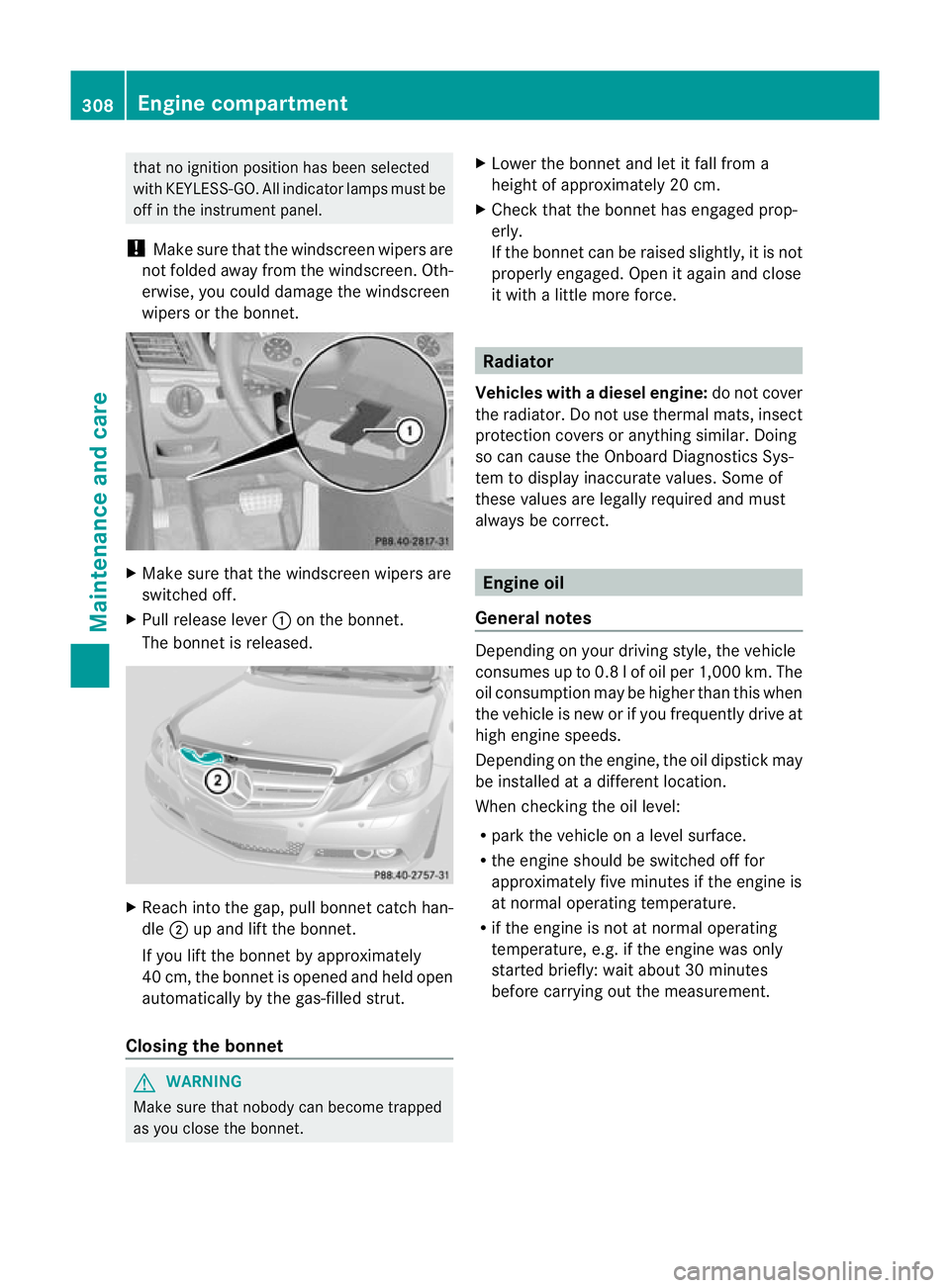
X Pull release lever :on the bonnet.
The bonnet is released. X
Reach into the gap, pull bonnet catch han-
dle ;up and lift the bonnet.
If you lift the bonnet by approximately
40 cm, the bonnet is opened and held open
automatically by the gas-filled strut.
Closing the bonnet G
WARNING
Make sure that nobody can become trapped
as you close the bonnet. X
Lower the bonnet and let it fall from a
height of approximately 20 cm.
X Check that the bonnet has engaged prop-
erly.
If the bonnet can be raised slightly, it is not
properly engaged. Open it again and close
it with a little more force. Radiator
Vehicles with adiesel engine: do not cover
the radiator .Do not use thermal mats, insect
protection covers or anything similar. Doing
so can cause the Onboard Diagnostics Sys-
tem to display inaccurate values. Some of
these values are legally required and must
always be correct. Engine oil
General notes Depending on your driving style, the vehicle
consumes up to 0.8 l of oil per 1,000 km. The
oil consumption may be higher than this when
the vehicle is new or if you frequently drive at
high engine speeds.
Depending on the engine, the oil dipstick may
be installed at a different location.
When checking the oil level:
R park the vehicle on a level surface.
R the engine should be switched off for
approximately five minutes if the engine is
at normal operating temperature.
R if the engine is not at normal operating
temperature, e.g. if the engine was only
started briefly: wait about 30 minutes
before carrying out the measurement. 308
Engine compartmentMaintenance and care
Page 351 of 389
Raising the vehicle
G
WARNING
If you do not position the jack correctly at the
appropriate jacking point of the vehicle, the
jack could tip ove rwith the vehicle raised.
There is a risk of injury.
Only position the jac katthe appropriate jack-
ing point of the vehicle. The base of the jack
must be positioned vertically, directly under
the jacking point of the vehicle.
The following must be observed when raising
the vehicle:
R to raise the vehicle, only use the vehicle-
specific jack that has been tested and
approved by Mercedes-Benz. If the jack is
used incorrectly, it could tip over while the
vehicle is raised.
R the jack is designed only to raise and hold
the vehicle for a short time while a wheel
is being changed. It is not suited for per-
forming maintenance work under the vehi-
cle.
R avoid changing the wheel on uphill and
downhill slopes.
R before raising the vehicle, secure it from
rolling away by applying the parking brake
and inserting wheel chocks. Never disen-
gage the parking brake while the vehicle is
raised.
R the jack must be placed on a firm, flat and
non-slip surface. On a loose surface, a
large, load-bearing underlay must be used.
On a slippery surface, a non-slip underlay
must be used, e.g. rubber mats.
R do not use wooden blocks or similar
objects as a jack underlay.O therwise, the
jack will not be able to achieve its load-
bearing capacity due to the restricted
height.
R make sure tha tthe distance between the
underside of the tyres and the ground does
not exceed 3 cm.
R never place your hands or feet under the
raised vehicle. R
never lie under the raised vehicle.
R never start the engine when the vehicle is
raised.
R never open or close a door or the boot lid
when the vehicle is raised.
R make sure that no persons are present in
the vehicle when the vehicle is raised. X
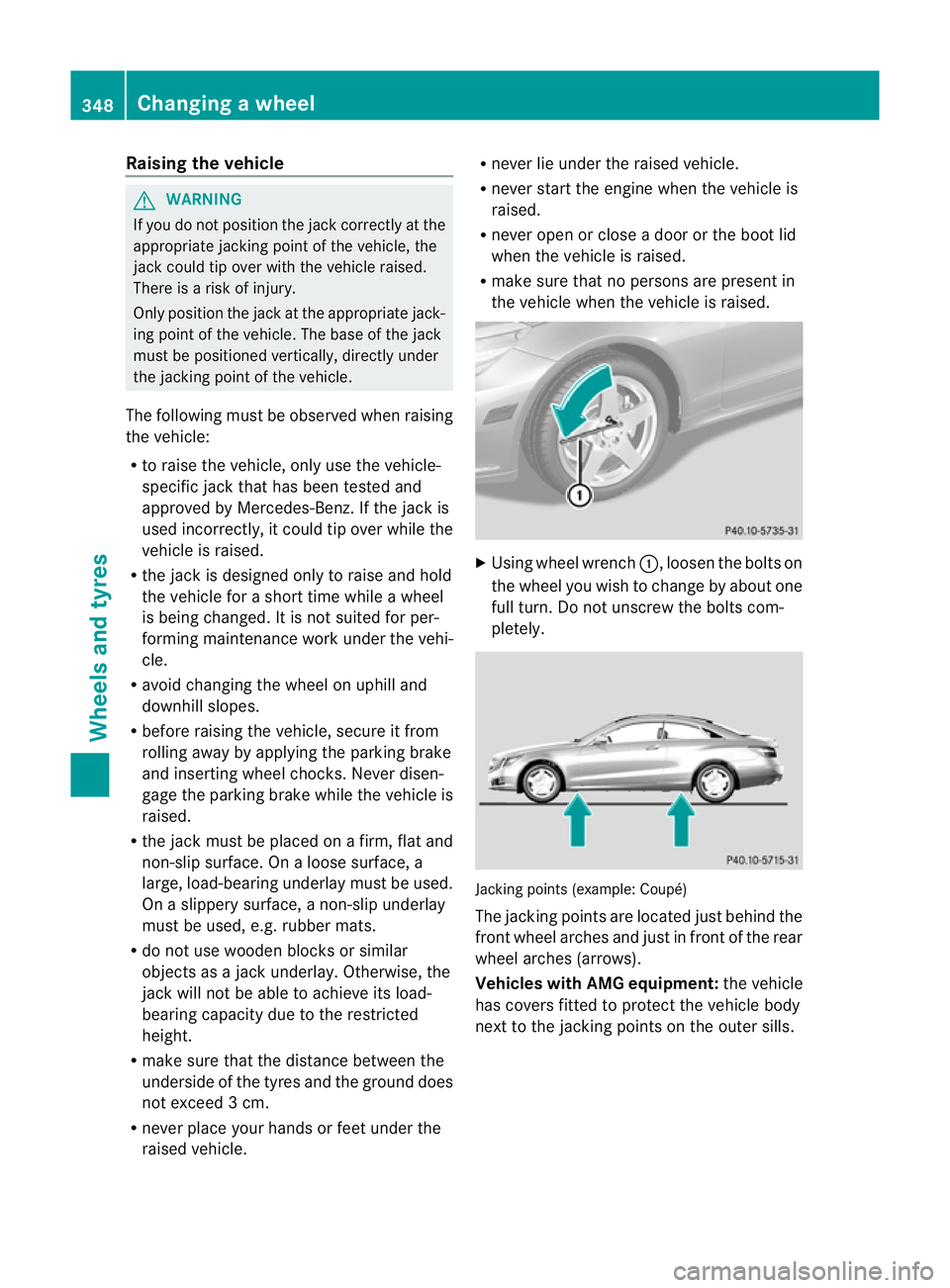
Using wheel wrench :, loosen the bolts on
the wheel you wish to change by about one
full turn. Do not unscrew the bolts com-
pletely. Jacking points (example: Coupé)
The jacking points are located just behind the
front wheel arches and just in front of the rear
wheel arches (arrows).
Vehicles with AMG equipment: the vehicle
has covers fitted to protect the vehicle body
next to the jacking points on the outer sills. 348
Changing
awheelWheels and tyres
Page 381 of 389

At temperatures below freezing:
X
Fill the washe rfluid reservoir with a mixture
of water and washer fluid, e.g. MB Winter-
Fit.
Adapt the mixing ratio to the outside temper-
ature.
R Down to Ò10 †: mix 1 part MB WinterFit
with 2parts water.
R Down to Ò20 †: mix 1 part MB WinterFit
with 1 part water.
R Down to Ò29 †: mix 2 parts MB WinterFit
with 1 part water.
i Add washe rfluid concentrate, e.g. MB
SummerFit or MB WinterFit, to the washer
fluid all year round. Vehicle data
General notes
Please note that for the specified vehicle
data:
R the heights specified may vary as a result
of:
-tyres
- load
- conditio nofthe suspension
- optional equipment
R items of optional equipment increase the
unladen weight and reduce the maximum
payload. The unladen weight is specified in
accordance with EC directive and includes:
-driver (68 kg)
- luggage (7 kg)
- all fluids (fuel tank 90 % full)
R vehicle-specific weight information can be
found on the vehicle identification plate
(Y page 371).
R only for certain countries: you can find vehi-
cle-specific vehicle data in the COC docu-
ments (CERTIFICATE OF CONFORMITY).
These documents are delivered with your
vehicle. Dimensions and weights
model : Opening height
All models (except
E 500 BlueEFFI-
CIENCY), Coupé
1682 mm
All models (except
E 500 BlueEFFI-
CIENCY), Cabriolet
1555 mm
E 500 BlueEFFI-
CIENCY, Coupé
1676 mm
E 500 BlueEFFI-
CIENCY, Cabriolet
1553 mm
Missing values were not available at the time
of going to print.
All models
Vehicle width including
exterior mirrors
2015 mm
Wheelbase
2760 mm
Vehicle height when
opening/closing the roof,
Cabriolet
Maximum roof load,
Coupé only
100 kg
Maximum boot load
100 kg378
Vehicle dataTechnical data
Page 382 of 389

E 200 BlueEFFICIENCY
Vehicle length
4698 mm
Vehicle widt
hexcluding
exterior mirrors 1786 mm
Vehicle height, Coupé
1397 mm
Vehicle height, Cabriolet
1398 mm
Unladen weight, manual
transmission, Coupé
1560 kg
Unladen weight, manual
transmission, Cabriolet
1685 kg
Unladen weight, auto-
matic transmission,
Coupé
1585 kg
Unladen weight, auto-
matic transmission, Cab-
riolet
1710 kg
E 250 BlueEFFICIENCY
Vehicle length
4698 mm
Vehicle width excluding
exterior mirrors
1786 mm
Vehicle height, Coupé
1397 mm
Vehicle height, Cabriolet
1398 mm
Unladen weight, Coupé
1600 kg
Unladen weight, Cabriolet
1725 kg
E 300 BlueEFFICIENCY
E 350 BlueEFFICIENCY
Vehicle length
4698 mm
Vehicle width excluding
exterior mirrors
1786 mm
Vehicle height, Coupé
1397 mm
Vehicle height, Cabriolet
1398 mm E 300 BlueEFFICIENCY
E 350 BlueEFFICIENCY
Unladen weight, Coupé
1660 kg
Unladen weight, Cabriolet
1785 kg
E 500 BlueEFFICIENCY
Vehicle length
4717 mm
Vehicle width excluding
exterior mirrors
Vehicle height, Coupé
1395 mm
Vehicle height, Cabriolet
1397 mm
Unladen weight, Coupé
1795 kg
Unladen weight, Cabriolet
1920 kg
E 220 CDI BlueEFFI-
CIENCY
Vehicle length
4698 mm
Vehicle width excluding
exterior mirrors
1786 mm
Vehicle height, Coupé
1397 mm
Vehicle height, Cabriolet
1398 mm
Unladen weight, manual
transmission, Coupé
1670 kg
Unladen weight, manual
transmission, Cabriolet
1795 kg
Unladen weight, auto-
matic transmission,
Coupé
1680 kg
Unladen weight, auto-
matic transmission, Cab-
riolet
1805 kgVehicle data
379Technical data Z
Page 383 of 389

E 250 CDI BlueEFFI-
CIENCY
Vehicle length
4698 mm
Vehicle widt
hexcluding
exterior mirrors 1786 mm
Vehicle height, Coupé
1397 mm
Vehicle height, Cabriolet
1398 mm
Unladen weight, manual
transmission
1700 kg
Unladen weight, auto-
matic transmission
1825 kg
E 350 CDI BlueEFFI-
CIENCY
Vehicle length
4698 mm
Vehicle width excluding
exterior mirrors
1786 mm
Vehicle height, Coupé
1397 mm
Vehicle height, Cabriolet
1398 mm
Unladen weight, Coupé
1735 kg
Unladen weight, Cabriolet
1865 kg
Trailer tow hitch
Mounting dimensions
! If you have a trailer tow hitch retrofitted,
changes to the cooling system may be nec-
essary, depending on the vehicle type.
If you have a trailer tow hitch retrofitted,
observe the anchorage points on the chas-
sis frame. Example: anchorage points for the trailer tow hitch
:
Anchorage points
; Overhang dimension
= Rear axle centre line
For trailer tow hitches fitted at the factory, the
overhang dimension including the protective
covering is 1181 mm. Missing values for the
E5 00 BlueEFFICIENCY model were not avail-
able at the time of going to print. 380
Trailer tow hitchTechnical data