Page 258 of 381
WARNING:Vehicles with a higher center of gravity such as
utility and four-wheel drive vehicles handle differently than
vehicles with a lower center of gravity. Utility and four-wheel drive
vehicles arenotdesigned for cornering at speeds as high as passenger
cars any more than low-slung sports cars are designed to perform
satisfactorily under off-road conditions. Avoid sharp turns, excessive
speed and abrupt maneuvers in these vehicles. Failure to drive
cautiously could result in an increased risk of loss of vehicle control,
vehicle rollover, personal injury and death.
•If the vehicle goes from one type of surface to another (i.e., from
concrete to gravel) there will be a change in the way the vehicle
responds to a maneuver (steering, acceleration or braking). Again,
avoid these abrupt inputs.
Control Trac�four–wheel drive system (if equipped)
When a four–wheel drive mode is selected, the Control Trac system uses
all four wheels to power the vehicle. This increases traction, enabling
you to drive over terrain and road conditions that a conventional
two-wheel drive vehicle cannot.
Power is supplied to all four wheels through a transfer case. On
four–wheel drive vehicles, the transfer case allows you to select
four–wheel drive when necessary. Information on transfer case operation
and shifting procedures can be found in this chapter. Information on
transfer case maintenance can be found in theMaintenance and
Specificationschapter. You should become thoroughly familiar with this
information before you operate your vehicle.
Normal characteristics
On some four–wheel drive models, the initial shift from two-wheel drive
to four–wheel drive while the vehicle is moving can cause some
momentary clunk and ratcheting sounds. This is the front drivetrain
coming up to speed and engaging the front wheels, and is not cause for
concern.
Sand
When driving over sand, try to keep all four wheels on the most solid
area of the trail. Avoid reducing the tire pressures but shift to a lower
gear and drive steadily through the terrain. Apply the accelerator slowly
and avoid spinning the wheels.
Note:If air is released from your tires, the Tire Pressure Monitoring
System (TPMS) indicator light may illuminate.
Driving
258
2012 Navigator(nav)
Owners Guide, 1st Printing
USA(fus)
Page 271 of 381
Power distribution box
The power distribution box is located in the engine compartment. The
power distribution box contains high-current fuses that protect your
vehicle’s main electrical systems from overloads.
WARNING:Always disconnect the battery before servicing high
current fuses.
WARNING:To reduce risk of electrical shock, always replace
the cover to the power distribution box before reconnecting the
battery or refilling fluid reservoirs.
If the battery has been disconnected and reconnected, refer to the
Batterysection of theMaintenance and Specificationschapter.
The high-current fuses are coded as follows:
Fuse/Relay
LocationFuse Amp
RatingProtected Circuits
1 — Powertrain control module
(PCM) relay
2 — Starter relay
3 — Blower motor relay
Roadside Emergencies
271
2012 Navigator(nav)
Owners Guide, 1st Printing
USA(fus)
Page 283 of 381

Stowing the spare tire
1. Lay the tire on the ground, near the rear of the vehicle, with the valve
stem side facing up.
2. Slide the wheel partially under
the vehicle and install the retainer
through the wheel center. If
equipped, you may have to remove
the wheel center cap prior to
pushing the retainer through the
center of the wheel. To remove the
center cap, press it off with the jack
tool from the inner side of the
wheel. After doing so, pull on the
cable to align the components at the
end of the cable.
3. Assemble the jack handle and
winch extension (as shown in
illustration), then insert the winch
extension through the access hole
behind the 3rd row seat and engage the winch.
4. Turn the jack handle clockwise until the tire is raised to its stowed
position underneath the vehicle. The wrench will become harder to turn
and the spare tire winch will ratchet or slip when the tire is raised to
maximum tightness. A clicking sound will be heard from the winch
indicating that the tire is properly stowed.
5. Disassemble the jack tool and winch extension and snap them back
into the tool tray. Reinstall the jack bag properly around the jack and
tool assembly tray, making sure the strap is securely fastened. Close the
access hole with the rubber plug. Reinstall the tray into the vehicle and
secure it with the wing nut (turn clockwise until tight).
WHEEL LUG NUT TORQUE SPECIFICATIONS
Retighten the lug nuts to the specified torque within 100 miles (160 km)
after any wheel disturbance (rotation, flat tire, wheel removal, etc.).
Bolt size Wheel lug nut torque*
ft-lb N•m
M14 x 2.0 150 200
* Torque specifications are for nut and bolt threads free of dirt and
rust. Use only Ford recommended replacement fasteners.
Roadside Emergencies
283
2012 Navigator(nav)
Owners Guide, 1st Printing
USA(fus)
Page 284 of 381
WARNING:When a wheel is installed, always remove any
corrosion, dirt or foreign materials present on the mounting
surfaces of the wheel or the surface of the wheel hub, brake drum or
brake disc that contacts the wheel. Ensure that any fasteners that
attach the rotor to the hub are secured so they do not interfere with
the mounting surfaces of the wheel. Installing wheels without correct
metal-to-metal contact at the wheel mounting surfaces can cause the
wheel nuts to loosen and the wheel to come off while the vehicle is in
motion, resulting in loss of control.
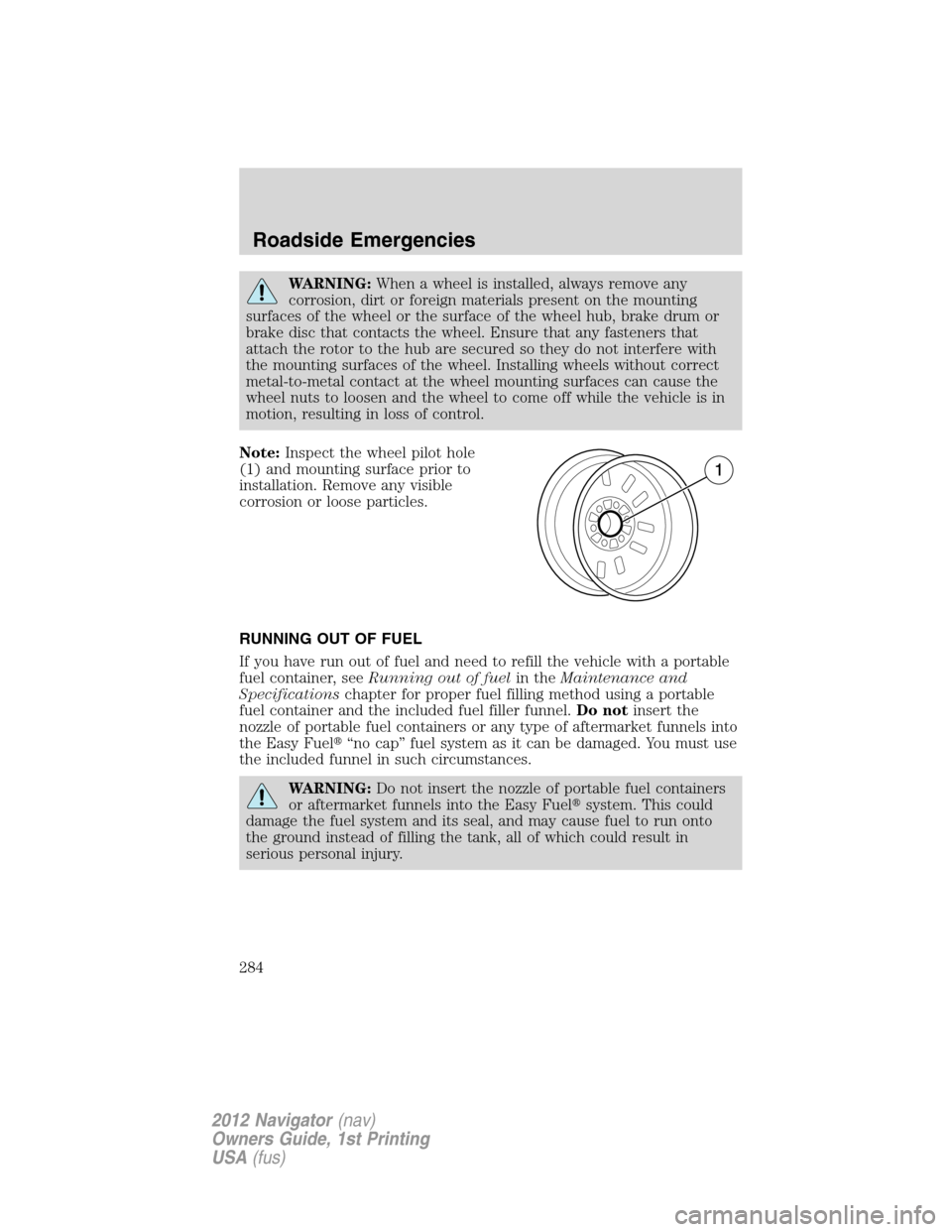
Note:Inspect the wheel pilot hole
(1) and mounting surface prior to
installation. Remove any visible
corrosion or loose particles.
RUNNING OUT OF FUEL
If you have run out of fuel and need to refill the vehicle with a portable
fuel container, seeRunning out of fuelin theMaintenance and
Specificationschapter for proper fuel filling method using a portable
fuel container and the included fuel filler funnel.Do notinsert the
nozzle of portable fuel containers or any type of aftermarket funnels into
the Easy Fuel�“no cap” fuel system as it can be damaged. You must use
the included funnel in such circumstances.
WARNING:Do not insert the nozzle of portable fuel containers
or aftermarket funnels into the Easy Fuel�system. This could
damage the fuel system and its seal, and may cause fuel to run onto
the ground instead of filling the tank, all of which could result in
serious personal injury.
Roadside Emergencies
284
2012 Navigator(nav)
Owners Guide, 1st Printing
USA(fus)
Page 305 of 381

•To check for compatibility, first test any cleaner or stain remover on
an inconspicuous part of the leather.
•Do not use household cleaning products, alcohol solutions, solvents or
cleaners intended for rubber, vinyl and plastics, or oil/petroleum-based
leather conditioners. These products may cause premature wearing or
damage to the leather.
UNDERBODY
Flush the complete underside of your vehicle frequently. Keep body and
door drain holes free from packed dirt.
FORD AND LINCOLN CAR CARE PRODUCTS
Your Ford or Lincoln authorized dealer has many quality products
available to clean your vehicle and protect its finishes. These quality
products have been specifically engineered to fulfill your automotive
needs; they are custom designed to complement the style and
appearance of your vehicle. Each product is made from high quality
materials that meet or exceed rigid specifications. For best results, use
the following products or products of equivalent quality:
Motorcraft�Bug and Tar Remover (ZC-42)
Motorcraft�Custom Bright Metal Cleaner (ZC-15)
Motorcraft�Detail Wash (ZC-3-A)
Motorcraft�Dusting Cloth (ZC-24)
Motorcraft�Engine Shampoo and Degreaser (U.S. only) (ZC-20)
Motorcraft�Engine Shampoo (Canada only) (CXC-66-A)
Motorcraft�Multi-Purpose Cleaner (Canada only) (CXC-101)
Motorcraft�Premium Glass Cleaner (Canada only) (CXC-100)
Motorcraft�Premium Quality Windshield Washer Fluid (Canada only)
[CXC-37-(A, B, D or F)]
Motorcraft�Premium Windshield Washer Concentrate (U.S. only)
(ZC-32-A)
Motorcraft�Professional Strength Carpet & Upholstery Cleaner (ZC-54)
Motorcraft�Spot and Stain Remover (U.S. only) (ZC-14)
Motorcraft�Ultra-Clear Spray Glass Cleaner (ZC-23)
Motorcraft�Vinyl Cleaner (Canada only) (CXC-93)
Motorcraft�Wheel and Tire Cleaner (ZC-37-A)
Cleaning
305
2012 Navigator(nav)
Owners Guide, 1st Printing
USA(fus)
Page 306 of 381

SERVICE RECOMMENDATIONS
To help you service your vehicle, we providescheduled maintenance
informationwhich makes tracking routine service easy.
If your vehicle requires professional service, your authorized dealer can
provide the necessary parts and service. Check yourWarranty Guideto
find out which parts and services are covered.
Use only recommended fuels, lubricants, fluids and service parts
conforming to specifications. Motorcraft�parts are designed and built to
provide the best performance in your vehicle.
PRECAUTIONS WHEN SERVICING YOUR VEHICLE
•Do not work on a hot engine.
•Make sure that nothing gets caught in moving parts.
•Do not work on a vehicle with the engine running in an enclosed
space, unless you are sure you have enough ventilation.
•Keep all open flames and other lit material away from the battery and
all fuel related parts.
WARNING:Turn off the power running boards, if equipped,
before working under the vehicle, jacking or placing any object
under the vehicle. Never place your hand between the extended
running board and the vehicle. A moving running board may cause
injury.
Working with the engine off
1. Set the parking brake and ensure the gearshift is securely latched in P
(Park).
2. Turn off the engine and remove the key.
3. Block the wheels to prevent the vehicle from moving unexpectedly.
Working with the engine on
WARNING:To reduce the risk of vehicle damage and/or
personal burn injuries, do not start your engine with the air
cleaner removed and do not remove it while the engine is running.
1. Set the parking brake and shift to P (Park).
2. Block the wheels.
Maintenance and Specifications
306
2012 Navigator(nav)
Owners Guide, 1st Printing
USA(fus)
Page 307 of 381
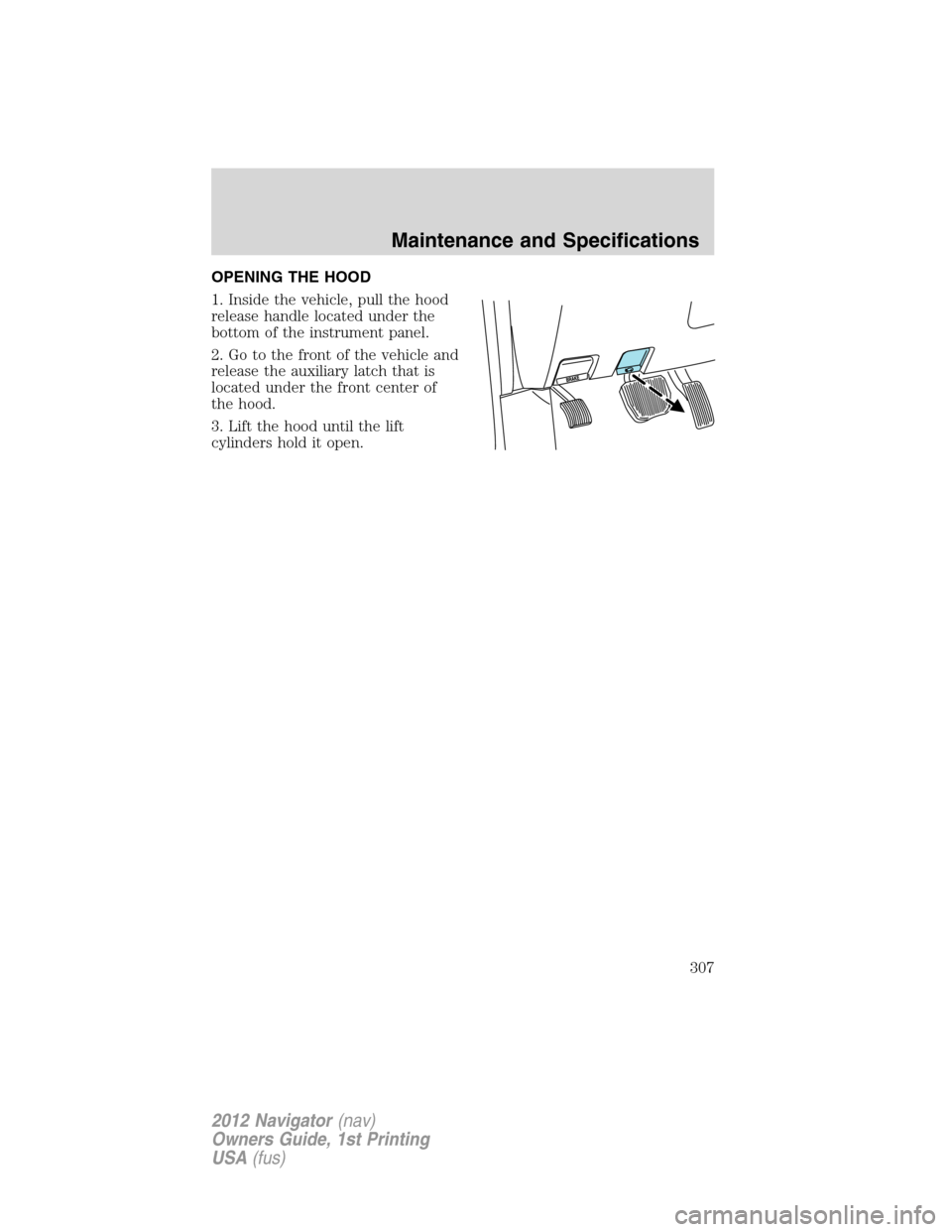
OPENING THE HOOD
1. Inside the vehicle, pull the hood
release handle located under the
bottom of the instrument panel.
2. Go to the front of the vehicle and
release the auxiliary latch that is
located under the front center of
the hood.
3. Lift the hood until the lift
cylinders hold it open.
Maintenance and Specifications
307
2012 Navigator(nav)
Owners Guide, 1st Printing
USA(fus)
Page 308 of 381
IDENTIFYING COMPONENTS IN THE ENGINE COMPARTMENT
5.4L V8
1. Windshield washer fluid reservoir
2. Engine oil dipstick
3. Brake fluid reservoir
4. Engine coolant reservoir
5. Air filter assembly
6. Power steering fluid reservoir
7. Power distribution box
8. Engine oil filler cap
9. Battery
Maintenance and Specifications
308
2012 Navigator(nav)
Owners Guide, 1st Printing
USA(fus)