2012 LINCOLN MKZ Rear seat
[x] Cancel search: Rear seatPage 155 of 347

How does the side air-curtain system work?
The design and development of the
side air curtain system included
recommended testing procedures
that were developed by a group of
automotive safety experts known as
the Side Airbag Technical Working
Group. These recommended testing
procedures help reduce the risk of
injuries related to the deployment of
side airbags (including side air
curtain systems).
The side air curtain system consists
of the following:
•An inflatable curtain with a gas
generator concealed behind the
headliner and above the doors.
•The headliner will flex to open
above the side doors to allow air
curtain deployment.
•The same warning light, electronic control and diagnostic unit as used
for the front airbags.
•Two crash sensors located under the outboard side of the front seats,
attached near the floor.
•Two crash sensors located at the base of the “C” pillars above the
wheel house.
Side air curtains and side airbags, in combination with safety belts, can
help reduce the risk of severe injuries in the event of a significant side
impact collision.
Children 12 years old and under should always be properly restrained in
the rear seats. The side air curtain will not interfere with children
restrained using a properly installed child or booster seat because it is
designed to inflate downward from the headliner above the doors along
the side window openings.
The side air curtains are mounted to the sheet metal above the first and
second row seats. In certain lateral collisions, the air curtain and
seat-mounted side airbag on the side affected by the collision will be
inflated, except that the passenger sensing system will deactivate the
passenger seat-mounted side airbag if it detects an empty unbuckled
Seating and Safety Restraints
155
2012 MKZ(378)
Owners Guide, 1st Printing
USA(fus)
Page 156 of 347

passenger seat or an unbuckled child or small person in the passenger
seat. The air curtain was designed to inflate between the side window
area and occupant to further enhance the protection provided to
occupants in side impact collisions. The seat-mounted side airbag was
designed to inflate between the door panel and occupant to further
enhance the protection provided occupants in side impact collisions.
The side air curtain system SRS is designed to activate when the vehicle
sustains lateral deceleration sufficient to cause the sensors to close an
electrical circuit that initiates air curtain and seat-mounted side airbag
inflation.
The fact that the side air curtain and seat-mounted side airbag did not
inflate in a collision does not mean that something is wrong with the
system. Rather, it means the forces were not of the type sufficient to
cause activation. The side air curtain system is designed to inflate in side
impact collisions, not roll-over, rear impact, frontal or near-frontal
collisions, unless the collision causes sufficient lateral deceleration.
WARNING:Several air bag system components get hot after
inflation. Do not touch them after inflation.
WARNING:If the side air
curtain has deployed,the
air curtain will not function
again. The side air curtain
system (including the A, B and
C pillar trim and headliner)
must be inspected and serviced
by an authorized dealer.If the
air curtain is not replaced, the
unrepaired area will increase the
risk of injury in a collision.
Seating and Safety Restraints
156
2012 MKZ(378)
Owners Guide, 1st Printing
USA(fus)
Page 159 of 347
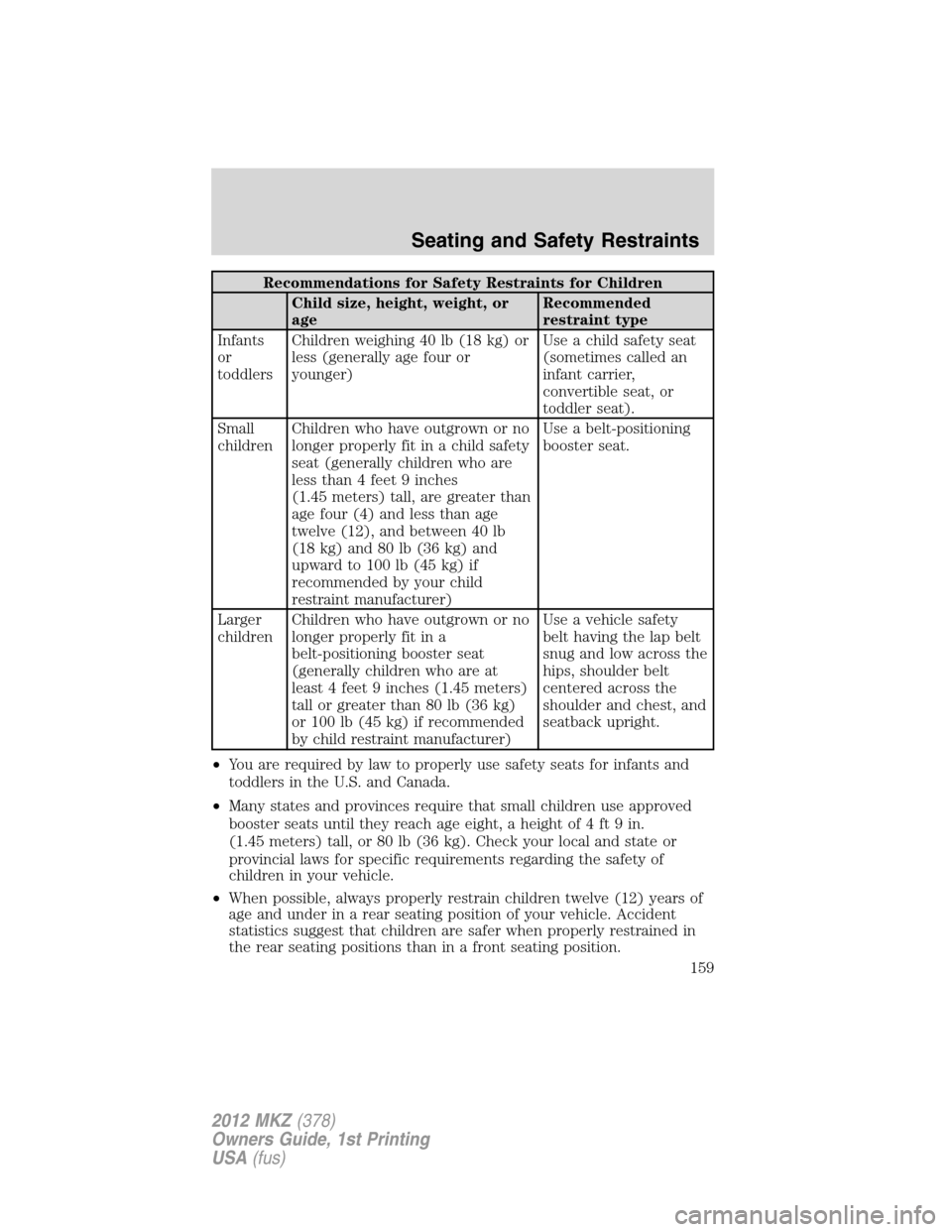
Recommendations for Safety Restraints for Children
Child size, height, weight, or
ageRecommended
restraint type
Infants
or
toddlersChildren weighing 40 lb (18 kg) or
less (generally age four or
younger)Use a child safety seat
(sometimes called an
infant carrier,
convertible seat, or
toddler seat).
Small
childrenChildren who have outgrown or no
longer properly fit in a child safety
seat (generally children who are
less than 4 feet 9 inches
(1.45 meters) tall, are greater than
age four (4) and less than age
twelve (12), and between 40 lb
(18 kg) and 80 lb (36 kg) and
upward to 100 lb (45 kg) if
recommended by your child
restraint manufacturer)Use a belt-positioning
booster seat.
Larger
childrenChildren who have outgrown or no
longer properly fit in a
belt-positioning booster seat
(generally children who are at
least 4 feet 9 inches (1.45 meters)
tall or greater than 80 lb (36 kg)
or 100 lb (45 kg) if recommended
by child restraint manufacturer)Use a vehicle safety
belt having the lap belt
snug and low across the
hips, shoulder belt
centered across the
shoulder and chest, and
seatback upright.
•You are required by law to properly use safety seats for infants and
toddlers in the U.S. and Canada.
•Many states and provinces require that small children use approved
booster seats until they reach age eight, a height of 4 ft 9 in.
(1.45 meters) tall, or 80 lb (36 kg). Check your local and state or
provincial laws for specific requirements regarding the safety of
children in your vehicle.
•When possible, always properly restrain children twelve (12) years of
age and under in a rear seating position of your vehicle. Accident
statistics suggest that children are safer when properly restrained in
the rear seating positions than in a front seating position.
Seating and Safety Restraints
159
2012 MKZ(378)
Owners Guide, 1st Printing
USA(fus)
Page 160 of 347
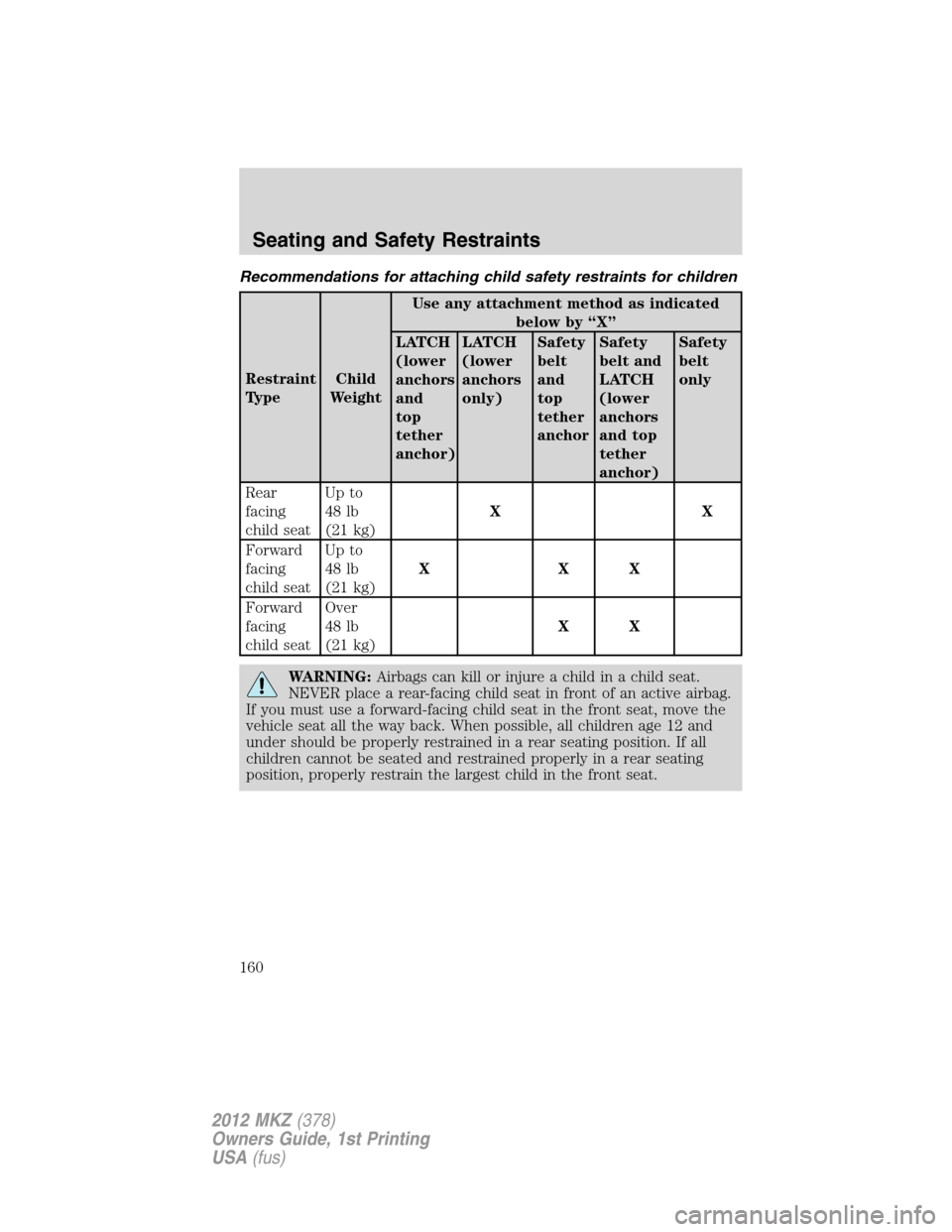
Recommendations for attaching child safety restraints for children
Restraint
TypeChild
WeightUse any attachment method as indicated
below by “X”
LATCH
(lower
anchors
and
top
tether
anchor)LATCH
(lower
anchors
only)Safety
belt
and
top
tether
anchorSafety
belt and
LATCH
(lower
anchors
and top
tether
anchor)Safety
belt
only
Rear
facing
child seatUp to
48 lb
(21 kg)XX
Forward
facing
child seatUp to
48 lb
(21 kg)XXX
Forward
facing
child seatOver
48 lb
(21 kg)XX
WARNING:Airbags can kill or injure a child in a child seat.
NEVER place a rear-facing child seat in front of an active airbag.
If you must use a forward-facing child seat in the front seat, move the
vehicle seat all the way back. When possible, all children age 12 and
under should be properly restrained in a rear seating position. If all
children cannot be seated and restrained properly in a rear seating
position, properly restrain the largest child in the front seat.
Seating and Safety Restraints
160
2012 MKZ(378)
Owners Guide, 1st Printing
USA(fus)
Page 163 of 347
SAFETY SEATS FOR CHILDREN
Infant and/or toddler seats
Use a safety seat that is recommended for the size and weight of the
child.
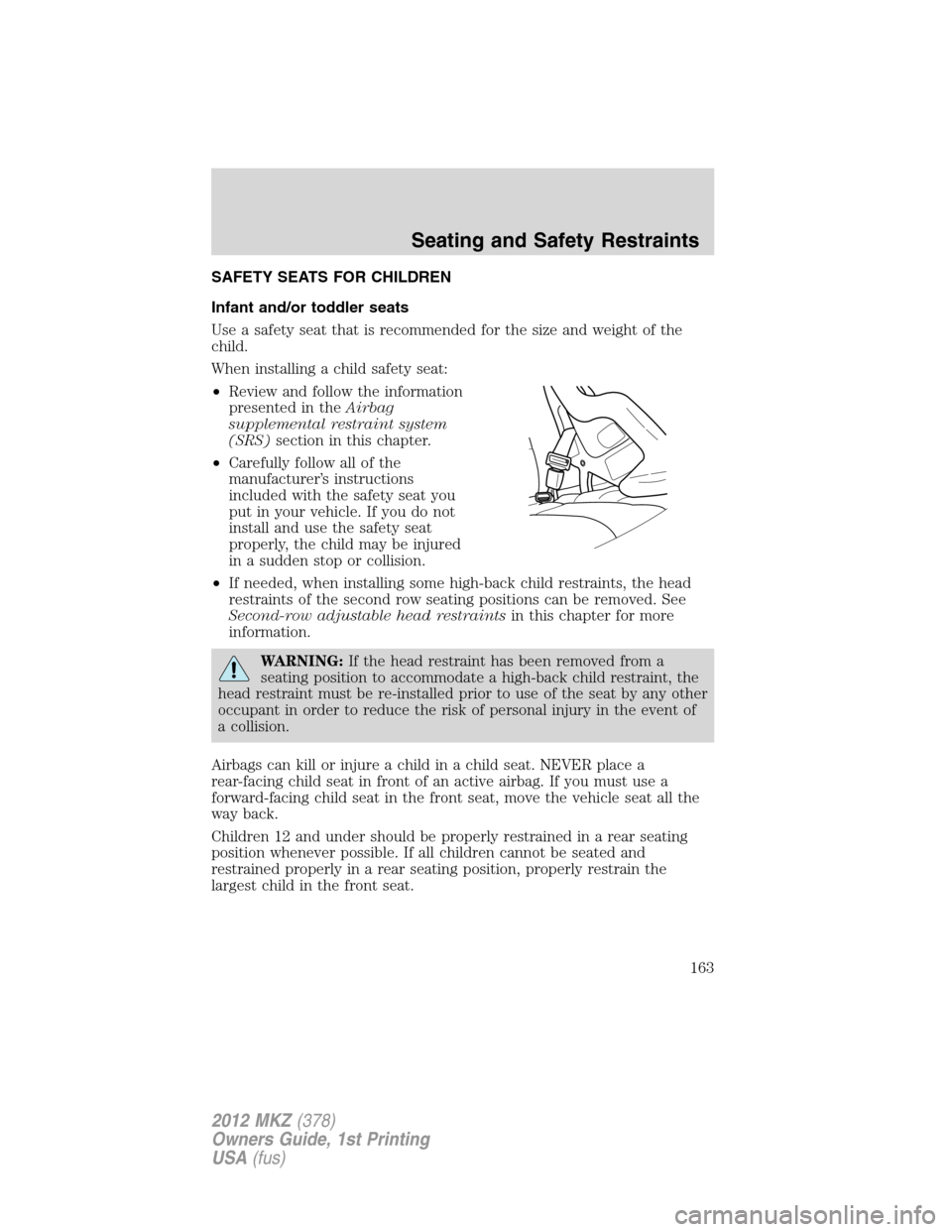
When installing a child safety seat:
•Review and follow the information
presented in theAirbag
supplemental restraint system
(SRS)section in this chapter.
•Carefully follow all of the
manufacturer’s instructions
included with the safety seat you
put in your vehicle. If you do not
install and use the safety seat
properly, the child may be injured
in a sudden stop or collision.
•If needed, when installing some high-back child restraints, the head
restraints of the second row seating positions can be removed. See
Second-row adjustable head restraintsin this chapter for more
information.
WARNING:If the head restraint has been removed from a
seating position to accommodate a high-back child restraint, the
head restraint must be re-installed prior to use of the seat by any other
occupant in order to reduce the risk of personal injury in the event of
a collision.
Airbags can kill or injure a child in a child seat. NEVER place a
rear-facing child seat in front of an active airbag. If you must use a
forward-facing child seat in the front seat, move the vehicle seat all the
way back.
Children 12 and under should be properly restrained in a rear seating
position whenever possible. If all children cannot be seated and
restrained properly in a rear seating position, properly restrain the
largest child in the front seat.
Seating and Safety Restraints
163
2012 MKZ(378)
Owners Guide, 1st Printing
USA(fus)
Page 164 of 347
Installing child safety seats with combination lap and shoulder
belts
Check to make sure the child seat is properly secured before each use.
When installing a child safety seat with combination lap/shoulder belts:
•Use the correct safety belt buckle for that seating position.
•Insert the belt tongue into the proper buckle until you hear a snap
and feel it latch. Make sure the tongue is securely fastened in the
buckle.
•Keep the buckle release button pointing up and away from the safety
seat, with the tongue between the child seat and the release button,
to help prevent accidental unbuckling.
•Place vehicle seat back in upright position.
•Put the safety belt in the automatic locking mode. Refer to Step 5
below. This vehicle does not require the use of a locking clip.
WARNING:Depending on where you secure a child restraint,
and depending on the child restraint design, you may block
access to certain safety belt buckle assemblies and/or LATCH lower
anchors, rendering those features potentially unusable. To avoid risk of
injury, occupants should only use seating positions where they are able
to be properly restrained.
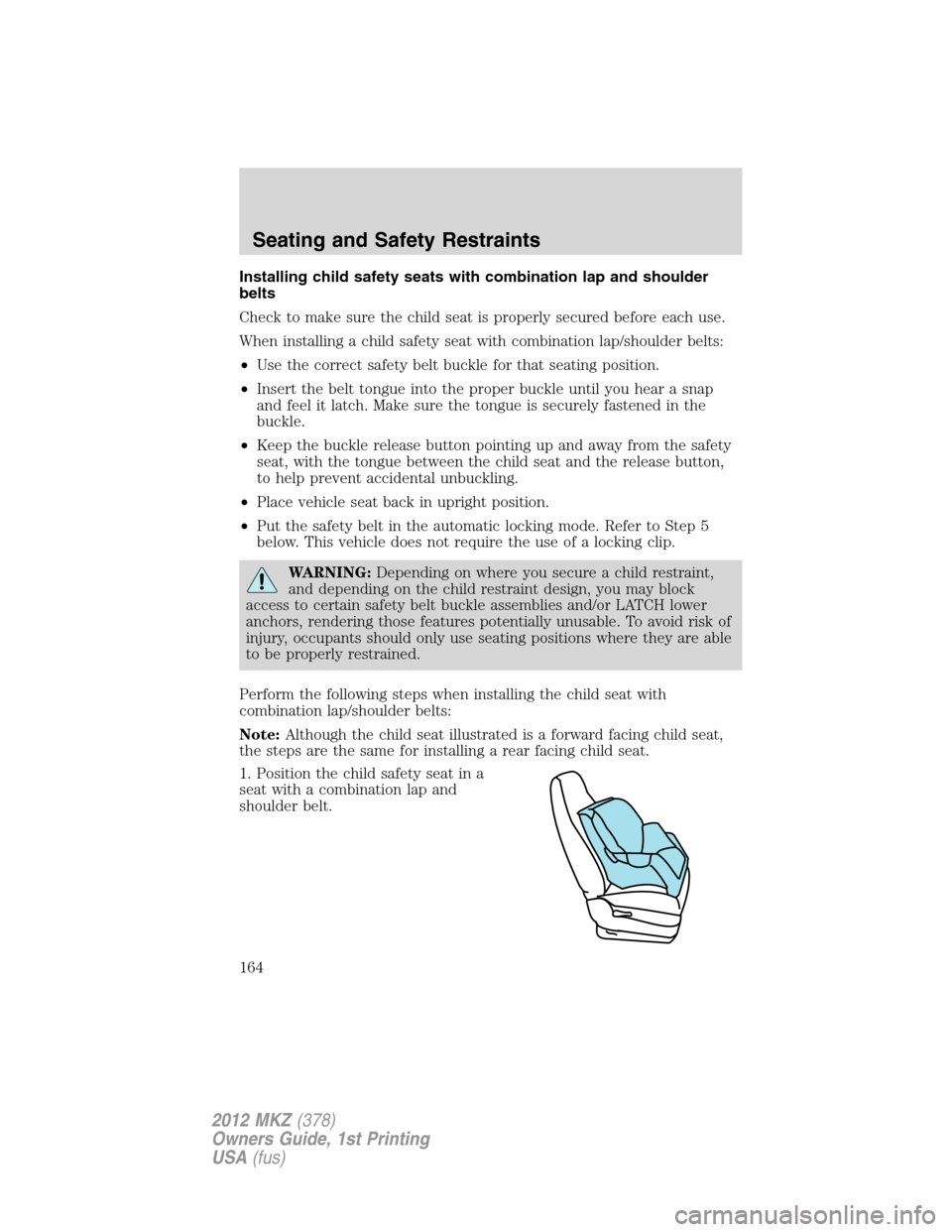
Perform the following steps when installing the child seat with
combination lap/shoulder belts:
Note:Although the child seat illustrated is a forward facing child seat,
the steps are the same for installing a rear facing child seat.
1. Position the child safety seat in a
seat with a combination lap and
shoulder belt.
Seating and Safety Restraints
164
2012 MKZ(378)
Owners Guide, 1st Printing
USA(fus)
Page 168 of 347
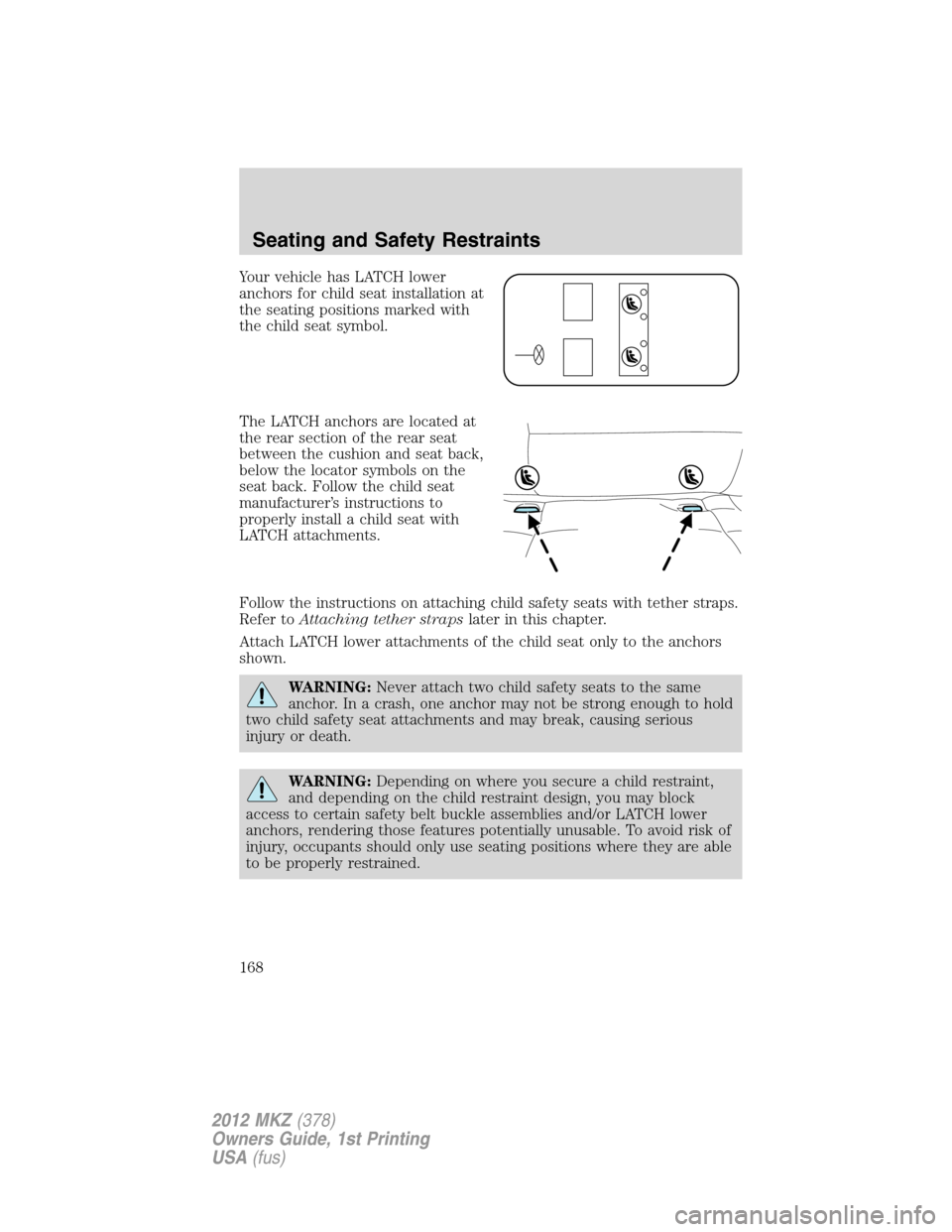
Your vehicle has LATCH lower
anchors for child seat installation at
the seating positions marked with
the child seat symbol.
The LATCH anchors are located at
the rear section of the rear seat
between the cushion and seat back,
below the locator symbols on the
seat back. Follow the child seat
manufacturer’s instructions to
properly install a child seat with
LATCH attachments.
Follow the instructions on attaching child safety seats with tether straps.
Refer toAttaching tether strapslater in this chapter.
Attach LATCH lower attachments of the child seat only to the anchors
shown.
WARNING:Never attach two child safety seats to the same
anchor. In a crash, one anchor may not be strong enough to hold
two child safety seat attachments and may break, causing serious
injury or death.
WARNING:Depending on where you secure a child restraint,
and depending on the child restraint design, you may block
access to certain safety belt buckle assemblies and/or LATCH lower
anchors, rendering those features potentially unusable. To avoid risk of
injury, occupants should only use seating positions where they are able
to be properly restrained.
Seating and Safety Restraints
168
2012 MKZ(378)
Owners Guide, 1st Printing
USA(fus)
Page 169 of 347
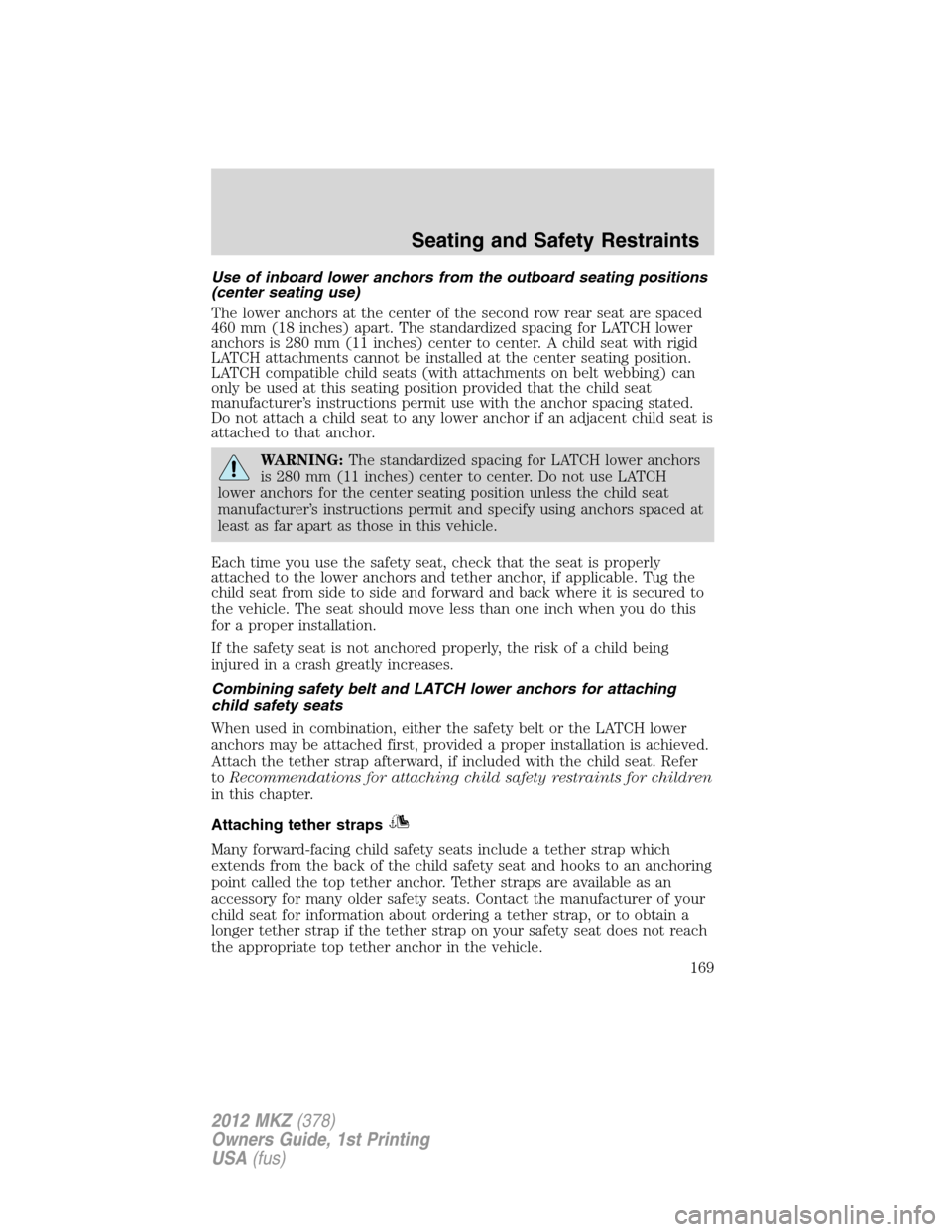
Use of inboard lower anchors from the outboard seating positions
(center seating use)
The lower anchors at the center of the second row rear seat are spaced
460 mm (18 inches) apart. The standardized spacing for LATCH lower
anchors is 280 mm (11 inches) center to center. A child seat with rigid
LATCH attachments cannot be installed at the center seating position.
LATCH compatible child seats (with attachments on belt webbing) can
only be used at this seating position provided that the child seat
manufacturer’s instructions permit use with the anchor spacing stated.
Do not attach a child seat to any lower anchor if an adjacent child seat is
attached to that anchor.
WARNING:The standardized spacing for LATCH lower anchors
is 280 mm (11 inches) center to center. Do not use LATCH
lower anchors for the center seating position unless the child seat
manufacturer’s instructions permit and specify using anchors spaced at
least as far apart as those in this vehicle.
Each time you use the safety seat, check that the seat is properly
attached to the lower anchors and tether anchor, if applicable. Tug the
child seat from side to side and forward and back where it is secured to
the vehicle. The seat should move less than one inch when you do this
for a proper installation.
If the safety seat is not anchored properly, the risk of a child being
injured in a crash greatly increases.
Combining safety belt and LATCH lower anchors for attaching
child safety seats
When used in combination, either the safety belt or the LATCH lower
anchors may be attached first, provided a proper installation is achieved.
Attach the tether strap afterward, if included with the child seat. Refer
toRecommendations for attaching child safety restraints for children
in this chapter.
Attaching tether straps
Many forward-facing child safety seats include a tether strap which
extends from the back of the child safety seat and hooks to an anchoring
point called the top tether anchor. Tether straps are available as an
accessory for many older safety seats. Contact the manufacturer of your
child seat for information about ordering a tether strap, or to obtain a
longer tether strap if the tether strap on your safety seat does not reach
the appropriate top tether anchor in the vehicle.
Seating and Safety Restraints
169
2012 MKZ(378)
Owners Guide, 1st Printing
USA(fus)