Page 316 of 437

Vehicles sold in the U.S. : Using roadside assistance
Complete the roadside assistance identification card and place it in your
wallet for quick reference. This card is found in the Owner’s Guide
portfolio in the glove compartment.
U.S. Lincoln vehicle customers who require Roadside Assistance, call
1-800-521-4140.
If you need to arrange roadside assistance for yourself, Ford Motor
Company will reimburse a reasonable amount for towing to the nearest
dealership within 35 miles (56 km). To obtain reimbursement
information, U.S. Lincoln vehicle customers call 1-800-521-4140.
Customers will be asked to submit their original receipts.
Vehicles sold in Canada : Getting roadside assistance
Canadian customers who require roadside assistance, call 1–800–665–2006.
Vehicles sold in Canada : Using roadside assistance
Complete the roadside assistance identification card and place it in your
wallet for quick reference. In Canada, the card is found in the Warranty
Guide in the glove box.
Canadian Roadside coverage and benefits may differ from the U.S.
coverage. Please refer to your Warranty Guide or visit our website at
www.ford.ca for information on Canadian services and benefits.
Canadian customers who need to obtain roadside information, call
1-800-665-2006 or visit our website at www.ford.ca.
HAZARD FLASHER CONTROL
The hazard flasher control is located
on the instrument panel by the
radio. The hazard flashers will
operate when the ignition is in any
position or if the key is not in the
ignition.
•Press the flasher control and all front and rear direction signals will
flash.
•Press the flasher control again to turn them off.
Use it when your vehicle is disabled and is creating a safety hazard for
other motorists.
Note:With extended use, the flasher may run down your battery.
Roadside Emergencies
316
2012 MKT(mkt)
Owners Guide, 1st Printing
USA(fus)
Page 319 of 437
Passenger compartment fuse panel
The fuse panel is located under the instrument panel to the left of the
steering wheel.
The fuses are coded as follows.
Fuse/Relay
LocationFuse Amp
RatingProtected Circuits
1 30A Right rear smart window
2 15A Refrigerator
3 15A Driver seat switch, 2nd row
lumbar switches
4 30A Right front smart window
5 10A Brake transmission shift interlock,
3rd row power fold module
6 20A Turn signals
7 10A Low beam headlamps (left)
8 10A Low beam headlamps (right)
Roadside Emergencies
319
2012 MKT(mkt)
Owners Guide, 1st Printing
USA(fus)
Page 320 of 437

Fuse/Relay
LocationFuse Amp
RatingProtected Circuits
9 15A Interior lights, Cargo lamps
10 15A Backlighting, Puddle lamps
11 10A All wheel drive (AWD)
12 7.5A Intelligent access (IA)
13 5A IA receiver, Exterior mirror
switch, Steering column position
switch, Driver seat module, Driver
door module, Keypad
14 10A Power liftgate module, SYNC�,
Rear entertainment
15 10A Climate control, Electronic finish
panel
16 15A Navigation display, ALM, Auxiliary
climate control
17 20A Global window open
18 20A Amplifier
19 25A Amplifier
20 15A Data link connector (OBD-2), 2nd
row power fold seat motors
21 15A Fog lamps
22 15A Park lamps, License plate lamps,
Illuminated liftgate applique
23 15A High beam headlamps, Auto high
beam relay, Fog lamp deactivation
relay
24 20A Horn
25 10A Demand lamps/Interior lamps, 2nd
row power fold seats, Powertrain
control module (GTDI) wake-up,
3rd row seat relay
26 10A Instrument panel cluster,
Heads-up display
Roadside Emergencies
320
2012 MKT(mkt)
Owners Guide, 1st Printing
USA(fus)
Page 321 of 437
Fuse/Relay
LocationFuse Amp
RatingProtected Circuits
27 20A Ignition Switch, IA
28 5A Radio mute
29 5A Instrument panel cluster
30 5A Transmission shifter
31 10A Steering angle sensor, Heads-up
display
32 10A Restraint control module
33 10A Adaptive lighting module
34 5A Front body run/start feeds
35 10A Body module run/start feeds
36 5A Not used (spare)
37 10A Powertrain control module
run/start, Fuel relay
38 20A Trailer tow park lamps
39 20A Audio control module
40 20A Cigarette lighter
41 15A Delayed accessory feeds
42 10A Not used (spare)
43 10A Auxiliary blower, Rear wiper, Rain
sensor
44 10A Trailer tow backup lamps
45 5A Front wiper, Front blower, Wiper
relay
46 7.5A Occupant classification sensor
(OCS), Passenger airbag
deactivation indicator (PADI),
Front control interface module
47 30A Circuit
BreakerNot used
48 Full ISO relay Delayed accessory relay
Roadside Emergencies
321
2012 MKT(mkt)
Owners Guide, 1st Printing
USA(fus)
Page 351 of 437
•The wiper blades can be cleaned with isopropyl (rubbing) alcohol or
Motorcraft�Premium Windshield Washer Concentrate (ZC-32-A) in
the U.S., or Premium Quality Windshield Washer Fluid [CXC-37-(A, B,
D, or F)] in Canada, available from your authorized dealer. This
washer fluid contains special solution in addition to alcohol which
helps to remove the hot wax deposited on the wiper blade and
windshield from automated car wash facilities. Be sure to replace
wiper blades when they appear worn or do not function properly.
•Do not use abrasives, as they may cause scratches.
•Do not use fuel, kerosene, or paint thinner to clean any parts.
If you cannot remove those streaks after cleaning with the glass cleaner
or if the wipers chatter and move in a jerky motion, clean the outer
surface of the windshield and the wiper blades using a sponge or soft
cloth with a neutral detergent or mild-abrasive cleaning solution. After
cleaning, rinse the windshield and wiper blades with clean water. The
windshield is clean if beads do not form when you rinse the windshield
with water.
Do not use sharp objects, such as a razor blade, to clean the
inside of the rear window or to remove decals, as it may cause
damage to the rear window defroster’s heated grid lines.
INSTRUMENT PANEL/INTERIOR TRIM AND CLUSTER LENS
Clean the instrument panel, interior trim areas and cluster lens with a
clean, damp, white cotton cloth, then use a clean and dry white cotton
cloth to dry these areas.
•Avoid cleaners or polishes that increase the gloss of the upper portion
of the instrument panel. The dull finish in this area helps protect the
driver from undesirable windshield reflection.
•Be certain to wash or wipe your hands clean if you have been in
contact with certain products such as insect repellent and suntan
lotion in order to avoid possible damage to the interior painted
surfaces.
•Do not use household or glass cleaners as these may damage the
finish of the instrument panel, interior trim and cluster lens.
•Do not allow air fresheners and hand sanitizers to spill on interior
surfaces. If a spill occurs,wipe off immediately.Damage may not be
covered by your warranty.
Cleaning
351
2012 MKT(mkt)
Owners Guide, 1st Printing
USA(fus)
Page 352 of 437
WARNING:Do not use chemical solvents or strong detergents
when cleaning the steering wheel or instrument panel to avoid
contamination of the airbag system.
If a staining liquid like coffee/juice has been spilled on the instrument
panel or on interior trim surfaces, clean as follows:
1. Wipe up spilled liquid using a clean, white, cotton cloth.
2. Wipe the surface with a damp, clean, white cotton cloth. For more
thorough cleaning, use a mild soap and water solution. If the spot cannot
be completely cleaned by this method, the area may be cleaned using a
commercially available cleaning product designed for automotive
interiors.
3. If necessary, apply more soap and water solution or cleaning product
to a clean, white, cotton cloth and press the cloth onto the soiled
area–allow this to set at room temperature for 30 minutes.
4. Remove the soaked cloth, and if it is not soiled badly, use this cloth to
clean the area by using a rubbing motion for 60 seconds.
5. Following this, wipe area dry with a clean, white, cotton cloth.
INTERIOR
For fabric, carpets, cloth seats, safety belts and seats equipped with side
airbags:
•Remove dust and loose dirt with a vacuum cleaner.
•Remove light stains and soil with Motorcraft�Professional Strength
Carpet & Upholstery Cleaner (ZC-54).
•If grease or tar is present on the material, spot-clean the area first
with Motorcraft�Spot and Stain Remover (ZC-14). In Canada, use
Motorcraft�Multi-Purpose Cleaner (CXC-101).
•If a ring forms on the fabric after spot cleaning, clean the entire area
immediately (but do not oversaturate) or the ring will set.
•Do not use household cleaning products or glass cleaners, which can
stain and discolor the fabric and affect the flame retardant abilities of
the seat materials.
WARNING:Do not use cleaning solvents, bleach or dye on the
vehicle’s safety belts, as these actions may weaken the belt
webbing.
Cleaning
352
2012 MKT(mkt)
Owners Guide, 1st Printing
USA(fus)
Page 356 of 437
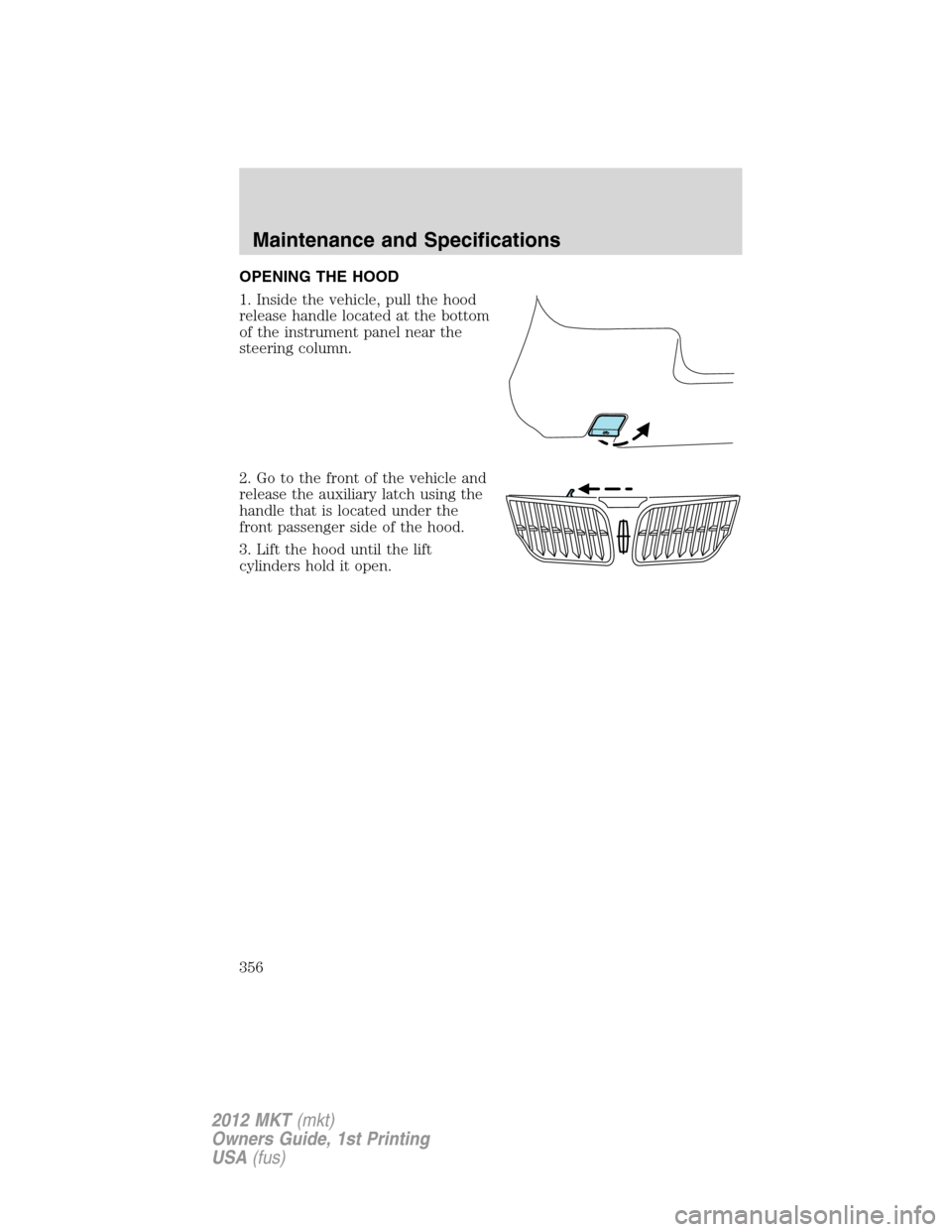
OPENING THE HOOD
1. Inside the vehicle, pull the hood
release handle located at the bottom
of the instrument panel near the
steering column.
2. Go to the front of the vehicle and
release the auxiliary latch using the
handle that is located under the
front passenger side of the hood.
3. Lift the hood until the lift
cylinders hold it open.
Maintenance and Specifications
356
2012 MKT(mkt)
Owners Guide, 1st Printing
USA(fus)
Page 404 of 437
Vehicle identification number (VIN)
The vehicle identification number is
located on the driver side
instrument panel.
Please note that in the graphic,
XXXX is representative of your
vehicle identification number.
The Vehicle Identification Number (VIN) contains the following
information:
1. World manufacturer identifier
2. Brake system / Gross Vehicle
Weight Rating (GVWR) / Restraint
Devices and their location
3. Make, vehicle line, series, body
type
4. Engine type
5. Check digit
6. Model year
7. Assembly plant
8. Production sequence number
XXXXXXXXXXXXXXXXX
Maintenance and Specifications
404
2012 MKT(mkt)
Owners Guide, 1st Printing
USA(fus)