Page 320 of 437

Fuse/Relay
LocationFuse Amp
RatingProtected Circuits
9 15A Interior lights, Cargo lamps
10 15A Backlighting, Puddle lamps
11 10A All wheel drive (AWD)
12 7.5A Intelligent access (IA)
13 5A IA receiver, Exterior mirror
switch, Steering column position
switch, Driver seat module, Driver
door module, Keypad
14 10A Power liftgate module, SYNC�,
Rear entertainment
15 10A Climate control, Electronic finish
panel
16 15A Navigation display, ALM, Auxiliary
climate control
17 20A Global window open
18 20A Amplifier
19 25A Amplifier
20 15A Data link connector (OBD-2), 2nd
row power fold seat motors
21 15A Fog lamps
22 15A Park lamps, License plate lamps,
Illuminated liftgate applique
23 15A High beam headlamps, Auto high
beam relay, Fog lamp deactivation
relay
24 20A Horn
25 10A Demand lamps/Interior lamps, 2nd
row power fold seats, Powertrain
control module (GTDI) wake-up,
3rd row seat relay
26 10A Instrument panel cluster,
Heads-up display
Roadside Emergencies
320
2012 MKT(mkt)
Owners Guide, 1st Printing
USA(fus)
Page 321 of 437
Fuse/Relay
LocationFuse Amp
RatingProtected Circuits
27 20A Ignition Switch, IA
28 5A Radio mute
29 5A Instrument panel cluster
30 5A Transmission shifter
31 10A Steering angle sensor, Heads-up
display
32 10A Restraint control module
33 10A Adaptive lighting module
34 5A Front body run/start feeds
35 10A Body module run/start feeds
36 5A Not used (spare)
37 10A Powertrain control module
run/start, Fuel relay
38 20A Trailer tow park lamps
39 20A Audio control module
40 20A Cigarette lighter
41 15A Delayed accessory feeds
42 10A Not used (spare)
43 10A Auxiliary blower, Rear wiper, Rain
sensor
44 10A Trailer tow backup lamps
45 5A Front wiper, Front blower, Wiper
relay
46 7.5A Occupant classification sensor
(OCS), Passenger airbag
deactivation indicator (PADI),
Front control interface module
47 30A Circuit
BreakerNot used
48 Full ISO relay Delayed accessory relay
Roadside Emergencies
321
2012 MKT(mkt)
Owners Guide, 1st Printing
USA(fus)
Page 325 of 437

Fuse/Relay
LocationFuse Amp
RatingProtected Circuits
54 HC micro relay 3rd row power seats
55 HC micro relay Wipers (front)
56 HC micro relay Rear window defroster, Heated
mirrors
57 — Not used
58 — Not used
59 HC micro relay Auxiliary blower motor
60 HC micro relay Trailer tow battery charge
61 G8VA relay Refrigerator
62 G8VA relay Automatic high beams
63 HC micro relay Run/start
64 HC micro relay PCM
65 G8VA relay A/C clutch
66 G8VA relay Fuel pump
* Cartridge Fuses ** Mini Fuses
CHANGING THE TIRES
If you get a flat tire while driving, do not apply the brake heavily.
Instead, gradually decrease your speed. Hold the steering wheel firmly
and slowly move to a safe place on the side of the road.
Note:The tire pressure monitoring system (TPMS) indicator light will
illuminate when the spare tire is in use. To restore the full functionality
of the monitoring system, all road wheels equipped with tire pressure
monitoring sensors must be mounted on the vehicle.
Have a flat serviced by an authorized dealer in order to prevent damage to
the TPMS sensors, refer toTire pressure monitoring system (TPMS)in
theTires, Wheels and Loadingchapter. Replace the spare tire with a road
tire as soon as possible. During repairing or replacing of the flat tire, have
the authorized dealer inspect the TPMS sensor for damage.
WARNING:The use of tire sealants may damage your tire
pressure monitoring system (TPMS) and should not be used.
However, if you must use a sealant, the TPMS sensor and valve stem
on the wheel must be replaced by an authorized Ford dealer.
Roadside Emergencies
325
2012 MKT(mkt)
Owners Guide, 1st Printing
USA(fus)
Page 359 of 437
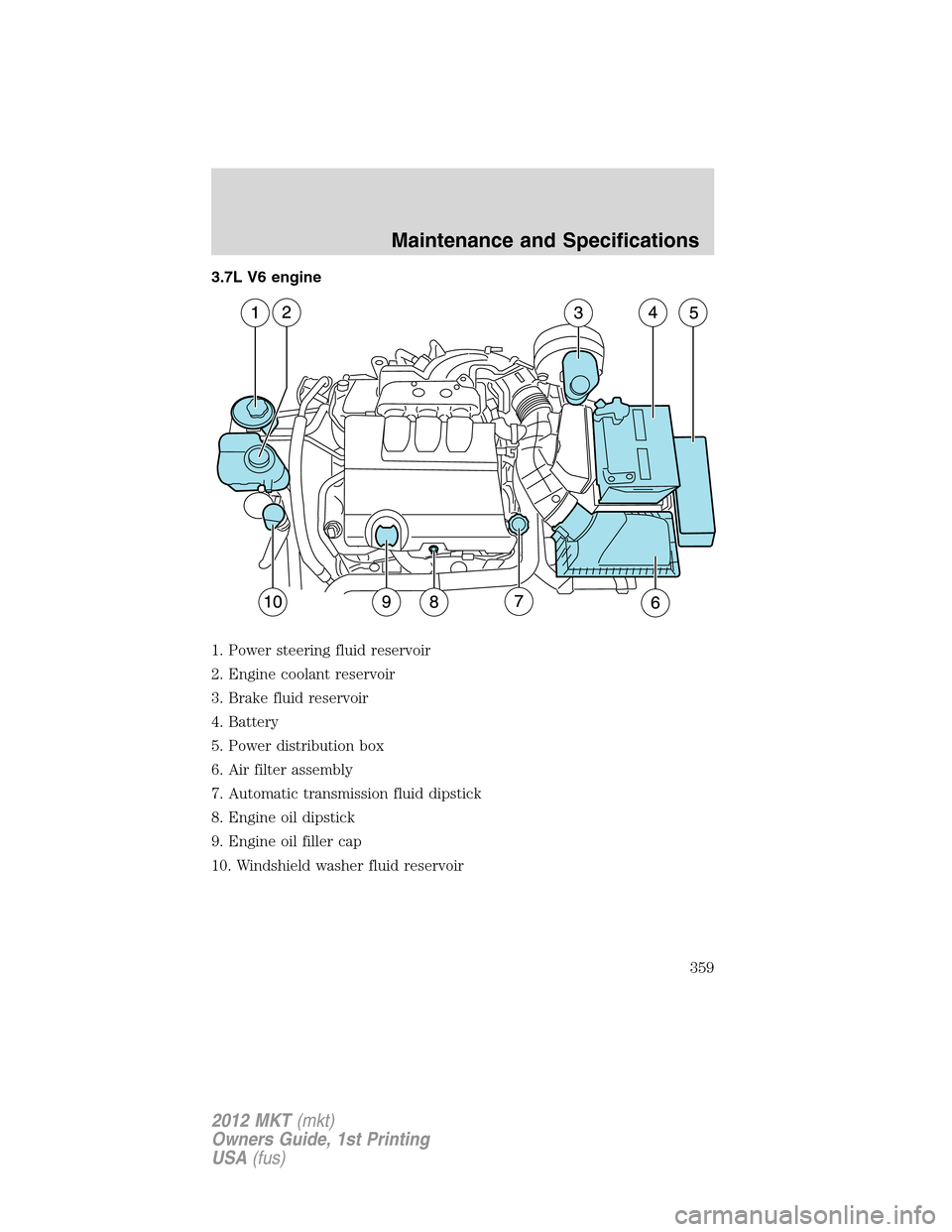
3.7L V6 engine
1. Power steering fluid reservoir
2. Engine coolant reservoir
3. Brake fluid reservoir
4. Battery
5. Power distribution box
6. Air filter assembly
7. Automatic transmission fluid dipstick
8. Engine oil dipstick
9. Engine oil filler cap
10. Windshield washer fluid reservoir
Maintenance and Specifications
359
2012 MKT(mkt)
Owners Guide, 1st Printing
USA(fus)
Page 374 of 437

What you should know about fail-safe cooling
If the engine coolant supply is depleted, this feature allows the vehicle to
be driven temporarily before incremental component damage is incurred.
The “fail-safe” distance depends on ambient temperatures, vehicle load
and terrain.
How fail-safe cooling works
If the engine begins to overheat:
•The engine coolant temperature gauge will move to the red (hot)
area.
•The coolant temperature warning light
will illuminate.
•The service engine soon
indicator will illuminate.
If the engine reaches a preset over-temperature condition, the engine
will automatically switch to alternating cylinder operation. Each disabled
cylinder acts as an air pump and cools the engine.
When this occurs the vehicle will still operate. However:
•The engine power will be limited.
•The air conditioning system will be disabled.
Continued operation will increase the engine temperature and the engine
will completely shut down, causing steering and braking effort to
increase.
Once the engine temperature cools, the engine can be re-started. Take
your vehicle to an authorized dealer as soon as possible to minimize
engine damage.
When fail-safe mode is activated
You have limited engine power when in the fail-safe mode, so drive the
vehicle with caution. The vehicle will not be able to maintain high-speed
operation and the engine will run rough. Remember that the engine is
capable of completely shutting down automatically to prevent engine
damage, therefore:
1. Pull off the road as soon as safely possible and turn off the engine.
2. Arrange for the vehicle to be taken to an authorized dealer.
3. If this is not possible, wait a short period for the engine to cool.
4. Check the coolant level and replenish if low.
Maintenance and Specifications
374
2012 MKT(mkt)
Owners Guide, 1st Printing
USA(fus)
Page 375 of 437

WARNING:Fail-safe mode is for use during emergencies only.
Operate the vehicle in fail-safe mode only as long as necessary to
bring the vehicle to rest in a safe location and seek immediate repairs.
When in fail-safe mode, the vehicle will have limited power, will not be
able to maintain high-speed operation, and may completely shut down
without warning, potentially losing engine power, power steering assist,
and power brake assist, which may increase the possibility of a crash
resulting in serious injury.
WARNING:Never remove the coolant reservoir cap while the
engine is running or hot.
5. Re-start the engine and take your vehicle to an authorized dealer.
Driving the vehicle without repairing the engine problem
increases the chance of engine damage. Take your vehicle to an
authorized dealer as soon as possible.
FUEL FILTER
Your vehicle is equipped with a lifetime fuel filter that is integrated with
the fuel tank. Regular maintenance or replacement is not needed.
WHAT YOU SHOULD KNOW ABOUT AUTOMOTIVE FUELS
Important safety precautions
WARNING:Do not overfill the fuel tank. The pressure in an
overfilled tank may cause leakage and lead to fuel spray and fire.
WARNING:The fuel system may be under pressure. If you hear
a hissing sound near the fuel filler door, do not refuel until the
sound stops. Otherwise, fuel may spray out, which could cause serious
personal injury.
WARNING:Automotive fuels can cause serious injury or death
if misused or mishandled.
WARNING:Gasoline may contain benzene, which is a
cancer-causing agent.
Maintenance and Specifications
375
2012 MKT(mkt)
Owners Guide, 1st Printing
USA(fus)
Page 387 of 437

for 15 seconds without cranking the engine. If the service engine
soon
indicator blinks eight times, it means that the vehicle is not
ready for I/M testing; if the service engine soon
indicator stays on
solid, it means that the vehicle is ready for I/M testing.
The OBD-II system is designed to check the emission control system
during normal driving. A complete check may take several days. If the
vehicle is not ready for I/M testing, the following driving cycle consisting
of mixed city and highway driving may be performed:
15 minutes of steady driving on an expressway/highway followed by
20 minutes of stop-and-go driving with at least four 30-second idle
periods.
Allow the vehicle to sit for at least eight hours without starting the
engine. Then, start the engine and complete the above driving cycle. The
engine must warm up to its normal operating temperature. Once started,
do not turn off the engine until the above driving cycle is complete. If
the vehicle is still not ready for I/M testing, the above driving cycle will
have to be repeated.
POWER STEERING FLUID (EXCEPT ECOBOOST™ ENGINE)
Refer toscheduled maintenance information.
1. Start the engine and let it run
until it reaches normal operating
temperature (the engine coolant
temperature gauge indicator will be
near the center of the normal area
between H and C).
2. While the engine idles, turn the
steering wheel left and right several
times.
3. Turn the engine off.
4. Check the fluid level in the reservoir. It should be between the MIN
and MAX lines. Do not add fluid if the level is in this range.
5. If the fluid is low, add fluid in small amounts, continuously checking
the level until it reaches the range between the MIN and MAX lines. Be
sure to put the cap back on the reservoir. Refer toMaintenance
product specifications and capacitiesin this chapter for the proper
fluid type.
Maintenance and Specifications
387
2012 MKT(mkt)
Owners Guide, 1st Printing
USA(fus)
Page 400 of 437
Items CapacityFord Part Name or
equivalentFord Part Number /
Ford Specification
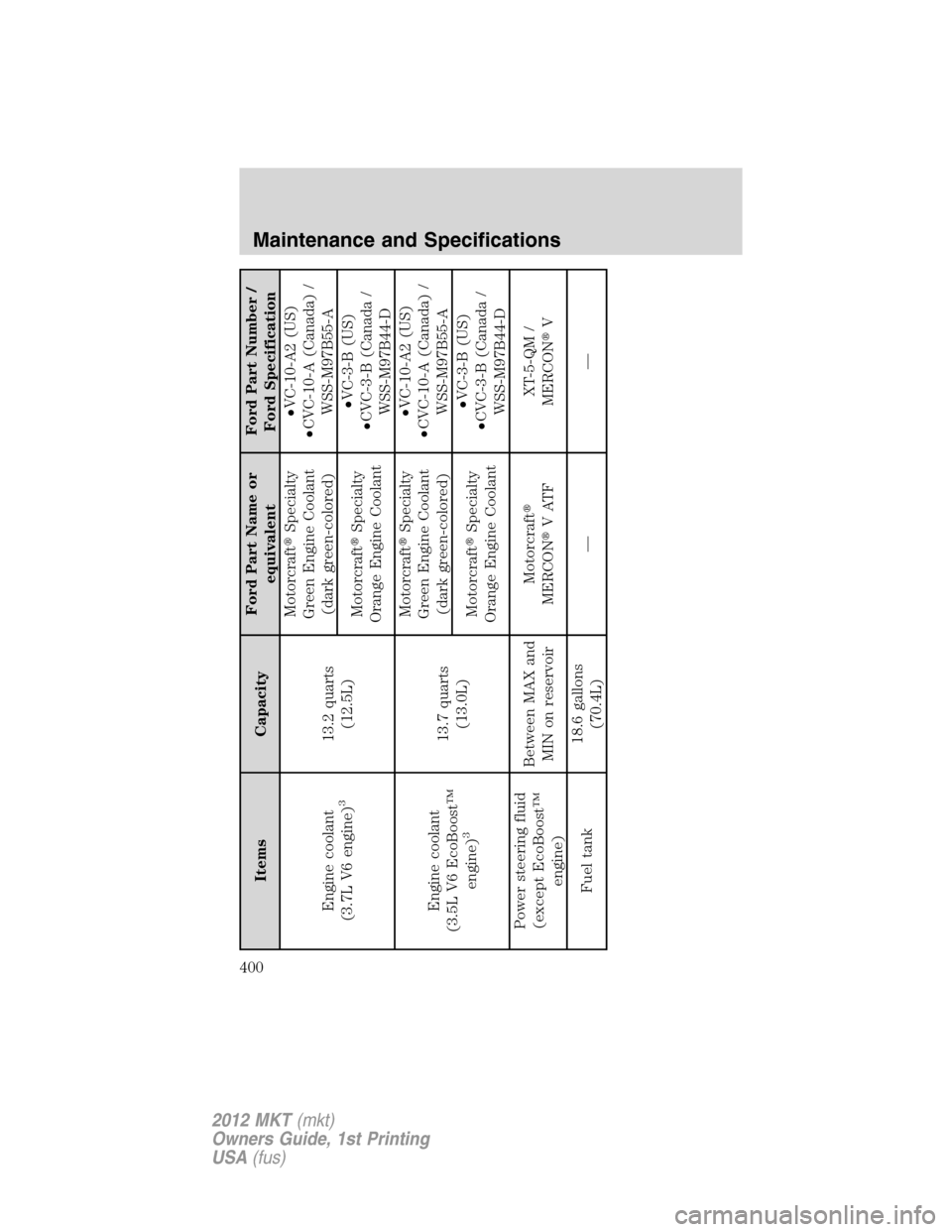
Engine coolant
(3.7L V6 engine)
3
13.2 quarts
(12.5L)Motorcraft�Specialty
Green Engine Coolant
(dark green-colored)•VC-10-A2 (US)
•CVC-10-A (Canada) /
WSS-M97B55-A
Motorcraft�Specialty
Orange Engine Coolant•VC-3-B (US)
•CVC-3-B (Canada /
WSS-M97B44-D
Engine coolant
(3.5L V6 EcoBoost™
engine)
3
13.7 quarts
(13.0L)Motorcraft�Specialty
Green Engine Coolant
(dark green-colored)•VC-10-A2 (US)
•CVC-10-A (Canada) /
WSS-M97B55-A
Motorcraft�Specialty
Orange Engine Coolant•VC-3-B (US)
•CVC-3-B (Canada /
WSS-M97B44-D
Power steering fluid
(except EcoBoost™
engine)Between MAX and
MIN on reservoirMotorcraft�
MERCON�VATFXT-5-QM /
MERCON�V
Fuel tank18.6 gallons
(70.4L)——
Maintenance and Specifications
400
2012 MKT(mkt)
Owners Guide, 1st Printing
USA(fus)