Page 234 of 384

To put your vehicle in P (Park):
1. Come to a complete stop
2. Move the gearshift lever and securely latch it in P (Park)
WARNING:Always set the parking brake fully and make sure
the gearshift is latched in P (Park). Switch the ignition off and
remove the key whenever you leave your vehicle.
R (Reverse)
With the gearshift lever in R (Reverse), the vehicle will move backward.
Always come to a complete stop before shifting into and out of R
(Reverse).
N (Neutral)
With the gearshift lever in N (Neutral), the vehicle can be started and is
free to roll. Hold the brake pedal down while in this position.
D (Drive)
The normal driving position for the best fuel economy. Transmission
operates in gears one through six.
M (Manual)
With the gearshift lever in M
(manual), the driver can change
gears up or down as desired. This is
called SelectShift Automatic™
transmission (SST) mode. By
moving the gearshift lever from
drive position D (Drive) to M
(Manual) you now have control of
selecting the gear you desire using
the paddle shifters on the steering
wheel.
To return to normal D (Drive) position, move the shift lever back from M
(manual) to D (Drive). The transmission will operate in gears one
through six.
Driving
234
2012 MKS(mks)
Owners Guide, 1st Printing
USA(fus)
Page 235 of 384
Understanding your SelectShift Automatic™ Transmission (SST)
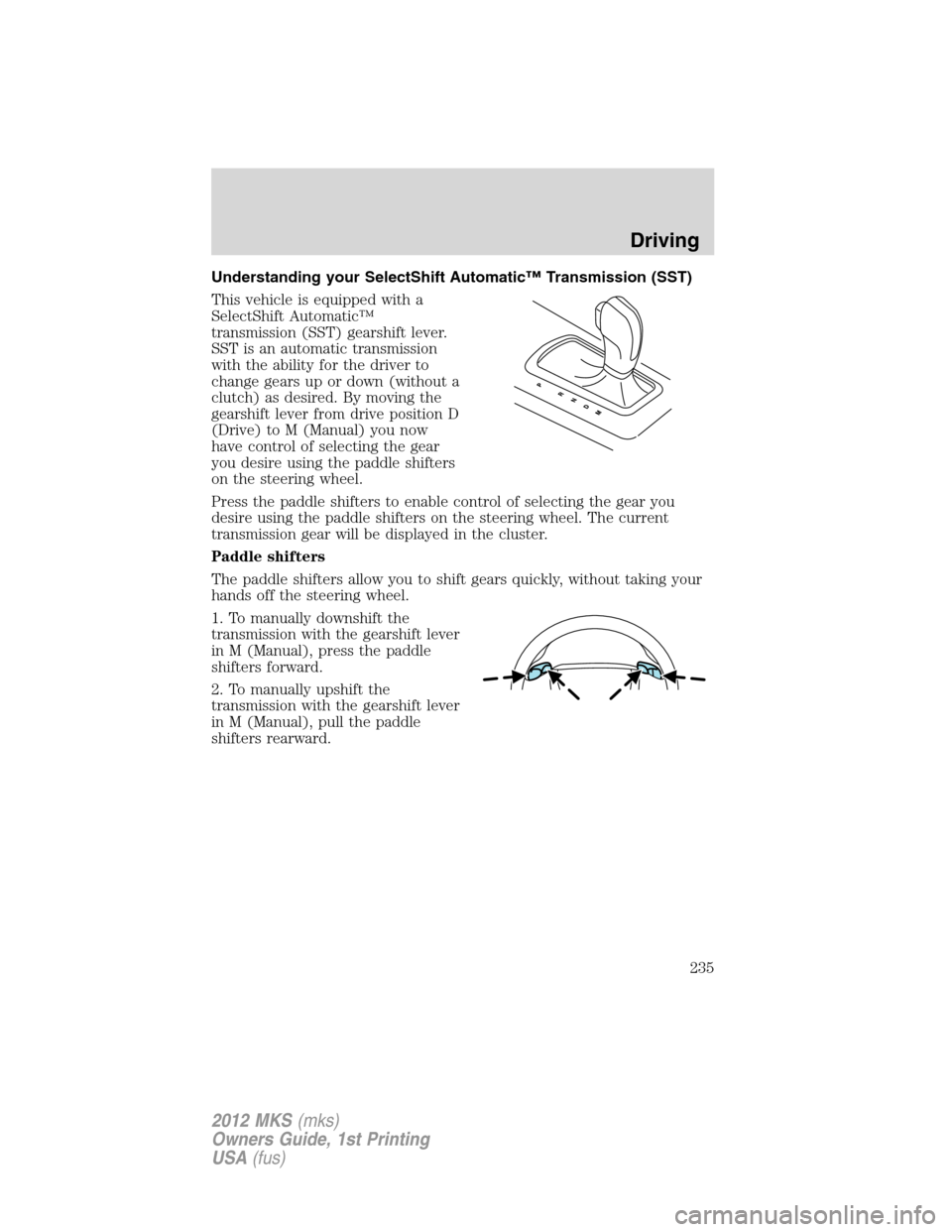
This vehicle is equipped with a
SelectShift Automatic™
transmission (SST) gearshift lever.
SST is an automatic transmission
with the ability for the driver to
change gears up or down (without a
clutch) as desired. By moving the
gearshift lever from drive position D
(Drive) to M (Manual) you now
have control of selecting the gear
you desire using the paddle shifters
on the steering wheel.
Press the paddle shifters to enable control of selecting the gear you
desire using the paddle shifters on the steering wheel. The current
transmission gear will be displayed in the cluster.
Paddle shifters
The paddle shifters allow you to shift gears quickly, without taking your
hands off the steering wheel.
1. To manually downshift the
transmission with the gearshift lever
in M (Manual), press the paddle
shifters forward.
2. To manually upshift the
transmission with the gearshift lever
in M (Manual), pull the paddle
shifters rearward.
Driving
235
2012 MKS(mks)
Owners Guide, 1st Printing
USA(fus)
Page 252 of 384
BLIND SPOT INFORMATION SYSTEM (BLIS�) WITH CROSS
TRAFFIC ALERT (CTA) (IF EQUIPPED)
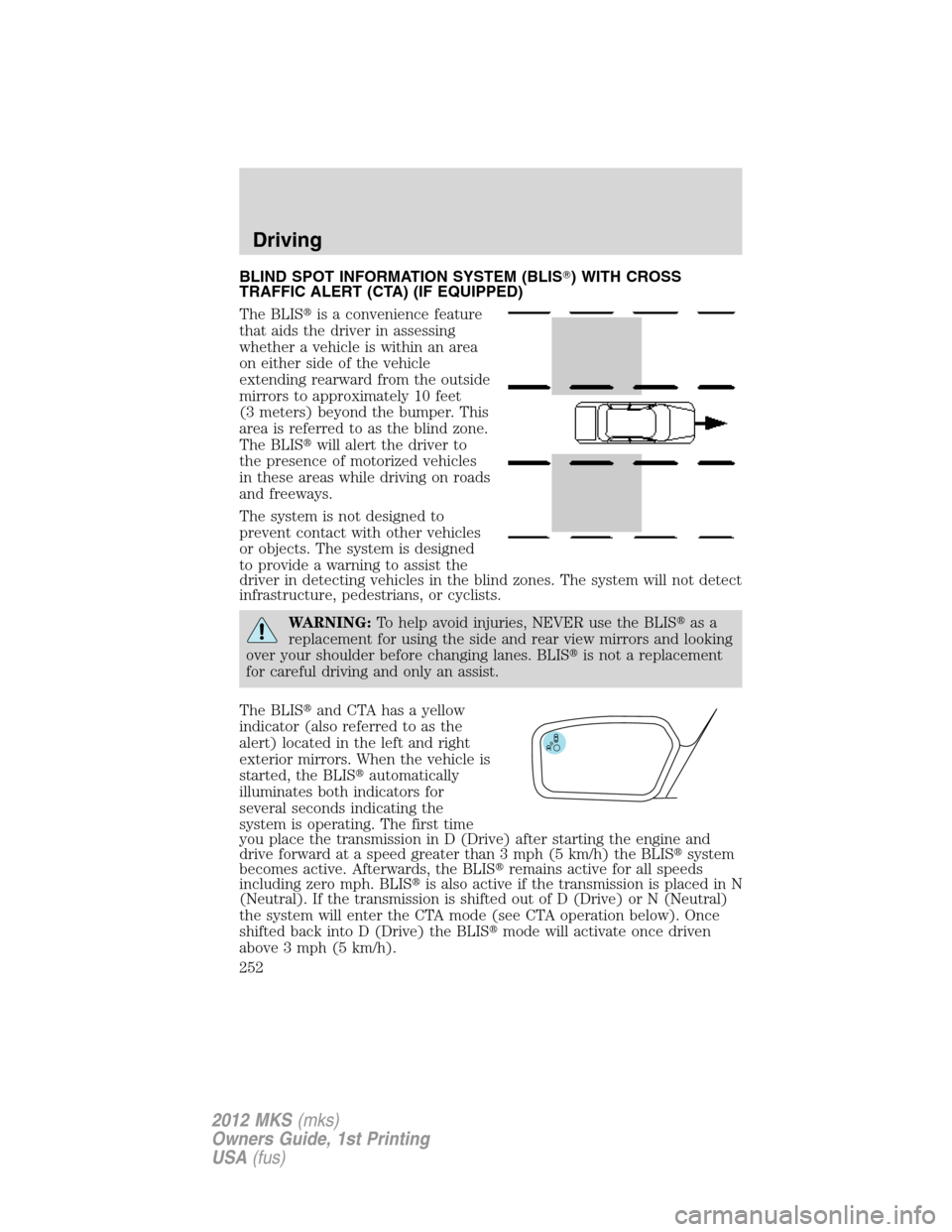
The BLIS�is a convenience feature
that aids the driver in assessing
whether a vehicle is within an area
on either side of the vehicle
extending rearward from the outside
mirrors to approximately 10 feet
(3 meters) beyond the bumper. This
area is referred to as the blind zone.
The BLIS�will alert the driver to
the presence of motorized vehicles
in these areas while driving on roads
and freeways.
The system is not designed to
prevent contact with other vehicles
or objects. The system is designed
to provide a warning to assist the
driver in detecting vehicles in the blind zones. The system will not detect
infrastructure, pedestrians, or cyclists.
WARNING:To help avoid injuries, NEVER use the BLIS�as a
replacement for using the side and rear view mirrors and looking
over your shoulder before changing lanes. BLIS�is not a replacement
for careful driving and only an assist.
The BLIS�and CTA has a yellow
indicator (also referred to as the
alert) located in the left and right
exterior mirrors. When the vehicle is
started, the BLIS�automatically
illuminates both indicators for
several seconds indicating the
system is operating. The first time
you place the transmission in D (Drive) after starting the engine and
drive forward at a speed greater than 3 mph (5 km/h) the BLIS�system
becomes active. Afterwards, the BLIS�remains active for all speeds
including zero mph. BLIS�is also active if the transmission is placed in N
(Neutral). If the transmission is shifted out of D (Drive) or N (Neutral)
the system will enter the CTA mode (see CTA operation below). Once
shifted back into D (Drive) the BLIS�mode will activate once driven
above 3 mph (5 km/h).
Driving
252
2012 MKS(mks)
Owners Guide, 1st Printing
USA(fus)
Page 282 of 384
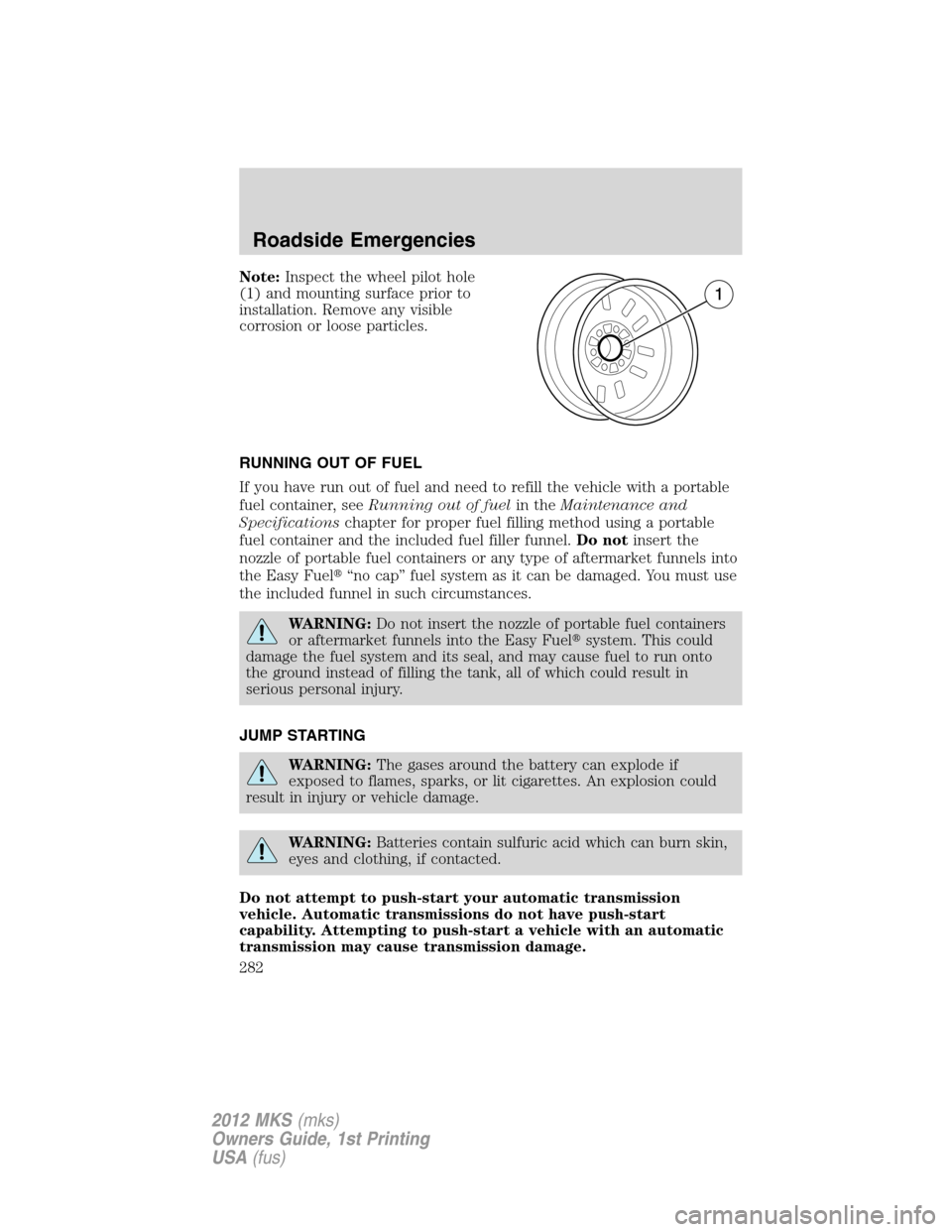
Note:Inspect the wheel pilot hole
(1) and mounting surface prior to
installation. Remove any visible
corrosion or loose particles.
RUNNING OUT OF FUEL
If you have run out of fuel and need to refill the vehicle with a portable
fuel container, seeRunning out of fuelin theMaintenance and
Specificationschapter for proper fuel filling method using a portable
fuel container and the included fuel filler funnel.Do notinsert the
nozzle of portable fuel containers or any type of aftermarket funnels into
the Easy Fuel�“no cap” fuel system as it can be damaged. You must use
the included funnel in such circumstances.
WARNING:Do not insert the nozzle of portable fuel containers
or aftermarket funnels into the Easy Fuel�system. This could
damage the fuel system and its seal, and may cause fuel to run onto
the ground instead of filling the tank, all of which could result in
serious personal injury.
JUMP STARTING
WARNING:The gases around the battery can explode if
exposed to flames, sparks, or lit cigarettes. An explosion could
result in injury or vehicle damage.
WARNING:Batteries contain sulfuric acid which can burn skin,
eyes and clothing, if contacted.
Do not attempt to push-start your automatic transmission
vehicle. Automatic transmissions do not have push-start
capability. Attempting to push-start a vehicle with an automatic
transmission may cause transmission damage.
Roadside Emergencies
282
2012 MKS(mks)
Owners Guide, 1st Printing
USA(fus)
Page 283 of 384

Preparing your vehicle
When the battery is disconnected or a new battery is installed, the
automatic transmission must relearn its shift strategy. As a result, the
transmission may have firm and/or soft shifts. This operation is
considered normal and will not affect function or durability of the
transmission. Over time, the adaptive learning process will fully update
transmission operation.
1.Use only a 12–volt supply to start your vehicle.
2. Do not disconnect the battery of the disabled vehicle as this could
damage the vehicle’s electrical system.
3. Park the booster vehicle close to the hood of the disabled vehicle
making sure the two vehiclesdo nottouch. Set the parking brake on
both vehicles and stay clear of the engine cooling fan and other moving
parts.
4. Check all battery terminals and remove any excessive corrosion before
you attach the battery cables. Ensure that vent caps are tight and level.
5. Turn the heater fan on in both vehicles to protect from any electrical
surges. Turn all other accessories off.
Connecting the jumper cables
Note:In the illustration, the vehicle on the bottom is used to designate
the assisting (boosting) battery.
Roadside Emergencies
283
2012 MKS(mks)
Owners Guide, 1st Printing
USA(fus)
Page 286 of 384
WRECKER TOWING
If you need to have your vehicle towed, contact a professional towing
service or, if you are a member of a roadside assistance program, your
roadside assistance service provider.
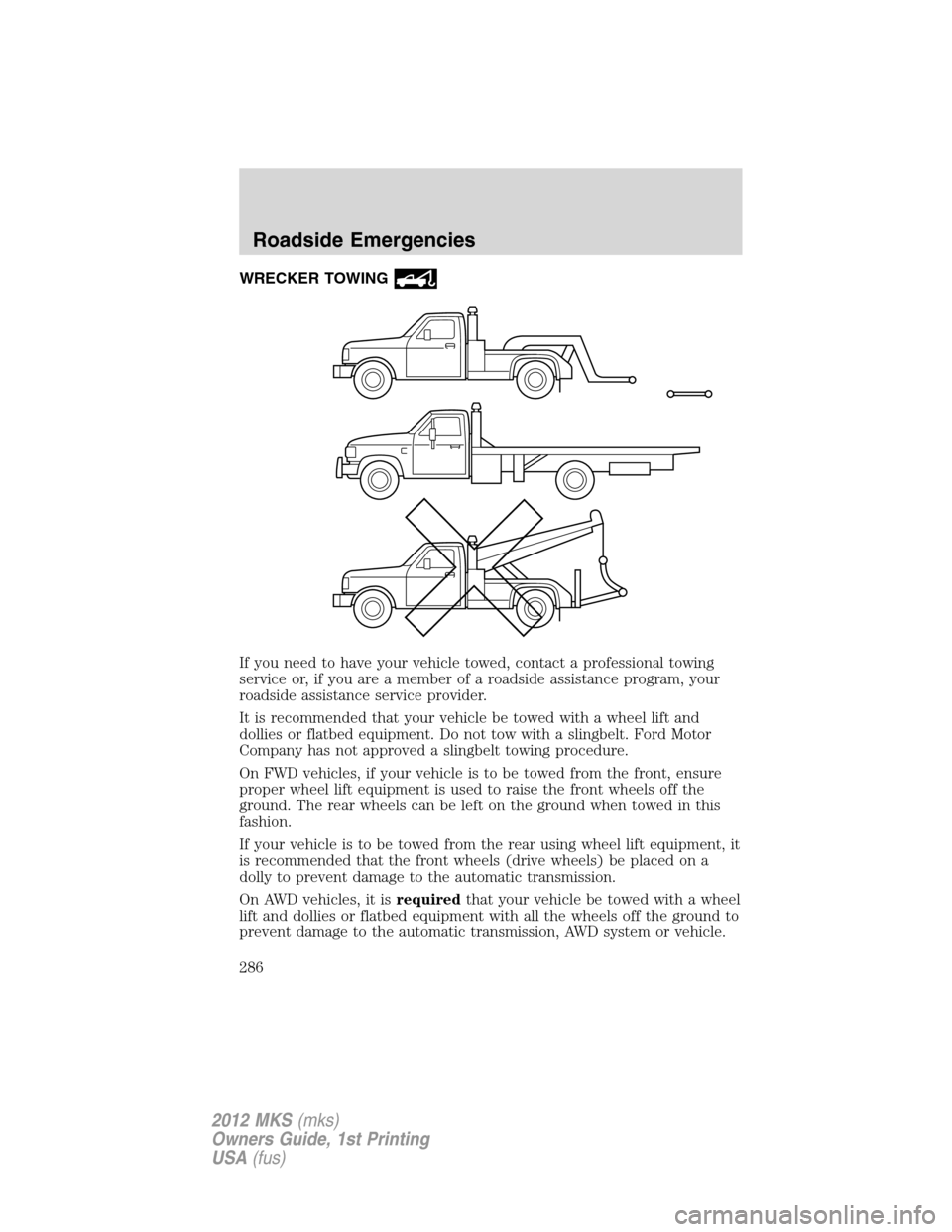
It is recommended that your vehicle be towed with a wheel lift and
dollies or flatbed equipment. Do not tow with a slingbelt. Ford Motor
Company has not approved a slingbelt towing procedure.
On FWD vehicles, if your vehicle is to be towed from the front, ensure
proper wheel lift equipment is used to raise the front wheels off the
ground. The rear wheels can be left on the ground when towed in this
fashion.
If your vehicle is to be towed from the rear using wheel lift equipment, it
is recommended that the front wheels (drive wheels) be placed on a
dolly to prevent damage to the automatic transmission.
On AWD vehicles, it isrequiredthat your vehicle be towed with a wheel
lift and dollies or flatbed equipment with all the wheels off the ground to
prevent damage to the automatic transmission, AWD system or vehicle.
Roadside Emergencies
286
2012 MKS(mks)
Owners Guide, 1st Printing
USA(fus)
Page 307 of 384
IDENTIFYING COMPONENTS IN THE ENGINE COMPARTMENT
3.7L V6 engine
1. Power steering fluid reservoir
2. Engine coolant reservoir
3. Brake fluid reservoir
4. Battery
5. Power distribution box
6. Air filter assembly
7. Automatic transmission fluid dipstick
8. Engine oil dipstick
9. Engine oil filler cap
10. Windshield washer fluid reservoir
Maintenance and Specifications
307
2012 MKS(mks)
Owners Guide, 1st Printing
USA(fus)
Page 308 of 384
3.5L V6 EcoBoost™ engine
1. Engine coolant reservoir
2. Brake fluid reservoir
3. Battery
4. Power distribution box
5. Air filter assembly
6. Automatic transmission fluid dipstick (out of view)
7. Engine oil dipstick
8. Engine oil filler cap
9. Windshield washer fluid reservoir
9
1234
6587
Maintenance and Specifications
308
2012 MKS(mks)
Owners Guide, 1st Printing
USA(fus)

