2012 Lexus LFA motor
[x] Cancel search: motorPage 65 of 420
63
1-7. Safety information
1
Before driving
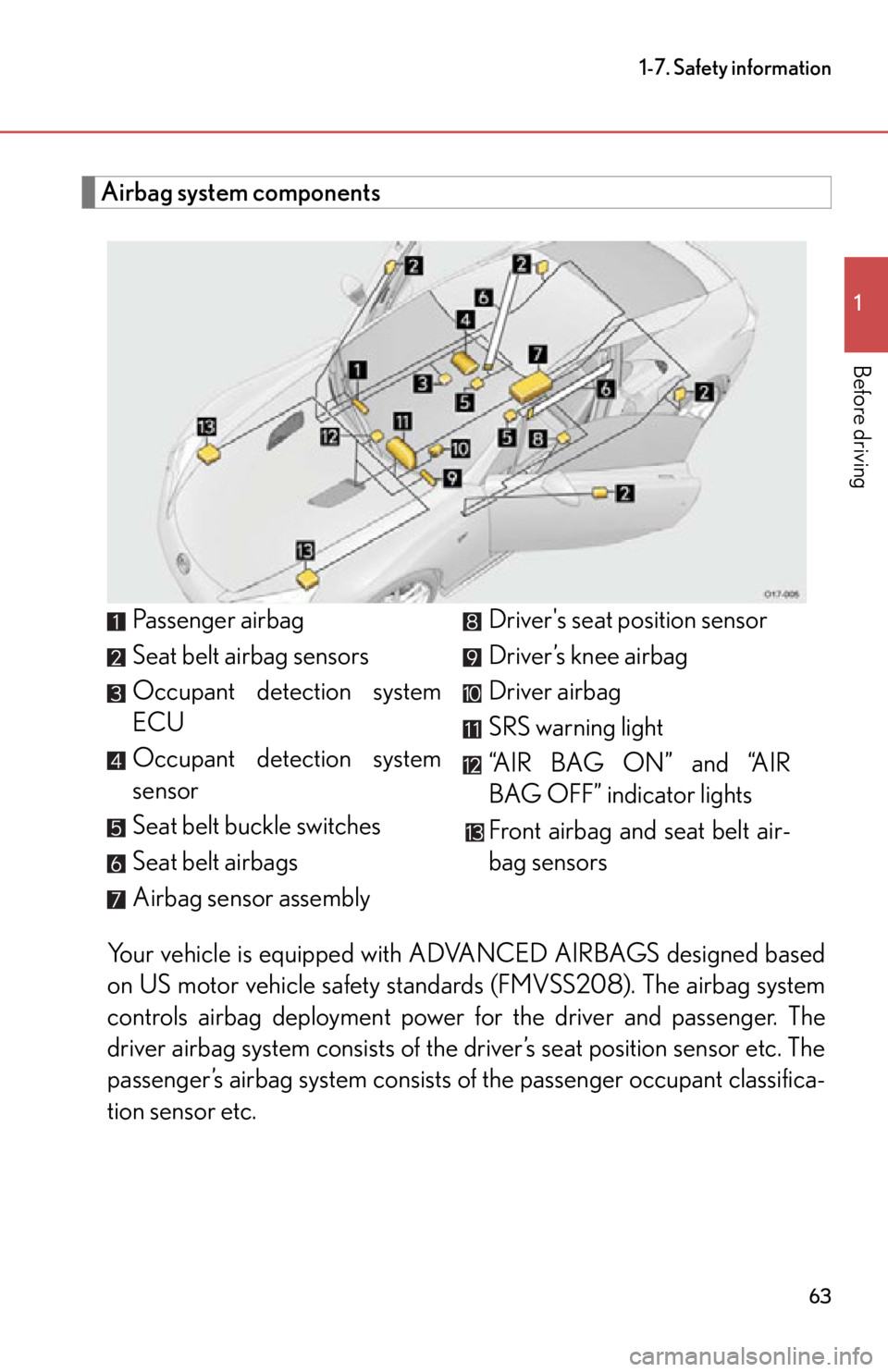
Airbag system componentsYour vehicle is equipped with AD VANCED AIRBAGS designed based
on US motor vehicle sa fety standards (FMVSS208). The airbag system
controls airbag deployment power for the driver and passenger. The
driver airbag system consist s of the driver’s seat position sensor etc. The
passenger’s airbag system consists of the passenger occupant classifica-
tion sensor etc. Passenger airbag
Seat belt airbag sensors
Occupant detection system
ECU
Occupant detection system
sensor
Seat belt buckle switches
Seat belt airbags
Airbag sensor assembly
Driver's seat position sensor
Driver’s knee airbag
Driver airbag
SRS warning light
“A I R B A G O N ” a n d “A I R
BAG OFF” indicator lights
Front airbag and seat belt air-
bag sensors
Page 92 of 420

90
2-1. Driving procedures
■Engine speed restrictions
The following restrictions exist for engine protection:
●The engine speed is limited to 7400 rpm if the total mileage shown on the
odometer is less than 310 miles (500 km).
●The engine speed is limited when the engine is not sufficiently warmed-up, such
as immediately after the engine is started or during the engine warm-up period.
The variable red zone shows the maximum engine speed currently available.
( P. 1 1 9 )
●The engine speed is limited to 4400 rpm for approximately 8 minutes when the
engine is started with the coolant temperature at 5 F (-15 C) or lower.
●The engine speed may be limited when either the coolant temperature gauge
or oil temperature gauge is flashing.
■Idling with five cylinders
To improve fuel consumption, the engine may idle at a reduced speed using five cyl-
inders on one side of the engine whil e stopped or immediately before stopping
when 1st gear is selected in AUTO driving mode. During this time, “5 cylinders
idling” will be displayed on the meter an d vibration or a change in engine sound
may occur. This is normal and does not indicate a malfunction.
■ASG (Automated Sequential Gearbox) operating sounds
P. 1 1 0
■Braking sound
●As the LFA uses CCM (Carbon Ceramic Material) brake discs with high-fric-
tion pads, it may be possible to hear the sound of the brakes operating (such as
a rubbing or squealing sound). This is normal and does not indicate a malfunc-
tion.
●The sound of a motor operating may be heard after the engine is stopped. This
does not indicate a malfunction.
■Driving in the rain
●Drive carefully when it is raining, because visibility will be reduced, the windows
may become fogged-up, and the road will be slippery.
●Drive carefully when it starts to rain, because the road surface will be especially
slippery.
●Refrain from driving at high speeds on wet surfaces such as on an expressway in
the rain, as the LFA is fitted with wide-t read tires that may increase the risk of
hydroplaning.
Page 98 of 420

96
2-1. Driving procedures
NOTICE
■When driving the vehicle
●Do not depress the accelerator and brake pedals at the same time during driving.
If the brake pedal is depressed whil e driving with the accelerator pedal
depressed, driving torque may be restrained.
●Do not use the accelerator pedal or depress the accelerator and brake pedals at
the same time to hold the vehicle on a hill. Doing so may damage the clutch.
■When parking the vehicle
●Parking with the rear of the vehicle close to a wall or similar structure may cause
the area around the exhaust pipes to over heat. As this may result in damage to
the rear bumper or other components, be sure to park the vehicle rear end as far
away as possible from walls and other such structures.
●When it rains, do not park on a slope with an angle of 15 degrees or more, as rain-
water may enter the vehicle. If parking at such an angle is unavoidable, use wheel
chocks and place a car cover over the vehicle.
■Avoiding damage to vehicle parts
●Do not turn the steering wheel fully in either direction and hold it there for an
extended period of time.
Doing so may damage the power steering motor.
●When driving over bumps in the road, be careful and drive as slowly as possible
to avoid damaging the wheels, tires, underside of the vehicle, etc.
■If you get a flat tire while driving
A flat or damaged tire may cause the following situations. Hold the steering wheel
firmly and gradually depress the brak e pedal to slow down the vehicle.
●It may be difficult to control your vehicle.
●The vehicle will make abnormal sounds or vibrations.
●The vehicle will lean.
Information on what to do in case of a flat tire ( P. 3 3 2 )
Page 115 of 420
113
2-1. Driving procedures
2
When driving
Parking brake
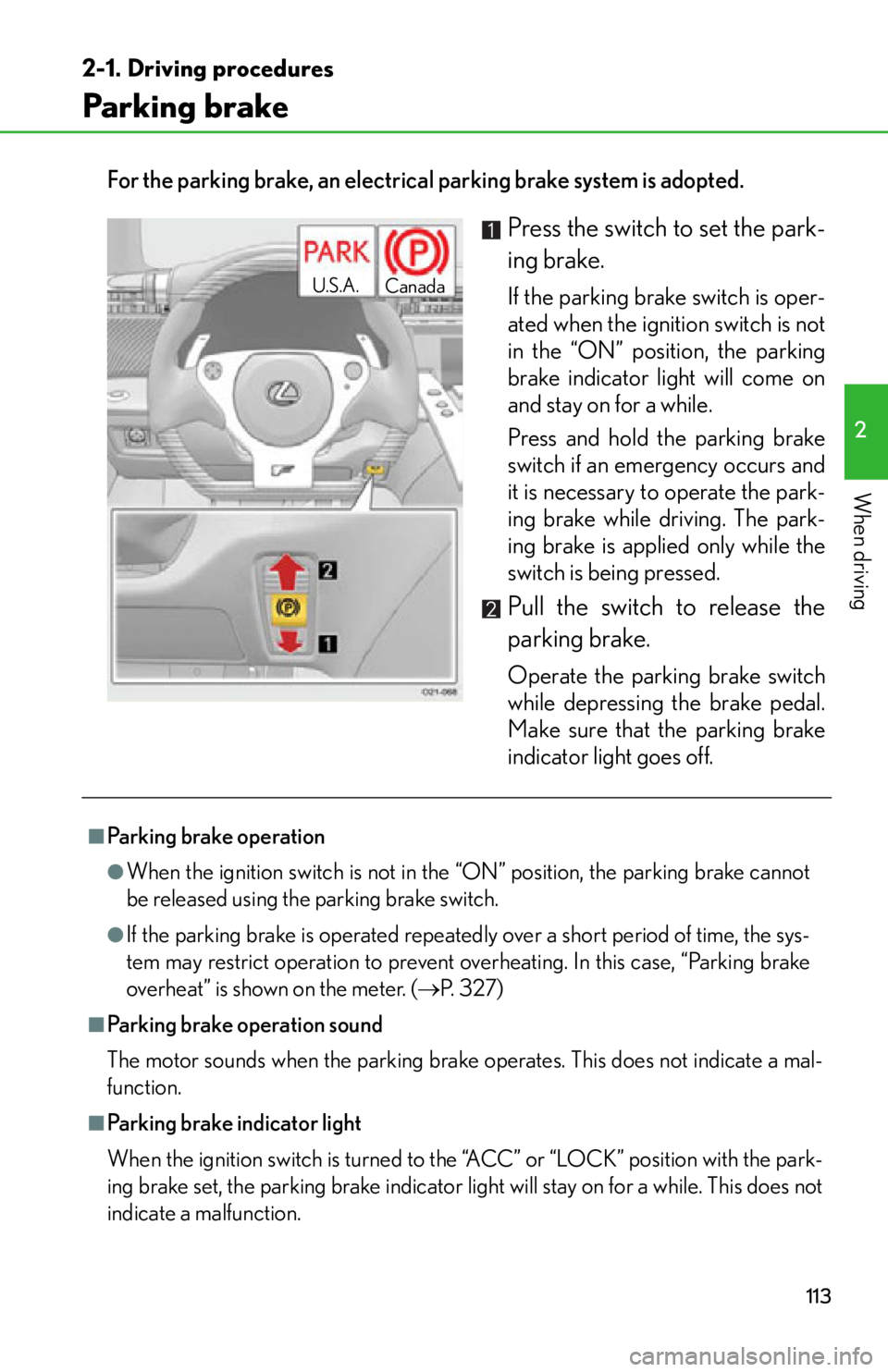
For the parking brake, an electrical parking brake system is adopted.
Press the switch to set the park-
ing brake.
If the parking brake switch is oper-
ated when the ignition switch is not
in the “ON” position, the parking
brake indicator light will come on
and stay on for a while.
Press and hold the parking brake
switch if an emergency occurs and
it is necessary to operate the park-
ing brake while driving. The park-
ing brake is applied only while the
switch is being pressed.
Pull the switch to release the
parking brake.
Operate the parking brake switch
while depressing the brake pedal.
Make sure that the parking brake
indicator light goes off.
U.S.A.
Canada
■Parking brake operation
●When the ignition switch is not in th e “ON” position, the parking brake cannot
be released using the parking brake switch.
●If the parking brake is operated repeated ly over a short period of time, the sys-
tem may restrict operation to prevent over heating. In this case, “Parking brake
overheat” is shown on the meter. ( P. 3 2 7 )
■Parking brake operation sound
The motor sounds when the parking brake operates. This does not indicate a mal-
function.
■Parking brake indicator light
When the ignition switch is turned to the “ACC” or “LOCK” position with the park-
ing brake set, the parking brake indicator light will stay on for a while. This does not
indicate a malfunction.
Page 168 of 420

166
2-4. Using other driving systems
Driving assist systems
To help enhance driving safety and performance, the following systems oper-
ate automatically in response to various driving situations. Be aware, however,
that these systems are supplementary and should not be relied upon too
heavily when operating the vehicle.
■ ABS (Anti-lock Brake System)
Helps to prevent wheel lock when the br akes are applied suddenly, or if the
brakes are applied while driving on a slippery road surface.
■ Brake assist
Generates an increased level of braking force after the brake pedal is
depressed when the system de tects a panic stop situation.
■VSC (Vehicle Stability Control)
Helps the driver to control skidding when swerving suddenly or turning on
slippery road surfaces.
■ TRAC (Traction Control)
Helps to maintain drive power and prevent the drive wheels from spinning
when starting the vehicle or accelerating on slippery roads.
■Hill-start assist control
Helps to reduce the vehicle’s rolling backward distance when starting on an
incline or slippery slope.
■EPS (Electric Power Steering)
Employs an electric motor to reduce the amount of effort needed to turn the
steering wheel.
■VDIM (Vehicle Dynamics Integrated Management)
Provides integrated control of the ABS, brake assist, VSC, TRAC, and hill-
start assist control systems.
Helps to maintain vehicle stability when swerving on slippery road surfaces
by controlling the brakes and engine output.
When switched to SPORT driving mode, the control characteristics of the
VDIM system are altered.
■ Active rear wing
P. 1 7 1
Page 170 of 420

168
2-4. Using other driving systems
■Hill-start assist control operation conditions
●The vehicle rolls backward.
●A forward gear is selected.
●The brake pedal is not depressed.
■Automatic reactivation of the VSC/TRAC systems
If the VSC/TRAC systems are turned off, re-starting the engine will automatically
reactivate them.
■Sounds and vibrations caused by the ABS, brake assist, VSC, TRAC and hill-start
assist control systems
●A sound may be heard from the engine compartment if the brake pedal is
depressed repeatedly when the engine is started or just after the vehicle begins
to move. This sound does not indicate that a malfunction has occurred in any of
these systems.
●Any of the following conditions may occur when the above systems are operat-
ing. None of these indicates that a malfunction has occurred.
• Vibrations may be felt through the vehicle body and steering.
• A motor sound may be heard after the vehicle comes to a stop.
■EPS operation sound
When the steering wheel is operated, a motor sound may be heard. This does not
indicate a malfunction.
■Reduced effectiveness of the EPS system
The effectiveness of the EPS system is reduced to prevent the system from over-
heating when there is frequent steering in put over an extended period of time. The
steering wheel may feel heavy as a result. Should this occur, refrain from excessive
steering input or stop the vehicle and turn the engine off. The EPS system should
return to normal within 10 minutes.
■If the slip indicator comes on
It may indicate a malfunction in the VSC, TRAC or hill-start assist control system.
Contact your Lexus dealer.
Page 185 of 420
183
2-5. Driving information
2
When driving
Dinghy towing
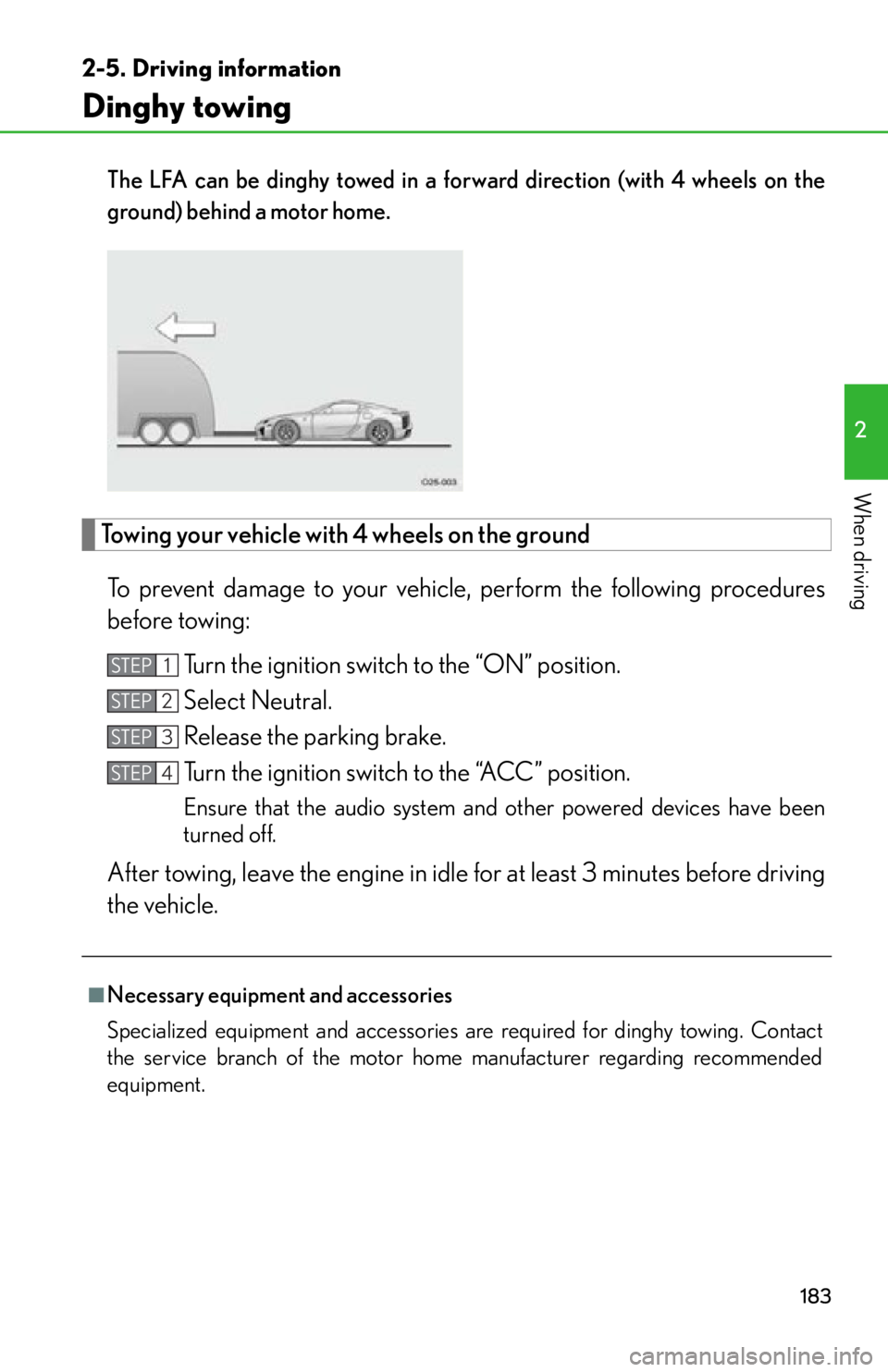
The LFA can be dinghy towed in a forward direction (with 4 wheels on the
ground) behind a motor home.
Towing your vehicle with 4 wheels on the groundTo prevent damage to your vehicle, perform the following procedures
before towing: Turn the ignition switch to the “ON” position.
Select Neutral.
Release the parking brake.
Turn the ignition switch to the “ACC” position.
Ensure that the audio system and other powered devices have been
turned off.
After towing, leave the engine in idle for at least 3 minutes before driving
the vehicle.
■Necessary equipment and accessories
Specialized equipment and accessories are required for dinghy towing. Contact
the service branch of the motor home manufacturer regarding recommended
equipment.
STEP1
STEP2
STEP3
STEP4
Page 236 of 420
234
4-1. Maintenance and care
NOTICE
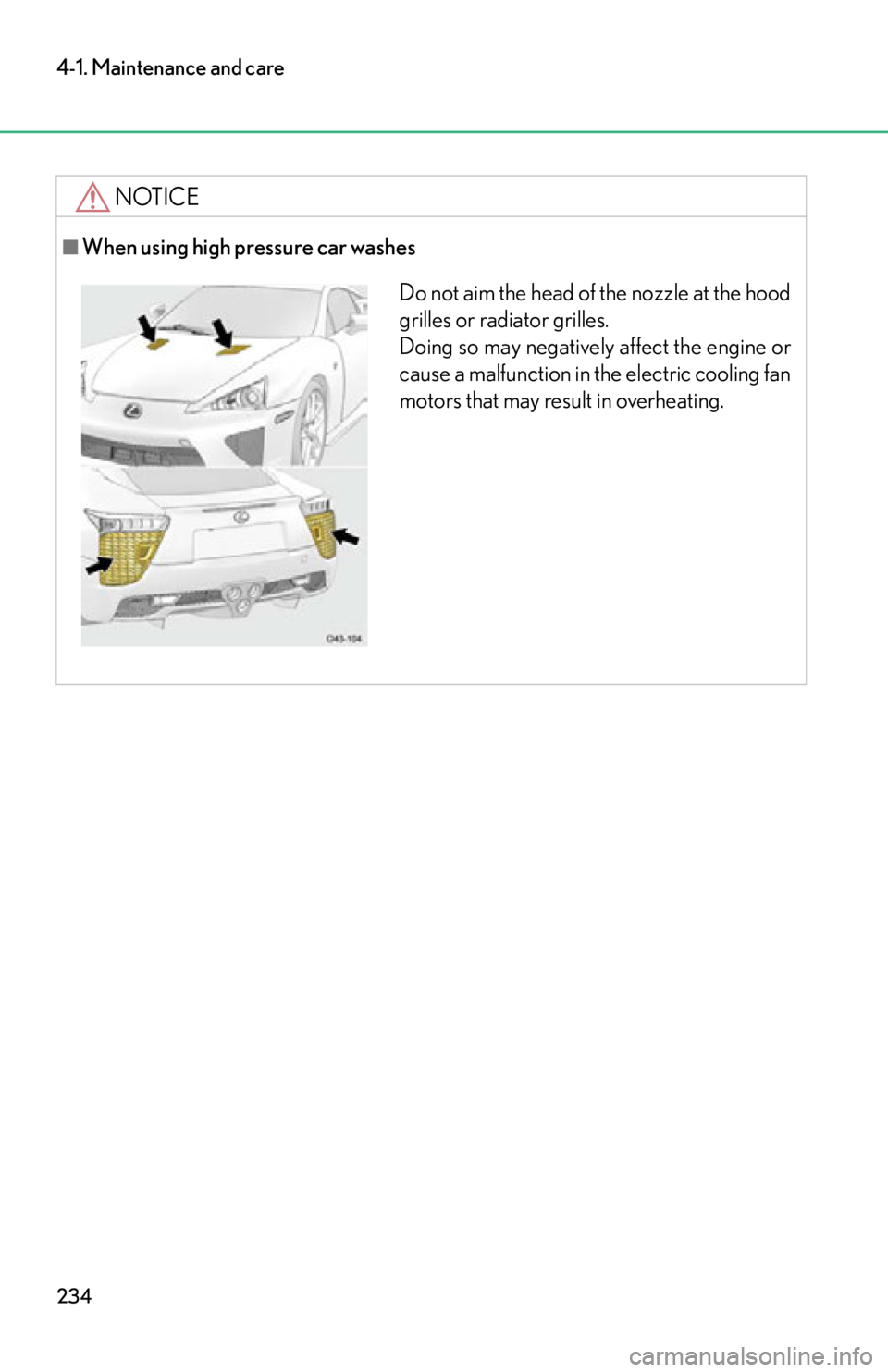
■When using high pressure car washes
Do not aim the head of the nozzle at the hood
grilles or radiator grilles.
Doing so may negatively affect the engine or
cause a malfunction in the electric cooling fan
motors that may result in overheating.