Page 60 of 914
601-1. For safe use
GS350/250_EE (OM30C36E)Child restraint systems are classified into the following 5 groups
according to the regulation ECE No.44:
Group 0: Up to 10 kg (22 lb.) (0 - 9 months)
Group 0
+: Up to 13 kg (28 lb.) (0 - 2 years)
Group I: 9 to 18 kg (20 to 39 lb.) (9 months - 4 years)
Group II: 15 to 25 kg (34 to 55 lb.) (4 years - 7 years)
Group III: 22 to 36 kg (49 to 79 lb.) (6 years - 12 years)
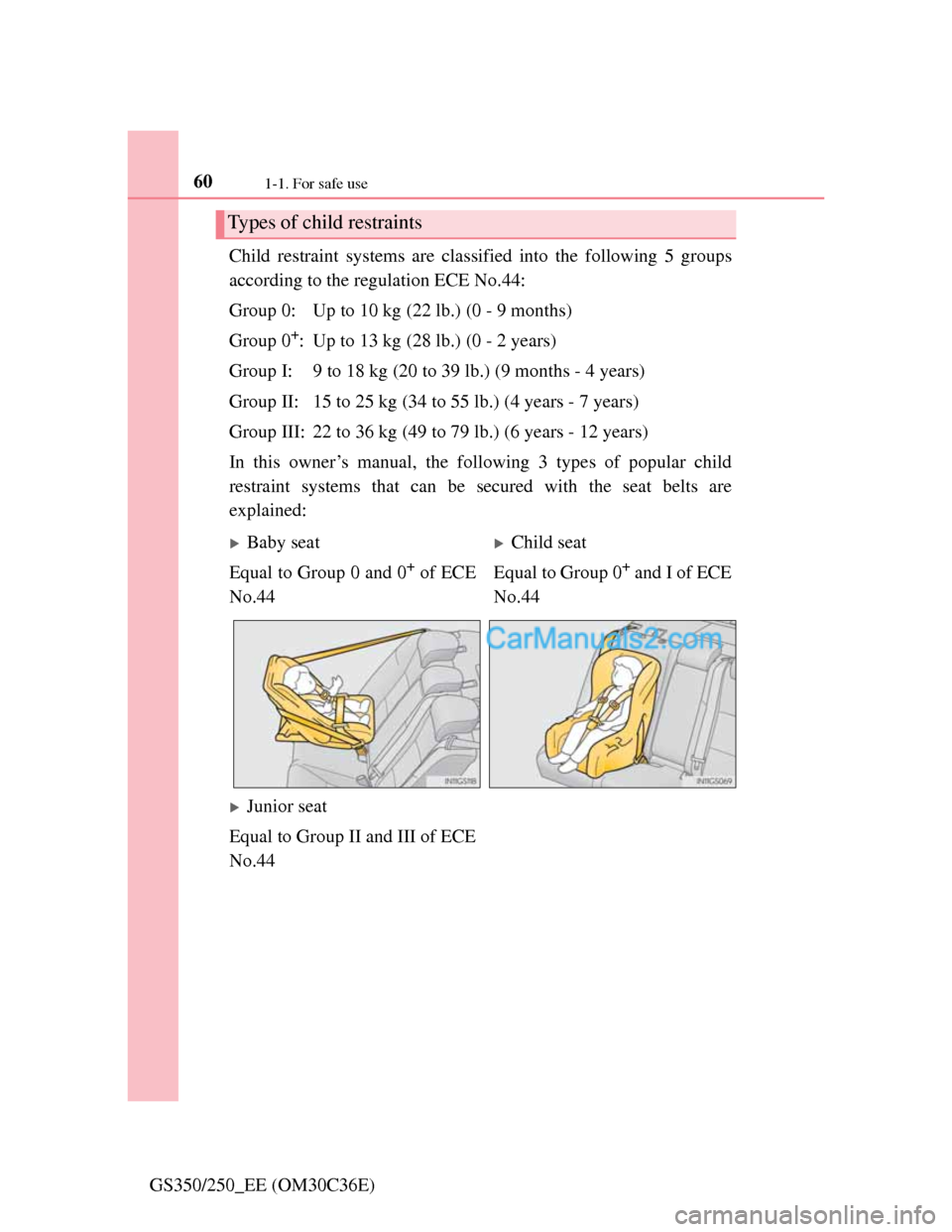
In this owner’s manual, the following 3 types of popular child
restraint systems that can be secured with the seat belts are
explained:
Types of child restraints
Baby seat Child seat
Equal to Group 0 and 0
+ of ECE
No.44Equal to Group 0+ and I of ECE
No.44
Junior seat
Equal to Group II and III of ECE
No.44
Page 62 of 914
621-1. For safe use
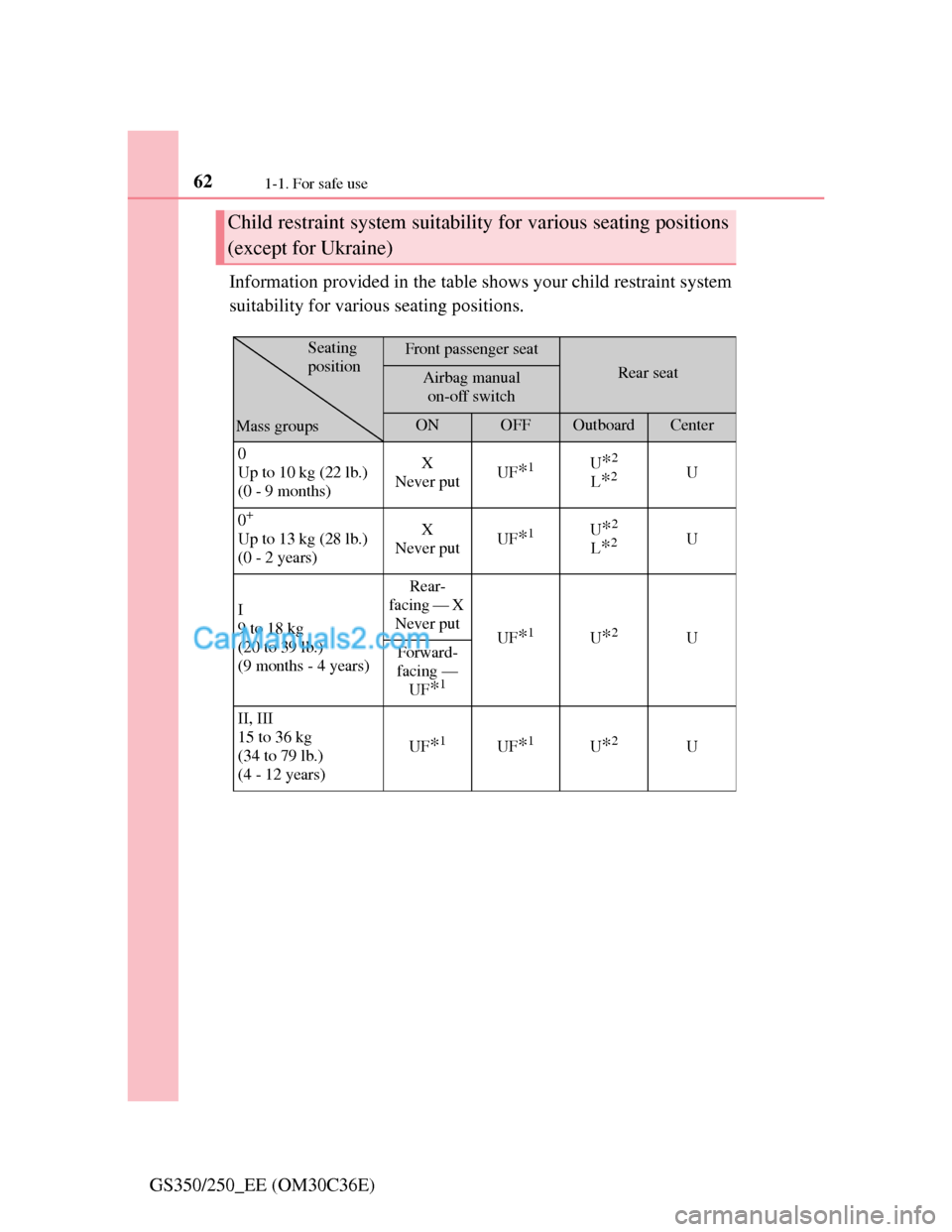
GS350/250_EE (OM30C36E)Information provided in the table shows your child restraint system
suitability for various seating positions.
Child restraint system suitability for various seating positions
(except for Ukraine)
Front passenger seat
Rear seatAirbag manual
on-off switch
ONOFFOutboardCenter
0
Up to 10 kg (22 lb.)
(0 - 9 months)X
Never putUF
*1U*2
L*2U
0
+
Up to 13 kg (28 lb.)
(0 - 2 years)X
Never putUF*1U*2
L*2U
I
9 to 18 kg
(20 to 39 lb.)
(9 months - 4 years)Rear-
facing — X
Never put
UF
*1U*2U
Forward-
facing —
UF
*1
II, III
15 to 36 kg
(34 to 79 lb.)
(4 - 12 years)UF
*1UF*1U*2U
Mass groupsSeating
position
Page 63 of 914

631-1. For safe use
1
For safety and security
GS350/250_EE (OM30C36E)Key of letters inserted in the above table:
U: Suitable for “universal” category child restraint system
approved for the use in this mass group.
UF: Suitable for forward-facing “universal” category child
restraint system approved for the use in this mass group.
L: Suitable for “LEXUS G 0
+, BABY SAFE PLUS with SEAT
BELT FIXATION, BASE PLATFORM” approved for the use
in this mass group.
X: Not suitable seat position for children in this mass group.
NOTE:
*1: When you use a child restraint system in this position, move the seatback
to the most upright position and the seat cushion to the highest position.
*2: When you use a child restraint system in this position, remove the head
restraint.
The child restraint system mentioned in the table may not be avail-
able outside of the EU area.
Other child restraint system which is different from the system
mentioned in the table can be used, but the suitability of the sys-
tems must be carefully checked with the child restraint system
manufacturer concerned and the seller of those seats.
Page 64 of 914
641-1. For safe use
GS350/250_EE (OM30C36E)Information provided in the table shows your child restraint system
suitability for various seating positions.
Child restraint system suitability for various seating positions
(with ISOFIX rigid anchors) (except for Ukraine)
Mass groupsSize classFixture
Ve h i c l e I S O F I X
positions
Rear outboard
CarrycotFISO/L1 X
GISO/L2 X
(1) X
Group 0
Up to 10 kg (22 lb.)EISO/R1 X
(1) X
Group 0+
Up to 13 kg (28 lb.)EISO/R1 X
DISO/R2 X
CISO/R3 X
(1) X
Group I
9 to 18 kg
(20 to 39 lb.)DISO/R2 X
CISO/R3 X
BISO/F2IUF
*
B1 ISO/F2X IUF*
AISO/F3 IUF*
(1) X
Group II
15 to 25 kg (34 to 55
lb.)(1) X
Group III
22 to 36 kg (49 to 79
lb.)(1) X
Page 66 of 914
661-1. For safe use
GS350/250_EE (OM30C36E)
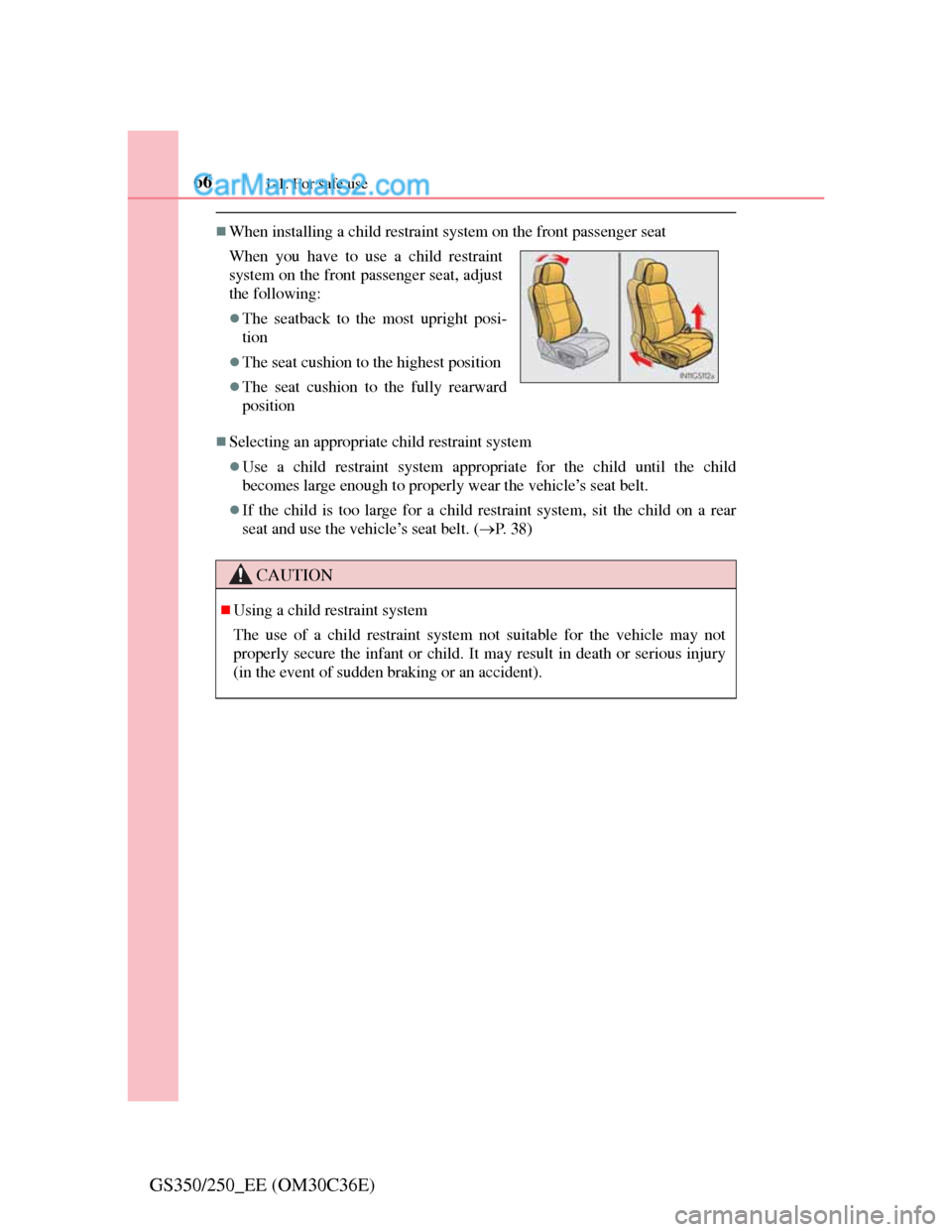
When installing a child restraint system on the front passenger seat
Selecting an appropriate child restraint system
Use a child restraint system appropriate for the child until the child
becomes large enough to properly wear the vehicle’s seat belt.
If the child is too large for a child restraint system, sit the child on a rear
seat and use the vehicle’s seat belt. (P. 3 8 ) When you have to use a child restraint
system on the front passenger seat, adjust
the following:
The seatback to the most upright posi-
tion
The seat cushion to the highest position
The seat cushion to the fully rearward
position
CAUTION
Using a child restraint system
The use of a child restraint system not suitable for the vehicle may not
properly secure the infant or child. It may result in death or serious injury
(in the event of sudden braking or an accident).
Page 67 of 914
671-1. For safe use
1
For safety and security
GS350/250_EE (OM30C36E)
CAUTION
Child restraint precautions
For effective protection in automobile accidents and sudden stops, a child
must be properly restrained, using a seat belt or child restraint system
depending on the age and size of the child. Holding a child in your arms is
not a substitute for a child restraint system. In an accident, the child can be
crushed against the windshield, or between you and the vehicle’s interior.
Lexus strongly urges the use of a proper child restraint system that con-
forms to the size of the child, installed on the rear seat. According to acci-
dent statistics, the child is safer when properly restrained in the rear seat
than in the front seat.
Never use a rear-facing child restraint system on the front passenger seat
when the airbag manual on-off switch is on. (P. 5 6 )
In the event of an accident, the force of the rapid inflation of the front pas-
senger airbag can cause death or serious injury to the child.
A forward-facing child restraint system may be installed on the front pas-
senger seat only when it is unavoidable. A child restraint system that
requires a top strap should not be used in the front passenger seat since
there is no top strap anchor for the front passenger seat. Adjust the seat-
back as upright as possible and always move the seat as far back as possi-
ble because the front passenger airbag could inflate with considerable
speed and force. Otherwise, the child may be killed or seriously injured.
Do not allow the child to lean his/her head or any part of his/her body
against the door or the area of the seat, front and rear pillars or roof side
rails from which the SRS side airbags or SRS curtain shield airbags
deploy even if the child is seated in the child restraint system. It is danger-
ous if the SRS side airbags and curtain shield airbags inflate, and the
impact could cause death or serious injury to the child.
Make sure you have complied with all installation instructions provided
by the child restraint manufacturer and that the system is properly
secured. If it is not secured properly, it may cause death or serious injury
to the child in the event of a sudden stop or accident.
Page 68 of 914
681-1. For safe use
GS350/250_EE (OM30C36E)
CAUTION
When children are in the vehicle
Do not allow children to play with the seat belt. If the seat belt becomes
twisted around a child’s neck, it may lead to choking or other serious inju-
ries that could result in death.
If this occurs and the buckle cannot be unfastened, scissors should be used
to cut the belt.
When the child restraint system is not in use
Keep the child restraint system properly secured on the seat even if it is
not in use. Do not store the child restraint system unsecured in the passen-
ger compartment.
If it is necessary to detach the child restraint system, remove it from the
vehicle or store it securely in the trunk. This will prevent it from injuring
passengers in the event of a sudden stop or accident.
Page 69 of 914
691-1. For safe use
1
For safety and security
GS350/250_EE (OM30C36E)
Installing child restraints
Seat belts (An ELR belt requires
a locking clip)
ISOFIX rigid anchors
Lower anchors are provided for the
outboard rear seats. (Buttons dis-
playing the location of the anchors
are attached to the seats.)
Anchor brackets (for top strap)
An anchor bracket is provided for
each rear seat.
Follow the child restraint system manufacturer’s instructions.
Firmly secure child restraints to the seats using a seat belt or ISO-
FIX rigid anchors. Attach the top strap when installing a child
restraint.