Page 204 of 914
2004-1. Before driving
GS350/250_EE (OM30C36E)
Total trailer weight and permissible drawbar load
Total trailer weight
Weight of the trailer itself plus
the trailer load should be within
the maximum towing capacity.
Exceeding this weight is dan-
gerous. (P. 836)
When the total trailer weight is
greater than the vehicle weight,
we recommend the use of a fric-
tion stabilizer (sway control
device).
Permissible drawbar load
Allocate the trailer load so that
the drawbar load is greater than
25 kg (55.1 lb.) or 4% of the
towing capacity. Do not let the
drawbar load exceed the indi-
cated weight. (P. 836)
Important points regarding trailer loads
1
2
Page 205 of 914
2014-1. Before driving
4
Driving
GS350/250_EE (OM30C36E)
Information tag (manufacturer’s label)
Gross vehicle mass
The combined weight of the
driver, passengers, towing hitch,
total curb mass and drawbar
load should not exceed the gross
vehicle mass by more than 100
kg (220.5 lb.). Exceeding this
weight is dangerous.
Maximum permissible rear
axle capacity
The weight borne by the rear
axle should not exceed the max-
imum permissible axle capacity
by 15% or more. Exceeding this
weight is dangerous.
The values for towing capacity
were derived from testing con-
ducted at sea level. Take note
that engine output and towing
capacity will be reduced at high
altitudes.
1
2
CAUTION
When the gross vehicle mass limit or maximum permissible axle capacity is
exceeded
Do not exceed the established speed limit for towing a trailer in built-up
areas or 100 km/h (62 mph), whichever is the lower.
Page 206 of 914
2024-1. Before driving
GS350/250_EE (OM30C36E)
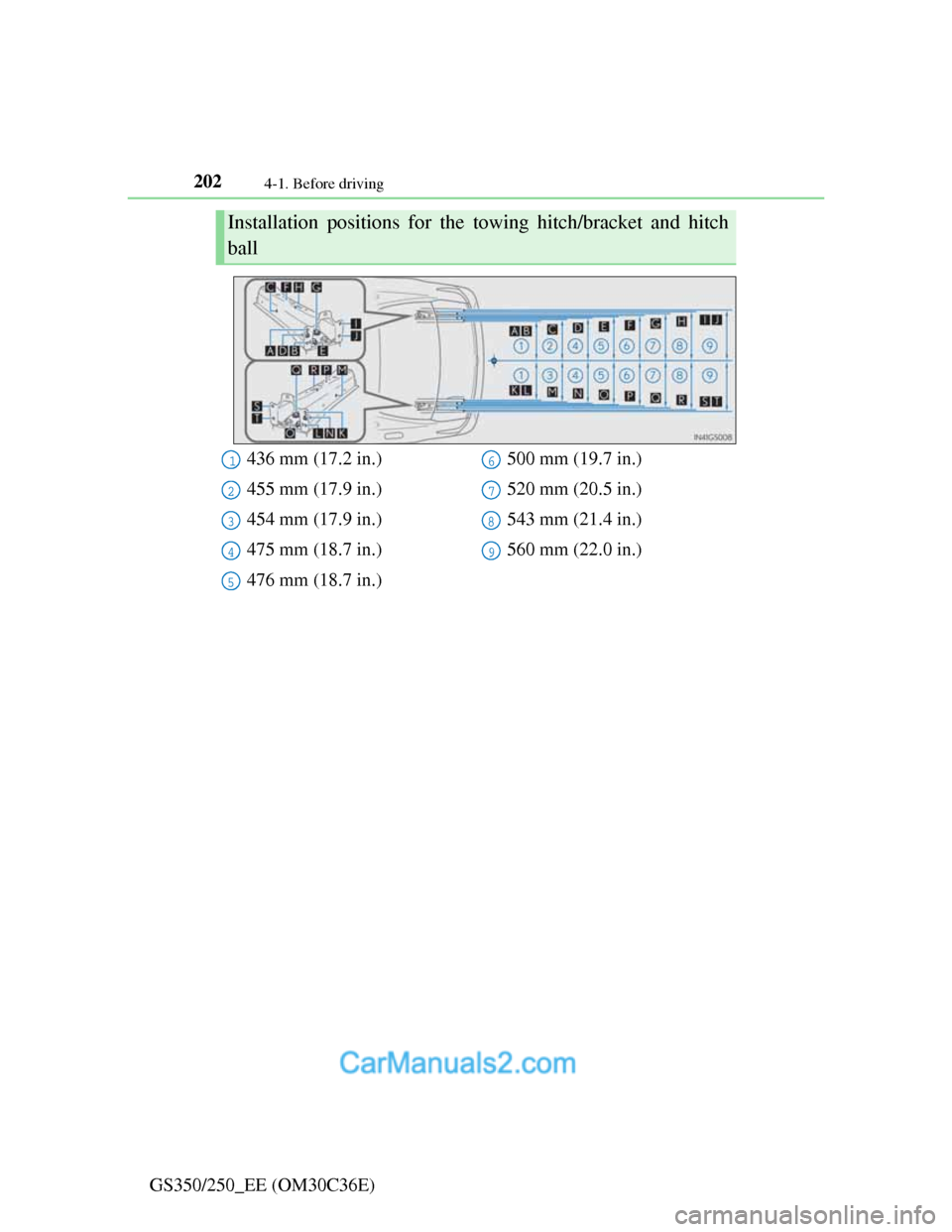
Installation positions for the towing hitch/bracket and hitch
ball
436 mm (17.2 in.)
455 mm (17.9 in.)
454 mm (17.9 in.)
475 mm (18.7 in.)
476 mm (18.7 in.)500 mm (19.7 in.)
520 mm (20.5 in.)
543 mm (21.4 in.)
560 mm (22.0 in.)1
2
3
4
5
6
7
8
9
Page 208 of 914

2044-1. Before driving
GS350/250_EE (OM30C36E)
Tire information
Increase the tire inflation pressure to 20.0 kPa (0.2 kgf/cm2 or bar, 3 psi)
greater than the recommended value when towing. (P. 850)
Increase the air pressure of the trailer tires in accordance with the total
trailer weight and according to the values recommended by the manufac-
turer of your trailer.
Break-in schedule
Lexus recommends that vehicles fitted with new power train components
should not be used for towing trailers for the first 800 km (500 miles).
Safety checks before towing
Check that the maximum load limit for the towing hitch/bracket hitch ball is
not exceeded. Bear in mind that the coupling weight of the trailer will add
to the load exerted on the vehicle. Also make sure that you will not be tow-
ing a load that exceeds the maximum permissible axle capacity.
Ensure that the trailer load is secure.
Supplementary outside rear view mirrors should be added to the vehicle if
the traffic behind cannot be clearly seen with standard mirrors. Adjust the
extending arms of these mirrors on both sides of the vehicle so that they
always provide maximum visibility of the road behind.
Maintenance
Maintenance must be performed more frequently when using the vehicle
for towing due to the greater weight burden placed on the vehicle compared
to normal driving.
Retighten all bolts securing the hitching ball and bracket after towing for
approximately 1000 km (600 miles).
Page 209 of 914

2054-1. Before driving
4
Driving
GS350/250_EE (OM30C36E)Your vehicle will handle differently when towing a trailer. In order
to avoid accident, death or serious injury, keep the following in
mind when towing:
Checking connections between trailer and lights
Stop the vehicle and check the operation of the connection
between the trailer and lights after driving for a brief period as
well as before starting off.
Practicing driving with a coupled trailer
Get the feel for turning, stopping and reversing with the trailer
coupled by practicing in an area with no or light traffic.
When reversing with a coupled trailer, hold the section of the
steering wheel nearest to you and rotate clockwise to turn the
trailer left or counterclockwise to turn it right. Always rotate a
little at a time to prevent steering error. Have someone guide
you when reversing to lessen the risk of an accident.
NOTICE
When the rear bumper strengthening material is aluminum
Ensure the steel bracket part does not come directly in contact with that
area.
When steel and aluminum come into contact, there is a reaction similar to
corrosion, which will weaken the section concerned and may result in dam-
age. Apply a rust inhibitor to parts that will come in contact when attaching
a steel bracket.
Guidance
Page 210 of 914

2064-1. Before driving
GS350/250_EE (OM30C36E)
Increasing vehicle-to-vehicle distance
At a speed of 10 km/h (6 mph), the distance to the vehicle run-
ning ahead of you should be equivalent to or greater than the
combined length of your vehicle and trailer. Avoid sudden brak-
ing that may cause skidding. Otherwise, the vehicle may spin out
of control. This is especially true when driving on wet or slippery
road surfaces.
Sudden acceleration/steering input/cornering
Executing sharp turns when towing may result in the trailer col-
liding with your vehicle. Decelerate well in advance when
approaching turns and take them slowly and carefully to avoid
sudden braking.
Important points regarding turning
The wheels of the trailer will travel closer to the inside of the
curve than the wheels of the vehicle. To make allowance for this,
take the turns wider than you would normally do.
Important points regarding stability
Vehicle movement resulting from uneven road surfaces and
strong crosswinds will affect handling. The vehicle may also be
rocked by passing buses or large trucks. Frequently check behind
when moving alongside such vehicles. As soon as such vehicle
movement occurs, immediately start to decelerate smoothly by
slowly applying the brakes. Always steer the vehicle straight
ahead while braking.
Passing other vehicles
Consider the total combined length of your vehicle and trailer
and ensure that the vehicle-to-vehicle distance is sufficient
before executing lane changes.
Transmission information
To maintain engine braking efficiency, when using engine brak-
ing, when driving on a long steep downgrade, do not use the
Page 212 of 914

2084-1. Before driving
GS350/250_EE (OM30C36E)
If the engine overheats
Towing a loaded trailer up a long, steep incline in temperatures
exceeding 30C (85F) may result in the engine overheating. If
the engine coolant temperature gauge indicates that the engine is
overheating, turn the air conditioning off immediately, leave the
road and stop the vehicle in a safe place. (P. 829)
When parking the vehicle
Always place wheel chocks under the wheels of both the vehicle
and trailer. Firmly set the parking brake and shift the shift lever
to P.
CAUTION
To avoid accident or injury
Do not tow a trailer when the compact spare tire is installed on your vehi-
cle.
Do not tow the vehicle when the tire installed is repaired with the emer-
gency tire puncture repair kit.
Vehicle speed in towing
Observe the legal maximum speeds for trailer towing.
Before descending hills or long declines
Reduce speed and downshift. However, never downshift suddenly while
descending steep or long downhill grades.
Operation of the brake pedal
Do not hold the brake pedal depressed often or for long periods of time.
Doing so may result in the brake overheating or reduce braking effects.
NOTICE
For vehicles with an emergency tire puncture repair kit (if equipped)
Do not tow anything if a tire that has been repaired using the emergency tire
puncture repair kit is installed. The load on the tire may cause unexpected
damage to the tire.
Page 264 of 914
2574-5. Using the driving support
4
Driving
GS350/250_EE (OM30C36E)
CAUTION
To avoid operating the cruise control by mistake
Switch the cruise control off using the “ON-OFF” button when not in use.
Situations unsuitable for cruise control
Do not use cruise control in any of the following situations.
Doing so may result in loss of control and could cause an accident resulting
in death or serious injury.
In heavy traffic
On roads with sharp bends
On winding roads
On slippery roads, such as those covered with rain, ice or snow
On steep hills
Vehicle speed may exceed the set speed when driving down a steep hill.
When your vehicle is towing a trailer or during emergency towing