Page 519 of 914

5085-3. Using the audio system
GS350/250_EE (OM30C36E)
About Bluetooth®
Compatible models
Portable players must correspond to the following specifications:
Bluetooth® specification
Ver. 1.1 or higher
(Recommended: Ver. 2.1+EDR or higher)
Profile
• A2DP (Advanced Audio Distribution Profile) Ver. 1.0 or higher
(Recommended: Ver. 1.2 or higher)
• AVRCP (Audio/Video Remote Control Profile) Ver. 1.0 or higher
(Recommended: Ver. 1.4 or higher)
However, please note that some functions may be limited depending on the
type of portable player. Also, the different screen is displayed depending on
which portable player is connecting.
Certification
P. 5 4 9
Reconnecting the portable player
If the portable player is disconnected with a poor reception when the engine
switch is in ACCESSORY or IGNITION ON mode, the system automati-
cally reconnects the portable player.
If you have switched off the portable player yourself, follow the instructions
below to reconnect:
Select the portable player again
Enter the portable player
When transferring ownership of your vehicle
Be sure to remove the registered portable player from the system. (P. 601) Bluetooth is a registered trademark of
Bluetooth SIG. Inc.
Page 563 of 914
5485-4. Using the hands-free phone system (for cellular phone)
GS350/250_EE (OM30C36E)
Compatible models
This system supports the following service.
Bluetooth® Specification Ver. 1.1 or higher (Recommended: Ver. 2.1+EDR
or higher)
Profiles
• HFP (Hands Free Profile) Ver. 1.0 or higher (Recommended: Ver. 1.5 or
higher)
• OPP (Object Push Profile) Ver. 1.1 or higher
• PBAP (Phone Book Access Profile) Ver. 1.0 or higher
• MAP (Message Access Profile) Ver. 1.0 or higher
• DUN (Dial-Up Networking Profile) Ver.1.1 or higher
*
*
: This profile is necessary when using connected services. For details,
refer to the “Navigation System Owner’s Manual”
If your cellular phone does not support HFP, you cannot enter the Bluetooth
®
phone, and take OPP, PBAP, MAP or DUN service individually.
If the connected Bluetooth
® phone version is older than recommended or
incompatible, this function may not be used.
Page 705 of 914

687 6-3. Do-it-yourself maintenance
6
Maintenance and care
GS350/250_EE (OM30C36E)
CAUTION
When inspecting or replacing tires
Observe the following precautions to prevent accidents.
Failure to do so may cause damage to parts of the drive train as well as dan-
gerous handling characteristics, which may lead to an accident resulting in
death or serious injury.
Do not mix tires of different makes, models or tread patterns.
Also, do not mix tires of remarkably different treadwear.
Do not use tire sizes other than those recommended by Lexus.
Do not mix differently constructed tires (radial, bias-belted or bias-ply
tires).
Do not mix summer, all season and snow tires.
Do not use tires that have been used on another vehicle.
Do not use tires if you do not know how they were used previously.
Vehicles with a compact spare tire: Do not tow if your vehicle has a com-
pact spare tire installed.
Vehicles with an emergency tire puncture repair kit (if equipped): Do not
tow anything if a tire that has been repaired using the emergency tire
puncture repair kit is installed. The load on the tire may cause unexpected
damage to the tire.
When initializing the tire pressure warning system (vehicles with the tire
pressure warning system)
Do not operate the tire pressure warning reset switch without first adjusting
the tire inflation pressure to the specified level. Otherwise, the tire pressure
warning light may not come on even if the tire inflation pressure is low, or
it may come on when the tire inflation pressure is actually normal.
Page 712 of 914
6946-3. Do-it-yourself maintenance
GS350/250_EE (OM30C36E)
When replacing wheels (vehicles with the tire pressure warning system)
The wheels of your vehicle are equipped with tire pressure warning valves
and transmitters that allow the tire pressure warning system to provide
advance warning in the event of a loss in tire inflation pressure. Whenever
wheels are replaced, tire pressure warning valves and transmitters must be
installed. (P. 674)
CAUTION
When replacing wheels
Do not use wheels that are a different size from those recommended in the
Owner’s Manual, as this may result in a loss of handling control.
Never use an inner tube in a leaking wheel which is designed for a tube-
less tire. Doing so may result in an accident, causing death or serious
injury.
NOTICE
Replacing tire pressure warning valves and transmitters (vehicles with the
tire pressure warning system)
Because tire repair or replacement may affect the tire pressure warning
valves and transmitters, make sure to have tires serviced by any autho-
rized Lexus dealer or repairer, or another duly qualified and equipped pro-
fessional or other qualified service shop. In addition, make sure to
purchase your tire pressure warning valves and transmitters at any autho-
rized Lexus dealer or repairer, or another duly qualified and equipped pro-
fessional.
Ensure that only genuine Lexus wheels are used on your vehicle.
Tire pressure warning valves and transmitters may not work properly with
non-genuine wheels.
Page 716 of 914
6986-3. Do-it-yourself maintenance
GS350/250_EE (OM30C36E)Remove the depleted battery.
Insert a new battery with the “+”
terminal facing up.
Use a CR2032 lithium battery
Batteries can be purchased at any authorized Lexus dealer or repairer, or
another duly qualified and equipped professional, local electrical appliance
shops or camera stores.
Replace only with the same or equivalent type recommended by the manu-
facturer.
Dispose of used batteries according to local laws.
When the card key battery needs to be replaced (if equipped)
The battery for the card key is available only at Lexus dealers. Your Lexus
dealer can replace the battery for you.
If the electronic key battery is depleted
The following symptoms may occur:
The smart entry & start system and wireless remote control will not func-
tion properly.
The operational range will be reduced.
4
Page 830 of 914
8097-2. Steps to take in an emergency
7
When trouble arises
GS350/250_EE (OM30C36E)
• If the tire inflation pressure
exceeds the recommended
level, let out some air to
adjust the tire inflation pres-
sure.
(P. 813)
Disconnect the hose from the valve on the tire and then pull out
the power plug from the power outlet socket.
To spread the liquid sealant evenly within the tire, immediately
drive for about 5 km (3 miles).
After driving for about 5 km
(3 miles), stop your vehicle in
a safe place on a hard, flat sur-
face and reconnect the com-
pressor.12
13
14
Page 831 of 914
8107-2. Steps to take in an emergency
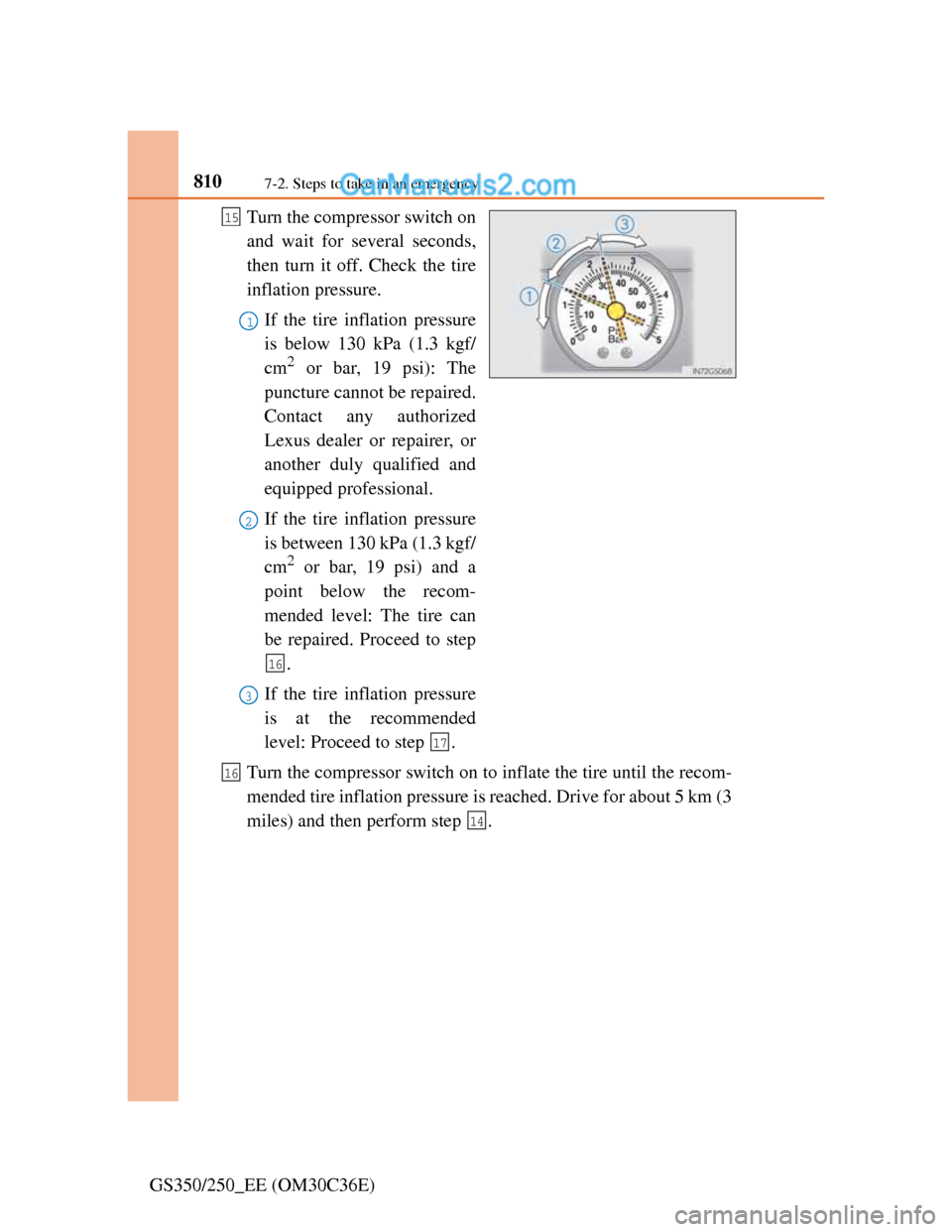
GS350/250_EE (OM30C36E)Turn the compressor switch on
and wait for several seconds,
then turn it off. Check the tire
inflation pressure.
If the tire inflation pressure
is below 130 kPa (1.3 kgf/
cm
2 or bar, 19 psi): The
puncture cannot be repaired.
Contact any authorized
Lexus dealer or repairer, or
another duly qualified and
equipped professional.
If the tire inflation pressure
is between 130 kPa (1.3 kgf/
cm
2 or bar, 19 psi) and a
point below the recom-
mended level: The tire can
be repaired. Proceed to step
.
If the tire inflation pressure
is at the recommended
level: Proceed to step .
Turn the compressor switch on to inflate the tire until the recom-
mended tire inflation pressure is reached. Drive for about 5 km (3
miles) and then perform step .
15
1
2
16
3
17
16
14
Page 834 of 914
8137-2. Steps to take in an emergency
7
When trouble arises
GS350/250_EE (OM30C36E)
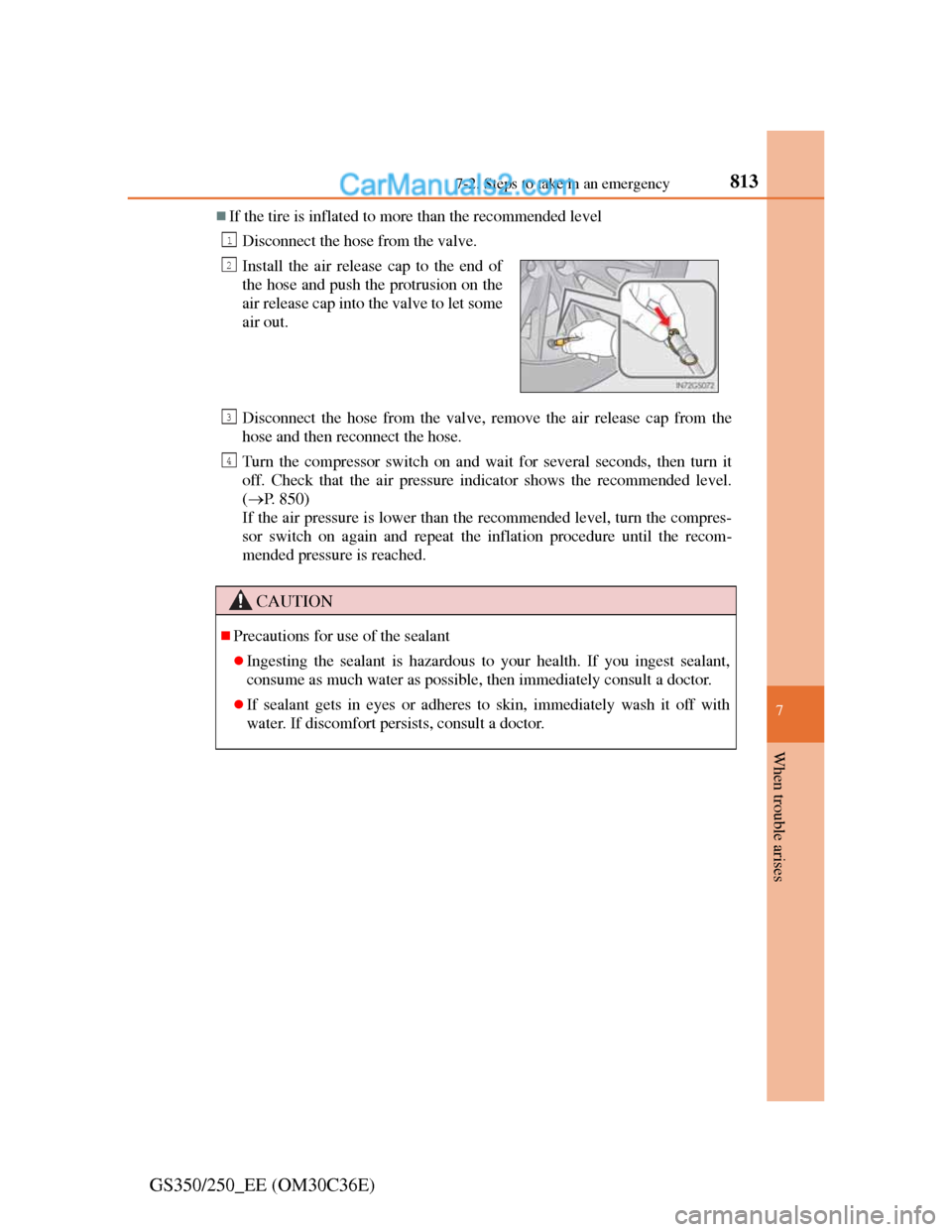
If the tire is inflated to more than the recommended level
Disconnect the hose from the valve.
Disconnect the hose from the valve, remove the air release cap from the
hose and then reconnect the hose.
Turn the compressor switch on and wait for several seconds, then turn it
off. Check that the air pressure indicator shows the recommended level.
(P. 850)
If the air pressure is lower than the recommended level, turn the compres-
sor switch on again and repeat the inflation procedure until the recom-
mended pressure is reached. Install the air release cap to the end of
the hose and push the protrusion on the
air release cap into the valve to let some
air out.
CAUTION
Precautions for use of the sealant
Ingesting the sealant is hazardous to your health. If you ingest sealant,
consume as much water as possible, then immediately consult a doctor.
If sealant gets in eyes or adheres to skin, immediately wash it off with
water. If discomfort persists, consult a doctor.
1
2
3
4