Page 484 of 554

5
When trouble arises
483
5-2. Steps to take in an emergency
ES350_U
If the vehicle becomes stuck
CAUTION
■When attempting to free a stuck vehicle
If you choose to rock the vehicle back and forth to free it, make sure the surround-
ing area is clear, to avoid striking other vehicles, objects or persons. The vehicle
may also lunge forward or lunge back suddenly as it becomes free. Use extreme
caution.
■When shifting the shift lever
Be careful not to shift the shift lever with the accelerator pedal depressed.
This may lead to unexpected rapid acceleration of the vehicle that may cause an
accident and result in death or serious injury.
NOTICE
■To avoid damaging the transmission and other components
●Avoid spinning the wheels and do not rev the engine.
●If the vehicle remains stuck after trying these procedures, the vehicle may require
towing to be freed.
Carry out the following procedures if the tires spin or the vehicle becomes
stuck in mud, dirt, or snow.
●Stop the engine. Set the parking brake and put the shift lever in P.
● Remove the mud, snow, or sand from around the stuck tire.
● Place wood, stones or some other material to help provide trac-
tion under the tires.
● Restart the engine.
● Carefully apply the accelerator to free the vehicle.
Page 485 of 554
484
5-2. Steps to take in an emergency
ES350_U
If your vehicle has to be stopped in an emergency
CAUTION
■If the engine has to be turned off while driving
Power assist for the brakes and steering wheel will be lost, making the brake pedal
harder to depress and the steering wheel heavier to turn. Decelerate as much as
possible before turning off the engine.
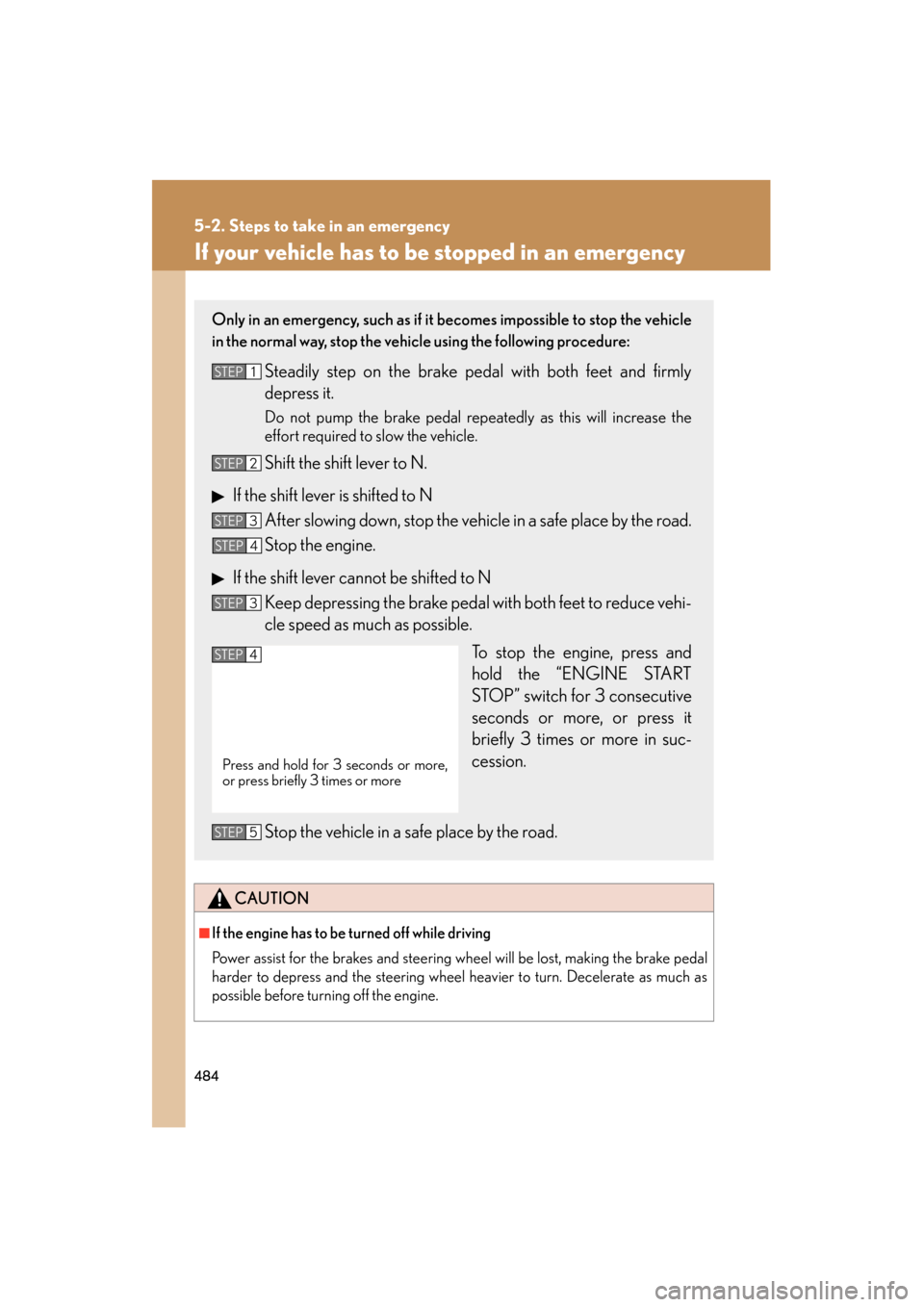
Only in an emergency, such as if it becomes impossible to stop the vehicle
in the normal way, stop the vehicle using the following procedure:
Steadily step on the brake pedal with both feet and firmly
depress it.
Do not pump the brake pedal repeatedly as this will increase the
effort required to slow the vehicle.
Shift the shift lever to N.
If the shift lever is shifted to N After slowing down, stop the vehicle in a safe place by the road.
Stop the engine.
If the shift lever cannot be shifted to N Keep depressing the brake pedal with both feet to reduce vehi-
cle speed as much as possible.
To stop the engine, press and
hold the “ENGINE START
STOP” switch for 3 consecutive
seconds or more, or press it
briefly 3 times or more in suc-
cession.
Stop the vehicle in a safe place by the road.
STEP1
STEP2
STEP3
STEP4
STEP3
STEP4
Press and hold for 3 seconds or more,
or press briefly 3 times or more
STEP5
Page 487 of 554
486
ES350_U
6-1. Specifications
Maintenance data (fuel, oil level, etc.)
Dimensions and weight
*: Unladen vehicle
Overall length191.7 in. (4870 mm)
Overall width71.7 in. (1820 mm)
Overall height *57.1 in. (1450 mm)
Wheelbase109.3 in. (2775 mm)
Tr e a dFront62.0 in. (1575 mm)
Rear61.6 in. (1565 mm)
Vehicle capacity weight
(Occupants + luggage)900 lb. (410 kg)
Page 494 of 554
493
6-1. Specifications
6
Vehicle specifications
ES350_U
Steering
Tires and wheelsType A
Free playLess than 1.2 in. (30 mm)
Power steering fluidAutomatic transmission fluid
DEXRON® II or III
Ti r e s i z eP215/55R17 93V
Tire inflation pressure
(Recommended cold tire inflation
pressure)
Front:
30 psi (210 kPa, 2.1 kgf/cm2 or bar)
Rear:
30 psi (210 kPa, 2.1 kgf/cm
2 or bar)
Spare:
30 psi (210 kPa, 2.1 kgf/cm
2 or bar)
When driving at high speeds above 100 mph
(160 km/h), in countries where such speeds
are permitted by law, add 4.3 psi (30 kPa, 0.3
kgf/cm
2 or bar) to the front tires and rear tires.
Never exceed the maximum cold tire inflation
pressure indicated on the tire sidewall.
Wheel size17 × 7J
Wheel nut torque76 ft•lbf (103 N•m, 10.5 kgf•m)
Page 495 of 554
494
6-1. Specifications
ES350_UTy p e B
Ti r e s i z eP215/55R17 93V,
T155/70D17 110M (spare)
Tire inflation pressure
(Recommended cold tire inflation
pressure)
Front:
30 psi (210 kPa, 2.1 kgf/cm2 or bar)*
Rear:
30 psi (210 kPa, 2.1 kgf/cm
2 or bar)*
Spare:
60 psi (420 kPa, 4.2 kgf/cm
2 or bar)
*:When driving at high speeds above 100 mph (160 km/h), in countries where such
speeds are permitted by law, add 4.3 psi
(30 kPa, 0.3 kgf/cm
2 or bar) to the front
tires and rear tires. Never exceed the maxi-
mum cold tire inflation pressure indicated
on the tire sidewall.
Wheel size17 × 7J, 17 × 4T (spare)
Wheel nut torque76 ft•lbf (103 N•m, 10.5 kgf•m)
Page 502 of 554
501
6-1. Specifications
6
Vehicle specifications
ES350_U
Typical DOT and tire identification number (TIN)DOT symbol
*
Tire Identification Number (TIN)
Tire manufacturer's identifica-
tion mark
Tire size code
Manufacturer's optional tire
type code (3 or 4 letters)
Manufacturing week
Manufacturing year
*: The DOT symbol certifies thatthe tire conforms to applicable
Federal Motor Vehicle Safety
Standards.
Tire size
■ Typical tire si ze information
The illustration indicates typical
tire size.
Ti r e u s e
(P = Passenger car,
T = Temporary use)
Section width (millimeters)
Aspect ratio
(tire height to section width)
Tire construction code
(R = Radial, D = Diagonal)
Wheel diameter (inches)
Load index (2 or 3 digits)
Speed symbol
(alphabet with one letter)
Page 503 of 554
502
6-1. Specifications
ES350_U■
Tire dimensions
Section width
Ti r e h e i g h t
Wheel diameter
Tire section names
Bead
Sidewall
Shoulder
Tr e a d
Belt
Inner liner
Reinforcing rubber
Carcass
Rim lines
Bead wires
Chafer
Uniform Tire Quality GradingThis information has been prepared in accordance with regulations
issued by the National Highway Traffic Safety Administration of the U.S.
Department of Transportation.
It provides the purchasers and/or prospective purchasers of Lexus vehi-
cles with information on uniform tire quality grading.
Your Lexus dealer will help answer any questions you may have as you read
this information.
Page 505 of 554

504
6-1. Specifications
ES350_U■
Temperature A, B, C
The temperature grades are A (the highest), B, and C, representing
the tire's resistance to the generation of heat and its ability to dissipate
heat when tested under controlled conditions on a specified indoor
laboratory test wheel.
Sustained high temperature can cause the material of the tire to degenerate
and reduce tire life, and excessive temperature can lead to sudden tire fail-
ure.
The grade C corresponds to a level of performance which all passenger car
tires must meet under the Federal Motor Vehicle Safety Standard No. 109.
Grades B and A represent higher levels of performance on the laboratory
test wheel than the minimum required by law.
Warning: The temperature grades for this tire are established for a tire that
is properly inflated and not overloaded.
Excessive speed, underinflation, or excessive loading, either separately or in
combination, can cause heat buildup and possible tire failure.
Glossary of tire terminology
Tire related termMeaning
Cold tire inflation pres-
sureTire pressure when the vehicle has been parked for
three hours or more, or has not been driven more
than 1 mile or 1.5 km under that condition
Maximum inflation pres-
sureThe maximum cold inflated pressure to which a tire
may be inflated, shown on the sidewall of the tire
Recommended inflation
pressureCold tire inflation pressure recommended by a man-
ufacturer
Accessory weight
The combined weight (in excess of those standard
items which may be replaced) of automatic transmis-
sion, power steering, power brakes, power windows,
power seats, radio and heater, to the extent that these
items are available as factory-installed equipment
(whether installed or not)


