2012 KIA Sportage warning
[x] Cancel search: warningPage 21 of 387
23
Your vehicle at a glance
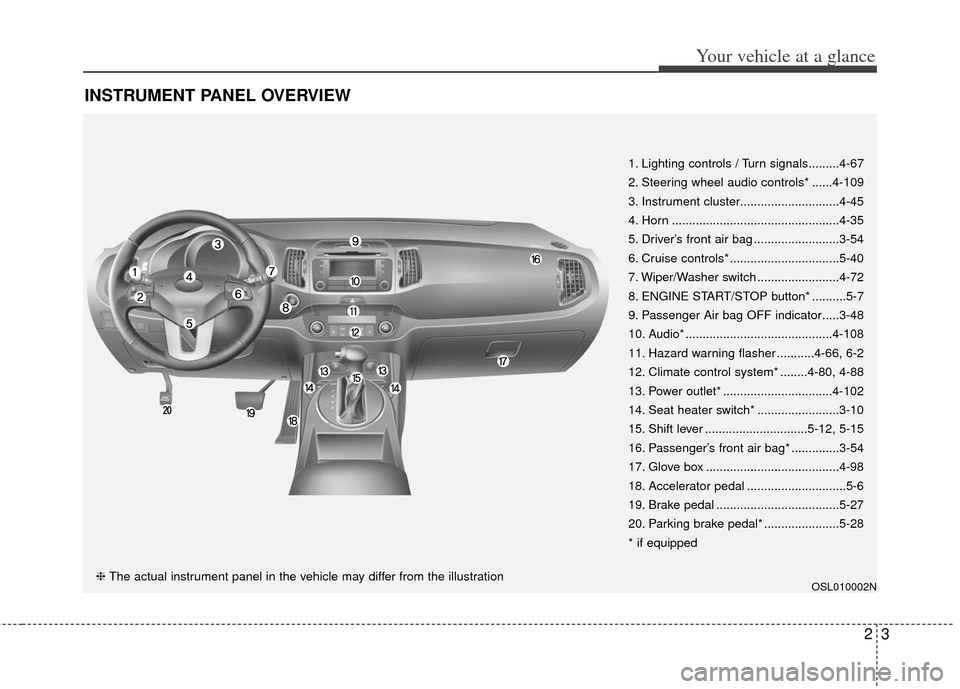
INSTRUMENT PANEL OVERVIEW
OSL010002N
1. Lighting controls / Turn signals.........4-67
2. Steering wheel audio controls* ......4-109
3. Instrument cluster.............................4-45
4. Horn .................................................4-35
5. Driver’s front air bag .........................3-54
6. Cruise controls* ................................5-40
7. Wiper/Washer switch ........................4-72
8. ENGINE START/STOP button* ..........5-7
9. Passenger Air bag OFF indicator.....3-48
10. Audio* ...........................................4-108
11. Hazard warning flasher ...........4-66, 6-2
12. Climate control system* ........4-80, 4-88
13. Power outlet* ................................4-102
14. Seat heater switch* ........................3-10
15. Shift lever ..............................5-12, 5-15
16. Passenger’s front air bag* ..............3-54
17. Glove box .......................................4-98
18. Accelerator pedal .............................5-6
19. Brake pedal ....................................5-27
20. Parking brake pedal* ......................5-28
* if equipped
❈ The actual instrument panel in the vehicle may differ from the illustration
Page 25 of 387
33
Safety features of your vehicle
WARNING- Driver’s seat
Never attempt to adjust the seatwhile the vehicle is moving. This
could result in loss of control,
and an accident causing death,
serious injury, or property dam-
age.
Do not allow anything to interfere with the normal position of the
seatback. Storing items against a
seatback or in any other way
interfering with proper locking of
a seatback could result in serious
or fatal injury in a sudden stop or
collision.
seatback upright and the lap por-
tion of the seat belt snug and low
across the hips. This is the best
position to protect you in case of
an accident.
In order to avoid unnecessary and perhaps severe air bag
injuries, always sit as far back as
possible from the steering wheel
while maintaining comfortable
control of the vehicle. We recom-
mend that your chest be at least
25 cm (10 inches) away from the
steering wheel.
WARNING - Uprighting
seat
When you return the seatback to its
upright position, hold the seatback
and return it slowly and be sure
there are no other passengers
around the seat. If the seatback is
returned without being held and
controlled, the back of the seat
could spring forward resulting in
accidental injury to a person struck
by the seatback.
WARNING- Loose objects
Loose objects in the driver’s foot
area could interfere with the opera-
tion of the foot pedals, possibly
causing an accident. Do not place
anything under the front seats.
WARNING
Do not use a sitting cushion that
reduces friction between the seat
and passenger. The passenger’s
hips may slide under the lap por-
tion of the seat belt during an acci-
dent or a sudden stop. Serious or
fatal internal injuries could result
because the seat belt cannot oper-
ate normally.
(Continued)
If a seat is reclined during an acci-
dent, the occupant’s hips may slide
under the lap portion of the seat
belt applying great force to the
unprotected abdomen. Serious or
fatal internal injuries could result.
The driver must advise the passen-
ger to keep the seatback in an
upright position whenever the vehi-
cle is in motion. In addition, exces-
sive reclining can significantly
reduce the ability of the restraint
system to restrain occupants in
certain accidents, specifically
rollover accidents.
WARNING- Driver respon-
sibility for passengers
Riding in a vehicle with the seat-
back reclined could lead to serious
or fatal injury in an accident.
(Continued)
Page 26 of 387
Safety features of your vehicle
43
(Continued)
When resetting the seatback tothe upright position, make sure it
is securely latched by pushing it
forward and backwards.
To avoid the possibility of burns, do not remove the carpet in the
cargo area. Emission control
devices beneath this floor gener-
ate high temperatures.WARNING- Rear seatbacks
The rear seatback must besecurely latched. If not, passen-
gers and objects could be thrown
forward resulting in serious
injury or death in the event of a
sudden stop or collision.
Luggage and other cargo should be laid flat in the cargo area. If
objects are large, heavy, or must
be piled, they must be secured.
Under no circumstances should
cargo be piled higher than the
seatbacks. Failure to follow these
warnings could result in serious
injury or death in the event of a
sudden stop, collision or rollover.
No passenger should ride in the cargo area or sit or lie on folded
seatbacks while the vehicle is
moving. All passengers must be
properly seated in seats and
restrained properly while riding.
(Continued)
WARNING
After adjusting the seat, always
check that it is securely locked into
place by attempting to move the
seat forward or backward without
using the lock release lever.
Sudden or unexpected movement
of the driver's seat could cause you
to lose control of the vehicle result-
ing in an accident.
WARNING
Do not adjust the seat while wear-ing seat belts. Moving the seat
cushion forward may cause
strong pressure on the abdomen.
Use extreme caution so that hands or other objects are not
caught in the seat mechanisms
while the seat is moving.
Do not put a cigarette lighter on the floor or seat. When you oper-
ate the seat, gas may gush out of
the lighter and cause fire.
Page 28 of 387
Safety features of your vehicle
63
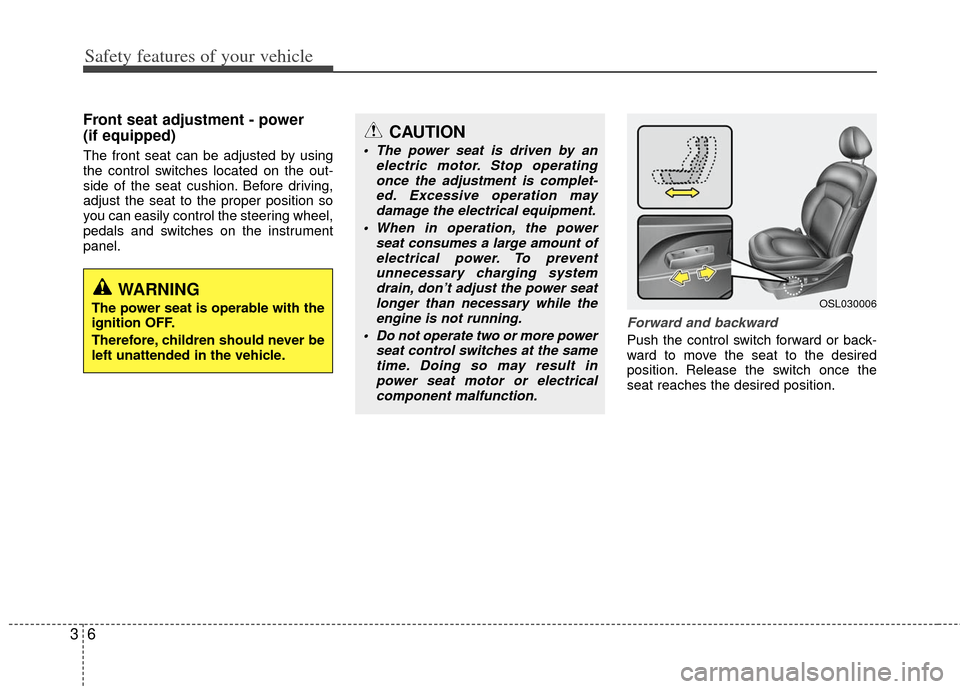
Front seat adjustment - power
(if equipped)
The front seat can be adjusted by using
the control switches located on the out-
side of the seat cushion. Before driving,
adjust the seat to the proper position so
you can easily control the steering wheel,
pedals and switches on the instrument
panel.
Forward and backward
Push the control switch forward or back-
ward to move the seat to the desired
position. Release the switch once the
seat reaches the desired position.
CAUTION
The power seat is driven by anelectric motor. Stop operatingonce the adjustment is complet-ed. Excessive operation maydamage the electrical equipment.
When in operation, the power seat consumes a large amount ofelectrical power. To preventunnecessary charging systemdrain, don’t adjust the power seatlonger than necessary while theengine is not running.
Do not operate two or more power seat control switches at the sametime. Doing so may result inpower seat motor or electricalcomponent malfunction.
OSL030006WARNING
The power seat is operable with the
ignition OFF.
Therefore, children should never be
left unattended in the vehicle.
Page 30 of 387
Safety features of your vehicle
83
C010104AHM
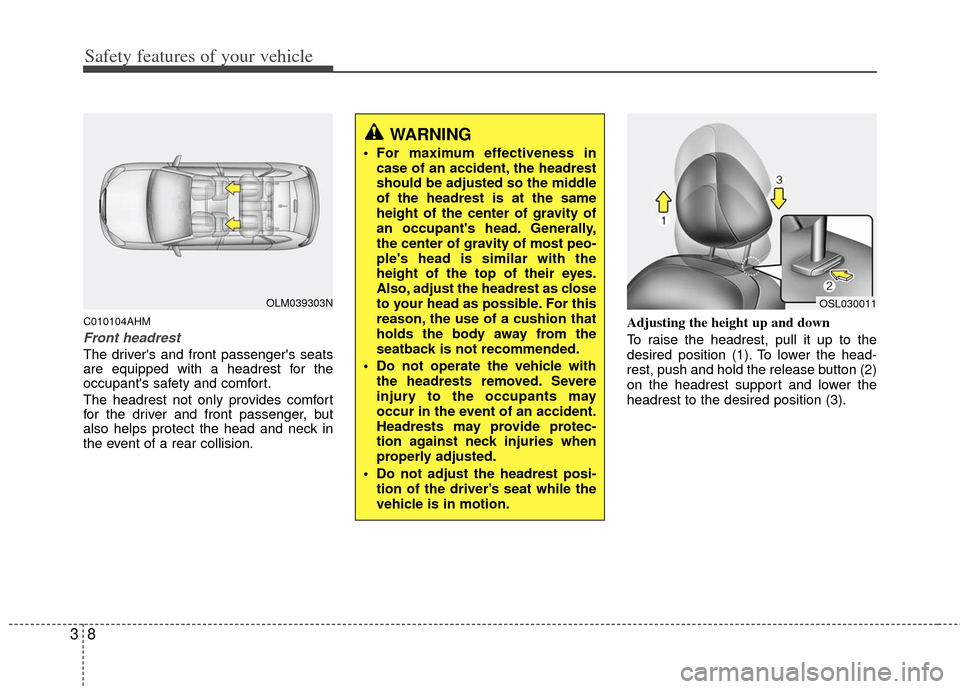
Front headrest
The driver's and front passenger's seats
are equipped with a headrest for the
occupant's safety and comfort.
The headrest not only provides comfort
for the driver and front passenger, but
also helps protect the head and neck in
the event of a rear collision.Adjusting the height up and down
To raise the headrest, pull it up to the
desired position (1). To lower the head-
rest, push and hold the release button (2)
on the headrest support and lower the
headrest to the desired position (3).
WARNING
For maximum effectiveness in
case of an accident, the headrest
should be adjusted so the middle
of the headrest is at the same
height of the center of gravity of
an occupant's head. Generally,
the center of gravity of most peo-
ple's head is similar with the
height of the top of their eyes.
Also, adjust the headrest as close
to your head as possible. For this
reason, the use of a cushion that
holds the body away from the
seatback is not recommended.
Do not operate the vehicle with the headrests removed. Severe
injury to the occupants may
occur in the event of an accident.
Headrests may provide protec-
tion against neck injuries when
properly adjusted.
Do not adjust the headrest posi- tion of the driver’s seat while the
vehicle is in motion.
OSL030011OLM039303N
Page 31 of 387
39
Safety features of your vehicle
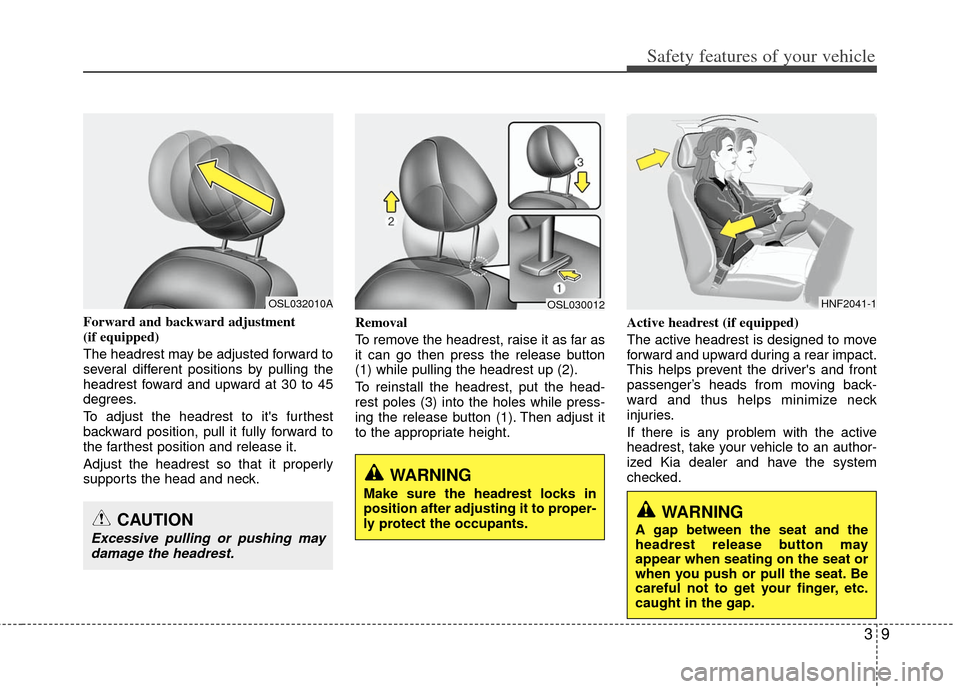
Forward and backward adjustment
(if equipped)
The headrest may be adjusted forward to
several different positions by pulling the
headrest foward and upward at 30 to 45
degrees.
To adjust the headrest to it's furthest
backward position, pull it fully forward to
the farthest position and release it.
Adjust the headrest so that it properly
supports the head and neck.Removal
To remove the headrest, raise it as far as
it can go then press the release button
(1) while pulling the headrest up (2).
To reinstall the headrest, put the head-
rest poles (3) into the holes while press-
ing the release button (1). Then adjust it
to the appropriate height.
Active headrest (if equipped)
The active headrest is designed to move
forward and upward during a rear impact.
This helps prevent the driver's and front
passenger’s heads from moving back-
ward and thus helps minimize neck
injuries.
If there is any problem with the active
headrest, take your vehicle to an author-
ized Kia dealer and have the system
checked.
CAUTION
Excessive pulling or pushing may
damage the headrest.
WARNING
Make sure the headrest locks in
position after adjusting it to proper-
ly protect the occupants.
HNF2041-1OSL032010AOSL030012
WARNING
A gap between the seat and the
headrest release button may
appear when seating on the seat or
when you push or pull the seat. Be
careful not to get your finger, etc.
caught in the gap.
Page 33 of 387
311
Safety features of your vehicle
The seat heater (with air ventilation)defaults to the OFF position whenever
the ignition switch is turned on.
C010108AAM
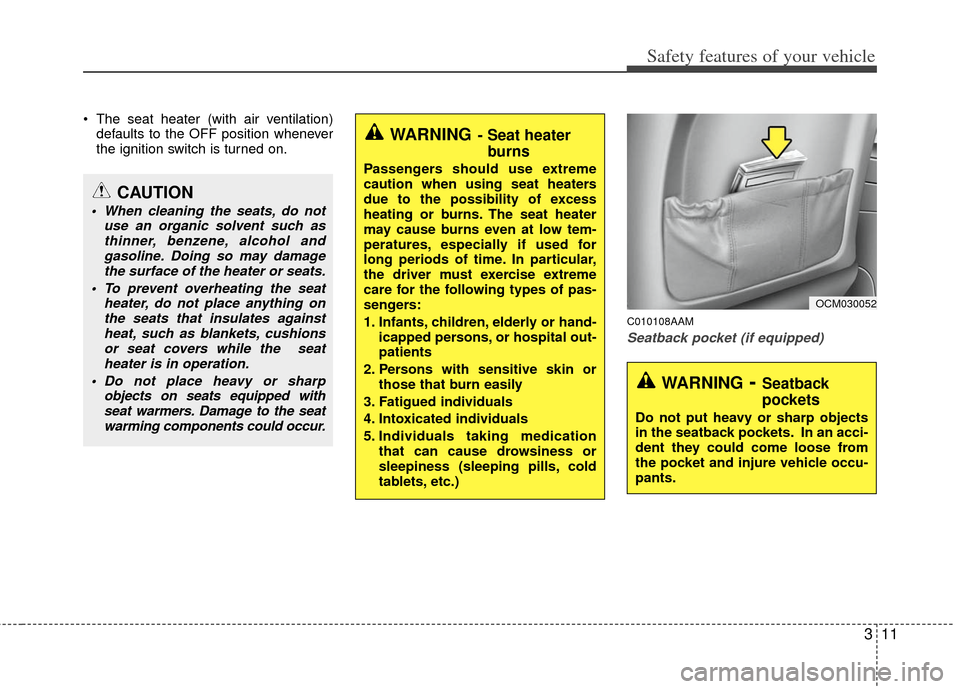
Seatback pocket (if equipped)
OCM030052
WARNING- Seatback
pockets
Do not put heavy or sharp objects
in the seatback pockets. In an acci-
dent they could come loose from
the pocket and injure vehicle occu-
pants.
CAUTION
When cleaning the seats, do not use an organic solvent such asthinner, benzene, alcohol and gasoline. Doing so may damagethe surface of the heater or seats.
To prevent overheating the seat heater, do not place anything onthe seats that insulates againstheat, such as blankets, cushionsor seat covers while the seatheater is in operation.
Do not place heavy or sharp objects on seats equipped withseat warmers. Damage to the seatwarming components could occur.
WARNING- Seat heater burns
Passengers should use extreme
caution when using seat heaters
due to the possibility of excess
heating or burns. The seat heater
may cause burns even at low tem-
peratures, especially if used for
long periods of time. In particular,
the driver must exercise extreme
care for the following types of pas-
sengers:
1. Infants, children, elderly or hand-
icapped persons, or hospital out-
patients
2. Persons with sensitive skin or those that burn easily
3. Fatigued individuals
4. Intoxicated individuals
5. Individuals taking medication that can cause drowsiness or
sleepiness (sleeping pills, cold
tablets, etc.)
Page 34 of 387
Safety features of your vehicle
12
3
Rear seat adjustment
Folding the rear seat
The rear seatbacks can be folded to facil-
itate carrying long items or to increase
the luggage capacity of the vehicle.
1. Insert the rear seat belt buckle in thepocket (if equipped) between the rear
seatback and cushion, and insert the
rear seat belt webbing into the guide to
prevent the seat belt from being dam-
aged.
2. Set the front seatback to the upright position and if necessary, slide the
front seat forward.
3. Lower the rear headrests to the lowest position.
WARNING
The purpose of the fold-down rear
seatbacks is to allow you to carry
longer objects that could not be
accommodated in the cargo area.
Never allow passengers sit on top
of the folded down seatback while
the vehicle is moving. This is not a
proper seating position and no seat
belts are available for use.
Ignoring this warning could result
in serious injury or death in case of
an accident or sudden stop.
Objects carried on the folded down
seatback should not extend higher
than the top of the front seatbacks.
Doing this could allow cargo to
slide forward and cause injury or
damage during sudden stops.
WARNING
For proper operation of the
Occupant Detection System (ODS):
Do not place any items cumula-tively weighing over 1 kg (2.2 lbs)
in the seatback pocket or on the
front passenger seat.
Do not hanging clothing or other articles on the front passenger
seat.
WARNING- Cargo
Cargo should always be secured to
prevent it from being thrown about
the vehicle in a collision and caus-
ing injury to the vehicle occupants.
Do not place objects on the rear
seats, since they cannot be proper-
ly secured and may hit the front
seat occupants in a collision.