2012 KIA Sorento Fuel
[x] Cancel search: FuelPage 371 of 388

757
Maintenance
Description Fuse ratingProtected component
EMS
BOX ECU 30A Engine Control Relay
ECU 3
20AG4KE - Ignition Coil #1/2/3/4, Condenser
G6DC - Ignition Coil #1/2/3/4/5/6, Condenser #1/2
SENSOR 1 10AG4KE - Variable Intake Manifold Valve, Crankshaft Position Sensor, Immobilizer Module, Camshaft
Position Sensor #1/2, Oil Control Valve #1/2, Canister Purge Control Solenoid Valve,
Canister Close Valve, Cooling Fan (Low) Relay
G6DC - Variable Intake Manifold Valve #1/2, Immobilizer Module, Canister Purge Control Solenoid Valve, Oil Control Valve #1/2 (Exhaust), Oil Control Valve #1/2 (Intake), Canister Close
Valve
SENSOR 2 10A G6DC - Cooling Fan (Low) Relay, Stop Lamp Switch
SENSOR 3 10AG4KE - Injector #1/2/3/4, A/C Relay
G6DC - PCM, Injector #1/2/3/4/5/6, A/C Relay
SENSOR 4 15AG4KE - Oxygen Sensor Up/Down, Fuel Pump Relay
G6DC - PCM, Oxygen Sensor #1/2/3/4, Fuel Pump Relay, Variable Charge Motion Actuator
ECU 1 15A PCM
A/CON 10A A/C Relay
F/PUMP 15A Fuel Pump Relay
XM CAN (ENG) 7.QXP 4/19/2011 10:54 AM Page 57
Page 374 of 388

Maintenance60
7G230105ASAUnderbody maintenanceCorrosive materials used for ice and
snow removal and dust control may col-
lect on the underbody. If these materials
are not removed, accelerated rusting can
occur on underbody parts such as the
fuel lines, frame, floor pan and exhaust
system, even though they have been
treated with rust protection.
Thoroughly flush the vehicle underbody
and wheel openings with lukewarm or
cold water once a month, after off-road
driving and at the end of each winter. Pay
special attention to these areas because
it is difficult to see all the mud and dirt. It
will do more harm than good to wet down
the road grime without removing it. The
lower edges of the doors, rocker panels,
and frame members have drain holes
that should not be allowed to clog with
dirt; trapped water in these areas can
cause rusting.
G230106AAMAluminum wheel maintenance The aluminum wheels are coated with a
clear protective finish.
Do not use any abrasive cleaner, pol-
ishing compound, solvent, or wire
brushes on aluminum wheels. They
may scratch or damage the finish.
Use only mild soap or neutral deter- gent, and rinse thoroughly with water.
Also, be sure to clean the wheels after
driving on salted roads. This helps pre-
vent corrosion.
Avoid washing the wheels with high- speed car wash brushes.
Do not use any cleaners containing acid or acid detergents. It may damage
and corrode the aluminum wheels
coated with a clear protective finish.
WARNING
After washing the vehicle, test the
brakes while driving slowly to see if
they have been affected by water. If
braking performance is impaired,
dry the brakes by applying them
lightly while maintaining a slow for-
ward speed.
XM CAN (ENG) 7.QXP 4/19/2011 10:55 AM Page 60
Page 378 of 388

Maintenance64
7EMISSION CONTROL SYSTEMG270000AHM-EUThe emission control system of your
vehicle is covered by a written limited
warranty. Please see the warranty infor-
mation contained in the Warranty &
Maintenance booklet in your vehicle.
Your vehicle is equipped with an emis-
sion control system to meet all applicable
emission regulations.
There are three emission control sys-
tems, as follows.
(1) Crankcase emission control system
(2) Evaporative emission control system
(3) Exhaust emission control system
In order to assure the proper function of
the emission control systems, it is rec-
ommended that you have your vehicle
inspected and maintained by an author-
ized KIA dealer in accordance with the
maintenance schedule in this manual. Caution for the Inspection and
Maintenance Test (With Electronic
Stability Control (ESC) system)
To prevent the vehicle from misfir-
ing during dynamometer testing,
turn the Electronic Stability Control
(ESC) system off by pressing the
ESC switch.
After dynamometer testing is com- pleted, turn the ESC system back on
by pressing the ESC switch again.
G270100AUN1. Crankcase emission control systemThe positive crankcase ventilation sys-
tem is employed to prevent air pollution
caused by blow-by gases being emitted
from the crankcase. This system supplies
fresh filtered air to the crankcase through
the air intake hose. Inside the crankcase,
the fresh air mixes with blow-by gases,
which then pass through the PCV valve
into the induction system.G270200AUN2. Evaporative emission control(including ORVR: Onboard
Refueling Vapor Recovery)
systemThe Evaporative Emission Control
System is designed to prevent fuel
vapors from escaping into the atmos-
phere.
(The ORVR system is designed to allow
the vapors from the fuel tank to be
loaded into a canister while refueling at
the gas station, preventing the escape of
fuel vapors into the atmosphere.)
XM CAN (ENG) 7.QXP 4/19/2011 10:55 AM Page 64
Page 379 of 388

765
Maintenance
G270201AUNCanisterFuel vapors generated inside the fuel
tank are absorbed and stored in the
onboard canister. When the engine is
running, the fuel vapors absorbed in the
canister are drawn into the surge tank
through the purge control solenoid valve.G270202AHMPurge Control Solenoid Valve (PCSV)The purge control solenoid valve is con-
trolled by the Engine Control Module
(ECM); when the engine coolant temper-
ature is low during idling, the PCSV clos-
es so that evaporated fuel is not taken
into the engine. After the engine warms
up during ordinary driving, the PCSV
opens to introduce evaporated fuel to the
engine.
G270300AUN3. Exhaust emission control systemThe Exhaust Emission Control System is
a highly effective system which controls
exhaust emissions while maintaining
good vehicle performance.G270301AUNVehicle modifications This vehicle should not be modified.
Modification of your vehicle could affect
its performance, safety or durability and
may even violate governmental safety
and emissions regulations.
In addition, damage or performance
problems resulting from any modification
may not be covered under warranty.
G270302AUN-ECEngine exhaust gas precautions
(carbon monoxide) Carbon monoxide can be present with other exhaust fumes. Therefore, if you
smell exhaust fumes of any kind inside
your vehicle, have it inspected and
repaired immediately. If you ever sus-
pect exhaust fumes are coming into
your vehicle, drive it only with all the
windows fully open. Have your vehicle
checked and repaired immediately.
WARNING
- Exhaust
Engine exhaust gases contain car-
bon monoxide (CO). Though color-
less and odorless, it is dangerous
and could be lethal if inhaled.
Follow the instructions on this
page to avoid CO poisoning.
XM CAN (ENG) 7.QXP 4/19/2011 10:55 AM Page 65
Page 380 of 388

Do not operate the engine in confinedor closed areas (such as garages) any
more than what is necessary to move
the vehicle in or out of the area.
When the vehicle is stopped in an open area for more than a short time
with the engine running, adjust the
ventilation system (as needed) to draw
outside air into the vehicle.
Never sit in a parked or stopped vehi- cle for any extended time with the
engine running.
When the engine stalls or fails to start, excessive attempts to restart the
engine may cause damage to the
emission control system.
G270303AAMOperating precautions for catalyticconverters (if equipped)
Your vehicle is equipped with a catalytic
converter emission control device.
Therefore, the following precautions
must be observed:
Use only UNLEADED FUEL for gaso- line engines.
Do not operate the vehicle when there are signs of engine malfunction, such
as misfire or a noticeable loss of per-
formance.
Do not misuse or abuse the engine. Examples of misuse are coasting with
the ignition off and descending steep
grades in gear with the ignition off.
Do not operate the engine at high idle speed for extended periods (5 minutes
or more).
Do not modify or tamper with any part of the engine or emission control sys-
tem. All inspections and adjustments
must be made by an authorized KIA
dealer.
Avoid driving with a extremely low fuel level. Running out of fuel could cause
the engine to misfire, damaging the
catalytic converter.
Failure to observe these precautions
could result in damage to the catalytic
converter and to your vehicle.
Additionally, such actions could void your
warranties.
WARNING
- Fire
A hot exhaust system can ignite flammable items under your vehi-
cle. Do not park, idle or drive the
vehicle over or near flammable
objects, such as grass, vegeta-
tion, paper, leaves, etc.
The exhaust system and catalytic system are very hot while the
engine is running or immediately
after the engine is turned off.
Keep away from the exhaust sys-
tem and catalytic, you may get
burned.
Also, do not remove the heat sink
around the exhaust system, do
not seal the bottom of the vehicle
or do not coat the vehicle for cor-
rosion control. It may present a
fire risk under certain conditions.
766Maintenance
XM CAN (ENG) 7.QXP 4/19/2011 10:55 AM Page 66
Page 384 of 388

Specifications & Consumer information48RECOMMENDED LUBRICANTS AND CAPACITIESThese lubricants and fluids are recommended for use in your vehicle.LubricantVolume Classification
2.4 Engine 4.6 l (4.86 US qt.) API Service SM*
3,
3.5 Engine 5.2 l (5.49 US qt.) ILSAC GF-4 or above
Manual transaxle fluid 2.4 Engine 1.8 l(1.90 US qt.) API GL-4, SAE 75W/85
2.4 Engine 7.1 l (7.50 US qt.) MICHANG ATF SP-IV
Automatic transaxle fluid SK ATF SP-IV
3.5 Engine 7.8 l (8.24 US qt.) NOCA ATF SP-IV
KIA genuine ATF SP-IV
Power steering 1.0 l (1.06 US qt.) PSF-3
2.4 Engine MT 6.5
l (6.87 US qt.)
Mixture of antifreeze and distilled water
Coolant AT 6.6 l (6.97 US qt.)
(Ethylene glycol base coolant for aluminum radiator)
3.5 Engine AT 8.6 l (9.09 US qt.)
Engine oil
*1 *2
(drain and refill)To help achieve proper engine and powertrain performance and durability, use only lubricants of the proper quality. The correct
lubricants also help promote engine efficiency that results in improved fuel economy.
XM CAN (ENG) 8.QXP 4/19/2011 10:58 AM Page 4
Page 385 of 388
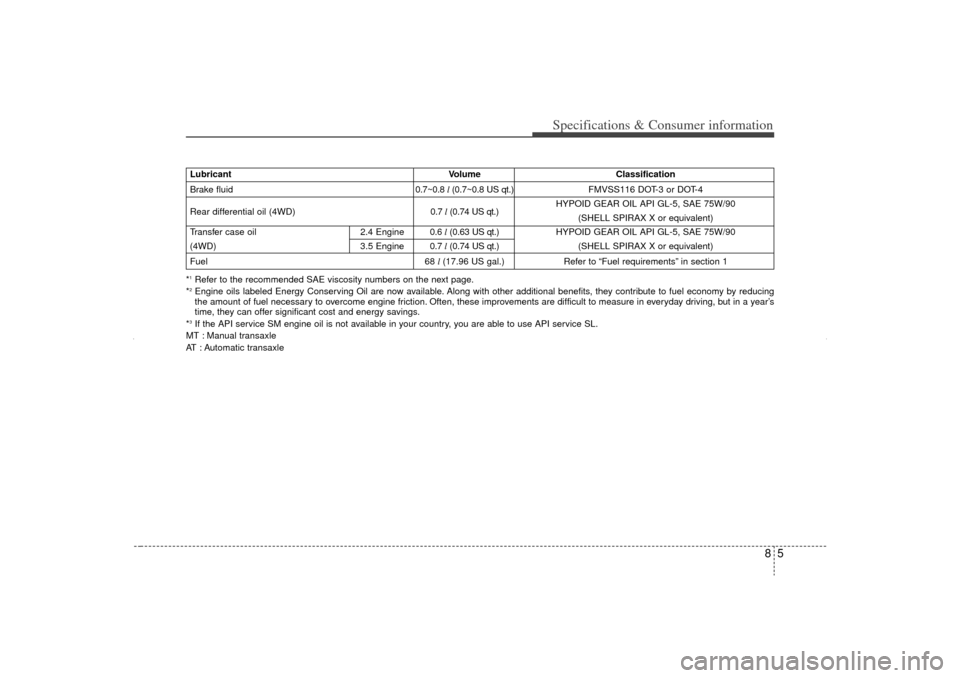
85
Specifications & Consumer information
LubricantVolume Classification
Brake fluid 0.7~0.8 l (0.7~0.8 US qt.) FMVSS116 DOT-3 or DOT-4
Rear differential oil (4WD) 0.7 l(0.74 US qt.) HYPOID GEAR OIL API GL-5, SAE 75W/90
(SHELL SPIRAX X or equivalent)
Transfer case oil 2.4 Engine0.6 l(0.63 US qt.) HYPOID GEAR OIL API GL-5, SAE 75W/90
(4WD) 3.5 Engine0.7 l(0.74 US qt.) (SHELL SPIRAX X or equivalent)
Fuel 68 l (17.96 US gal.) Refer to “Fuel requirements” in section 1*1Refer to the recommended SAE viscosity numbers on the next page.
*2Engine oils labeled Energy Conserving Oil are now available. Along with other additional benefits, they contribute to fuel economy by reducing
the amount of fuel necessary to overcome engine friction. Often, these improvements are difficult to measure in everyday driving, but in a year’s
time, they can offer significant cost and energy savings.
*3If the API service SM engine oil is not available in your country, you are able to use API service SL.
MT : Manual transaxle
AT : Automatic transaxle
XM CAN (ENG) 8.QXP 4/19/2011 10:58 AM Page 5
Page 386 of 388

Specifications & Consumer information68I040000AAM-EURecommended SAE viscosity
number
Engine oil viscosity (thickness) has an
effect on fuel economy and cold weather
operating (engine start and engine oil
flowability). Lower viscosity engine oils
can provide better fuel economy and cold
weather performance, however, higher
viscosity engine oils are required for sat-
isfactory lubrication in hot weather. Using
oils of any viscosity other than those rec-
ommended could result in engine dam-
age.When choosing an oil, consider the range
of temperature your vehicle will be oper-
ated in before the next oil change.
Proceed to select the recommended oil
viscosity from the chart.
CAUTION
Always be sure to clean the area
around any filler plug, drain plug, ordipstick before checking or drain-ing any lubricant. This is especially important in dusty or sandy areasand when the vehicle is used onunpaved roads. Cleaning the plugand dipstick areas will prevent dirt and grit from entering the engineand other mechanisms that couldbe damaged.
Temperature Range for SAE Viscosity Numbers
Temperature
Gasoline
Engine Oil *
1°C
(°F)
-30 -20 -10 0 10 20 30 40 50 -10 0 20 40 60 80 100 120
1. For better fuel economy, it is recommended to use the engine oil of
a viscosity grade SAE 5W-20 (API SM / ILSAC GF-4). However, if
the engine oil is not available in your country, select the proper
engine oil using the engine oil viscosity chart.
10W-30
5W-20 (5W-30)
XM CAN (ENG) 8.QXP 4/19/2011 10:58 AM Page 6