2012 KIA Sorento engine oil
[x] Cancel search: engine oilPage 332 of 388

Maintenance18
7ENGINE OILG060100AHM-EUChecking the engine oil level 1. Be sure the vehicle is on level ground.
2. Start the engine and allow it to reach
normal operating temperature. 3. Turn the engine off and wait for a few
minutes (about 5 minutes) for the oil to
return to the oil pan.
4. Pull the dipstick out, wipe it clean, and re-insert it fully.
5. Pull the dipstick out again and check the level. The level should be between
F and L. If it is near or at L, add enough oil to bring
the level to F.
Do not overfill.
Use a funnel to help prevent oil from
being spilled on engine components.
Use only the specified engine oil. (Refer to “Recommended lubricants and capaci-ties” in section 8.)
WARNING -
Radiator hose
Be very careful not to touch the
radiator hose when checking or
adding the engine oil as it may be
hot enough to burn you.
OXM079005N
OXM079004N
CAUTION
Do not overfill the engine oil. It may damage the engine.
Do not spill engine oil, when adding or changing engine oil. Ifyou drop the engine oil on the engine room, wipe it off immedi-ately.
XM CAN (ENG) 7.QXP 4/19/2011 10:52 AM Page 18
Page 333 of 388

719
Maintenance
G060200BHMChanging the engine oil and filterHave engine oil and filter changed by an
authorized KIA dealer according to the
Maintenance Schedule at the beginning
of this section.
G070000AHMThe high-pressure cooling system has a
reservoir filled with year round antifreeze
coolant. The reservoir is filled at the fac-
tory.
Check the antifreeze protection and
coolant level at least once a year, at the
beginning of the winter season, and
before traveling to a colder climate.G070100AHMChecking the coolant levelENGINE COOLANT
WARNING
- Removingradiator cap
Never attempt to remove the radi-
ator cap while the engine is oper-
ating or hot. Doing so might lead
to cooling system and engine
damage. Also, hot coolant or
steam could cause serious per-
sonal injury.
Turn the engine off and wait until it cools down. Use extreme care
when removing the radiator cap.
Wrap a thick towel around it, and
turn it counterclockwise slowly to
the first stop. Step back while the
pressure is released from the
cooling system.
(Continued)
(Continued)When you are sure all the pres-
sure has been released, press
down on the cap, using a thick
towel, and continue turning coun-
terclockwise to remove it.
Even if the engine is not operat- ing, do not remove the radiator
cap or the drain plug while the
engine and radiator are hot. Hot
coolant and steam may still blow
out under pressure, causing seri-
ous injury.
WARNING
Used engine oil may cause skin irri-
tation or cancer if left in contact
with the skin for prolonged periods
of time. Used engine oil contains
chemicals that have caused cancer
in laboratory animals. Always pro-
tect your skin by washing your
hands thoroughly with soap and
warm water as soon as possible
after handling used oil.
WARNING
The electric motor (cooling fan) is
controlled by engine coolant tem-
perature, refrigerant pressure and
vehicle speed. It may sometimes
operate even when the engine is
not running. Use extreme caution
when working near the blades of
the cooling fan so that you are not
injured by a rotating fan blades. As
the engine coolant temperature
decreases, the electric motor will
automatically shut off. This is a nor-
mal condition.
XM CAN (ENG) 7.QXP 4/19/2011 10:52 AM Page 19
Page 336 of 388

Maintenance22
7BRAKE/CLUTCH (IF EQUIPPED) FLUIDG080100AAMChecking the brake/clutch* fluid
level Check the fluid level in the reservoir peri-
odically. The fluid level should be
between MAX and MIN marks on the
side of the reservoir.
Before removing the reservoir cap and
adding brake/clutch* fluid, clean the area
around the reservoir cap thoroughly to
prevent brake/clutch* fluid contamina-
tion.
* if equipped If the level is low, add fluid to the MAX
level. The level will fall with accumulated
mileage. This is a normal condition asso-
ciated with the wear of the brake linings
and/or clutch disc (if equipped). If the
fluid level is excessively low, have the
brake/clutch* system checked by an
authorized KIA dealer.
Use only the specified brake/clutch* fluid.
(Refer to “Recommended lubricants andcapacities” in section 8.)
Never mix different types of fluid.
WARNING -
Brake/clutch*
fluid
When changing and adding
brake/clutch* fluid, handle it care-
fully. Do not let it come in contact
with your eyes. If brake/clutch* fluid
should come in contact with your
eyes, immediately flush them with a
large quantity of fresh tap water.
Have your eyes examined by a doc-
tor as soon as possible.
WARNING -
Loss of
brake/clutch* fluid
In the event the brake/clutch* sys-
tem requires frequent additions of
fluid, the vehicle should be inspect-
ed by an authorized KIA dealer.
CAUTION
Do not allow brake/clutch* fluid to
contact the vehicle's body paint, aspaint damage will result.
Brake/clutch* fluid, which has beenexposed to open air for an extendedtime should never be used as its quality cannot be guaranteed. Itshould be disposed of properly. Don't put in the wrong kind of fluid.A few drops of mineral-based oil, such as engine oil, in yourbrake/clutch* system can damagebrake/clutch* system parts.
OXM079008
XM CAN (ENG) 7.QXP 4/19/2011 10:52 AM Page 22
Page 337 of 388
723
Maintenance
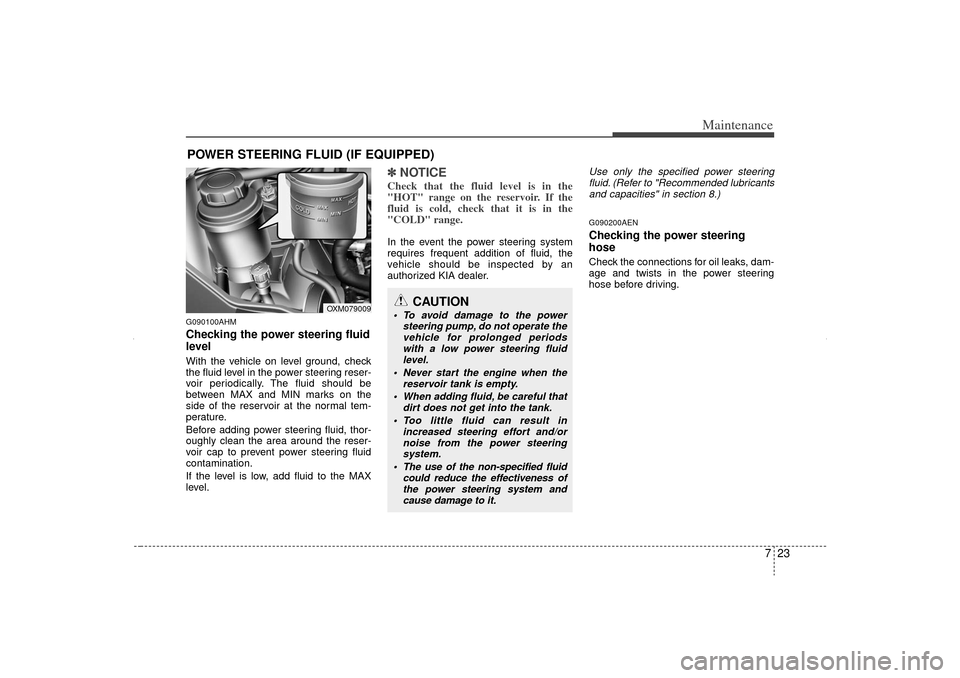
POWER STEERING FLUID (IF EQUIPPED)G090100AHMChecking the power steering fluid
level With the vehicle on level ground, check
the fluid level in the power steering reser-
voir periodically. The fluid should be
between MAX and MIN marks on the
side of the reservoir at the normal tem-
perature.
Before adding power steering fluid, thor-
oughly clean the area around the reser-
voir cap to prevent power steering fluid
contamination.
If the level is low, add fluid to the MAX
level.
✽ ✽NOTICECheck that the fluid level is in the
"HOT" range on the reservoir. If the
fluid is cold, check that it is in the
"COLD" range.In the event the power steering system
requires frequent addition of fluid, the
vehicle should be inspected by an
authorized KIA dealer.
Use only the specified power steering
fluid. (Refer to "Recommended lubricantsand capacities" in section 8.)G090200AENChecking the power steering
hoseCheck the connections for oil leaks, dam-
age and twists in the power steering
hose before driving.
CAUTION
To avoid damage to the power steering pump, do not operate thevehicle for prolonged periodswith a low power steering fluid level.
Never start the engine when the reservoir tank is empty.
When adding fluid, be careful that dirt does not get into the tank.
Too little fluid can result in increased steering effort and/ornoise from the power steering system.
The use of the non-specified fluid could reduce the effectiveness ofthe power steering system andcause damage to it.
OXM079009
XM CAN (ENG) 7.QXP 4/19/2011 10:52 AM Page 23
Page 348 of 388

Maintenance34
7
G190200AUNBattery recharging Your vehicle has a maintenance-free,
calcium-based battery.
If the battery becomes discharged in a
short time (because, for example, the
headlights or interior lights were left on
while the vehicle was not in use),
recharge it by slow charging (trickle)
for 10 hours.
If the battery gradually discharges because of high electric load while the
vehicle is being used, recharge it at 20-
30A for two hours.
(Continued)
The electrical ignition systemworks with high voltage. Never
touch these components with the
engine running or the ignition
switched on.
Failure to follow the above warn-
ings can result in serious bodily
injury or death.
WARNING
- Recharging battery
When recharging the battery,
observe the following precautions:
The battery must be removed
from the vehicle and placed in an
area with good ventilation.
Do not allow cigarettes, sparks, or flame near the battery.
Watch the battery during charg- ing, and stop or reduce the charg-
ing rate if the battery cells begin
gassing (boiling) violently or if
the temperature of the electrolyte
of any cell exceeds 49°C (120°F).
Wear eye protection when check- ing the battery during charging.
Disconnect the battery charger in the following order.
1. Turn off the battery charger main switch.
2. Unhook the negative clamp from the negative battery terminal.
3. Unhook the positive clamp from the positive battery terminal.
XM CAN (ENG) 7.QXP 4/19/2011 10:53 AM Page 34
Page 371 of 388

757
Maintenance
Description Fuse ratingProtected component
EMS
BOX ECU 30A Engine Control Relay
ECU 3
20AG4KE - Ignition Coil #1/2/3/4, Condenser
G6DC - Ignition Coil #1/2/3/4/5/6, Condenser #1/2
SENSOR 1 10AG4KE - Variable Intake Manifold Valve, Crankshaft Position Sensor, Immobilizer Module, Camshaft
Position Sensor #1/2, Oil Control Valve #1/2, Canister Purge Control Solenoid Valve,
Canister Close Valve, Cooling Fan (Low) Relay
G6DC - Variable Intake Manifold Valve #1/2, Immobilizer Module, Canister Purge Control Solenoid Valve, Oil Control Valve #1/2 (Exhaust), Oil Control Valve #1/2 (Intake), Canister Close
Valve
SENSOR 2 10A G6DC - Cooling Fan (Low) Relay, Stop Lamp Switch
SENSOR 3 10AG4KE - Injector #1/2/3/4, A/C Relay
G6DC - PCM, Injector #1/2/3/4/5/6, A/C Relay
SENSOR 4 15AG4KE - Oxygen Sensor Up/Down, Fuel Pump Relay
G6DC - PCM, Oxygen Sensor #1/2/3/4, Fuel Pump Relay, Variable Charge Motion Actuator
ECU 1 15A PCM
A/CON 10A A/C Relay
F/PUMP 15A Fuel Pump Relay
XM CAN (ENG) 7.QXP 4/19/2011 10:54 AM Page 57
Page 373 of 388

759
Maintenance
Waxing
Wax the vehicle when water will no
longer bead on the paint.
Always wash and dry the vehicle before
waxing. Use a good quality liquid or
paste wax, and follow the manufacturer’s
instructions. Wax all metal trim to protect
it and to maintain its luster.
Removing oil, tar, and similar materials
with a spot remover will usually strip the
wax from the finish. Be sure to re-wax
these areas even if the rest of the vehicle
does not yet need waxing.
G230103AUNFinish damage repair Deep scratches or stone chips in the
painted surface must be repaired
promptly. Exposed metal will quickly rust
and may develop into a major repair
expense.✽ ✽NOTICEIf your vehicle is damaged and requires
any metal repair or replacement, be sure
the body shop applies anti-corrosion
materials to the parts repaired or
replaced. G230104AUNBright-metal maintenance To remove road tar and insects, use a
tar remover, not a scraper or other
sharp object.
To protect the surfaces of bright-metal parts from corrosion, apply a coating of
wax or chrome preservative and rub to
a high luster.
During winter weather or in coastal areas, cover the bright metal parts with
a heavier coating of wax or preserva-
tive. If necessary, coat the parts with
non-corrosive petroleum jelly or other
protective compound.
CAUTION
Water washing in the engine com- partment including high pressurewater washing may cause the fail- ure of electrical circuits located inthe engine compartment.
Never allow water or other liquids to come in contact with electri-cal/electronic components inside the vehicle as this may damagethem.
CAUTION
Wiping dust or dirt off the body with a dry cloth will scratch thefinish.
Do not use steel wool, abrasive cleaners, acid detergents orstrong detergents containing high alkaline or caustic agents onchrome-plated or anodized alu- minum parts. This may result indamage to the protective coating and cause discoloration or paintdeterioration.
OJB037800
XM CAN (ENG) 7.QXP 4/19/2011 10:55 AM Page 59
Page 384 of 388

Specifications & Consumer information48RECOMMENDED LUBRICANTS AND CAPACITIESThese lubricants and fluids are recommended for use in your vehicle.LubricantVolume Classification
2.4 Engine 4.6 l (4.86 US qt.) API Service SM*
3,
3.5 Engine 5.2 l (5.49 US qt.) ILSAC GF-4 or above
Manual transaxle fluid 2.4 Engine 1.8 l(1.90 US qt.) API GL-4, SAE 75W/85
2.4 Engine 7.1 l (7.50 US qt.) MICHANG ATF SP-IV
Automatic transaxle fluid SK ATF SP-IV
3.5 Engine 7.8 l (8.24 US qt.) NOCA ATF SP-IV
KIA genuine ATF SP-IV
Power steering 1.0 l (1.06 US qt.) PSF-3
2.4 Engine MT 6.5
l (6.87 US qt.)
Mixture of antifreeze and distilled water
Coolant AT 6.6 l (6.97 US qt.)
(Ethylene glycol base coolant for aluminum radiator)
3.5 Engine AT 8.6 l (9.09 US qt.)
Engine oil
*1 *2
(drain and refill)To help achieve proper engine and powertrain performance and durability, use only lubricants of the proper quality. The correct
lubricants also help promote engine efficiency that results in improved fuel economy.
XM CAN (ENG) 8.QXP 4/19/2011 10:58 AM Page 4