2012 KIA Sedona warning light
[x] Cancel search: warning lightPage 55 of 370
Features of your vehicle
38
3
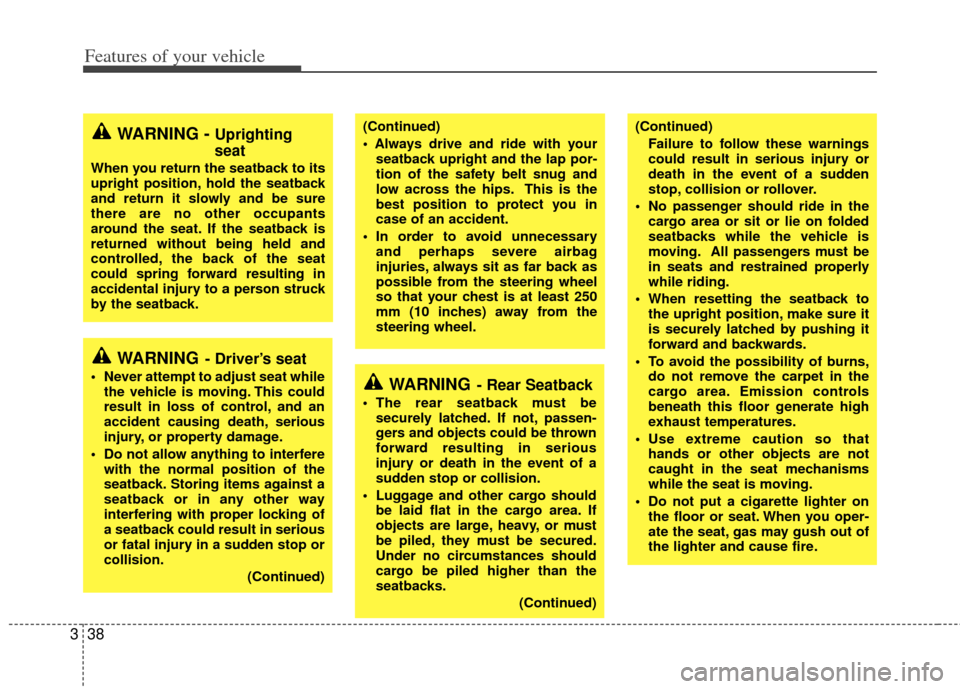
(Continued)
seatback upright and the lap por-
tion of the safety belt snug and
low across the hips. This is the
best position to protect you in
case of an accident.
In order to avoid unnecessary and perhaps severe airbag
injuries, always sit as far back as
possible from the steering wheel
so that your chest is at least 250
mm (10 inches) away from the
steering wheel.
WARNING- Driver’s seat
Never attempt to adjust seat whilethe vehicle is moving. This could
result in loss of control, and an
accident causing death, serious
injury, or property damage.
Do not allow anything to interfere with the normal position of the
seatback. Storing items against a
seatback or in any other way
interfering with proper locking of
a seatback could result in serious
or fatal injury in a sudden stop or
collision.
(Continued)
WARNING - Uprighting
seat
When you return the seatback to its
upright position, hold the seatback
and return it slowly and be sure
there are no other occupants
around the seat. If the seatback is
returned without being held and
controlled, the back of the seat
could spring forward resulting in
accidental injury to a person struck
by the seatback.
WARNING- Rear Seatback
The rear seatback must besecurely latched. If not, passen-
gers and objects could be thrown
forward resulting in serious
injury or death in the event of a
sudden stop or collision.
Luggage and other cargo should be laid flat in the cargo area. If
objects are large, heavy, or must
be piled, they must be secured.
Under no circumstances should
cargo be piled higher than the
seatbacks.
(Continued)
(Continued)Failure to follow these warnings
could result in serious injury or
death in the event of a sudden
stop, collision or rollover.
No passenger should ride in the cargo area or sit or lie on folded
seatbacks while the vehicle is
moving. All passengers must be
in seats and restrained properly
while riding.
When resetting the seatback to the upright position, make sure it
is securely latched by pushing it
forward and backwards.
To avoid the possibility of burns, do not remove the carpet in the
cargo area. Emission controls
beneath this floor generate high
exhaust temperatures.
Use extreme caution so that hands or other objects are not
caught in the seat mechanisms
while the seat is moving.
Do not put a cigarette lighter on the floor or seat. When you oper-
ate the seat, gas may gush out of
the lighter and cause fire.
Page 56 of 370

339
Features of your vehicle
Front seat adjustment - manual
Forward and backward
To move the seat forward or backward:
1. Pull the seat slide adjustment leverunder the front edge of the seat cush-
ion up and hold it.
2. Slide the seat to the position you desire.
3. Release the lever and make sure the seat is locked in place.
Adjust the seat before driving, and make
sure the seat is locked securely by trying
to move forward and backward without
using the lever. If the seat moves, it is not
locked properly.
Seatback angle
To recline the seatback:
1. Lean forward slightly and lift up on the seatback recline lever located on the
outside of the seat, at the rear.
2. Carefully lean back on the seat and adjust the seatback of the seat to the
position you desire.
3. Release the lever and make sure the seatback is locked in place. (The lever
MUST return to its original position for
the seatback to lock.)
1VQA20411VQA2043
WARNING- Driver respon-
sibility for front seat pas-
senger
Riding in a vehicle with a front seat-
back reclined could lead to serious
or fatal injury in an accident. If a
front seat is reclined during an acci-
dent, the occupant’s hips may slide
under the lap portion of the safety
belt applying great force to the
unprotected abdomen. Serious or
fatal internal injuries could result.
The driver must advise the front
passenger to keep the seatback in
an upright position whenever the
vehicle is in motion.
Page 81 of 370

Features of your vehicle
64
3
Safety belt warning light and chime
If the driver's safety belt is not fastened
when the key is turned ON or if it is dis-
connected after the key is turned ON, the
safety belt warning light will blink until the
belt is fastened.
If the driver's safety belt is not fastened
when the key is turned ON or if it is
unfastened after the key is ON, the safe-
ty belt warning chime will sound for
approximately 6 seconds.
WARNING- Safety belt
care
A damaged belt may not give you
the protection you need in an
accident.
Inspect your safety belts periodi- cally for excessive wear or dam-
age. Pull out each belt fully and
look for fraying, cuts, burns or
other damage. Pull the safety belt
out and let it retract a number of
times. Make sure that the
lap/shoulder belts return smooth-
ly and easily into the retractor.
Check the latches to make sure they latch and release without
interference or delay.
Never close the doors on any part of the lap or shoulder belt.
Any belt not in good condition or in good working order should be
promptly replaced.
WARNING
Never close the doors on any part
of the lap or shoulder belt. It can
damage the safety belt or buckle
which could increase the risk of
injury in case of an accident.
1GQA2083
WARNING
When you fasten the seat belt, becareful not to latch the seat belt in
buckles of other seat. It's very dan-
gerous and you may not be pro-
tected by the seat belt properly.
Do not unfasten the seat belt and do not fasten and unfasten the
seat belt repeatedly while driving.
This could result in loss of con-
trol, and an accident causing
death, serious injury, or property
damage.
When fastening the seat belt, make sure that the seat belt does
not pass over objects that are
hard or can break easily.
Make sure there is nothing in the buckle. The seat belt may not be
fastened securely.
Page 88 of 370

371
Features of your vehicle
Larger children
As children grow, they may need to use
new child-restraint systems, including
larger child seats or booster seats, which
are appropriate for their increased size.
A child who has outgrown available child-
restraint systems should use the belts
provided in the vehicle. When seated in
the rear outboard seats, the child should
be restrained by the lap/shoulder belt.
If the shoulder belt portion slightly touch-
es the child’s neck or face, try placing the
child closer to the center of the vehicle. If
the shoulder belt still touches their face
or neck they need to be returned to a
child restraint system. In addition, after-
market devices are available from inde-
pendent manufacturers which help pull
the shoulder belt down and away from
the child’s face or neck.WARNING- Infants and
young children
Infants and young children are at
much greater risk of serious injury
or death in an accident or sudden
stop if they are unrestrained or
restrained improperly. Follow all
instructions in this section and the
instructions that came with an
approved child safety system. The
child restraint must be correctly
installed in the vehicle, and the
child must be correctly placed in
the child restraint.
All children under 12 are safest in the back seat.
Never install a rear facing infant seat in the front passenger posi-
tion. The baby will be injured or
killed by the air bag if it deploys.
Never allow a child to stand or
kneel on the seat of a moving vehi-
cle.WARNING- Shoulder belts
on small children
Never allow a shoulder belt to be
in contact with a child’s neck or
face while the vehicle is in
motion.
If safety belts are not properly worn and adjusted on children,
there is a risk of death or serious
injury.
WARNING- Children onlaps
Never hold a child on your lap or in
your arms in a moving vehicle.
Even a very strong person cannot
hold onto a child in the event of
even a minor collision.
WARNING - Hot metal parts
Safety belts and seats can become
hot in a vehicle that has been
closed during warm/hot weather;
they could burn a child. Check seat
covers and buckles before you
place a child anywhere near them.
Page 89 of 370

Features of your vehicle
72
3
Pre-tensioner safety belt
Your vehicle is equipped with driver's and
front passenger's pre-tensioner safety
belts. The purpose of the pre-tensioner is
to make sure that excess slack is taken
up in certain frontal collisions. The pre-
tensioners may activate along with the
front air bags in frontal collisions based
on angle of impact, seat belt usage and
impact severity.
✽ ✽
NOTICE
The pre-tensioner seat belt is installed at
the front seats, and the sensor is
equipped inside the buckle, where pres-
ence of passenger is sensed by the fas-
tening of the seat belts. Therefore, pre-
tensioner will not activate if the passen-
ger is not fastened with the seat belts.
Likewise, it will activate if buckled even
without a passenger in the seat. Pre-ten-
sioner seat belt is designed to activate
when the seatbelt is in use. To ensure the
pretensioner seatbelts activate in event
of a possible seatbelt buckle switch mal-
function, the system is designed to acti-
vate regardless of whether a seat belt is
in use or if no seat belt use is detected
within 6 seconds of turning the ignition
switch ON.
The seat belt pre-tensioner system con-
sists mainly of the following components.
Their locations are shown in the illustra-
tion.
(1) SRS air bag warning light
(2) Seatbelt pre-tensioner assembly
(3) SRS air bag control module
WARNING- Safety belt
adjustment
To obtain maximum benefit from a
pre-tensioner seat belt:
The safety belt must be worn cor-
rectly.
The safety belt must be adjusted to the correct position.
1LDE3100OED030300
WARNING
For your safety, be sure that the belt
webbing is not loose or twisted and
always sit properly on your seat.
Page 90 of 370

373
Features of your vehicle
Load limiter (if equipped)
When the pre-tentioner activates, if the
system senses excessive seat belt ten-
sion on the driver or passenger’s seat
belt, the load limiter inside the pre-ten-
sioner will release some of the pressure
on the affected seat belt.WARNING- Air bag/pre-
tensioner warning light
If the SRS air bag warning light
does not illuminate when the igni-
tion key is turned to “ON”, or if it
remains illuminated after approxi-
mately 6 seconds, or if it illuminates
while the vehicle is being driven,
please have an authorized Kia deal-
er inspect the pre-tensioner and air
bag system as soon as possible.
WARNING - Hot parts
The pre-tensioner assembly mecha-
nism may become hot during acti-
vation. Do not touch the pre-ten-
sioner seat belt assembly for sever-
al minutes after they have been acti-
vated.
WARNING
If the vehicle or pre-tensioner seat
belt must be discarded, contact an
authorized Kia dealer.
WARNING- Replacing
used pre-tensioners
Pre-tensioners are designed to
operate once. After activation,
pre-tensioner seat belts must be
replaced. All seat belts, of any
type, should always be replaced
after they have been worn during
a collision.
Do not attempt to replace the pre- tensioners yourself. This must be
done by an authorized Kia dealer.
WARNING- Damaging the
pre-tensioners
Do not hit or strike the pre-ten-
sioner assemblies, especially
with a tool or heavy object.
Do not attempt to service or repair the pre-tensioners.
WARNING -Air bag/Pre-
tensioner dust
When the air bags and pre-tension-
ers are activated, a loud noise may
be heard and fine dust, which may
appear to be smoke, may be visible
in the passenger compartment. This
dust is not toxic. The dust may
cause skin irritation and should not
be breathed for prolonged periods.
Ventilate the vehicle after impact
and wash your hands and face thor-
oughly after an accident.
Page 99 of 370

Features of your vehicle
82
3
(1) Driver’s air bag
(2) Front passenger’s air bag
(3) Side air bag*
(4) Curtain Air bag*
(5) Side impact sensor*
(6) Front impact sensor
(7) Occupant classification system
(8) Front seat position sensor
(9) SRS Control Module
■Air bag inflation conditions
■Air bag non-inflation conditions
■Air bag warning light
■SRS care
■Air bag warning label
*: if equipped
What your air bag system does
Driver’s air bag and front passenger’s air
bag are designed to supplement the pro-
tection offered by the safety belt in cer-
tain frontal collisions. Likewise, side air
bag and curtain air bags are designed to
supplement the protection offered by the
safety belt in side collisions. Safety belts
are designed to reduce the injury of the
driver or passengers in case of impact or
collision. No safety belt or air bag system
can completely eliminate injuries that
may cause in collisions or impacts. To
help reduce impact on driver or passen-
gers in any collision, safety belts must be
correctly worn.
What your air bag system does
not do
The air bag system is designed to sup-
plement the protection offered by the
safety belt system. IT IS NOT A SUB-
STITUTE FOR THE SAFETY BELT.
The importance of using
safety belts
There are four very important reasons to
use safety belts even with an air bag sup-
plemental restraint system. They:
help keep you in the proper position (away from the air bag) when it inflates.
reduce the risk of harm in rollover, side impact (vehicles not equipped with
side and curtain air bags) or rear
impact collisions, because an air bag is
not designed to inflate in such situa-
tions and even a side curtain air bag is
designed to inflate only in certain side
impact collisions.
reduce the risk of harm in frontal or side collisions which are not severe
enough to actuate the air bag supple-
mental restraint system.
reduce the risk of being ejected from your vehicle.
Page 102 of 370
385
Features of your vehicle
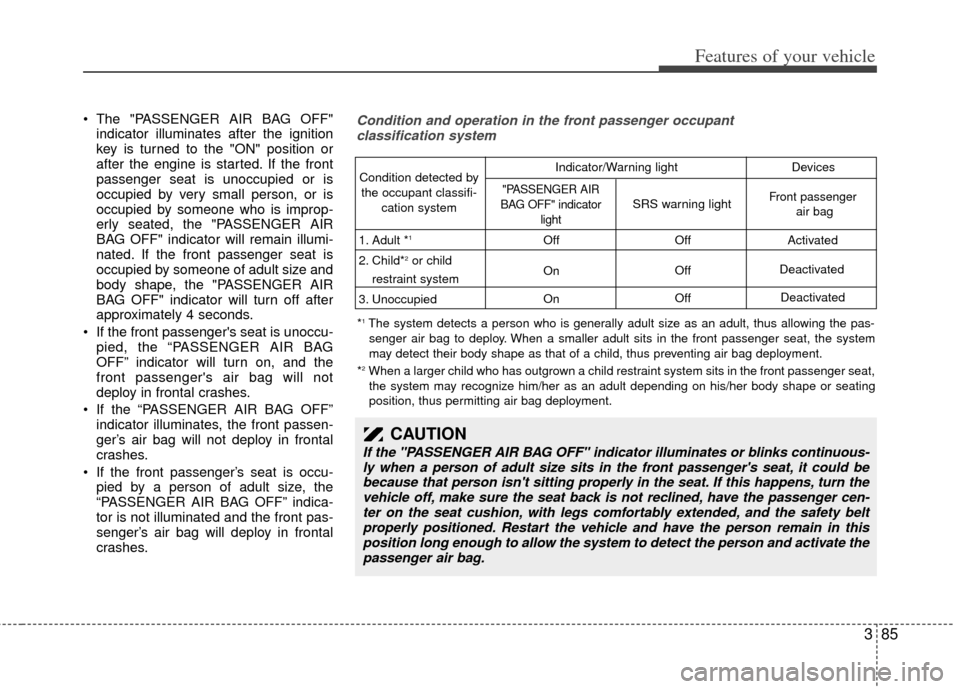
The "PASSENGER AIR BAG OFF"indicator illuminates after the ignition
key is turned to the "ON" position or
after the engine is started. If the front
passenger seat is unoccupied or is
occupied by very small person, or is
occupied by someone who is improp-
erly seated, the "PASSENGER AIR
BAG OFF" indicator will remain illumi-
nated. If the front passenger seat is
occupied by someone of adult size and
body shape, the "PASSENGER AIR
BAG OFF" indicator will turn off after
approximately 4 seconds.
If the front passenger's seat is unoccu- pied, the “PASSENGER AIR BAG
OFF” indicator will turn on, and the
front passenger's air bag will not
deploy in frontal crashes.
If the “PASSENGER AIR BAG OFF” indicator illuminates, the front passen-
ger’s air bag will not deploy in frontal
crashes.
If the front passenger’s seat is occu- pied by a person of adult size, the
“PASSENGER AIR BAG OFF” indica-
tor is not illuminated and the front pas-
senger’s air bag will deploy in frontal
crashes.Condition and operation in the front passenger occupant classification system
Condition detected by
the occupant classifi- cation system
1. Adult *
1
2. Child*2or child
restraint system
3. Unoccupied Off
On
On Off
Off
Off
Activated
Deactivated
"PASSENGER AIR
BAG OFF" indicator lightSRS warning lightFront passengerair bag
Deactivated
Indicator/Warning light Devices
*1The system detects a person who is generally adult size as an adult, thus allowing the pas-
senger air bag to deploy. When a smaller adult sits in the front passenger seat, the system
may detect their body shape as that of a child, thus preventing air bag deployment.
*
2When a larger child who has outgrown a child restraint system sits in the front passenger seat, the system may recognize him/her as an adult depending on his/her body shape or seating
position, thus permitting air bag deployment.
CAUTION
If the "PASSENGER AIR BAG OFF" indicator illuminates or blinks continuous- ly when a person of adult size sits in the front passenger's seat, it could bebecause that person isn't sitting properly in the seat. If this happens, turn thevehicle off, make sure the seat back is not reclined, have the passenger cen-ter on the seat cushion, with legs comfortably extended, and the safety beltproperly positioned. Restart the vehicle and have the person remain in thisposition long enough to allow the system to detect the person and activate thepassenger air bag.