Page 15 of 385

Introduction
21
We want to help you get the greatest
possible driving pleasure from your vehi-
cle. Your Owner’s Manual can assist you
in many ways. We strongly recommend
that you read the entire manual. In order
to minimize the chance of death or injury,
you must read the WARNING and CAU-
TION sections in the manual.
Illustrations complement the words in this
manual to best explain how to enjoy your
vehicle. By reading your manual, you will
learn about features, important safety
information, and driving tips under vari-
ous road conditions.The general layout of the manual is pro-
vided in the Table of Contents. Use the
index when looking for a specific area or
subject; it has an alphabetical listing of all
information in your manual.
Sections: This manual has eight sections
plus an index. Each section begins with a
brief list of contents so you can tell at a
glance if that section has the information
you want.
You will find various types of safety
instructions in this manual. These
instructions were prepared to enhance
your personal safety. Carefully read and
follow ALL procedures and recommen-
dations provided in these instructions.
✽ ✽
NOTICE
A NOTICE indicates interesting or help-
ful information is being provided.
HOW TO USE THIS MANUAL
WARNING
A WARNING indicates a situation in
which harm, serious bodily injury or
death could result if the warning is
ignored.
CAUTION
A CAUTION indicates a situation in
which damage to your vehicle couldresult if the caution is ignored.
Page 18 of 385
15
Introduction
INDICATOR SYMBOLS ON THE INSTRUMENT CLUSTER
Seat belt warning light
High beam indicator
Turn signal indicator
ABS warning light
Parking brake & Brake fluid
warning light
Engine oil pressure warning light
ESC indicator
ESC OFF indicator
Malfunction indicator light
Air bag warning light
Immobilizer indicator
Low fuel level warning light* : if equipped
Charging system warning light
Tail light indicator
Tailgate open ajar warning light
Front fog light indicator*
Electric power steering (EPS)
system warning light*Door ajar warning light
Shift pattern indicator*
Manual transaxle shift indicator* Key out warning light*
KEY
OUT
ECO indicator*ECO
Auto stop for ISG system
indicator*
Low beam indicator
Engine coolant temperature
warning light*
❈For more detailed explanations, refer to “Instrument cluster” in section 4. Low tire pressure telltale* /
TPMS malfunction indicator*
Cruise SET indicator*
Cruise control indicator*
CRUISE
Fuel cap open warning indicator
Page 34 of 385

Safety features of your vehicle
12
3
Seat belt restraint system
Seat belts are designed to bear upon the
bony structure of the body, and should
be worn low across the front of the pelvis
or the pelvis, chest and shoulders, as
applicable; wearing the lap section of the
belt across the abdominal area must be
avoided.
Seat belts should be adjusted as firmly
as possible, consistent with comfort, to
provide the protection for which they
have been designed.
A slack belt will greatly reduce the pro-
tection afforded to the wearer.
Care should be taken to avoid contami-
nation of the webbing with polishes, oils
and chemicals, and particularly battery
acid. Cleaning may safely be carried out
using mild soap and water. The belt
should be replaced if webbing becomes
frayed, contaminated or damaged.
For maximum restraint system protec-
tion, the seat belts must always be
used whenever the vehicle is moving.
A properly positioned shoulder belt
should be positioned midway over your
shoulder across your collarbone.
Never allow children to ride in the front passenger seat. See child restraint
system section for further discussion.
SEAT BELTS
WARNING- Shoulder belt
Never wear the shoulder belt under
your arm or behind your back. An
improperly positioned shoulder
belt cannot protect the occupant in
a crash.
WARNING- Damaged seatbelt
Replace the entire seat belt assem-
bly if any part of the webbing or
hardware is damage as you can no
longer be sure that a damage seat
belt will provide protection in a
crash.
WARNING- Twisted seatbelt
Make sure your seat belt is not
twisted when worn. A twisted seat
belt may not properly protect you in
an accident and could even cut into
your body.
WARNING - Seat belt buckle
Do not allow foreign material (gum,
crumbs, coins, etc.) to obstruct the
seat belt buckle. This may prevent
the seat belt from fastening secure-
ly.
Page 43 of 385
321
Safety features of your vehicle
Injured person
A seat belt should be used when an
injured person is being transported.
When this is necessary, you should con-
sult a physician for recommendations.
One person per belt
Two people (including children) should
never attempt to use a single seat belt.
This could increase the severity of
injuries in case of an accident.
Do not lie down
To reduce the chance of injuries in the
event of an accident and to achieve maxi-
mum effectiveness of the restraint system,
all passengers should be sitting up and
the front seats should be in an upright
position when the vehicle is moving. A
seat belt cannot provide proper protection
if the person is lying down in the rear seat
or if the front seat is in a reclined position.
Care of seat belts
Seat belt systems should never be disas-
sembled or modified. In addition, care
should be taken to assure that seat belts
and belt hardware are not damaged by
seat hinges, doors or other abuse.
Periodic inspection
All seat belts should be inspected peri-
odically for wear or damage of any kind.
Any damaged parts should be replaced
as soon as possible.
Keep belts clean and dry
Seat belts should be kept clean and dry.
If belts become dirty, they can be
cleaned by using a mild soap solution
and warm water. Bleach, dye, strong
detergents or abrasives should not be
used because they may damage and
weaken the fabric.
When to replace seat belts
The entire in-use seat belt assembly or
assemblies should be replaced if the
vehicle has been involved in an accident.
This should be done even if no damage
is visible. Additional questions concern-
ing seat belt operation should be directed
to an authorized Kia dealer.
WARNING - Pinched seat
belt
Make sure that the webbing and/or
buckle does not get caught or
pinched in the rear seat when
returning the rear seatback to its
upright position. A caught or
pinched webbing/buckle may
become damaged and could fail
during a collision or sudden stop.
Page 126 of 385
451
Features of your vehicle
Language
Choose a language you prefer within the
LCD display.
Maintenance system
(only for Type B cluster,
if equipped)
The Maintenance system informs the
driver when to replace engine oil and
rotate tires.
Maintenance
1. When the vehicle is at a standstill,pressing the TRIP button for more than
2 seconds with the ENGINE START/
STOP button in the ON position or
engine running, the LCD display on
the cluster will change to the "User
Setting" mode.
You can move to the items by pressing the TRIP button and select the item by
pressing the RESET button.
2. In the "User Setting" mode select "Maintenance".
OUB041067OUB041068OUB041069
Page 127 of 385
Features of your vehicle
52
4
Maintenance schedule
1. Select the desired engine oil (tire rota-
tion) maintenance schedule.
2. If finished, you can come out of the Maintenance mode by pressing the
TRIP button for more than 2 seconds.
Engine Oil(Tire Rotation) ServiceRequired
1. If service is required, the message will be displayed. 2. If you would like to reset or inactivate
the maintenance system press the
RESET button for more than 1 second.
The display will change to "Engine Oil
Service Message" mode.
You can move to items by pressing the TRIP button and select the desired
item by pressing the RESET button.
OUB041070OUB041071OUB041072
Page 135 of 385
Features of your vehicle
60
4
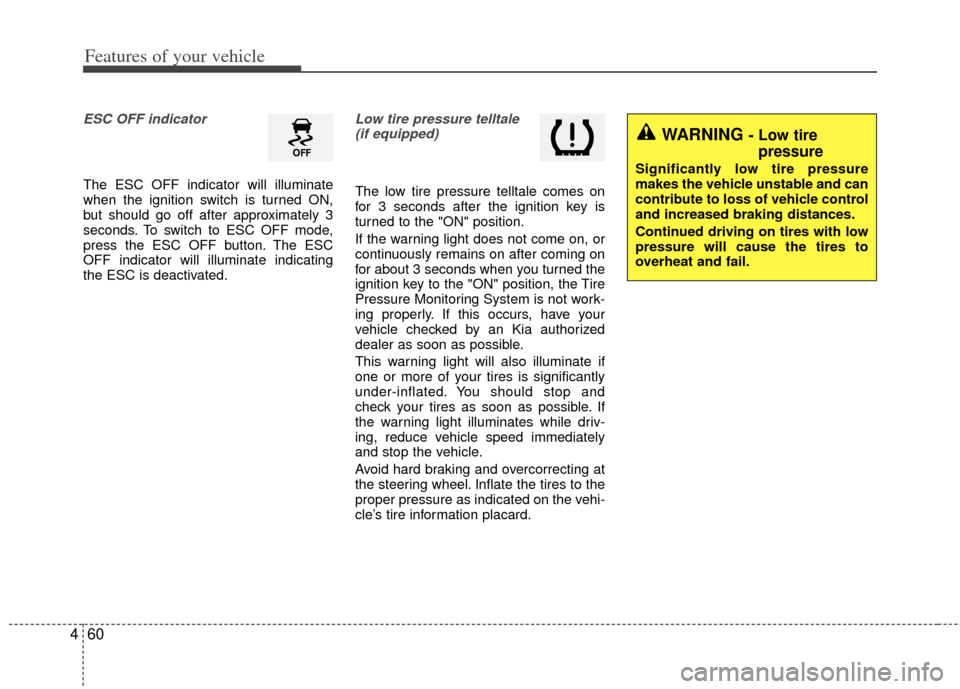
ESC OFF indicator
The ESC OFF indicator will illuminate
when the ignition switch is turned ON,
but should go off after approximately 3
seconds. To switch to ESC OFF mode,
press the ESC OFF button. The ESC
OFF indicator will illuminate indicating
the ESC is deactivated.
Low tire pressure telltale
(if equipped)
The low tire pressure telltale comes on
for 3 seconds after the ignition key is
turned to the "ON" position.
If the warning light does not come on, or
continuously remains on after coming on
for about 3 seconds when you turned the
ignition key to the "ON" position, the Tire
Pressure Monitoring System is not work-
ing properly. If this occurs, have your
vehicle checked by an Kia authorized
dealer as soon as possible.
This warning light will also illuminate if
one or more of your tires is significantly
under-inflated. You should stop and
check your tires as soon as possible. If
the warning light illuminates while driv-
ing, reduce vehicle speed immediately
and stop the vehicle.
Avoid hard braking and overcorrecting at
the steering wheel. Inflate the tires to the
proper pressure as indicated on the vehi-
cle’s tire information placard.
WARNING - Low tire pressure
Significantly low tire pressure
makes the vehicle unstable and can
contribute to loss of vehicle control
and increased braking distances.
Continued driving on tires with low
pressure will cause the tires to
overheat and fail.
Page 226 of 385

53
Driving your vehicle
Before entering vehicle
• Be sure that all windows, outside mir-ror(s), and outside lights are clean.
Check the condition of the tires.
Check under the vehicle for any sign of leaks.
Be sure there are no obstacles behind you if you intend to back up.
Necessary inspections
Fluid levels, such as engine oil, engine
coolant, brake fluid, and washer fluid
should be checked on a regular basis,
with the exact interval depending on the
fluid. Further details are provided in
Section 7, “Maintenance”.
Before starting
Close and lock all doors.
Position the seat so that all controls are
easily reached.
Buckle your seat belt.
Adjust the inside and outside rearview mirrors.
Be sure that all lights work.
Check all gauges.
Check the operation of warning lights when the ignition switch is turned to
the ON position.
Release the parking brake and make sure the brake warning light goes out.
For safe operation, be sure you are famil-
iar with your vehicle and its equipment.
BEFORE DRIVING
WARNING - Distracted driving
Focus on the road while driving.
The driver's primary responsibility
is in the safe and legal operation of
the vehicle. Use of any handled
devices, other equipment or vehicle
systems that distract the drive
should not be used during vehicle
operation.
WARNING
- Check surrounding
Always check the surrounding areas
near your vehicle for people, espe-
cially children, before putting a vehi-
cle into D (Drive) or R (Reverse).


