2012 KIA PICANTO call
[x] Cancel search: callPage 247 of 840

53
Driving your vehicle
Before entering vehicle
• Be sure that all windows, outside mir-ror(s), and outside lights are clean.
Check the condition of the tires.
Check under the vehicle for any sign of leaks.
Be sure there are no obstacles behind you if you intend to back up.
Necessary inspections
Fluid levels, such as engine oil, engine
coolant, brake fluid, and washer fluid
should be checked on a regular basis,
with the exact interval depending on the
fluid. Further details are provided in sec-
tion 7, “Maintenance”. Before starting
Close and lock all doors.
Position the seat so that all controls are
easily reached.
Adjust the inside and outside rearview mirrors.
Be sure that all lights work.
Check all gauges.
Check the operation of warning lights when the ignition switch is turned to the ON position.
Release the parking brake and make sure the brake warning light goes out.
For safe operation, be sure you are famil-
iar with your vehicle and its equipment.
BEFORE DRIVING
WARNING
All passengers must be properly
belted whenever the vehicle is mov-
ing. Refer to “Seat belts” in section
3 for more information on their
proper use.
WARNING
Always check the surrounding
areas near your vehicle for people,
especially children, before putting a
car into D (Drive) or R (Reverse).
WARNING - Driving under
the influence of alcohol or drugs
Drinking and driving is dangerous.
Drunk driving is the number one
contributor to the highway death
toll each year. Even a small amount
of alcohol will affect your reflexes,
perceptions and judgment. Drivingwhile under the influence of drugs
is as dangerous or more dangerousthan driving drunk.
You are much more likely to have a
serious accident if you drink or
take drugs and drive.
If you are drinking or taking drugs,
do not drive. Do not ride with a driv-er who has been drinking or taking
drugs. Choose a designated driveror call a cab.
WARNING
Driving while distracted can result in
a loss of vehicle control, that may
lead to an accident, severe personal
injury, and death. The driver’s pri-
mary responsibility is in the safe and
legal operation of a vehicle, and use
of any handheld devices, other
equipment, or vehicle systems which
take the driver’s eyes, attention and
focus away from the safe operation
of a vehicle or which are not permis-
sible by law should never be used
during operation of the vehicle.
Page 251 of 840

57
Driving your vehicle
ACC(Accessory)
With manual transaxle
Press the ENGINE START/STOP button
when the button is in the OFF positionwithout depressing the clutch pedal.
With automatic transaxle
Press the ENGINE START/STOP button while it is in the OFF position without
depressing the brake pedal.
The steering wheel unlocks and electri-
cal accessories are operational.
If the ENGINE START/STOP button is in
the ACC position for more than 1 hour,
the button is turned off automatically to
prevent battery discharge.
ON
With manual transaxle
Press the ENGINE START/STOP button
when the button is in the ACC positionwithout depressing the clutch pedal.
With automatic transaxle
Press the ENGINE START/STOP button
while it is in the ACC position without
depressing the brake pedal.
The warning lights can be checked
before the engine is started. Do not leave
the ENGINE START/STOP button in the
ON position for a long time. The battery
may discharge, because the engine is
not running.
Orange indicatorGreen indicator
CAUTION
You are able to turn off the engine(START/RUN) or vehicle power
(ON), only when the vehicle is not inmotion. In an emergency situationwhile the vehicle is in motion, you are able to turn the engine off and
to the ACC position by pressing theengine start/stop button for morethan 2 seconds or 3 times succes-
sively within 3 seconds. If the vehi- cle is still moving, you can restartthe engine without depressing thebrake pedal by pressing the engine
start/stop button with the shift leverin the N (Neutral) position.
Page 256 of 840
Driving your vehicle
12
5
Your vehicle may be equipped with the ISG system, which reduces fuel con-
sumption by automatically shutting down
the engine, when the vehicle is at a
standstill. (For example : red light, stop
sign and traffic jam)
The engine starts automatically as soon
as the starting conditions are met.
The ISG system is ON whenever the
engine is running.
✽✽
NOTICE
When the engine automatically starts by
the ISG system, some warning lights
(ABS, ESP, ESP OFF, EPS or Parking
brake warning light) may turn on for a
few seconds.
This happens because of low battery
voltage. It does not mean the system has
malfunctioned.
Auto stop
To stop the engine in idle stop mode
1. Decrease the vehicle speed to less than 5 km/h (3 mph).
2. Shift into N (Neutral) position.
3. Release the clutch pedal.
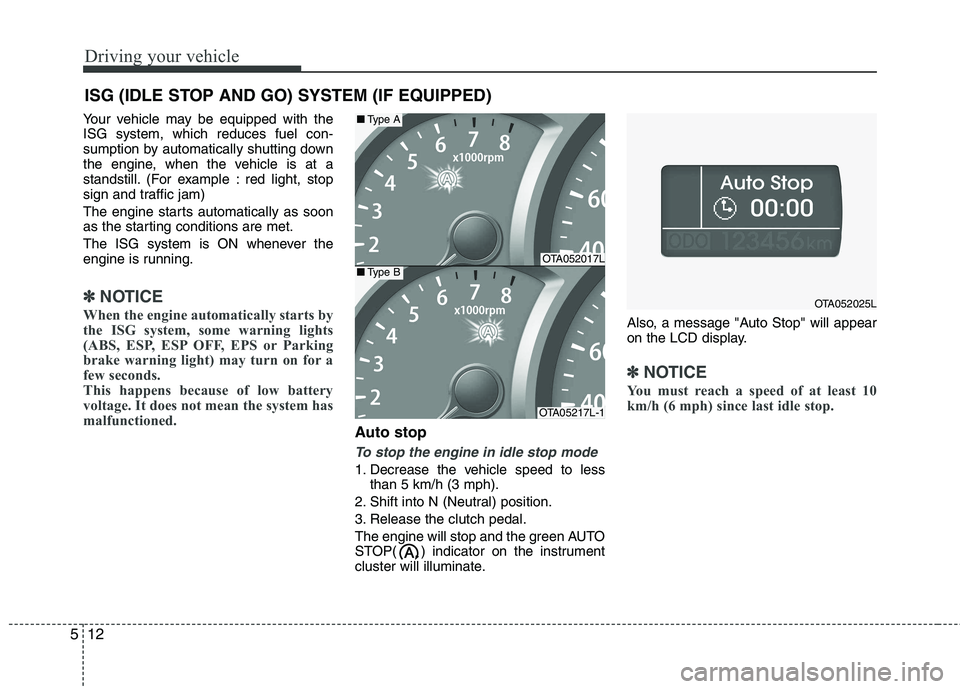
The engine will stop and the green AUTO
STOP( ) indicator on the instrument
cluster will illuminate. Also, a message "Auto Stop" will appear
on the LCD display.
✽✽
NOTICE
You must reach a speed of at least 10
km/h (6 mph) since last idle stop.
ISG (IDLE STOP AND GO) SYSTEM (IF EQUIPPED)
OTA052017L
OTA05217L-1
■ Type A
■Type B
OTA052025L
Page 257 of 840

513
Driving your vehicle
✽✽NOTICE
If you unfasten the seatbelt or open the
driver's door (or engine hood) in auto
stop mode, the following will happen:
The ISG system will deactivate (the light on the ISG OFF button will illu-
minate). (Continued)(Continued)
A message "Auto Start Deactivated
Start Manually" will appear on the
LCD display.
Turn the ignition switch to the START
position to start the engine manually.
The engine will also restart automati-
cally without the driver’s any actions if the following occurs:
- The fan speed of manual climate con- trol system is set above the 3rd position when the air conditioning is on.
- The fan speed of automatic climate control system is set above the 6thposition when the air conditioning is on.
- When a certain amount of time has passed with the climate control systemon.
- When the defroster is on.
- The brake vaccum pressure is low.
- The battery charging status is low.
- The vehicle speed exceeds 5 km/h (3 mph).
OTA050018LOTA052021L
Page 262 of 840
Driving your vehicle
18
5
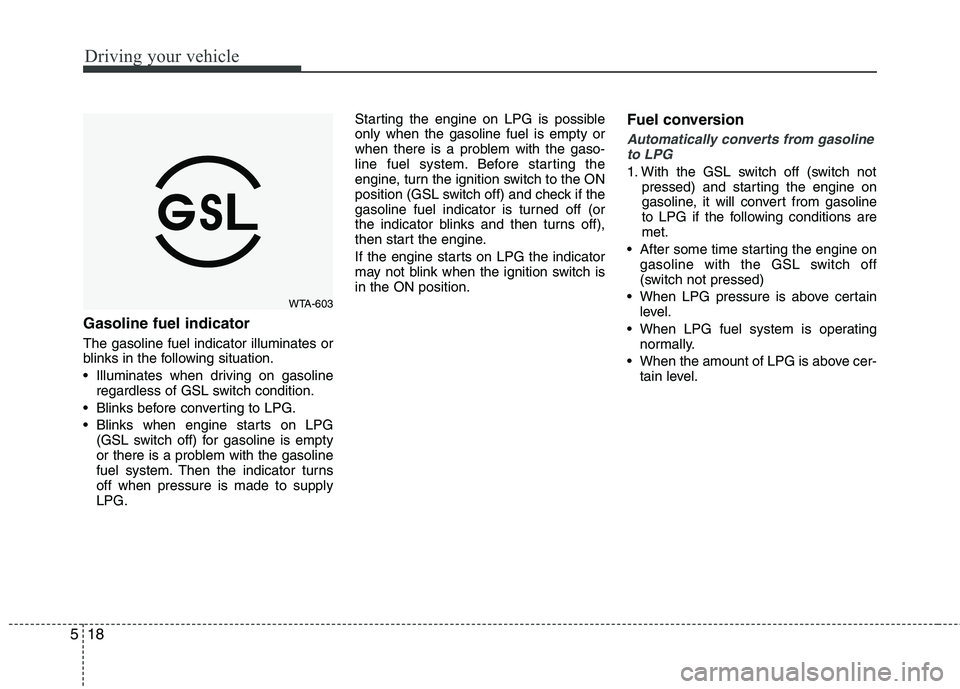
Gasoline fuel indicator The gasoline fuel indicator illuminates or
blinks in the following situation.
Illuminates when driving on gasoline
regardless of GSL switch condition.
Blinks before converting to LPG.
Blinks when engine starts on LPG (GSL switch off) for gasoline is empty
or there is a problem with the gasoline
fuel system. Then the indicator turnsoff when pressure is made to supplyLPG. Starting the engine on LPG is possibleonly when the gasoline fuel is empty or
when there is a problem with the gaso-
line fuel system. Before starting the
engine, turn the ignition switch to the ON
position (GSL switch off) and check if the
gasoline fuel indicator is turned off (or
the indicator blinks and then turns off),
then start the engine.
If the engine starts on LPG the indicator
may not blink when the ignition switch isin the ON position.
Fuel conversion
Automatically converts from gasoline
to LPG
1. With the GSL switch off (switch not pressed) and starting the engine on
gasoline, it will convert from gasoline
to LPG if the following conditions aremet.
After some time starting the engine on gasoline with the GSL switch off
(switch not pressed)
When LPG pressure is above certain level.
When LPG fuel system is operating normally.
When the amount of LPG is above cer- tain level.
WTA-603
Page 263 of 840

519
Driving your vehicle
2. Driving on gasoline with the GSLswitch on and gasoline below a certain
level, it will convert from gasoline to
LPG if the following conditions aremet.
After some time starting the engine on gasoline with the GSL switch off
(switch not pressed).
When LPG pressure is above certain level.
When LPG fuel system is operating normally.
When the amount of LPG is above cer- tain level. Automatically converts from LPG to gasoline
1. With LPG nearly empty, it will convert
from LPG to gasoline if the following conditions are met.
After some time starting the engine.
When gasoline fuel system is operat- ing normally.
When the amount of gasoline is above certain level. Manually converts from gasoline to LPG
1. When the GSL switch is turned off
(switch not pressed), while driving with
the GSL switch on (switch pressed), it
will convert to from gasoline to LPG if
the following conditions are met.
After some time starting the engine on gasoline.
When LPG pressure is above certain level.
When LPG fuel system is operating normally.
When the amount of LPG is above cer- tain level.
Page 264 of 840

Driving your vehicle
20
5
Manually converts from LPG to gasoline
1. When GSL switch is turned on (switch
pressed) while driving on LPG with the
GSL switch off (switch not pressed), it
will convert from LPG to gasoline if the
following conditions are met.
After some time starting the engine.
When gasoline fuel system is operat- ing normally.
When the amount of gasoline is above certain level.
To refill LPG
1. Turn off the engine.
2. To open the fuel filler lid, pull up thefuel filler lid opener.
3. Pull the fuel filler lid (1) out to fully open.
4. Open the LPG cap (2).
5. Refill your vehicle with LPG. While refilling, do not refill your tank over 80%.
Your vehicle automatically blocks the fuel if it is refilled 80%. But in any
case, you have refilled over 80%, have
your vehicle checked by an authorized
KIA dealer.
6. Close the LPG cap and fuel filler lid. Make sure it is securely closed.
OTA040206L
WARNING
Do not refill your tank over 80%.
Always turn the engine off before refilling.
Keep away from flammable mate- rials when refilling.
Start the engine after checking the fuel cap is securely closed.
LPG is extremely flammable. If something ignites it, you could
be badly burned. Keep sparks,flames and smoking materials
away from LPG. Do not smoke if
you are near LPG or refilling your
vehicle.
LPG is stored in the fuel tank at pressures up to 3.0Mpa(435psi).
To prevent personal injury, never:
- Fill to a pressure greater than3.0Mpa(435psi).
- Fill a leaking or damaged tank.
LPG can cause severe cold burns and frostbite. Never let liquid LPG
contact your skin or eyes. When
filling your LPG fuel tank, always
wear gloves approved for han-
dling LPG and appropriate eye
protection.
(Continued)
Page 267 of 840

523
Driving your vehicle
Do not repair your fuel tank. Alwayshave it replaced by an authorized KIA
dealer.
Do not try to stop the leak by covering it with your hand. You might suffer from
frostbites.
If the LPG fuel system has a leak, a spark from jumper cables could ignite
the LPG. You or someone else could
be badly burned. Do not jump start
your vehicle if you smell LPG or hear ahissing sound.
Towing your vehicle with improperly positioned tow straps, hooks or chainscan damage the LPG fuel system and
cause a leak. You or someone else
could be injured. Do not use the LPGfuel system components and/or fuel
lines as towing attachment points.
In emergency situation
1. Stop the engine.
2. Evacuate the passengers.
3. Close the refill valve (1).
4. If there is fire, put out the fire with a fire extinguisher.
If you are not able to carry out the above
instructions, please call the police and
fire department.
OSA0490223