2012 KIA PICANTO fuel
[x] Cancel search: fuelPage 262 of 840
Driving your vehicle
18
5
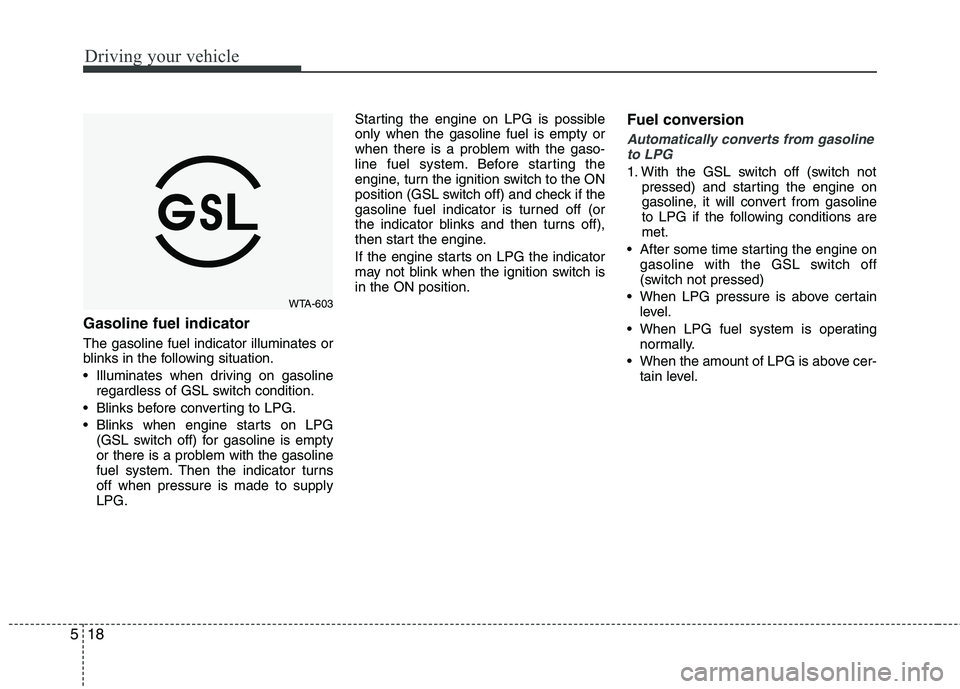
Gasoline fuel indicator The gasoline fuel indicator illuminates or
blinks in the following situation.
Illuminates when driving on gasoline
regardless of GSL switch condition.
Blinks before converting to LPG.
Blinks when engine starts on LPG (GSL switch off) for gasoline is empty
or there is a problem with the gasoline
fuel system. Then the indicator turnsoff when pressure is made to supplyLPG. Starting the engine on LPG is possibleonly when the gasoline fuel is empty or
when there is a problem with the gaso-
line fuel system. Before starting the
engine, turn the ignition switch to the ON
position (GSL switch off) and check if the
gasoline fuel indicator is turned off (or
the indicator blinks and then turns off),
then start the engine.
If the engine starts on LPG the indicator
may not blink when the ignition switch isin the ON position.
Fuel conversion
Automatically converts from gasoline
to LPG
1. With the GSL switch off (switch not pressed) and starting the engine on
gasoline, it will convert from gasoline
to LPG if the following conditions aremet.
After some time starting the engine on gasoline with the GSL switch off
(switch not pressed)
When LPG pressure is above certain level.
When LPG fuel system is operating normally.
When the amount of LPG is above cer- tain level.
WTA-603
Page 263 of 840

519
Driving your vehicle
2. Driving on gasoline with the GSLswitch on and gasoline below a certain
level, it will convert from gasoline to
LPG if the following conditions aremet.
After some time starting the engine on gasoline with the GSL switch off
(switch not pressed).
When LPG pressure is above certain level.
When LPG fuel system is operating normally.
When the amount of LPG is above cer- tain level. Automatically converts from LPG to gasoline
1. With LPG nearly empty, it will convert
from LPG to gasoline if the following conditions are met.
After some time starting the engine.
When gasoline fuel system is operat- ing normally.
When the amount of gasoline is above certain level. Manually converts from gasoline to LPG
1. When the GSL switch is turned off
(switch not pressed), while driving with
the GSL switch on (switch pressed), it
will convert to from gasoline to LPG if
the following conditions are met.
After some time starting the engine on gasoline.
When LPG pressure is above certain level.
When LPG fuel system is operating normally.
When the amount of LPG is above cer- tain level.
Page 264 of 840

Driving your vehicle
20
5
Manually converts from LPG to gasoline
1. When GSL switch is turned on (switch
pressed) while driving on LPG with the
GSL switch off (switch not pressed), it
will convert from LPG to gasoline if the
following conditions are met.
After some time starting the engine.
When gasoline fuel system is operat- ing normally.
When the amount of gasoline is above certain level.
To refill LPG
1. Turn off the engine.
2. To open the fuel filler lid, pull up thefuel filler lid opener.
3. Pull the fuel filler lid (1) out to fully open.
4. Open the LPG cap (2).
5. Refill your vehicle with LPG. While refilling, do not refill your tank over 80%.
Your vehicle automatically blocks the fuel if it is refilled 80%. But in any
case, you have refilled over 80%, have
your vehicle checked by an authorized
KIA dealer.
6. Close the LPG cap and fuel filler lid. Make sure it is securely closed.
OTA040206L
WARNING
Do not refill your tank over 80%.
Always turn the engine off before refilling.
Keep away from flammable mate- rials when refilling.
Start the engine after checking the fuel cap is securely closed.
LPG is extremely flammable. If something ignites it, you could
be badly burned. Keep sparks,flames and smoking materials
away from LPG. Do not smoke if
you are near LPG or refilling your
vehicle.
LPG is stored in the fuel tank at pressures up to 3.0Mpa(435psi).
To prevent personal injury, never:
- Fill to a pressure greater than3.0Mpa(435psi).
- Fill a leaking or damaged tank.
LPG can cause severe cold burns and frostbite. Never let liquid LPG
contact your skin or eyes. When
filling your LPG fuel tank, always
wear gloves approved for han-
dling LPG and appropriate eye
protection.
(Continued)
Page 265 of 840

521
Driving your vehicle
Adapter for Gas Filler Neck
The adapters are required for the fuelling
systems' different nozzles.
Adapters for Gas Filler Necks.
(1) ACME Adapter (2) Dish Coupling Adapter
(3) Bayonet Adapter
Your vehicle comes with a customary
adapter - either ACME (1), Dish Coupling
(2), or Bayonet (3).Fuelling systems and corresponding
adapters vary from country to country. As
not all service stations abroad will pro-
vide you with the required adapter for
your liquefied gas equipment we suggest
that you buy the necessary adapter
before travelling abroad.
Please check whether the adapters fit
your filling equipment.
✽✽
NOTICE
In Europe the most common adapter
types are ACME (1), Dish Coupling (2),
and Bayonet (3).
It is generally advisable to always carry
all three adapters on board as the pro-
liferation of filling systems varies from
country to country.
(Continued)
If your vehicles is parked on an angled surface, the auto-stop fill
device may not function correct-
ly. Make sure your vehicle is
parked on a level surface whenfilling the LPG fuel tank.
Under certain conditions, you may notice it takes longer to fill
your LPG fuel tank or LPG fuel
tank does not refill on a hot day.
This is caused by an increase inthe pressure inside the LPG fuel
tank. This is normal and does not
indicate a problem with the LPGfuel tank.
If it's difficult to refill your LPG
tank for the above reason, do as
follows: - Use gasoline (refuel gasoline).
- Avoid refilling the LPG fuel tankat a very hot midday.
- Do not refill a high propane LPG gas for home (camping) use.
OTA070044L
Page 266 of 840

Driving your vehicle
22
5
LPG safety precaution
Refill LPG only 80% of the tank.
Do not remove the valve to over refill. If
you refill more than you are permitted,
the fuel tank may explode.
Turn the engine off while refilling.
Avoid heat and direct sunlight the fuel tank may pressure up.
Avoid underground parking lots or closed places when you need to park
your vehicle for a very long time.
LPG is extremely flammable. Whenthere is a leak and parked under-
ground or in a closed place, the LPG
may ignite and cause fire. Therefore,
close the refill valve(green, 1) when
you need to park your car for morethan a month.
A refill valve (green,1) is on the fuel tank. Close the valve when you noticea leak.
If you smell LPG inside your vehicle open the windows. If you notice a leak,
have your vehicle checked at an
authorized KIA dealer.
Make sure your vehicle is parked on a level surface and nothing flammable is
near while you check your vehicle.CAUTION
When an adapter is used, the user
needs to be aware of the following:
Worn out adapters must not be used.
Due to use of an adapter the released volume of gas is muchgreater compared to a direct con-
nection with the vehicle fillingconnector.
The nozzle must be disconnected from the car before the adapter isremoved.
Some vehicles only have a very small diameter thread to fix anadaptor.
In this case, the user should takeextra care.
The added length of the adapterprovides a greater bending moment. If the fill coupling hasnot been properly installed, thiscan distort the panel of the car or
even cause the thread of theadapter to shear.
If the vehicle drives away stillconnected then the adapter mayshear unwontedly before the
break-away coupling parts.
OSA0490223
Page 267 of 840

523
Driving your vehicle
Do not repair your fuel tank. Alwayshave it replaced by an authorized KIA
dealer.
Do not try to stop the leak by covering it with your hand. You might suffer from
frostbites.
If the LPG fuel system has a leak, a spark from jumper cables could ignite
the LPG. You or someone else could
be badly burned. Do not jump start
your vehicle if you smell LPG or hear ahissing sound.
Towing your vehicle with improperly positioned tow straps, hooks or chainscan damage the LPG fuel system and
cause a leak. You or someone else
could be injured. Do not use the LPGfuel system components and/or fuel
lines as towing attachment points.
In emergency situation
1. Stop the engine.
2. Evacuate the passengers.
3. Close the refill valve (1).
4. If there is fire, put out the fire with a fire extinguisher.
If you are not able to carry out the above
instructions, please call the police and
fire department.
OSA0490223
Page 273 of 840
529
Driving your vehicle
R (Reverse)
Use this position to drive the vehicle
backward.N (Neutral)
The wheels and transaxle are not
engaged. The vehicle will roll freely even
on the slightest incline unless the parking
brake or service brakes are applied.
D (Drive)
This is the normal forward driving posi-
tion. The transaxle will automatically shift
through a 4-gear sequence, providing the
best fuel economy and power.
For extra power when passing another
vehicle or climbing grades, depress the
accelerator fully, at which time the
transaxle will automatically downshift to
the lower gear.
✽✽
NOTICE
Always come to a complete stop before
shifting into D (Drive).
3 (Third gear)
Use for towing a trailer during hill climb-
ing or to use engine braking downhill.
"3" automatically shifts between 1st, 2nd
and 3rd gears. This means that no shift-
up to 4th gear is performed. However, theshift-up to 4th gear is done when the car
speed exceeds a certain value to prevent
the engine from over-revving. Manually
move the selector to "D" when returning
to normal driving condition.
2 (Second gear)
Use for driving on a slippery road, hill
climbing or engine braking downhill. "2"
automatically shifts between first and
second gears. This means that no shift-up to 3rd gear is
performed. However, the shift-up to thirdgear is done when the car speed
exceeds a certain value to prevent the
engine from over-revving. Manually move
the selector to "D" returning to normal
driving condition.
CAUTION
Always come to a complete stop before shifting into or out of R(Reverse); you may damage thetransaxle if you shift into R(Reverse) while the vehicle is in
motion, except as explained in“Rocking the vehicle” in this sec- tion.
Page 289 of 840

545
Driving your vehicle
Your vehicle's fuel economy depends
mainly on your style of driving, where you
drive and when you drive.
Each of these factors affects how many
kilometers (miles) you can get from a
liter (gallon) of fuel. To operate your vehi-
cle as economically as possible, use the
following driving suggestions to help
save money in both fuel and repairs:
Drive smoothly. Accelerate at a moder-ate rate. Don't make "jack-rabbit" startsor full-throttle shifts and maintain a
steady cruising speed. Don't race
between stoplights. Try to adjust your
speed to the traffic so you don't have to
change speeds unnecessarily. Avoid
heavy traffic whenever possible.
Always maintain a safe distance from
other vehicles so you can avoid unnec-
essary braking. This also reduces
brake wear.
Drive at a moderate speed. The faster you drive, the more fuel your vehicle
uses. Driving at a moderate speed,
especially on the highway, is one of the
most effective ways to reduce fuel con-sumption. Don't "ride" the brake pedal. This can
increase fuel consumption and also
increase wear on these components.
In addition, driving with your foot rest-
ing on the brake pedal may cause the
brakes to overheat, which reduces
their effectiveness and may lead to
more serious consequences.
Take care of your tires. Keep them inflated to the recommended pressure.
Incorrect inflation, either too much or
too little, results in unnecessary tire
wear. Check the tire pressures at leastonce a month.
Be sure that the wheels are aligned correctly. Improper alignment can
result from hitting curbs or driving too
fast over irregular surfaces. Poor align-
ment causes faster tire wear and may
also result in other problems as well as
greater fuel consumption. Keep your car in good condition. For
better fuel economy and reduced
maintenance costs, maintain your carin accordance with the maintenance
schedule in section 7. If you drive your
car in severe conditions, more frequentmaintenance is required (see section 7
for details).
Keep your car clean. For maximum service, your vehicle should be kept
clean and free of corrosive materials. It
is especially important that mud, dirt,
ice, etc. not be allowed to accumulate
on the underside of the car. This extra
weight can result in increased fuel con-
sumption and also contribute to corro-sion.
Travel lightly. Don't carry unnecessary weight in your car. Weight reduces fuel
economy.
Don't let the engine idle longer than necessary. If you are waiting (and not
in traffic), turn off your engine and
restart only when you're ready to go.
ECONOMICAL OPERATION