2012 KIA PICANTO towing
[x] Cancel search: towingPage 328 of 840

621
What to do in an emergency
TOWING
Towing service
If emergency towing is necessary, we
recommend having it done by an author-
ized KIA dealer or a commercial tow-
truck service. Proper lifting and towing
procedures are necessary to prevent
damage to the vehicle. The use of wheeldollies or flatbed is recommended. It is acceptable to tow the vehicle with the
rear wheels on the ground (without dol-
lies) and the front wheels off the ground.
If any of the loaded wheels or suspen- sion components are damaged or the
vehicle is being towed with the front
wheels on the ground, use a towing dolly
under the front wheels.
When being towed by a commercial tow
truck and wheel dollies are not used, the
front of the vehicle should always be lifted,
not the rear.
OPA067015
A
B
C
dolly
OPA067016
OPA067017
CAUTION
Do not tow the vehicle with the
front wheels on the ground asthis may cause damage to thevehicle.
Do not tow with sling-type equip- ment. Use wheel lift or flatbedequipment.
Page 329 of 840

What to do in an emergency
22
6
CAUTION
Failure to place the shift lever in N
(Neutral) may cause internal dam- age to the transaxle.
When towing your vehicle in an emer- gency without wheel dollies :
1. Set the ignition switch in the ACC posi- tion.
2. Place the shift lever in N (Neutral).
3. Release the parking brake.
Removable towing hook
(front, if equipped)
1. Open the trunk, and remove the tow-ing hook from the tool case.
2. Remove the hole cover pressing the lower part of the cover on the front
bumper.
3. Install the towing hook by turning it clockwise into the hole until it is fullysecured.
4. Remove the towing hook and install the cover after use. Emergency towing
If towing is necessary, we recommend
you to have it done by an authorized
KIA dealer or a commercial tow truck
service.
OTA060010
OTA060012
Front
RearOTA060011
Page 330 of 840

623
What to do in an emergency
If towing service is not available in an
emergency, your vehicle may be tem-
porarily towed using a cable or chain
secured to the emergency towing hook
under the front/rear of the vehicle. Use
extreme caution when towing the vehicle.
A driver must be in the vehicle to steer it
and operate the brakes.
Towing in this manner may be done only
on hard-surfaced roads for a short dis-
tance and at low speeds. Also, the
wheels, axles, power train, steering and
brakes must all be in good condition.
Do not use the tow hooks to pull a vehi-cle out of mud, sand or other condi-
tions from which the vehicle cannot be
driven out under its own power.
Avoid towing a vehicle heavier than the vehicle doing the towing.
The drivers of both vehicles should com- municate with each other frequently. Before emergency towing, check that
the hook is not broken or damaged.
Fasten the towing cable or chain securely to the hook.
Do not jerk the hook. Apply steady and even force.
To avoid damaging the hook, do not pull from the side or at a vertical angle.
Always pull straight ahead.CAUTION
Attach a towing strap to the tow
hook.
Using a portion of the vehicle other than the tow hooks for tow-ing may damage the body of yourvehicle.
Use only a cable or chain specifi- cally intended for use in towingvehicles. Securely fasten thecable or chain to the towing hook provided.
WARNING
Use extreme caution when towing
the vehicle.
driving maneuvers which would
place excessive stress on the
emergency towing hook and tow-
ing cable or chain. The hook and
towing cable or chain may break
and cause serious injury or dam-
age.
If the disabled vehicle is unable to be moved, do not forcibly con-
tinue the towing. Contact an
authorized KIA dealer or a com-
mercial tow truck service for
assistance.
Tow the vehicle as straight ahead as possible.
Keep away from the vehicle dur- ing towing.
Page 331 of 840

What to do in an emergency
24
6
Use a towing strap less than 5 m (16
feet) long. Attach a white or red cloth (about 30 cm (12 inches) wide) in the
middle of the strap for easy visibility.
Drive carefully so that the towing strap is not loosened during towing.
Emergency towing precautions
Place the ignition switch in ACC so thesteering wheel isn’t locked.
Place the transaxle shift lever in N (Neutral).
Release the parking bake.
Press the brake pedal with more force than normal since you will have
reduced brake performance.
More steering effort will be required because the power steering system
will be disabled.
If you are driving down a long hill, the brakes may overheat and brake per-
formance will be reduced. Stop often
and let the brakes cool off.CAUTION - Automatic
transaxle
If the car is being towed with all four wheels on the ground, it can
be towed only from the front. Besure that the transaxle is in neu-tral. Be sure the steering isunlocked by placing the ignition
switch in the ACC position. Adriver must be in the towed vehi- cle to operate the steering and
brakes.
To avoid serious damage to the automatic transaxle, limit thevehicle speed to 15 km/h (10 mph)and drive less than 1.5 km (1
mile) when towing.
Before towing, check the level of the automatic transaxle fluid. If itis below the "HOT" range on the dipstick, add fluid. If you cannot
add fluid, a towing dolly must beused.
OPA067014
Page 350 of 840

Maintenance
18
7
Severe driving conditions
A : Repeated short distance driving
B : Extensive idling
C : Driving in dusty, rough roads
D : Driving in areas using salt or other corrosive
materials or in very cold weather
E : Driving in sandy areas
F : More than 50 % driving in heavy city traffic during hot weather above 32°C (90°F) G : Driving in mountainous areas.
H : Towing a trailer
I : Driving for patrol car, taxi, commercial car or vehicle tow-
ing
J : Driving over 170 km/h (106 mile/h)
K : Frequently driving in stop-and-go conditions
L : Driving in very cold weather
Maintenance itemMaintenance operationMaintenance intervalsDriving condition
Disc brakes and pads, calipers and rotorsIInspect more frequently
depending on the conditionC, D, E, G, H
Parking brakeIInspect more frequently
depending on the conditionC, D, G, H
Driveshaft and bootsIInspect more frequently
depending on the conditionB, C, D, E, F, G, H, I, J
Climate control air filter (if equipped)RReplace more frequently
depending on the conditionC, E
Page 421 of 840
Index
4
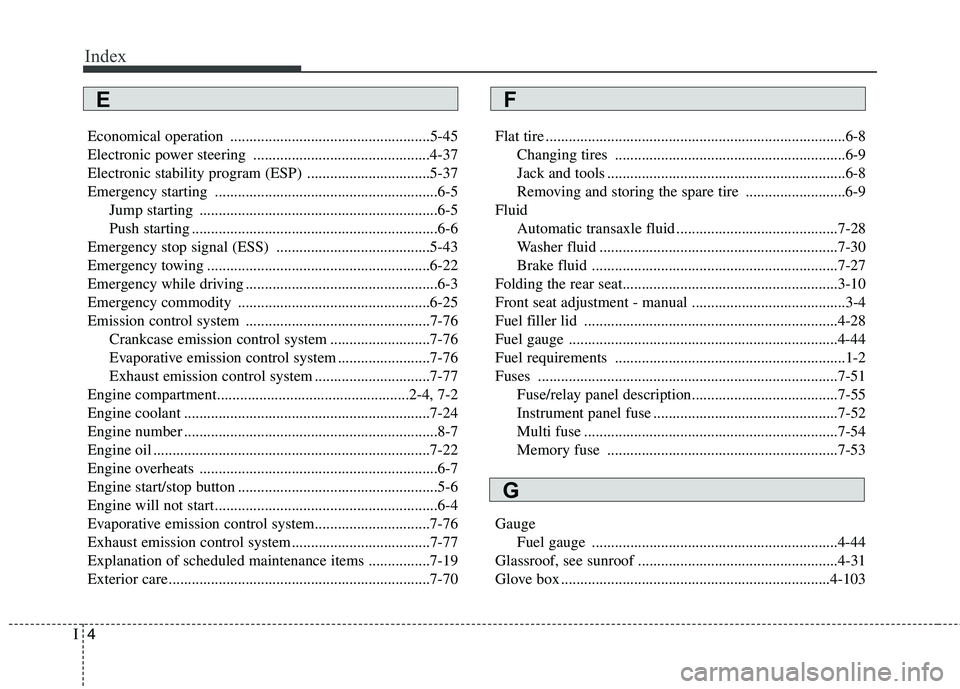
I
Economical operation ....................................................5-45
Electronic power steering ..............................................4-37
Electronic stability program (ESP) ................................5-37
Emergency starting ..........................................................6-5
Jump starting ..............................................................6-5
Push starting ................................................................6-6
Emergency stop signal (ESS) ........................................5-43
Emergency towing ..........................................................6-22
Emergency while driving ..................................................6-3
Emergency commodity ..................................................6-25
Emission control system ................................................7-76 Crankcase emission control system ..........................7-76
Evaporative emission control system ........................7-76
Exhaust emission control system ..............................7-77
Engine compartment..................................................2-4, 7-2
Engine coolant ................................................................7-24
Engine number ..................................................................8-7
Engine oil ........................................................................7-22
Engine overheats ..............................................................6-7
Engine start/stop button ....................................................5-6
Engine will not start..........................................................6-4
Evaporative emission control system..............................7-76
Exhaust emission control system ....................................7-77
Explanation of scheduled maintenance items ................7-19
Exterior care....................................................................7-70 Flat tire ..............................................................................6-8
Changing tires ............................................................6-9
Jack and tools ..............................................................6-8
Removing and storing the spare tire ..........................6-9
Fluid Automatic transaxle fluid ..........................................7-28
Washer fluid ..............................................................7-30
Brake fluid ................................................................7-27
Folding the rear seat........................................................3-10
Front seat adjustment - manual ........................................3-4
Fuel filler lid ..................................................................4-28
Fuel gauge ......................................................................4-44
Fuel requirements ............................................................1-2
Fuses ..............................................................................7-51 Fuse/relay panel description......................................7-55
Instrument panel fuse ................................................7-52
Multi fuse ..................................................................7-54
Memory fuse ............................................................7-53
Gauge Fuel gauge ................................................................4-44
Glassroof, see sunroof ....................................................4-31
Glove box ......................................................................4-103
F
G
E
Page 425 of 840

Index
8
I
Special driving conditions ..............................................5-47
Driving at night ........................................................5-48
Driving in flooded areas............................................5-50
Driving in the rain ....................................................5-49
Hazardous driving conditions ..................................5-47
Highway driving ........................................................5-50
Rocking the vehicle ..................................................5-47
Smooth cornering ......................................................5-48
Speedometer....................................................................4-44
Starting difficulties, see engine will not start ..................6-4
Starting the engine ............................................................5-9
Steering wheel ................................................................4-35 Electronic power steering..........................................4-35
Heated steering wheel ..............................................4-36
Horn ..........................................................................4-37
Tilt steering ..............................................................4-35
Steering wheel audio control ........................................4-111
Storage compartment ....................................................4-103 Glove box ................................................................4-103
Sunglass holder ......................................................4-103
Sunglass holder ............................................................4-103
Sunroof............................................................................4-31
Sunvisor ........................................................................4-106 Tachometer ......................................................................4-44
Tailgate ............................................................................4-19
Tilt steering ....................................................................4-35
Tire specification and pressure label ................................8-7
Tires and wheels ......................................................7-41, 8-2
Checking tire inflation pressure ................................7-42
Recommended cold tire inflation pressures ..............7-41
Tire care ....................................................................7-41
Tire maintenance ......................................................7-46
Tire replacement ........................................................7-45
Tire rotation ..............................................................7-43
Tire sidewall labeling ................................................7-47
Tire traction ..............................................................7-46
Wheel alignment and tire balance ............................7-44
Wheel replacement ....................................................7-46
Towing ............................................................................6-21 Emergency towing ....................................................6-22
Transaxle Automatic transaxle ..................................................5-27
Manual transaxle ......................................................5-24
Tripmeter ........................................................................4-46
Trip computer..................................................................4-45T
Page 459 of 840

321
Safety features of your vehicle
When using the rear centre seat belt, the
buckle with the “CENTER” mark must beused.To release the seat belt:
When you want to release the seat belt,
press the button (1) in the locking buckle.Stowing the rear seat belt
The rear seat belt buckles can be stowed
in the pocket between the rear seatback
and cushion when not in use.
The centre seat belt can be stowed with
the plate and webbing rolled in the pock-
et between the rear seatback and cush-
ion. (2-point static type belt, if equipped)
OTA032025OTA030027B210A02NF-2
WARNING
The centre lap belt latching mecha-
nism is different from those for the
rear seat shoulder belts. When fas-tening the rear seat shoulder belts
or the centre lap belt, make sure
they are inserted into the correct
buckles to obtain maximum protec-
tion from the seat belt system and
assure proper operation.