Page 371 of 840
739
Maintenance
Battery recharging
Your vehicle has a maintenance-free,
calcium-based battery.
If the battery becomes discharged in ashort time (because, for example, the
headlights or interior lights were left on
while the vehicle was not in use),
recharge it by slow charging (trickle)
for 10 hours.
If the battery gradually discharges because of high electric load while the
vehicle is being used, recharge it at 20-
30A for two hours.(Continued)
When lifting a plastic-cased bat-tery, excessive pressure on the
case may cause battery acid to
leak, resulting in personal injury.
Lift with a battery carrier or with
your hands on opposite corners.
Never attempt to recharge the battery when the battery cables are connected.
The electrical ignition system works with high voltage. Never
touch these components with theengine running or the ignition
switched on.
Failure to follow the above warn-
ings can result in serious bodily
injury or death.CAUTION
When you don’t use the vehicle for a long time in the low temper-
ature area, separate the batteryand keep it indoors.
Always charge the battery fully to prevent battery case damage in
low temperature area.
If you use unauthorized electron- ic devices, the battery may be dis-charged. Never use unauthorized devices.
WARNING
Separating the battery from the
vehicle should be done in an
authorized KIA dealer.
Page 384 of 840
Maintenance
52
7
Instrument panel fuse replace- ment
1. Turn the ignition switch and all other
switches off.
2. Open the fuse panel cover.
3. Pull the suspected fuse straight out.Use the removal tool provided in the
engine compartment fuse panel.
4. Check the removed fuse; replace it if it is blown.
5. Push in a new fuse of the same rating, and make sure it fits tightly in the clips.
If it fits loosely, consult an authorized KIA
dealer.
If you do not have a spare, use a fuse of the same rating from a circuit you may not need for operating the vehicle, suchas the cigarette lighter fuse.
If the headlights or other electrical com-
ponents do not work and the fuses are
OK, check the fuse panel in the engine
compartment. If a fuse is blown, it mustbe replaced.
OTA070018
OTA070043L
OTA070019
■ Type A
■ Type B
Page 385 of 840
753
Maintenance
Memory fuse
Your vehicle is equipped with a memory
fuse to prevent battery discharge if your
vehicle is parked without being operated
for prolonged periods. Use the following
procedures before parking the vehicle for
prolonged periods.
1. Turn off the engine.
2. Turn off the headlights and tail lights.
3. Open the driver’s side panel cover andpull up the memory fuse.
✽✽ NOTICE
If the memory fuse is pulled up from the fuse panel, the warning chime,
audio, clock and interior lamps, etc.,
will not operate. Some items must be
reset after replacement. Refer to
“Battery” in this section.
Even when the memory fuse is pulled
up, the battery can still be discharged
by operation of the headlights or other
electrical devices.
Engine compartment fuse replacement
1. Turn the ignition switch and all other switches off.
2. Remove the fuse panel cover by pressing the tab and pulling the cover
up.
OTA070020
OTA070021
OTA070040
■Type A
■ Type B
Page 412 of 840
![KIA PICANTO 2012 Owners Manual Specifications & Consumer information
2
8
ENGINE BULB WATTAGE
DIMENSIONS Item
Gasoline 1.0/
LPG 1.0 Gasoline 1.25
Displacement [cc(cu.in)] 998 (60.9) 1,248 (76.2)
Bore x Stroke [mm(in)] 71 x 84
(2.8](/manual-img/2/57971/w960_57971-411.png "KIA PICANTO 2012 Owners Manual Specifications & Consumer information
2
8
ENGINE BULB WATTAGE
DIMENSIONS Item
Gasoline 1.0/
LPG 1.0 Gasoline 1.25
Displacement [cc(cu.in)] 998 (60.9) 1,248 (76.2)
Bore x Stroke [mm(in)] 71 x 84
(2.8")
Specifications & Consumer information
2
8
ENGINE BULB WATTAGE
DIMENSIONS Item
Gasoline 1.0/
LPG 1.0 Gasoline 1.25
Displacement [cc(cu.in)] 998 (60.9) 1,248 (76.2)
Bore x Stroke [mm(in)] 71 x 84
(2.80 x 3.31) 71 x 78.8
(2.80 x 3.10)
Firing order 1-2-3 1-3-4-2
No. of cylinders 3, In-line 4, In-line
Item mm (in)
Overall length 3595 (141.5)
Overall width 1595 (62.8)
Overall heightFor Europe 1480 (58.3)
Except Europe 1490 (58.7)
Front tread
155/70R13 1421 (55.9)
165/60R14 1415 (55.7)
175/50R15 1409 (55.5)
Rear tread
155/70R13 1424 (56.1)
165/60R14 1418 (55.8)
175/50R15 1412 (55.6)
Wheelbase 2385 (93.9)
Light Bulb Wattage Bulb type
Headlights (Low/High) 55/60 H4 L/L
Headlights (Low/High)* 55 H7 L/L
Front turn signal lights* 21 PY21W
FRT Position lights (Bulb type)* 5 W5W
FRT Position lights (LED type)*LEDLED
Side repeater lights* 5 WY5W
Side repeater lights (LED type)* LED LED
Front fog lights* 27 GE881
D.R.L (Bulb type)21P21W
D.R.L (LED type)*LEDLED
Stop and tail light* 21/5 P21/5W
Stop and tail light (LED type)* LED LED
Rear turn signal lights 21 P21W
Back-up lights 16 W16W
Rear fog lights*21P21W
High mounted stop light* 5 W5W High mounted stop light (LED type)* LED LED
License plate lights 5 W5W
Map lamps 10 W10W
Room lamp 8 FESTOON 8W
Luggage lamp* 5 FESTOON 5W
* : If equipped
Page 536 of 840

437
Features of your vehicle
Inside rearview mirror
Adjust the rearview mirror to centre on
the view through the rear window. Make
this adjustment before you start driving.
Day/night rearview mirror
Make this adjustment before you start
driving and whilst the day/night lever is in
the day position.
Pull the day/night lever toward you to reduce the glare from the headlights of
the vehicles behind you during night driv-ing.
Remember that you lose some rearviewclarity in the night position.
Outside rearview mirror
Be sure to adjust mirror angles before
driving.
Your vehicle is equipped with both left-
hand and right-hand outside rearview
mirrors. The mirrors can be adjusted
remotely with the remote switch. The mir-
ror heads can be folded back to prevent
damage during an automatic car wash or
when passing in a narrow street.
MIRRORS
WARNING -
Rear visibility
Do not place objects in the rear
seat or cargo area which would
interfere with your vision through
the rear window.
OTA040028L
D
DDDaaaayyyy
NNNNiiiigggghhhhtttt
WARNING
Do not adjust the rearview mirror
whilst the vehicle is moving. This
could result in loss of control, and
an accident which could cause
death, serious injury or property
damage.
WARNING
Do not modify the inside mirror and
do not install a wide mirror. It could
result in injury, during an accident
or deployment of the air bag.
WARNING - Rearview mir-
rors
The outside rearview mirror is convex. Objects seen in the mir-
ror are closer than they appear.
Use your interior rearview mirror or direct observation to deter-
mine the actual distance of fol-
lowing vehicles when changinglanes.
Page 556 of 840

457
Features of your vehicle
High beam indicator
This indicator illuminates when the head- lights are on and in the high beam posi-
tion or when the turn signal lever is pulled
into the Flash-to-Pass position.
Tail light indicator
This indicator illuminates when the tail lights are on.
Front fog light indicator (if equipped)
This indicator illuminates when the front
fog lights are ON.
Rear fog light indicator (if equipped)
This indicator illuminates when the rear
fog lights are ON.
Low Beam Indicator Light
(if equipped)
This indicator light illuminates when the headlights are on.
Engine oil pressure warning light
This warning light indicates the engine oil
pressure is low.
If the warning light illuminates whilst driv- ing:
1. Drive safely to the side of the road and stop.
2. With the engine off, check the engine oil level. If the level is low, add oil as required.
If the warning light remains on after
adding oil or if oil is not available, call an
authorised KIA dealer.
CAUTION
If the engine is not stopped imme- diately after the engine oil pressure
warning light is illuminated, severedamage could result.
Page 566 of 840

467
Features of your vehicle
Battery saver function
The purpose of this feature is to pre-vent the battery from being dis-
charged. The system automatically
turns off the parking lights when the
driver removes the ignition key (smart
key: turns off the engine) and opens
the driver-side door.
With this feature, the parking lights will be turned off automatically if the driver
parks on the side of road at night.
If necessary, to keep the lights on
when the ignition key is removed,
(smart key: turns off the engine) per-
form the following:
1) Open the driver-side door.
2) Turn the parking lights OFF and ON again using the light switch on the
steering column. Headlight escort function (if equipped) The headlights (and/or taillights) will
remain on for approximately 20 minutes
after the ignition key is removed when
the engine is turned off. However, if the
driver’s door is opened and closed, the
headlights are turned off after 30 sec-
onds.
The headlights can be turned off by
pressing the lock button on the transmit-
ter (or smart key) twice or turning off the
light switch from the headlight or Autolight position.
Headlight welcome function (if equipped)
When the headlight switch is in the ON or
AUTO position and all doors (and tail-
gate) are closed and locked, if you press
the door unlock button on the transmitter
(or smart key), the headlights will come
on for about 15 seconds.
If the headlight switch is in the AUTO
position, the function can only operate atnight.
At this time, if you press the door unlock
button again or door lock button on the
transmitter (or smart key), the headlights
will turn off immediately.
Daytime running light (if equipped)
Daytime Running Lights (DRL) can make
it easier for others to see the front of your
vehicle during the day. DRL can be help-
ful in many different driving conditions,
and it is especially helpful after dawn and
before sunset.
The DRL system will make the head-
lights light turn OFF when:
1. The position or head light switch is ON.
2. Engine off or ACC.
LIGHTING
CAUTION
If the driver gets out of the vehicle
through other doors (except dri-
ver's door), the battery saver func- tion does not operate and the head-light escort function does not turnoff automatically. Therefore, It caus-
es the battery to be discharged. In this case, make sure to turn off thelamp before getting out of the vehi- cle.
Page 567 of 840
Features of your vehicle
68
4
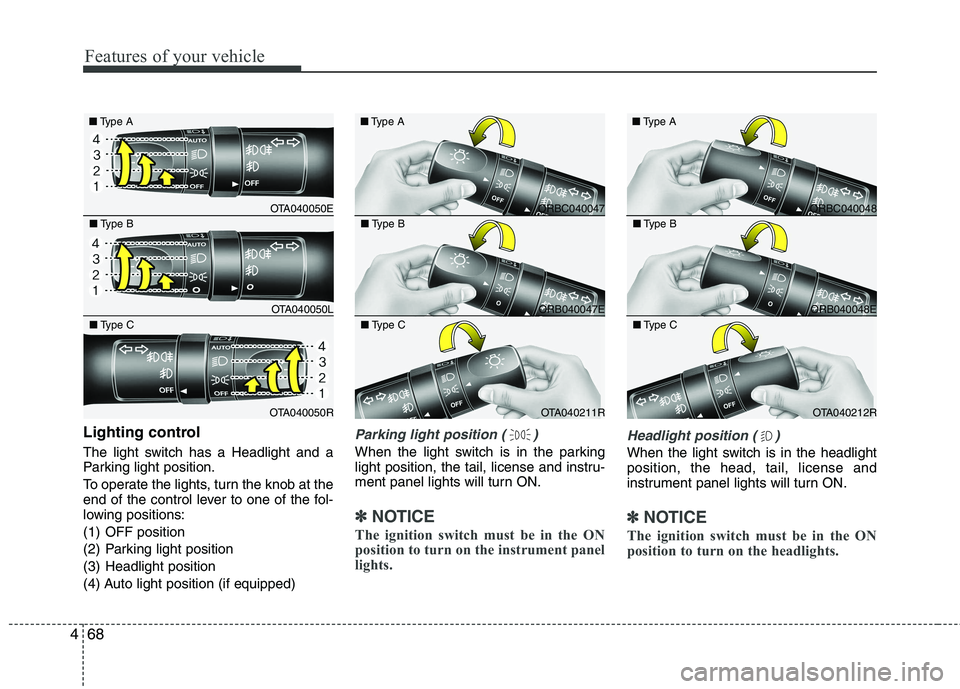
Lighting control
The light switch has a Headlight and a
Parking light position.
To operate the lights, turn the knob at the
end of the control lever to one of the fol-
lowing positions:
(1) OFF position
(2) Parking light position
(3) Headlight position
(4) Auto light position (if equipped)Parking light position ( )
When the light switch is in the parking
light position, the tail, license and instru-
ment panel lights will turn ON.
✽✽
NOTICE
The ignition switch must be in the ON
position to turn on the instrument panel
lights.
Headlight position ( )
When the light switch is in the headlight position, the head, tail, license and
instrument panel lights will turn ON.
✽✽ NOTICE
The ignition switch must be in the ON
position to turn on the headlights.
OTA040050E
■
Type A
OTA040050L
■
Type B
OTA040050R
■
Type C
ORBC040047
■
Type A
ORB040047E
■
Type B
OTA040211R
■
Type C
ORBC040048
■
Type A
ORB040048E
■
Type B
OTA040212R
■
Type C