2012 KIA Cerato engine air
[x] Cancel search: engine airPage 263 of 353

What to do in an emergency
26
ROAD WARNING
F010100AUN
Hazard warning flasher
The hazard warning flasher serves as a
warning to other drivers to exercise
extreme caution when approaching,
overtaking, or passing your vehicle.It should be used whenever emergency
repairs are being made or when the vehi-
cle is stopped near the edge of a road-
way.
Depress the flasher switch with the igni-
tion switch in any position. The flasher
switch is located in the center console
switch panel. All turn signal lights will
flash simultaneously.
• The hazard warning flasher operates
whether your vehicle is running or not.
The turn signals do not work when the hazard flasher is on.
Care must be taken when using the hazard warning flasher while the vehi-
cle is being towed.
F020100AUN-EU
If the engine stalls at a crossroad
or crossing
If the engine stalls at a crossroad or
crossing, set the shift lever in the N
(Neutral) position and then push the vehi-
cle to a safe place.
F020200APB
If you have a flat tire while driving
If a tire goes flat while you are driving:
1. Take your foot off the accelerator pedaland let the vehicle slow down while
driving straight ahead. Do not apply the
brakes immediately or attempt to pull
off the road as this may cause a loss of
control. When the vehicle has slowed
down to such a speed that it is safe to
do so, brake carefully and pull off the
road. Drive off the road as far as possi-
ble and park on a firm level ground. If
you are on a divided highway, do not
park in the median area between the
two traffic lanes.
2. When the vehicle is stopped, turn on your emergency hazard flashers, set
the parking brake and put the transaxle
in P (automatic transaxle) or reverse
(manual transaxle).
IN CASE OF AN EMERGENCY
WHILE DRIVING
OTD061001N
Page 267 of 353
What to do in an emergency
66
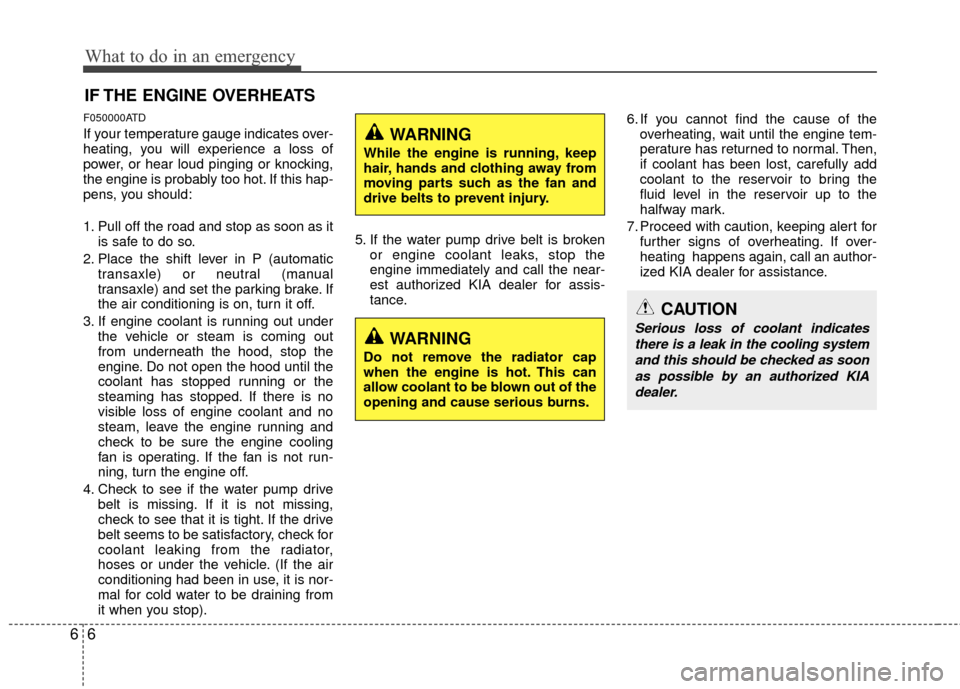
IF THE ENGINE OVERHEATS
F050000ATD
If your temperature gauge indicates over-
heating, you will experience a loss of
power, or hear loud pinging or knocking,
the engine is probably too hot. If this hap-
pens, you should:
1. Pull off the road and stop as soon as itis safe to do so.
2. Place the shift lever in P (automatic transaxle) or neutral (manual
transaxle) and set the parking brake. If
the air conditioning is on, turn it off.
3. If engine coolant is running out under the vehicle or steam is coming out
from underneath the hood, stop the
engine. Do not open the hood until the
coolant has stopped running or the
steaming has stopped. If there is no
visible loss of engine coolant and no
steam, leave the engine running and
check to be sure the engine cooling
fan is operating. If the fan is not run-
ning, turn the engine off.
4. Check to see if the water pump drive belt is missing. If it is not missing,
check to see that it is tight. If the drive
belt seems to be satisfactory, check for
coolant leaking from the radiator,
hoses or under the vehicle. (If the air
conditioning had been in use, it is nor-
mal for cold water to be draining from
it when you stop). 5. If the water pump drive belt is broken
or engine coolant leaks, stop the
engine immediately and call the near-
est authorized KIA dealer for assis-
tance. 6. If you cannot find the cause of the
overheating, wait until the engine tem-
perature has returned to normal. Then,
if coolant has been lost, carefully add
coolant to the reservoir to bring the
fluid level in the reservoir up to the
halfway mark.
7. Proceed with caution, keeping alert for further signs of overheating. If over-
heating happens again, call an author-
ized KIA dealer for assistance.
CAUTION
Serious loss of coolant indicates
there is a leak in the cooling systemand this should be checked as soonas possible by an authorized KIAdealer.
WARNING
While the engine is running, keep
hair, hands and clothing away from
moving parts such as the fan and
drive belts to prevent injury.
WARNING
Do not remove the radiator cap
when the engine is hot. This can
allow coolant to be blown out of the
opening and cause serious burns.
Page 280 of 353

7
Engine compartment / 7-2
Maintenance services / 7-3
Owner maintenance / 7-4
Maintenance schedule / 7-6
Explanation of scheduled maintenance items / 7-21
Engine oil / 7-24
Engine coolant / 7-25
Brake/clutch fluid / 7-28
Power steering fluid / 7-29
Automatic transaxle fluid / 7-30
Washer fluid / 7-30
Parking brake / 7-31
Air cleaner / 7-31
Climate control air filter / 7-32
Wiper blades / 7-32
Battery / 7-34
Tires and wheels / 7-37
Fuses / 7-50
Appearance care / 7-59
Emission control system / 7-65
Maintenance
Page 281 of 353

Maintenance
27
ENGINE COMPARTMENT
1. Engine coolant reservoir
2. Engine oil filler cap
3. Brake/clutch* fluid reservoir
4. Air cleaner
5. Fuse box
6. Positive battery terminal
7. Negative battery terminal
8. Windshield washer fluid reservoir
9. Radiator cap
10. Engine oil dipstick
11. Power steering fluid reservoir*
* : if equipped
OTD071055N-1
B010000ATD
* The actual engine room in the vehicle may differ from the illustration.
Page 284 of 353

75
Maintenance
G030102ATD
While operating your vehicle:
Note any changes in the sound of theexhaust or any smell of exhaust fumes
in the vehicle.
Check for vibrations in the steering wheel. Notice any increased steering
effort or looseness in the steering
wheel, or change in its straight-ahead
position.
Notice if your vehicle constantly turns slightly or “pulls” to one side when trav-
eling on smooth, level road.
When stopping, listen and check for unusual sounds, pulling to one side,
increased brake pedal travel or “hard-
to-push” brake pedal.
If any slipping or changes in the oper- ation of your transaxle occurs, check
the transaxle fluid level.
Check the automatic transaxle P (Park) function.
Check the parking brake.
Check for fluid leaks under your vehicle (water dripping from the air condition-
ing system during or after use is nor-
mal).
G030103AHM
At least monthly:
Check the coolant level in the enginecoolant reservoir.
Check the operation of all exterior lights, including the stoplights, turn sig-
nals and hazard warning flashers.
Check the inflation pressures of all tires including the spare.
G030104AHM
At least twice a year (i.e., every Spring and Fall) :
Check the radiator, heater and air con- ditioning hoses for leaks or damage.
Check the windshield washer spray and wiper operation. Clean the wiper
blades with clean cloth dampened with
washer fluid.
Check the headlight alignment.
Check the muffler, exhaust pipes, shields and clamps.
Check the lap/shoulder belts for wear and function.
Check for worn tires and loose wheel lug nuts.
G030105ATD
At least once a year :
Clean the body and door drain holes.
Lubricate the door hinges and checks,and hood hinges.
Lubricate the door and hood locks and latches.
Lubricate the door rubber weather- strips.
Check the air conditioning system.
Check the power steering fluid level.
Inspect and lubricate automatic transaxle linkage and controls.
Clean the battery and terminals.
Check the brake/clutch fluid level.
Page 286 of 353

77
Maintenance
NORMAL MAINTENANCE SCHEDULE
The following maintenance services must be performed to ensure good emission control and performance. Keep receipts for all
vehicle emission services to protect your warranty. Where both kilometrage and time are shown, the frequency of service is deter-
mined by whichever occurs first.
24,000 km (15,000 miles) or 12 months
❑Rotate tires - including tire pressure and tread wear
(Every 12,000 km or 12 months)
❑ Inspect air cleaner filter
❑Inspect power steering fluid and lines (if equipped)
❑Inspect power steering pump, belt and hoses (if equipped)
❑ Inspect vacuum hose
❑Inspect air conditioning refrigerant
❑Inspect brake lines, hoses and connections (including booster)
❑Inspect drive shafts and boots
(Continued)
(Continued)
❑Inspect exhaust pipe and muffler
❑Inspect front brake disc/pads, calipers
❑Inspect rear brake disc/pads
❑Inspect steering gear box, linkage & boots/lower arm ball joint,
upper arm ball joint
❑ Inspect suspension mounting bolts
❑Replace climate control air filter (if equipped)
❑Replace engine oil and filter
(24,000 km (15,000 miles) or 24 months)
❑ Inspect battery condition
❑Inspect cooling system hoses and connections
❑Inspect clutch (if equipped) and brake pedal free play
❑Inspect all latch, hinges and locks
❑Add fuel additive *3 (24,000 km (15,000 miles) or 24 months)
12,000 km (7,500 miles) or 6 months
❑Rotate tires - including tire pressure and tread wear
(Every 12,000 km or 12 months)
❑ Inspect air cleaner filter
❑Inspect vacuum hose
❑Replace engine oil and filter
(12,000 km (7,500 miles) or 12 months)
❑ Inspect battery condition
❑Inspect cooling system hoses and connections
❑Inspect clutch (if equipped) and brake pedal free play
❑Add fuel additive *3 (12,000 km (7,500 miles) or 12 months)
*3: If TOP TIER Detergent Gasoline is not available, one bottle of additive is rec-
ommended. Additives are available from your authorized KIA dealer along
with information on how to use them. Do not mix other additives.
Page 287 of 353

Maintenance
87
36,000 km (22,500 miles) or 18 months
❑Rotate tires - including tire pressure and tread wear
(Every 12,000 km or 12 months)
❑ Inspect air cleaner filter
❑Inspect vacuum hose
❑Replace engine oil and filter
(36,000 km (22,500 miles) or 36 months)
❑ Inspect add fuel additive (12,000 or 12 months) *3
❑Inspect battery condition
❑Inspect cooling system hoses and connections
❑Inspect clutch (if equipped) and brake pedal free play
NORMAL MAINTENANCE SCHEDULE (CONT.)
48,000 km (30,000 miles) or 24 months
❑Rotate tires - including tire pressure and tread wear
(Every 12,000 km or 12 months)
❑ Inspect air conditioning refrigerant
❑Inspect brake fluid / clutch (if equipped) fluid
❑ Inspect brake lines, hoses and connections (including booster)
❑Inspect drive shafts and boots
❑Inspect exhaust pipe and muffler
❑Inspect front brake disc/pads, calipers
❑Inspect fuel filter *1
❑Inspect fuel tank, cap, canister, fuel lines, fuel hoses, connections
and vapor hose
❑Inspect fuel tank air filter (if equipped) *1
(Continued)
(Continued)
❑Inspect power steering fluid and lines (if equipped)
❑Inspect power steering pump, belt and hoses (if equipped)
❑ Inspect rear brake disc/pads
❑Inspect parking brake
❑Inspect steering gear box, linkage & boots/lower arm ball joint,
upper arm ball joint
❑Inspect suspension mounting bolts
❑ Inspect vacuum hose
❑Replace air cleaner filter
❑ Replace climate control air filter (if equipped)
❑Replace engine oil and filter
(48,000 km (30,000 miles) or 48 months)
❑ Inspect add fuel additive (12,000 or 12 months) *3
❑Inspect battery condition
❑Inspect cooling system hoses and connections
❑Inspect clutch (if equipped) and brake pedal free play
❑Inspect all latch, hinges and locks
*1: Fuel filter & Fuel tank air filter are considered to be maintenance free\
but peri-
odic inspection is recommended for this maintenance schedule depends on
fuel quality. If there are some important safety matters like fuel flow restric-
tion, surging, loss of power, hard starting problem etc, replace the fuel filter
immediately regardless of maintenance schedule and consult an authorized
KIA dealer for details.
*
3: If TOP TIER Detergent Gasoline is not available, one bottle of additive is rec- ommended. Additives are available from your authorized KIA dealer along
with information on how to use them. Do not mix other additives.
Page 288 of 353

79
Maintenance
(Continued)
❑Inspect rear brake disc/pads
❑Inspect steering gear box, linkage & boots/lower arm ball joint,
upper arm ball joint
❑ Inspect suspension mounting bolts
❑Inspect vacuum hose
❑Replace climate control air filter (if equipped)
❑Replace engine oil and filter
(72,000 km (45,000 miles) or 72 months)
❑ Inspect add fuel additive (12,000 or 12 months) *3
❑Inspect battery condition
❑Inspect cooling system hoses and connections
❑Inspect clutch (if equipped) and brake pedal free play
❑Inspect all latch, hinges and locks
72,000 km (45,000 miles) or 36 months
❑Rotate tires - including tire pressure and tread wear
(Every 12,000 km or 12 months)
❑ Inspect air cleaner filter
❑Inspect air conditioning refrigerant
❑Inspect brake lines, hoses and connections (including booster)
❑Inspect drive shafts and boots
❑Inspect exhaust pipe and muffler
❑Inspect front brake disc/pads, calipers
❑Inspect power steering fluid and lines (if equipped)
❑Inspect power steering pump, belt and hoses (if equipped)
(Continued)
NORMAL MAINTENANCE SCHEDULE (CONT.)
60,000 km (37,500 miles) or 30 months
❑Rotate tires - including tire pressure and tread wear
(Every 12,000 km or 12 months)
❑ Inspect air cleaner filter
❑Inspect vacuum hose
❑Replace engine oil and filter
(60,000 km (37,500 miles) or 60 months)
❑ Inspect add fuel additive (12,000 or 12 months) *3
❑Inspect battery condition
❑Inspect cooling system hoses and connections
❑Inspect clutch (if equipped) and brake pedal free play
❑Inspect manual transaxle fluid (if equipped)
(Every 60,000 km or 48 months)
*3: If TOP TIER Detergent Gasoline is not available, one bottle of additive is rec-
ommended. Additives are available from your authorized KIA dealer along
with information on how to use them. Do not mix other additives.