2012 KIA Cerato ac control
[x] Cancel search: ac controlPage 54 of 353

Safety features of your vehicle
38
3
C041000AEN
Air bag warning light
The purpose of the air bag warning light
in your instrument panel is to alert you of
a potential problem with your air bag -
Supplemental Restraint System (SRS).
When the ignition switch is turned ON,
the indicator light should illuminate for
approximately 6 seconds, then go off.
Have the system checked if:
The light does not turn on briefly when
you turn the ignition ON.
The light stays on after illuminating for approximately 6 seconds.
The light comes on while the vehicle is in motion.
C040100BTD-EU
SRS components and functions
The SRS consists of the following com-
ponents:
1. Driver's front air bag module
2. Passenger's front air bag module
3. Side impact air bag modules*
4. Curtain air bag modules*
5. Retractor pre-tensioner assemblies*
6. Anchor pre-tensioner assemblies*
7. Air bag warning light
8. SRS control module (SRSCM)
9. Front impact sensors
10. Side impact sensors*
11. PASSENGER AIR BAG “OFF” indi- cator (Front passenger’s seat only)
12. Occupant detection system (Front passenger’s seat only)
WARNING
Extreme Hazard! Do not use arearward facing child restraint on
a seat protected by an air bag in
front of it!
Never put a child restraint in the front passenger’s seat. If the front
passenger air bag inflates, it can
cause serious or fatal injuries.
When children are seated in the rear outboard seats of a vehicle
equipped with side and/or curtain
air bags, be sure to install the
child restraint system as far away
from the door side as possible,
and securely lock the child
restraint system in position.
Inflation of side and/or curtain air
bags could cause serious injury
or death to an infant or child.
W7-147OTD030040N
Page 57 of 353

341
Safety features of your vehicle
C040300ATD
Occupant detection system
Your vehicle is equipped with an occu-
pant detection system in the front pas-
senger's seat.
The occupant detection system is
designed to detect the presence of a
properly-seated front passenger and
determine if the passenger's front air bag
should be enabled (may inflate) or not.
The driver's front air bag is not affected
or controlled by the occupant detection
system.
(Continued)
The SRS can function only whenthe ignition key is in the ON posi-
tion. If the SRS air bag warning
light does not illuminate, or con-
tinuously remains on after illumi-
nating for about 6 seconds when
the ignition switch is turned to
the ON position, or after the
engine is started, comes on while
driving, the SRS is not working
properly. If this occurs, have your
vehicle immediately inspected by
an authorized KIA dealer.
Before you replace a fuse or dis- connect a battery terminal, turn
the ignition switch to the LOCK
position and remove the ignition
key. Never remove or replace the
air bag related fuse(s) when the
ignition switch is in the ON posi-
tion. Failure to heed this warning
will cause the SRS air bag warn-
ing light to illuminate.WARNING
If an air bag deploys, there maybe a loud noise followed by a fine
dust released in the vehicle.
These conditions are normal and
are not hazardous - the air bags
are packed in this fine powder.
The dust generated during air
bag deployment may cause skin
or eye irritation as well as aggra-
vate asthma for some persons.
Always wash all exposed skin
areas thoroughly with lukewarm
water and a mild soap after an
accident in which the air bags
were deployed.
(Continued)
OTD031041N
Page 64 of 353

Safety features of your vehicle
48
3
The driver's seat track position sensor (if
equipped), which is installed on the seat
track, determine if the seat is fore or aft
of a reference position. The seat belt
buckle sensors determine if the driver
and front passenger's seat belts are fas-
tened. These sensors provide the ability to con-
trol the SRS deployment based on how
close the driver's seat is to the steering
wheel, whether or not the seat belts are
fastened, and how severe the impact is.
The advanced SRS offers the ability to
control the air bag inflation with two lev-
els. A first stage level is provided for mod-
erate-severity impacts. A second stage
level is provided for more severe impacts.
The passenger’s front air bag is designed
to help reduce the injury of children sit-
ting close to the instrument panel in low
speed collisions. However, children are
safer if they are restraint in the rear seat.
According to the impact severity, seating
position and seat belt usage, the SRSCM
(SRS Control Module) controls the air
bag inflation. Failure to properly wear
seat belts can increase the risk or sever-
ity of injury in an accident.
Additionally, your vehicle is equipped
with an occupant detection system in the
front passenger's seat. The occupant
detection system detects the presence of
a passenger in the front passenger's seat
and will turn off the front passenger's air
bag under certain conditions. For more
detail, see "Occupant detection system"
in this section.
WARNING
If a seat track position sensor (if
equipped) or an occupant detection
system is not working properly, the
SRS air bag warning light on the
instrument panel will illuminate
because the SRS air bag warning
light is connected with the seat
track position sensor and the occu-
pant detection system. If the SRS
air bag warning light does not illu-
minate when the ignition switch is
turned to the ON position, remains
illuminated after approximately 6
seconds when the ignition switch is
turned to the ON position, or if it
illuminates while the vehicle is
being driven, have an authorized
KIA dealer inspect the advanced
SRS air bag system as soon as
possible.
WARNING
Modification to the seat structure
can adversely affect the seat
track position sensor (if
equipped) and cause the air bag
to deploy at a different level than
should be provided.
Do not place any objects under- neath the front seats as they
could damage the seat track
position sensor or interfere with
the occupant detection system.
Do not place any objects that may cause magnetic fields near the
front seat. These may cause a
malfunction of the seat track
position sensor.
Page 65 of 353

349
Safety features of your vehicle
✽
✽NOTICE
• Be sure to read information about the
SRS on the labels provided on the sun
visor.
• Advanced air bags are combined with pre-tensioner seat belts to help provide
enhanced occupant protection in
frontal crashes. Front air bags are not
intended to deploy in collisions in which
sufficient protection can be provided by
the pre-tensioner seat belt alone.WARNING
Manufacturers are required by gov-
ernment regulations to provide a
contact point concerning modifica-
tions to the vehicle for persons with
disabilities, which modifications
may affect the vehicle’s advanced
air bag system. However, KIA does
not endorse nor will it support any
changes to any part or structure of
the vehicle that could affect the
advanced air bag system, including
the occupant detection system.
Specifically, the front passenger
seat, dashboard or door should not
be replaced except by an author-
ized KIA dealer using original KIA
parts designed for this vehicle and
model. Any other such replacement
or modification could adversely
affect the operation of the occupant
detection system and your
advanced air bags. For the same
reason, do not attach anything to
the seat, dashboard or door, even
temporarily. If the system is
adversely affected, it could cause
severe personal injuries or death in
a collision.
(Continued)
Never place a child in any child or
booster seat in the front seat.
ABC – Always Buckle Children in the back seat. It is the safest
place for children of any age to
ride.
Front and side air bags can injure occupants improperly positioned
in the front seats.
Move your seat as far back as practical from the front air bags,
while still maintaining control of
the vehicle.
You and your passengers should never sit or lean unnecessarily
close to the air bags. Improperly
positioned drivers and passen-
gers can be severely injured by
inflating air bags.
Never lean against the door or center console – always sit in an
upright position.
Do not allow a passenger to ride in the front seat when the PAS-
SENGER AIR BAG “OFF” indica-
tor is illuminated, because the air
bag will not deploy in the event of
a moderate or severe frontal
crash.
(Continued)
WARNING
Always use seat belts and child
restraints – every trip, every time,
everyone! Air bags inflate with con-
siderable force and in the blink of
an eye. Seat belts help keep occu-
pants in proper position to obtain
maximum benefit from the air bag.
Even with advanced air bags,
improperly and unbelted occupants
can be severely injured when the
air bag inflates. Always follow the
precautions about seat belts, air
bags and occupant safety con-
tained in this manual.
To reduce the chance of serious or
fatal injuries and receive the maxi-
mum safety benefit from your
restraint system: (Continued)
Page 71 of 353

355
Safety features of your vehicle
C040800ATD
Why didn’t my air bag go off in a
collision? (Inflation and non-infla-
tion conditions of the air bag)
There are many types of accidents in
which the air bag would not be expect-
ed to provide additional protection.
These include rear impacts, second or
third collisions in multiple impact
accidents, as well as low speed
impacts. In other words, just because
your vehicle is damaged and even if it
is totally unusable, don’t be surprised
that the air bags did not inflate.
Air bag collision sensors
(1) SRS control module
(2) Front impact sensor
(3) Side impact sensor (if equipped)
OTD039039NC/OMG035052/OHD036029/OMG035053
123
Page 79 of 353

4
Keys / 4-2
Smart key / 4-6
Remote keyless entry / 4-8
Door locks / 4-12
Trunk / 4-16
Tailgate (5 door vehicle) / 4-18
Windows / 4-20
Hood / 4-23
Fuel filler lid / 4-25
Sunroof / 4-28
Steering wheel / 4-32
Mirrors / 4-35
Instrument cluster / 4-39
Rearview camera / 4-58
Hazard warning flasher / 4-58
Lighting / 4-59
Wipers and washers / 4-63
Interior light / 4-66
Defroster / 4-67
Manual climate control system / 4-69
Automatic climate control system / 4-78
Windshield defrosting and defogging / 4-85
Storage compartment / 4-88
Interior features / 4-96
Audio system / 4-94
Features of your vehicle
Page 99 of 353
421
Features of your vehicle
D080100ATD
Power windows
The ignition switch must be in the ON
position for power windows to operate.
Each door has a power window switch
that controls the door’s window. The driv-
er has a power window lock switch which
can block the operation of passenger
windows.
The power windows can be operated for
approximately 30 seconds after the igni-
tion key is removed or turned to the ACC
or LOCK position. However, if the front
doors are opened, the power windows
cannot be operated even within the 30
second period.
✽ ✽NOTICE
While driving with the rear windows
down or with the sunroof (if equipped)
in an open (or partially open) position,
your vehicle may demonstrate a wind
buffeting or pulsation noise. This noise
is a normal occurrence and can be
reduced or eliminated by taking the fol-
lowing actions. If the noise occurs with
one or both of the rear windows down,
partially lower both front windows
approximately one inch. If you experi-
ence the noise with the sunroof open,
slightly reduce the size of the sunroof
opening.
D080101AUN
Window opening and closing
(if equipped)
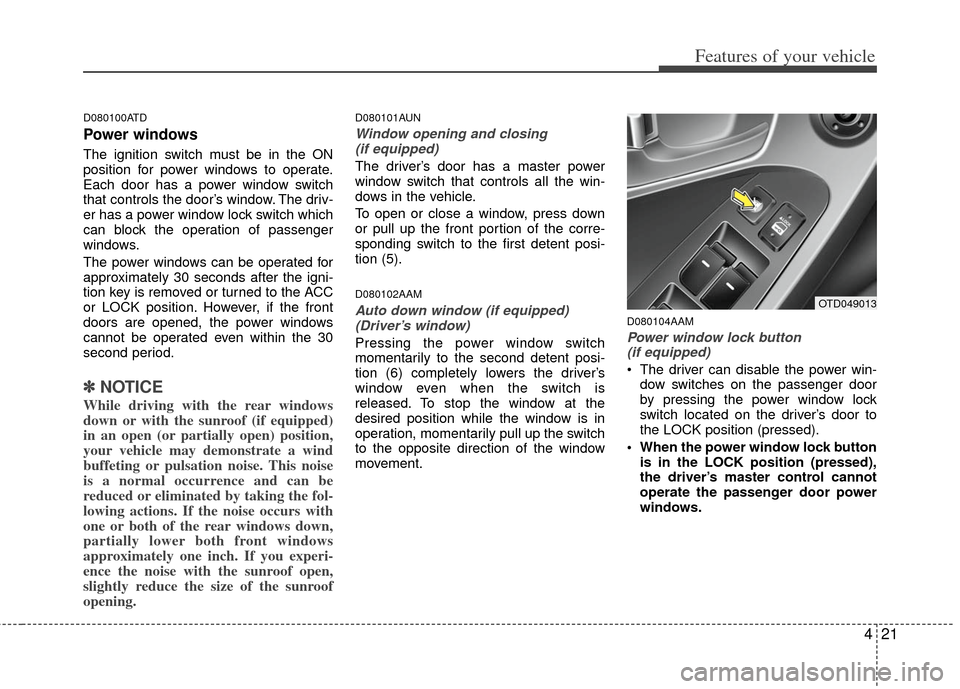
The driver’s door has a master power
window switch that controls all the win-
dows in the vehicle.
To open or close a window, press down
or pull up the front portion of the corre-
sponding switch to the first detent posi-
tion (5).
D080102AAM
Auto down window (if equipped) (Driver’s window)
Pressing the power window switch
momentarily to the second detent posi-
tion (6) completely lowers the driver’s
window even when the switch is
released. To stop the window at the
desired position while the window is in
operation, momentarily pull up the switch
to the opposite direction of the window
movement.
D080104AAM
Power window lock button (if equipped)
The driver can disable the power win-
dow switches on the passenger door
by pressing the power window lock
switch located on the driver’s door to
the LOCK position (pressed).
When the power window lock button is in the LOCK position (pressed),
the driver’s master control cannot
operate the passenger door power
windows.
OTD049013
Page 105 of 353

427
Features of your vehicle
(Continued)
If a fire breaks out during refuel-ing, leave the vicinity of the vehi-
cle, and immediately contact the
manager of the gas station and
then contact the local fire depart-
ment. Follow any safety instruc-
tions they provide.CAUTION
Make sure to refuel your vehicle according to the "Fuel require-ments" suggested in section 1.
If the fuel filler cap requires replacement, use only a genuineKIA cap or the equivalent speci-fied for your vehicle. An incorrect fuel filler cap can result in a seri-ous malfunction of the fuel sys-tem or emission control system.
Do not spill fuel on the exterior surfaces of the vehicle. Any typeof fuel spilled on painted surfacesmay damage the paint.
After refueling, make sure the fuel cap is installed securely to pre-vent fuel spillage in the event ofan accident.