Page 371 of 613

▫Brake Assist System (BAS) .............. 420
▫ Hill Start Assist (HSA) ................ 420
▫ Electronic Roll Mitigation (ERM) ......... 424
▫ Electronic Stability Control (ESC) ......... 425
▫ ESC Activation/Malfunction Indicator Light
And ESC Off Indicator Light ............ 429
▫ Trailer Sway Control (TSC) ............. 430
▫ Hill Descent Control (HDC) – If Equipped . . 431
� Tire Safety Information ................. 432
▫ Tire Markings ....................... 432
▫ Tire Identification Number (TIN) ......... 436
▫ Tire Terminology And Definitions ......... 437
▫ Tire Loading And Tire Pressure .......... 438�
Tires — General Information ............. 443
▫ Tire Pressure ....................... 443
▫ Tire Inflation Pressures ................ 444
▫ Tire Pressures For High-Speed Operation . . . 445
▫ Radial-Ply Tires ..................... 446
▫ Spare Tire Matching Original Equipped Tire
And Wheel – If Equipped .............. 446
▫ Compact Spare Tire – If Equipped ........ 447
▫ Full Size Spare – If Equipped ............ 447
▫ Limited-Use Spare – If Equipped ......... 448
▫ Tire Spinning ....................... 448
▫ Tread Wear Indicators ................. 449
▫ Life Of Tire ........................ 450
5
STARTING AND OPERATING 369
Page 374 of 613

STARTING PROCEDURES
Before starting your vehicle, adjust your seat, adjust both
inside and outside mirrors, and fasten your seat belts.
WARNING!
•When leaving the vehicle, always remove the key
fob from the ignition and lock your vehicle.
•Never leave children alone in a vehicle, or with
access to an unlocked vehicle. Allowing children
to be in a vehicle unattended is dangerous for a
number of reasons. A child or others could be
seriously or fatally injured. Children should be
warned not to touch the parking brake, brake
pedal or the shift lever.
Manual Transmission – If Equipped
Apply the parking brake, place the shift lever in NEU-
TRAL, and press the clutch pedal before starting the
vehicle. This vehicle is equipped with a clutch interlock-
ing ignition system. It will not start unless the clutch
pedal is pressed to the floor.
Four-Wheel Drive Models Only
In 4L mode, this vehicle will start regardless of whether
or not the clutch pedal is pressed to the floor. This feature
enhances off-road performance by allowing the vehicle to
start when in 4L without having to press the clutch pedal.
The “4WD Indicator Light” will illuminate when the
transfer case has been shifted into this mode.
Automatic Transmission – If Equipped
Start the vehicle with the shift lever in the PARK position
(vehicle can also be started in NEUTRAL). Apply the
brake before shifting to any driving range.
372 STARTING AND OPERATING
Page 378 of 613
WARNING!
Remember to disconnect the engine block heater
cord before driving. Damage to the 110-115 Volt AC
electrical cord could cause electrocution.
MANUAL TRANSMISSION — IF EQUIPPED
WARNING!
You or others could be injured if you leave the
vehicle unattended without having the parking
brake fully applied. The parking brake should al-
ways be applied when the driver is not in the vehicle,
especially on an incline.
CAUTION!
Never drive with your foot resting on the clutch
pedal, or attempt to hold the vehicle on a hill with the
clutch pedal partially engaged, as this will cause
abnormal wear on the clutch.
NOTE: During cold weather, you may experience in-
creased effort in shifting until the transmission fluid
warms up. This is normal.
376 STARTING AND OPERATING
Page 380 of 613
Downshifting
Moving from a high gear down to a lower gear is
recommended to preserve brakes when driving down
steep hills. In addition, downshifting at the right time
provides better acceleration when you desire to resume
speed. Downshift progressively. Do not skip gears to
avoid overspeeding the engine and clutch.
WARNING!
Do not downshift for additional engine braking on a
slippery surface. The drive wheels could lose their
grip, and the vehicle could skid.
CAUTION!
When descending a hill, be very careful to downshift
one gear at a time to prevent overspeeding the engine
which can cause valve damage, and/or clutch disc
damage, even if the clutch pedal is pressed.
Maximum Recommended Downshift Speeds
CAUTION!
Failure to follow the maximum recommended down-
shifting speeds may cause the engine to overspeed
and/or damage the clutch disc, even if the clutch
pedal is pressed.
378 STARTING AND OPERATING
Page 382 of 613
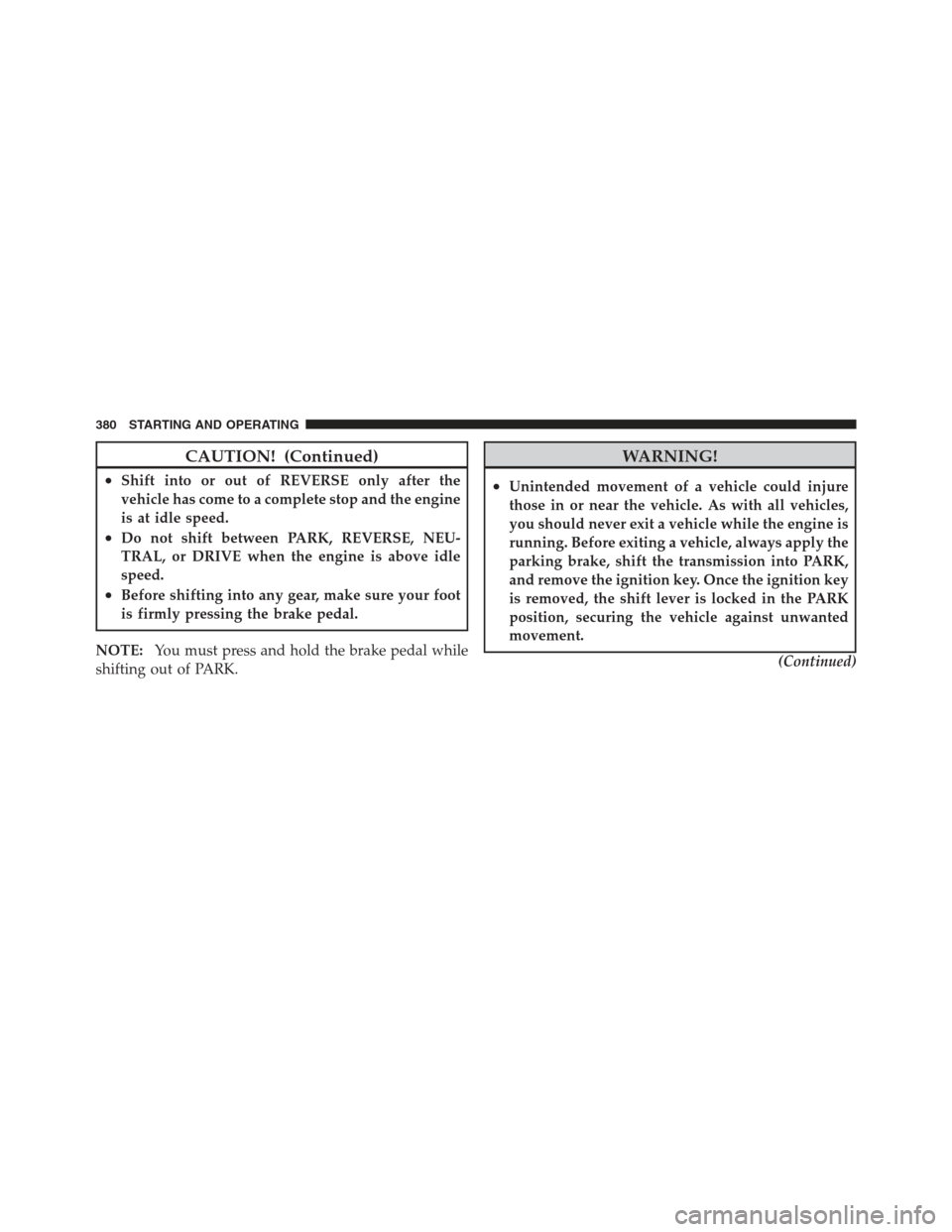
CAUTION! (Continued)
•Shift into or out of REVERSE only after the
vehicle has come to a complete stop and the engine
is at idle speed.
•Do not shift between PARK, REVERSE, NEU-
TRAL, or DRIVE when the engine is above idle
speed.
•Before shifting into any gear, make sure your foot
is firmly pressing the brake pedal.
NOTE: You must press and hold the brake pedal while
shifting out of PARK.
WARNING!
•Unintended movement of a vehicle could injure
those in or near the vehicle. As with all vehicles,
you should never exit a vehicle while the engine is
running. Before exiting a vehicle, always apply the
parking brake, shift the transmission into PARK,
and remove the ignition key. Once the ignition key
is removed, the shift lever is locked in the PARK
position, securing the vehicle against unwanted
movement.
(Continued)
380 STARTING AND OPERATING
Page 383 of 613

WARNING! (Continued)
•When leaving the vehicle, always remove the key
fob from the ignition and lock your vehicle. Never
leave children alone in a vehicle, or with access to
an unlocked vehicle. Allowing children to be in a
vehicle unattended is dangerous for a number of
reasons. A child or others could be seriously or
fatally injured. Children should be warned not to
touch the parking brake, brake pedal or the shift
lever. Do not leave the key in or near the vehicle.
A child could operate power windows, other con-
trols, or move the vehicle.(Continued)
WARNING! (Continued)
•It is dangerous to move the shift lever out of PARK
or NEUTRAL if the engine speed is higher than
idle speed. If your foot is not firmly pressing the
brake pedal, the vehicle could accelerate quickly
forward or in reverse. You could lose control of the
vehicle and hit someone or something. Only shift
into gear when the engine is idling normally and
when your foot is firmly pressing the brake pedal.
Key Ignition Park Interlock
This vehicle is equipped with a Key Ignition Park Inter-
lock which requires the shift lever to be placed in PARK
before the ignition switch can be turned to the LOCK/
OFF position. The key can only be removed from the
ignition when the ignition is in the LOCK/OFF position
and once removed the shift lever is locked in PARK.
5
STARTING AND OPERATING 381
Page 384 of 613

Brake/Transmission Shift Interlock System
This vehicle is equipped with a Brake Transmission Shift
Interlock System (BTSI) that holds the shift lever in the
PARK position unless the brakes are applied. To move
the shift lever out of the PARK position, the ignition
switch must be turned to the ON/RUN position (engine
running or not) and the brake pedal must be pressed.
Five-Speed Automatic Transmission
The shift lever position display (located in the instrument
panel cluster) indicates the transmission gear range. You
must press the brake pedal to move the shift lever out of
the PARK position (refer to “Brake/Transmission Shift
Interlock System” in this section). To drive, move the shift
lever from PARK or NEUTRAL to the DRIVE position.The electronically-controlled transmission provides a
precise shift schedule. The transmission electronics are
self-calibrating; therefore, the first few shifts on a new
vehicle may be somewhat abrupt. This is a normal
condition, and precision shifts will develop within a few
hundred miles (kilometers).
Shifting from DRIVE to PARK or REVERSE should be
done only after the accelerator pedal is released and the
vehicle is stopped. Be sure to keep your foot on the brake
pedal when moving the shift lever between these gears.
382 STARTING AND OPERATING
Page 386 of 613

Gear Ranges
DO NOT race the engine when shifting from PARK or
NEUTRAL into another gear range.
PARK
This range supplements the parking brake by locking the
transmission. The engine can be started in this range.
Never attempt to use PARK while the vehicle is in
motion. Apply the parking brake when leaving the
vehicle in this range.
When parking on a level surface, you may place the shift
lever in the PARK position first, and then apply the
parking brake.
When parking on a hill, apply the parking brake before
placing the shift lever in PARK, otherwise the load on the
transmission locking mechanism may make it difficult to
move the shift lever out of PARK. As an added precau-
tion, turn the front wheels toward the curb on a downhill
grade and away from the curb on an uphill grade.
WARNING!
•Never use the PARK position as a substitute for
the parking brake. Always apply the parking
brake fully when parked to guard against vehicle
movement and possible injury or damage.
•Your vehicle could move and injure you and others
if it is not completely in PARK. Check by trying to
move the shift lever rearward (with the brake
pedal released), after you have placed it in PARK.
Make sure the transmission is in PARK before
leaving the vehicle.(Continued)
384 STARTING AND OPERATING