Page 383 of 558
vehicle. If your vehicle has this option refer to an
authorized tire dealer for the recommended tire rotation
pattern.
If your vehicle is not equipped with an original equip-
ment tire and wheel as a spare, a non-matching tempo-
rary emergency use spare may be equipped with your
vehicle. Temporary use spares are engineered to be used
only with your vehicle. Your vehicle may be equipped
with one of the following types of non-matching tempo-
rary use spares; compact, full size, or limited-use. Do not
install more than one non-matching temporary use spare
tire/wheel on the vehicle at any given time.
CAUTION!
Because of the reduced ground clearance, do not take
your vehicle through an automatic car wash with a
compact, full size or limited-use temporary spare
installed. Damage to the vehicle may result.
Compact Spare Tire – If Equipped
The compact spare is for temporary emergency use only.
You can identify if your vehicle is equipped with a
compact spare by looking at the spare tire description on
the Tire and Loading Information Placard located on the
driver ’s side door opening or on the sidewall of the tire.
Compact spare tire descriptions begin with the letter “T”
or “S” preceding the size designation. Example: T145/
80D18 103M.
T, S = Temporary Spare Tire
Since this tire has limited tread life the original equip-
ment tire should be repaired (or replaced) and reinstalled
on your vehicle at the first opportunity.
Do not install a wheel cover or attempt to mount a
conventional tire on the compact spare wheel, since the
wheel is designed specifically for the compact spare tire.
Do not install more than one compact spare tire and
wheel on the vehicle at any given time.
5
STARTING AND OPERATING 381
Page 407 of 558
CAUTION!
•Damage to the fuel system or emission control
system could result from using an improper fuel
cap (gas cap). A poorly fitting cap could let impu-
rities into the fuel system. Also, a poorly fitting
aftermarket cap can cause the “Malfunction Indi-
cator Light (MIL)” to illuminate, due to fuel vapors
escaping from the system.
•A poorly fitting gas cap may cause the MIL to turn
on.
•To avoid fuel spillage and overfilling, do not “top
off” the fuel tank after filling.
WARNING!
•Never have any smoking materials lit in or near
the vehicle when the gas cap is removed or the
tank is being filled.
•Never add fuel when the engine is running. This is
in violation of most state and federal fire regula-
tions and may cause the MIL to turn on.
•A fire may result if gasoline is pumped into a
portable container that is inside of a vehicle. You
could be burned. Always place gas containers on
the ground while filling.
NOTE:
•When the fuel nozzle “clicks” or shuts off, the fuel
tank is full.
•Tighten the gas cap about one quarter turn until you
hear one click. This is an indication that the cap is
properly tightened.
5
STARTING AND OPERATING 405
Page 410 of 558
capacity conditions, and with no occupants or cargo
loaded into the vehicle. The front and rear curb weight
values are determined by weighing your vehicle on a
commercial scale before any occupants or cargo are
added.
Loading
The actual total weight and the weight of the front and
rear of your vehicle at the ground can best be determined
by weighing it when it is loaded and ready for operation.
The entire vehicle should first be weighed on a commer-
cial scale to ensure that the GVWR has not been ex-
ceeded. The weight on the front and rear of the vehicle
should then be determined separately to be sure that the
load is properly distributed over front and rear axle.
Weighing the vehicle may show that the GAWR of either
the front or rear axles has been exceeded, but the total
load is within the specified GVWR. If so, weight must be
shifted from front to rear, or rear to front, as appropriateuntil the specified weight limitations are met. Store the
heavier items down low and be sure that the weight is
distributed equally. Stow all loose items securely before
driving.
Improper weight distributions can have an adverse affect
on the way your vehicle steers and handles, and the way
the brakes operate.
CAUTION!
Do not load your vehicle any heavier than the GVWR
or the maximum front and rear GAWR. If you do,
parts on your vehicle can break, or it can change the
way your vehicle handles. This could cause you to
lose control. Also, overloading can shorten the life of
your vehicle.
408 STARTING AND OPERATING
Page 424 of 558
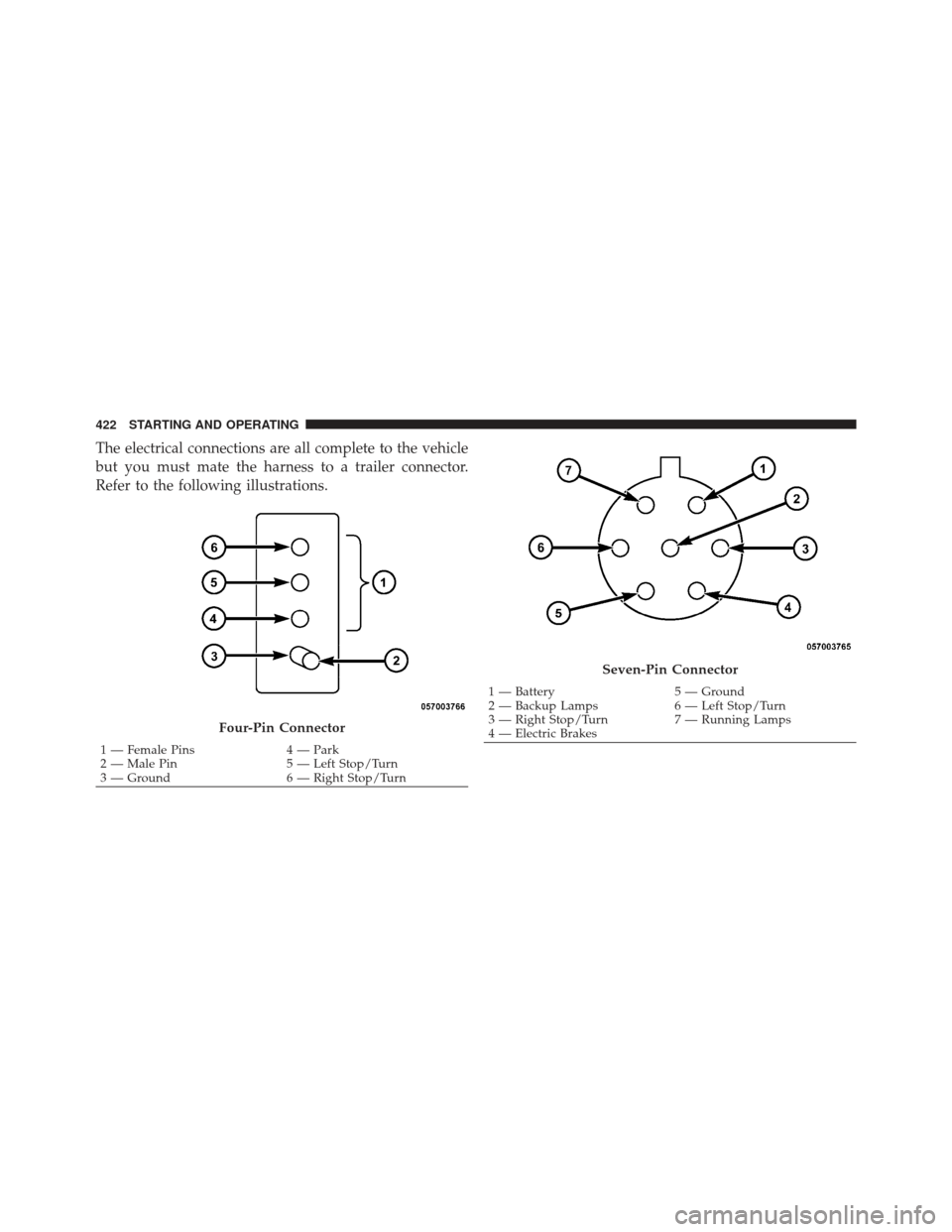
The electrical connections are all complete to the vehicle
but you must mate the harness to a trailer connector.
Refer to the following illustrations.
Four-Pin Connector
1 — Female Pins4 — Park
2 — Male Pin 5 — Left Stop/Turn
3 — Ground 6 — Right Stop/Turn
Seven-Pin Connector
1 — Battery5 — Ground
2 — Backup Lamps 6 — Left Stop/Turn
3 — Right Stop/Turn 7 — Running Lamps
4 — Electric Brakes
422 STARTING AND OPERATING
Page 426 of 558
Cooling System
To reduce potential for engine and transmission over-
heating, take the following actions:
City Driving
When stopped for short periods of time, shift the trans-
mission into NEUTRAL and increase engine idle speed.
Highway Driving
Reduce speed.
Air Conditioning
Turn off temporarily.
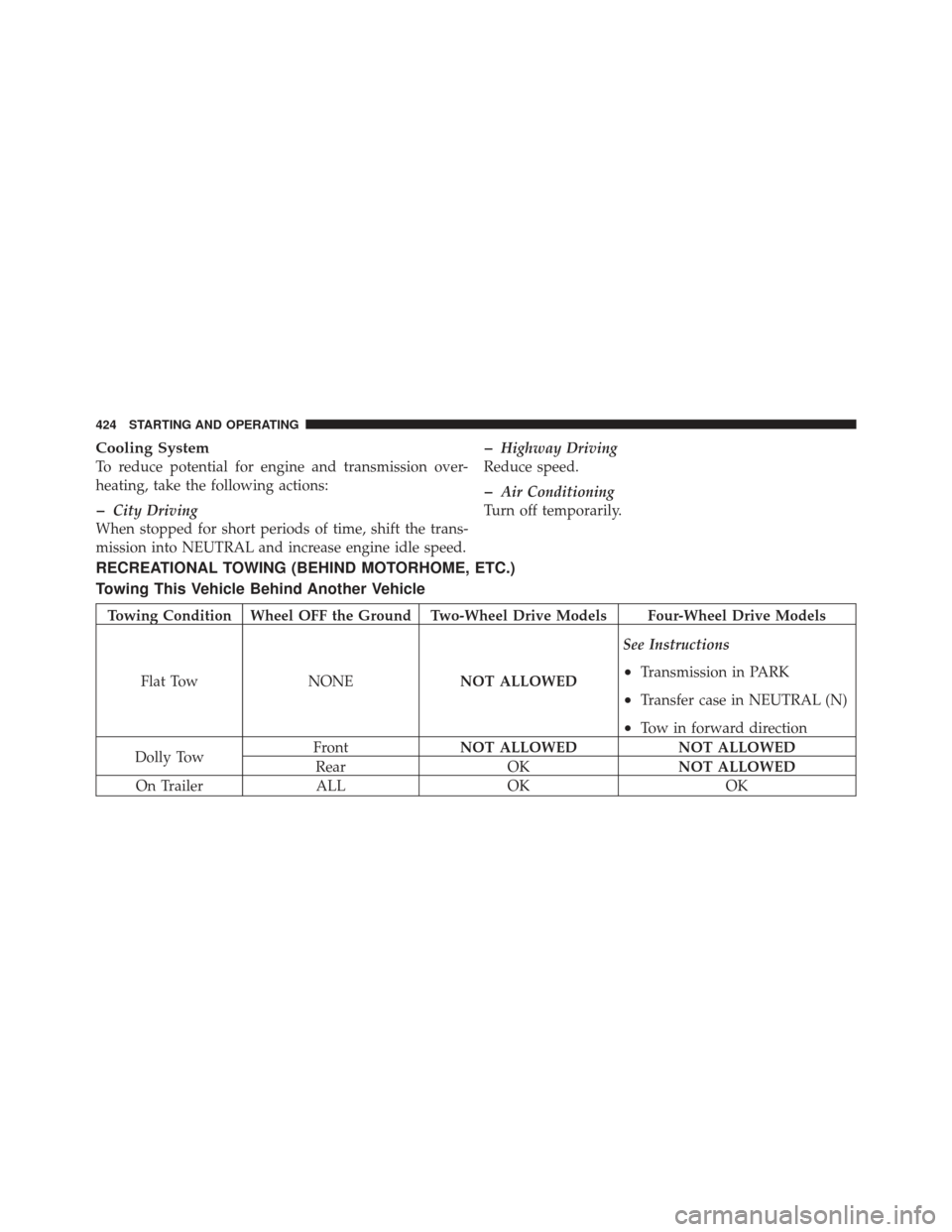
RECREATIONAL TOWING (BEHIND MOTORHOME, ETC.)
Towing This Vehicle Behind Another Vehicle
Towing Condition Wheel OFF the Ground Two-Wheel Drive Models Four-Wheel Drive Models
Flat Tow NONENOT ALLOWED See Instructions
•Transmission in PARK
•Transfer case in NEUTRAL (N)
•Tow in forward direction
Dolly Tow Front
NOT ALLOWED NOT ALLOWED
Rear OKNOT ALLOWED
On Trailer ALL OK OK
424 STARTING AND OPERATING
Page 427 of 558
Recreational Towing — Two-Wheel Drive Models
Recreational towing is allowed ONLY if the rear wheels
areOFF the ground. This may be accomplished using a
tow dolly or vehicle trailer. If using a tow dolly, follow
this procedure:
1. Properly secure the dolly to the tow vehicle, following
the dolly manufacturer’s instructions.
2. Drive the rear wheels onto the tow dolly.
3. Firmly set the parking brake. Place the transmission in
PARK.
4. Properly secure the rear wheels to the dolly, following
the dolly manufacturer’s instructions.
5. Remove the ignition key.
6. Install a suitable clamping device, designed for tow-
ing, to secure the front wheels in the straight position. Flat towing (with all four wheels on the ground) is
allowed ONLY if the driveshaft is removed.
Towing
with the rear wheels on the ground while the driveshaft
is connected will result in severe transmission damage.
WARNING!
If the driveshaft is removed, the vehicle can roll even
if the transmission is in PARK, which could cause
serious injury or death.
The parking brake mustbe firmly engaged and the
wheels chocked during driveshaft removal and installa-
tion. The parking brake must remainengaged unless the
vehicle is securely and properly connected to the tow
vehicle, or the driveshaft is completely reinstalled. See
your authorized dealer for proper driveshaft removal
and reinstallation procedures, including flange
orientation/alignment, use of thread-locking compound,
proper bolt torque specifications, etc.
5
STARTING AND OPERATING 425
Page 428 of 558
CAUTION!
Towing with the rear wheels on the ground (while
the driveshaft is connected) will cause severe trans-
mission damage. Damage from improper towing is
not covered under the New Vehicle Limited War-
ranty.
Recreational Towing — Four-Wheel Drive Models
The transfer case must be shifted into NEUTRAL (N) and
the transmission must be placed in PARK for recreational
towing. The NEUTRAL (N) selection button is adjacent to
the transfer case selector switch. Shifts into and out of
transfer case NEUTRAL (N) can take place with the
selector switch in any mode position.
CAUTION!
•Front or rear wheel lifts should not be used.
Internal damage to the transmission or transfer
case will occur if a front or rear wheel lift is used
when recreational towing.
•Tow only in a forward direction. Towing this
vehicle backwards can cause severe damage to the
transfer case.
•The transmission must be placed in PARK for
recreational towing.
•Before recreational towing, perform the procedure
outlined under “Shifting into NEUTRAL (N)” to
be certain that the transfer case is fully in NEU-
TRAL (N). Otherwise, internal damage will result.
•Failure to follow these procedures can cause se-
vere transmission and/or transfer case damage.(Continued)
426 STARTING AND OPERATING
Page 439 of 558
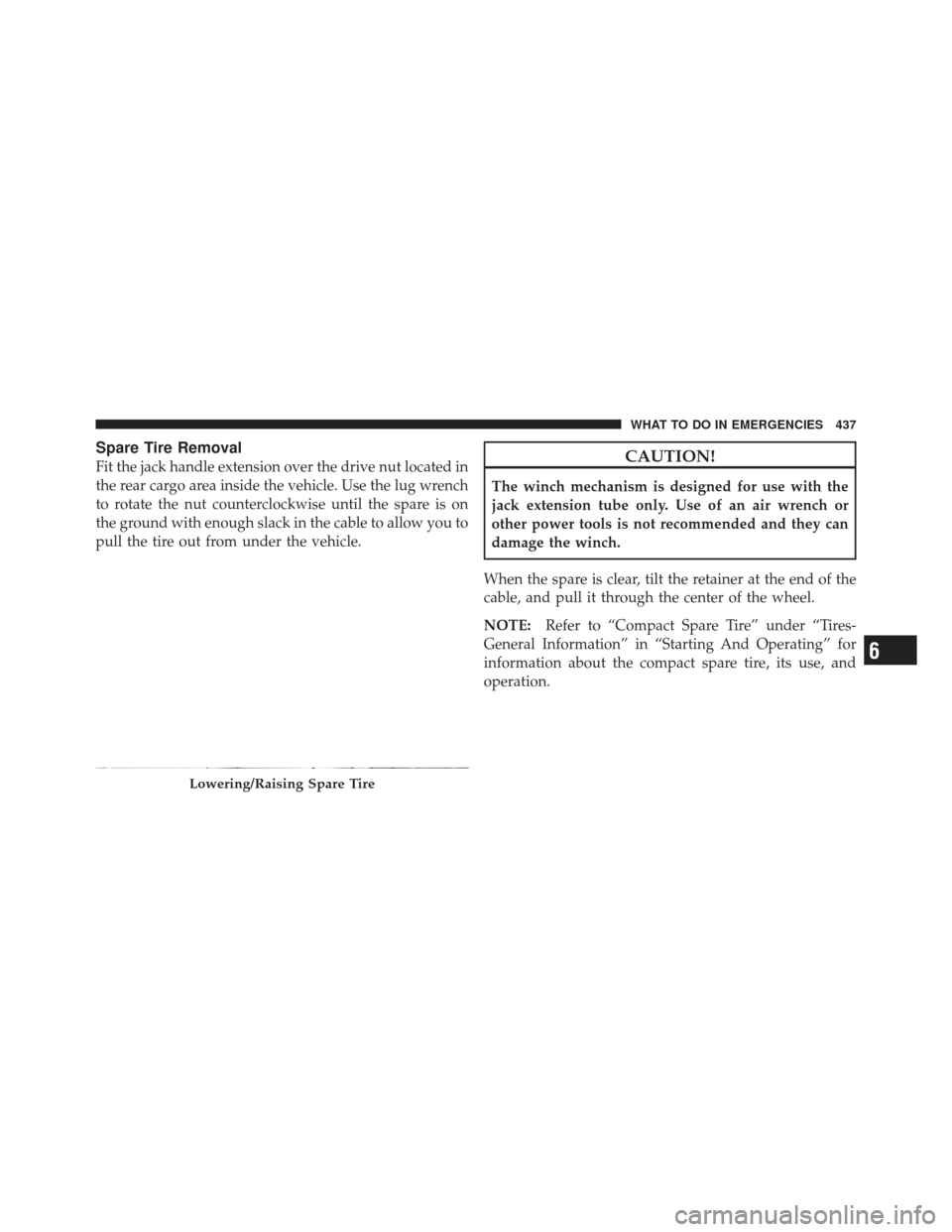
Spare Tire Removal
Fit the jack handle extension over the drive nut located in
the rear cargo area inside the vehicle. Use the lug wrench
to rotate the nut counterclockwise until the spare is on
the ground with enough slack in the cable to allow you to
pull the tire out from under the vehicle.CAUTION!
The winch mechanism is designed for use with the
jack extension tube only. Use of an air wrench or
other power tools is not recommended and they can
damage the winch.
When the spare is clear, tilt the retainer at the end of the
cable, and pull it through the center of the wheel.
NOTE: Refer to “Compact Spare Tire” under “Tires-
General Information” in “Starting And Operating” for
information about the compact spare tire, its use, and
operation.
Lowering/Raising Spare Tire
6
WHAT TO DO IN EMERGENCIES 437