Page 546 of 679

NOTE:
•Steps 1 through 6 are requirements that must be met
prior to pressing the NEUTRAL (N) button, and must
continue to be met until the four seconds elapse and
the shift has been completed. If any of these require-
ments are not met prior to pressing the NEUTRAL (N)
button or are no longer met during the four second
timer, then the NEUTRAL (N) indicator light will flash
continuously until all requirements are met or until the
NEUTRAL (N) button is released.
•The ignition switch must be in the ON/RUN position
for a shift to take place and for the position indicator
lights to be operable. If the ignition switch is not in the
ON/RUN position, the shift will not take place and no
position indicator lights will be on or flashing.
•A flashing NEUTRAL (N) position indicator light
indicates that shift requirements have not been met.
Shifting Out Of NEUTRAL (N)
Use the following procedure to prepare your vehicle for
normal usage.
1. Bring the vehicle to a complete stop, leaving it con-
nected to the tow vehicle.
2. Firmly apply the parking brake.
3. Turn the ignition switch to the ON/RUN position, but
do not start the engine.
4. Press and hold the brake pedal.
5. Shift the transmission into NEUTRAL.
6. Using the point of a ballpoint pen or similar object,
press and hold the recessed transfer case NEUTRAL (N)
button (located by the selector switch) for one second.
544 STARTING AND OPERATING
Page 547 of 679
NOTE:When shifting out of transfer case NEUTRAL
(N), turning the engine OFF may be required to avoid
gear clash.
7. After the NEUTRAL (N) indicator light turns off,
release the NEUTRAL (N) button. 8. After the NEUTRAL (N) button has been released, the
transfer case will shift to the position indicated by the
selector switch.
9. Shift the transmission into PARK.
10. Release the brake pedal.
11. Disconnect vehicle from the tow vehicle.
12. Start the engine.
13. Press and hold the brake pedal.
14. Release the parking brake.
15. Shift the transmission into DRIVE, release the brake
pedal, and check that the vehicle operates normally.
16. The Keyless Enter-N-Go button (if equipped) may
now be reinstalled if desired. Refer to “Starting
Procedures/Keyless Enter-N-Go” in “Starting and Oper-
ating” for further information.
NEUTRAL (N) Switch
5
STARTING AND OPERATING 545
Page 569 of 679
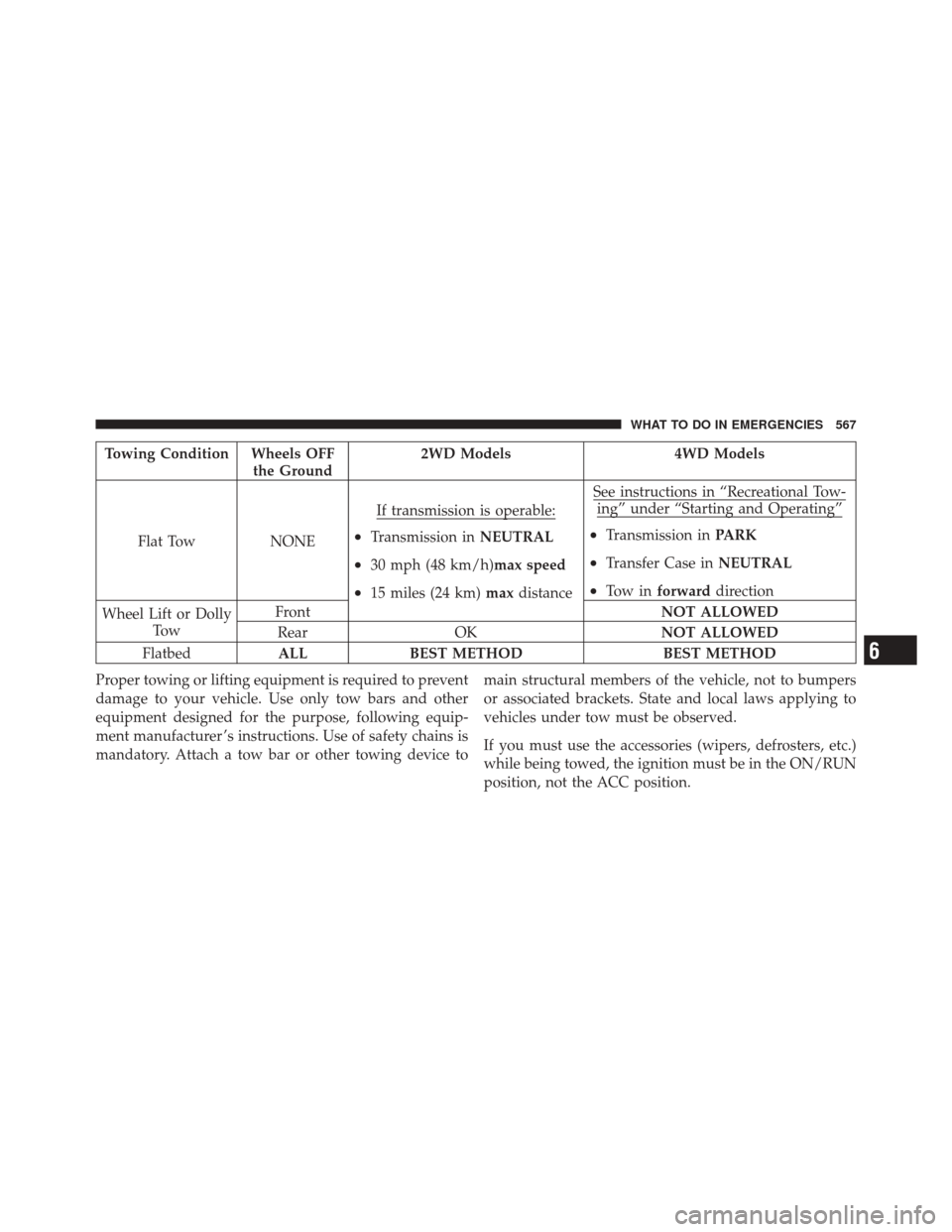
Towing Condition Wheels OFFthe Ground 2WD Models
4WD Models
Flat Tow NONEIf transmission is operable:
•Transmission in
NEUTRAL
•30 mph (48 km/h)max speed
•15 miles (24 km) maxdistance See instructions in “Recreational Tow-
ing” under “Starting and Operating”
•Transmission in
PARK
•Transfer Case in NEUTRAL
•To w i nforward direction
Wheel Lift or Dolly To w Front
NOT ALLOWED
Rear OK NOT ALLOWED
Flatbed ALL BEST METHOD BEST METHOD
Proper towing or lifting equipment is required to prevent
damage to your vehicle. Use only tow bars and other
equipment designed for the purpose, following equip-
ment manufacturer ’s instructions. Use of safety chains is
mandatory. Attach a tow bar or other towing device to main structural members of the vehicle, not to bumpers
or associated brackets. State and local laws applying to
vehicles under tow must be observed.
If you must use the accessories (wipers, defrosters, etc.)
while being towed, the ignition must be in the ON/RUN
position, not the ACC position.
6
WHAT TO DO IN EMERGENCIES 567
Page 571 of 679

If the transmission is not operable, or the vehicle must be
towed faster than 30 mph (48 km/h) or farther than
15 miles (24 km), tow with the rear wheelsOFFthe
ground. Acceptable methods are to tow the vehicle on a
flatbed, or with the front wheels raised and the rear
wheels on a towing dolly, or (when using a suitable
steering wheel stabilizer to hold the front wheels in the
straight position) with the rear wheels raised and the
front wheels on the ground.
Four-Wheel Drive Models
The manufacturer recommends towing with all wheels
OFF the ground. Acceptable methods are to tow the
vehicle on a flatbed or with one end of vehicle raised and
the opposite end on a towing dolly.
If flatbed equipment is not available, and the transfer
case is operable, vehicles with a two-speed transfer case
may be towed (in the forward direction, with ALLwheels
on the ground), IFthe transfer case is in NEUTRAL and the transmission is in
PARK. Refer to “Recreational
Towing” in “Starting And Operating” for detailed in-
structions.
Vehicles equipped with a single-speed transfer case have
no NEUTRAL position, and therefore mustbe towed
with all four wheels OFFthe ground.
CAUTION!
•Front or rear wheel lifts should not be used.
Internal damage to the transmission or transfer
case will occur if a front or rear wheel lift is used
when towing.
•Failure to follow these towing methods can cause
severe damage to the transmission and/or transfer
case. Such damage is not covered by the New
Vehicle Limited Warranty.
6
WHAT TO DO IN EMERGENCIES 569
Page 574 of 679

▫Brake System ....................... 597
▫ Front/Rear Axle Fluid ................. 599
▫ Transfer Case ....................... 600
▫ Automatic Transmission ............... 601
▫ Appearance Care And Protection From
Corrosion .......................... 604
� Fuses .............................. 610
▫ Totally Integrated Power Module ......... 610
� Vehicle Storage ....................... 616
� Replacement Bulbs .................... 616
� Bulb Replacement ..................... 617
▫ High Intensity Discharge Headlamps (HID) –
If Equipped ........................ 617 ▫
Halogen Headlamps – If Equipped ........ 618
▫ Front Turn Signal .................... 618
▫ Front Fog Lamps .................... 619
▫ Rear Tail, Stop, Turn Signal, And Backup
Lamps ............................ 620
▫ Rear Liftgate Mounted Tail Lamp ......... 620
▫ Center High-Mounted Stop Lamp
(CHMSL) .......................... 621
▫ Rear License Lamp ................... 622
� Fluid Capacities ...................... 622
� Fluids, Lubricants, And Genuine Parts ....... 623
▫ Engine ............................ 623
▫ Chassis ........................... 624
572 MAINTAINING YOUR VEHICLE
Page 602 of 679

The front axle fill and drain plugs should be tightened to
22 to 29 ft lbs (30 to 40 N·m).
CAUTION!
Do not over tighten the plugs as it could damage
them and cause them to leak.
Rear Axle Fluid Level Check
The rear axle oil level needs to be between 1/8 in (3 mm)
below the bottom of the fill hole and the bottom of the fill
hole.
The rear axle fill and drain plugs should be tightened to
22 to 29 ft lbs (30 to 40 N·m) on axles with aluminum
housings. The rear axle fill and drain plugs should be
tightened to 22 to 52 ft lbs (30 to 70 N·m) on axles with
cast iron housings.
CAUTION!
Do not over tighten the plugs as it could damage then
and cause them to leak.
Selection Of Lubricant
Use only the manufacturer’s recommended fluid. Refer
to “Fluids, Lubricants, and Genuine Parts” in “Maintain-
ing Your Vehicle” for further information.
Transfer Case
Fluid Level Check
Inspect the transfer case for fluid leaks. If a fluid leak is
found, the transfer case fluid level can be checked by
removing the filler plug located on the back side of the
transfer case. The fluid level should be at the bottom edge
of the filler plug hole when the vehicle is in a level
position.
600 MAINTAINING YOUR VEHICLE
Page 626 of 679

Chassis
ComponentFluid, Lubricant, or Genuine Part
Automatic Transmission MOPAR�ATF+4�Automatic Transmission Fluid or equivalent licensed
ATF+4� product.
Transfer Case – 3.6L Engine Shell Automatic Transmission Fluid 3353 or equivalent.
Transfer Case – 5.7L Engine MOPAR� ATF+4�Automatic Transmission Fluid or equivalent licensed
ATF+4� product.
Axle Differential (Front-Rear) We recommend you use MOPAR� GL-5 Synthetic Axle Lubricant
SAE 75W-85.
Axle Differential (Rear) – 5.7L
Engine With Electronic Limited-Slip
Differential (ELSD) We recommend you use MOPAR�
GL-5 Synthetic Axle Lubricant
SAE 75W-85 with friction modifier additive.
Axle Differential (Rear) – 5.7L
Engine Without Electronic
Limited-Slip Differential (ELSD) We recommend you use MOPAR�
GL-5 Synthetic Axle Lubricant
SAE 75W-85.
Brake Master Cylinder MOPAR�DOT 3 Brake Fluid, SAE J1703 should be used. If DOT 3, SAE
J1703 brake fluid is not available, then DOT 4 is acceptable. Use only rec-
ommended brake fluids or equivalent.
624 MAINTAINING YOUR VEHICLE
Page 634 of 679

24,000 Miles (39,000 km) or
18 Months Maintenance
Service Schedule
❏Change the engine oil and engine oil
filter.
❏ Rotate the tires, rotate at the first sign of
irregular wear, even if it occurs before
24,000 miles (39 000 km).
❏ Inspect the CV joints.
❏ Inspect exhaust system.
❏ Inspect the front and rear axle fluid,
change if using your vehicle for police,
taxi, fleet, off-road or frequent trailer
towing.
Odometer Reading Date
Repair Order #Dealer Code
Signature, Authorized Service Center
32,000 Miles (52,000 km) or 24 Months Maintenance Service
Schedule
❏Change the engine oil and engine oil filter.
❏ Rotate the tires, rotate at the first sign of irregular wear, even if it occurs before
32,000 miles (52 000 km).
❏ Replace the engine air cleaner filter.
❏ Replace the air conditioning filter.
❏ Replace the spark plugs (5.7L Engine).
❏ Adjust parking brake on vehicles equipped with four-wheel disc brakes.
❏ Inspect the transfer case fluid.
❏ Inspect the brake linings, replace if necessary.
❏ Inspect the front suspension, tie rod ends and boot seals for cracks or leaks and all parts for
damage, wear, improper looseness or end play; replace if necessary.
Odometer Reading Date
Repair Order #Dealer Code
Signature, Authorized Service Center
8
M
A I
N T
E
N A
N CE
S
C
H E
D
U L
E
S632 MAINTENANCE SCHEDULES
