Page 558 of 679
6. Raise the vehicle by turning the jack screw clockwise.
Raise the vehicle only until the tire just clears the surface
and enough clearance is obtained to install the spare tire.
Minimum tire lift provides maximum stability.
WARNING!
Raising the vehicle higher than necessary can make
the vehicle less stable. It could slip off the jack and
hurt someone near it. Raise the vehicle only enough
to remove the tire.
7. Remove the lug nuts and wheel.
8. Position the spare wheel/tire on the vehicle and install
the lug nuts with the cone-shaped end toward the wheel.
Lightly tighten the nuts.
CAUTION!
Be sure to mount the spare tire with the valve stem
facing outward. The vehicle could be damaged if the
spare tire is mounted incorrectly.
Rear Jacking Location
556 WHAT TO DO IN EMERGENCIES
Page 560 of 679
12. Remove the small center cap and securely store the
road wheel in the cargo area.
13. Have the aluminum road wheel and tire repaired as
soon as possible, properly secure the spare tire with the
special wing nut torqued to 3.7 ft-lbs (5 N·m), reinstall the
jack and tool kit foam tray, and latch the rear load floor
cover.WARNING!
A loose tire or jack, thrown forward in a collision or
hard stop could endanger the occupants of the ve-
hicle. Always stow the jack parts and the spare tire in
the places provided. Have the deflated (flat) tire
repaired or replaced immediately.
Road Tire Installation
1. Mount the road tire on the axle.
2. Install the remaining lug nuts with the cone shaped
end of the nut toward the wheel. Lightly tighten the lug
nuts.
Stowed Spare
558 WHAT TO DO IN EMERGENCIES
Page 566 of 679

CAUTION!
•When “rocking” a stuck vehicle by moving be-
tween DRIVE and REVERSE, do not spin the
wheels faster than 15 mph (24 km/h), or drivetrain
damage may result.
•Revving the engine or spinning the wheels too fast
may lead to transmission overheating and failure.
It can also damage the tires. Do not spin the
wheels above 30 mph (48 km/h) while in gear (no
transmission shifting occurring).
WARNING!
Fast spinning tires can be dangerous. Forces gener-
ated by excessive wheel speeds may cause damage, or
even failure, of the axle and tires. A tire could
explode and injure someone. Do not spin your vehi-
cle’s wheels faster than 30 mph (48 km/h) or for
longer than 30 seconds continuously without stop-
ping when you are stuck and do not let anyone near
a spinning wheel, no matter what the speed.
EMERGENCY TOW HOOKS — IF EQUIPPED
If your vehicle is equipped with tow hooks, there will be
one in the rear and two mounted on the front of the
vehicle. The rear hook will be located on the driver’s side
of the vehicle.
NOTE:For off-road recovery, it is recommended to use
both of the front tow hooks to minimize the risk of
damage to the vehicle.
564 WHAT TO DO IN EMERGENCIES
Page 567 of 679
WARNING!
•Chains are not recommended for freeing a stuck
vehicle. Chains may break, causing serious injury
or death.
•Stand clear of vehicles when pulling with tow
hooks. Tow straps may become disengaged, caus-
ing serious injury.
CAUTION!
Tow hooks are for emergency use only, to rescue a
vehicle stranded off road. Do not use tow hooks for
tow truck hookup or highway towing. You could
damage your vehicle.
SHIFT LEVER OVERRIDE
If a malfunction occurs and the shift lever cannot be
moved out of the PARK position, you can use the
following procedure to temporarily move the shift lever:
1. Firmly apply the parking brake.
2. Turn the engine OFF.
3. Remove the rubber liner from the cupholder (located
next to the shifter on the center console).
6
WHAT TO DO IN EMERGENCIES 565
Page 568 of 679

4. Using a screwdriver or similar tool, carefully remove
the shift lever override access cover, located on the
bottom of the cupholder.
5. Press and maintain firm pressure on the brake pedal.
6. Using the screwdriver or similar tool, press and hold
the shift lock lever down.
7. Move the shift lever to the NEUTRAL position.8. The vehicle may then be started in NEUTRAL.
9. Reinstall the shift lever override access cover and
install the rubber liner into the cupholder.
TOWING A DISABLED VEHICLE
This section describes procedures for towing a disabled
vehicle using a commercial wrecker service. If the trans-
mission and drivetrain are operable, disabled vehicles
may also be towed as described under “Recreational
Towing” in the “Starting and Operating” section.
NOTE:
Vehicles equipped with Quadra-Lift™ must be
lowered to the Park (lowest) level, and have automatic
leveling disabled, before tying them down (from the
body) on a trailer or flatbed truck. Refer to the section on
Quadra-Lift™ for more information. If the vehicle cannot
be lowered to the Park level (for example, engine will not
run), tie-downs must be fastened to the axles (not to the
body). Failure to follow these instructions may cause fault
codes to be set and/or loss of proper tie-down tension.
Shift Lever Override Access Cover
566 WHAT TO DO IN EMERGENCIES
Page 569 of 679
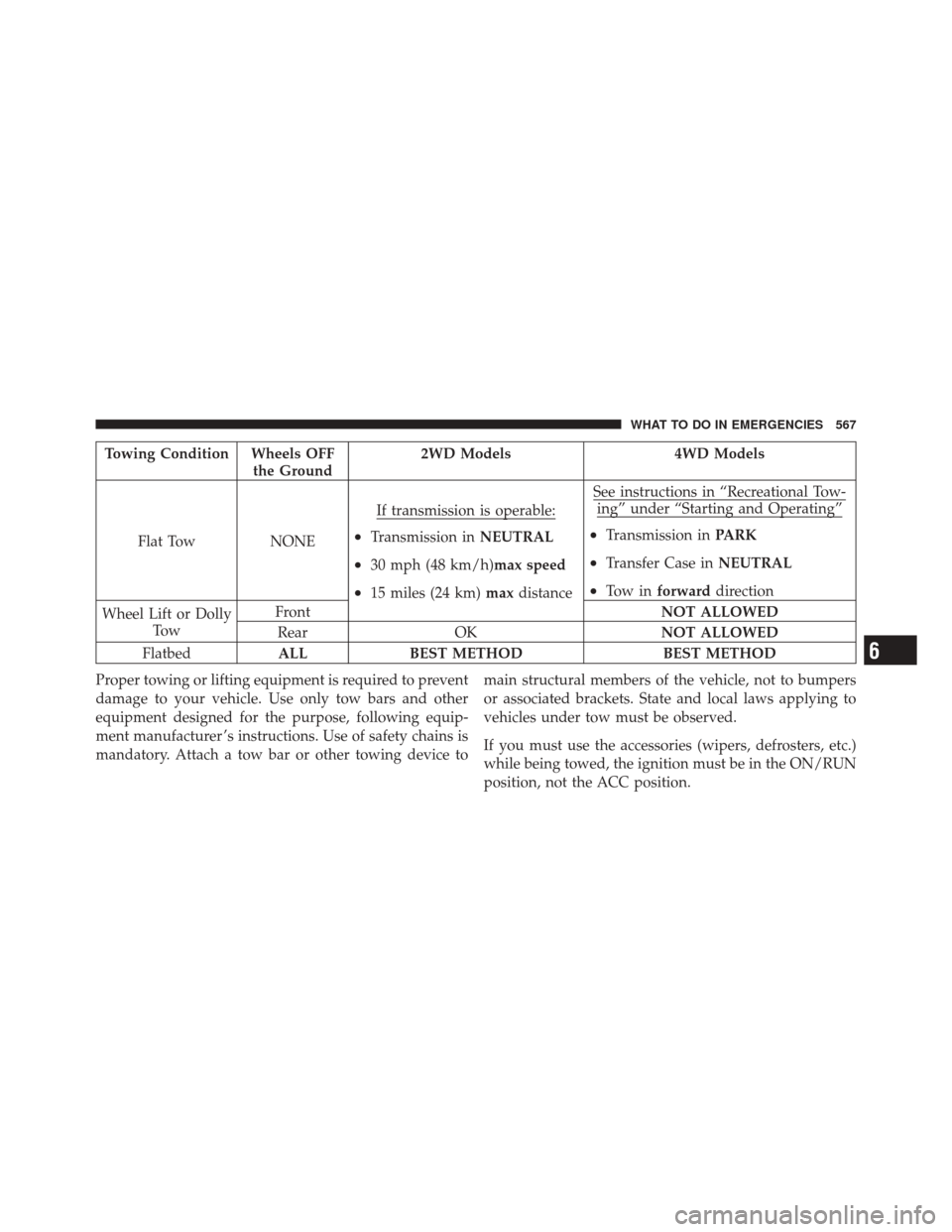
Towing Condition Wheels OFFthe Ground 2WD Models
4WD Models
Flat Tow NONEIf transmission is operable:
•Transmission in
NEUTRAL
•30 mph (48 km/h)max speed
•15 miles (24 km) maxdistance See instructions in “Recreational Tow-
ing” under “Starting and Operating”
•Transmission in
PARK
•Transfer Case in NEUTRAL
•To w i nforward direction
Wheel Lift or Dolly To w Front
NOT ALLOWED
Rear OK NOT ALLOWED
Flatbed ALL BEST METHOD BEST METHOD
Proper towing or lifting equipment is required to prevent
damage to your vehicle. Use only tow bars and other
equipment designed for the purpose, following equip-
ment manufacturer ’s instructions. Use of safety chains is
mandatory. Attach a tow bar or other towing device to main structural members of the vehicle, not to bumpers
or associated brackets. State and local laws applying to
vehicles under tow must be observed.
If you must use the accessories (wipers, defrosters, etc.)
while being towed, the ignition must be in the ON/RUN
position, not the ACC position.
6
WHAT TO DO IN EMERGENCIES 567
Page 570 of 679

If the vehicle’s battery is discharged, refer to “Shift Lever
Override” in “What to Do in Emergencies” for instruc-
tions on shifting the automatic transmission out of the
PARK position for towing.
CAUTION!
Do not attempt to use sling type equipment when
towing. When securing the vehicle to a flat bed truck,
do not attach to front or rear suspension components.
Damage to your vehicle may result from improper
towing.
Towing Without The Ignition Key Fob
Special care must be taken when the vehicle is towed
with the ignition in the LOCK/OFF position. The only
approved method of towing without the ignition key is
with a flatbed truck. Proper towing equipment is neces-
sary to prevent damage to the vehicle.
Two-Wheel Drive Models
The manufacturer recommends towing your vehicle with
all four wheelsOFFthe ground using a flatbed.
If flatbed equipment is not available, and the transmis-
sion is operable, the vehicle may be towed (with rear
wheels on the ground) with the transmission in NEU-
TRAL. Speed must not exceed 30 mph (48 km/h) and the
distance must not exceed 15 miles (24 km).
CAUTION!
Towing faster than 30 mph (48 km/h) or farther than
15 miles (24 km) with rear wheels on the ground can
cause severe damage to the transmission. Such dam-
age is not covered by the New Vehicle Limited
Warranty.
568 WHAT TO DO IN EMERGENCIES
Page 571 of 679

If the transmission is not operable, or the vehicle must be
towed faster than 30 mph (48 km/h) or farther than
15 miles (24 km), tow with the rear wheelsOFFthe
ground. Acceptable methods are to tow the vehicle on a
flatbed, or with the front wheels raised and the rear
wheels on a towing dolly, or (when using a suitable
steering wheel stabilizer to hold the front wheels in the
straight position) with the rear wheels raised and the
front wheels on the ground.
Four-Wheel Drive Models
The manufacturer recommends towing with all wheels
OFF the ground. Acceptable methods are to tow the
vehicle on a flatbed or with one end of vehicle raised and
the opposite end on a towing dolly.
If flatbed equipment is not available, and the transfer
case is operable, vehicles with a two-speed transfer case
may be towed (in the forward direction, with ALLwheels
on the ground), IFthe transfer case is in NEUTRAL and the transmission is in
PARK. Refer to “Recreational
Towing” in “Starting And Operating” for detailed in-
structions.
Vehicles equipped with a single-speed transfer case have
no NEUTRAL position, and therefore mustbe towed
with all four wheels OFFthe ground.
CAUTION!
•Front or rear wheel lifts should not be used.
Internal damage to the transmission or transfer
case will occur if a front or rear wheel lift is used
when towing.
•Failure to follow these towing methods can cause
severe damage to the transmission and/or transfer
case. Such damage is not covered by the New
Vehicle Limited Warranty.
6
WHAT TO DO IN EMERGENCIES 569


