Page 293 of 497

�Tires — General Information ............. 336
▫ Tire Pressure ....................... 336
▫ Tire Inflation Pressures ................ 337
▫ Tire Pressures For High Speed Operation . . . 339
▫ Radial Ply Tires ..................... 339
▫ Spare Tire Matching Original Equipped Tire
And Wheel – If Equipped .............. 339
▫ Compact Spare Tire – If Equipped ........ 340
▫ Full Size Spare – If Equipped ............ 341
▫ Limited-Use Spare – If Equipped ......... 341
▫ Tire Spinning ....................... 342
▫ Tread Wear Indicators ................. 342
▫ Life Of Tire ........................ 343 ▫
Replacement Tires .................... 344
� Tire Chains .......................... 346
� Snow Tires .......................... 346
� Tire Rotation Recommendations ........... 346
� Tire Pressure Monitoring System (TPMS) ..... 348
▫ Base System ........................ 350
▫ Premium System – If Equipped .......... 352
▫ General Information .................. 356
� Fuel Requirements ..................... 357
▫ 2.0L And 2.4L Engine ................. 357
▫ Reformulated Gasoline ................ 357
▫ Gasoline/Oxygenate Blends ............. 358
▫ E-85 Usage In Non-Flex Fuel Vehicles ...... 358
5
STARTING AND OPERATING 291
Page 294 of 497
▫MMT In Gasoline .................... 359
▫ Materials Added To Fuel ............... 359
▫ Fuel System Cautions ................. 359
▫ Carbon Monoxide Warnings ............ 360
� Adding Fuel ......................... 361
▫ Fuel Filler Cap (Gas Cap) .............. 361
▫ Loose Fuel Filler Cap Message ........... 363
� Vehicle Loading ...................... 363
▫ Vehicle Certification Label .............. 363�
Trailer Towing ........................ 365
▫ Common Towing Definitions ............ 365
▫ Trailer Hitch Classification .............. 368
▫ Trailer Towing Weights
(Maximum Trailer Weight Ratings) ........ 369
▫ Trailer And Tongue Weight ............. 370
▫ Towing Requirements ................. 371
▫ Towing Tips ........................ 376
� Recreational Towing
(Behind Motorhome, Etc.) ................ 377
292 STARTING AND OPERATING
Page 296 of 497
Automatic Transmission – If Equipped
The shift lever must be in the PARK or NEUTRAL
position before you can start the engine. Apply the brakes
before shifting to any driving gear.
NOTE:You must press the brake pedal before shifting
out of PARK.
Tip Start
Do not press the accelerator. Turn the ignition switch to
the START position and release it as soon as the starter
engages. The starter motor will continue to run, and it
will disengage automatically when the engine is running.
If the engine fails to start, the starter will disengage
automatically in 10 seconds. If this occurs, turn the
ignition switch to the LOCK position, wait 10 to 15 sec-
onds, then repeat the “Normal Starting” procedure.
Normal Starting
Normal starting of either a cold or a warm engine does
not require pumping or pressing the accelerator pedal. Simply turn the ignition switch to the START position
and release when the engine starts. If the engine fails to
start within 15 seconds, turn the ignition switch to the
OFF position, wait 10 to 15 seconds, then repeat the
“Normal Starting” procedure.
WARNING!
Do not attempt to push or tow your vehicle to get it
started. Vehicles equipped with an automatic trans-
mission cannot be started this way. Unburned fuel
could enter the catalytic converter and once the
engine has started, ignite and damage the converter
and vehicle. If the vehicle has a discharged battery,
booster cables may be used to obtain a start from
another vehicle. This type of start can be dangerous if
done improperly, so follow the procedure carefully.
Refer to “Jump Starting” in “What To Do In Emer-
gencies” for further information.
294 STARTING AND OPERATING
Page 297 of 497

Extreme Cold Weather (Below –20°F or�29°C)
To ensure reliable starting at these temperatures, use of
an externally powered electric engine block heater (avail-
able from your authorized dealer) is recommended.
If Engine Fails To Start
If the engine fails to start after you have followed the
“Normal Starting” and “Extreme Cold Weather” proce-
dures, it may be flooded. Push the accelerator pedal all
the way to the floor and hold it there. Crank the engine
for no more than 15 seconds. This should clear any excess
fuel in case the engine is flooded. Leave the ignition key
in the ON position, release the accelerator pedal and
repeat the “Normal Starting” procedure.
WARNING!
Never pour fuel or other flammable liquid into the
throttle body air inlet opening in an attempt to start
the vehicle. This could result in flash fire causing
serious personal injury.
CAUTION!
To prevent damage to the starter, do not crank the
engine for more than 15 seconds at a time. Wait 10 to
15 seconds before trying again.
After Starting
The idle speed will automatically decrease as the engine
warms up.
5
STARTING AND OPERATING 295
Page 300 of 497
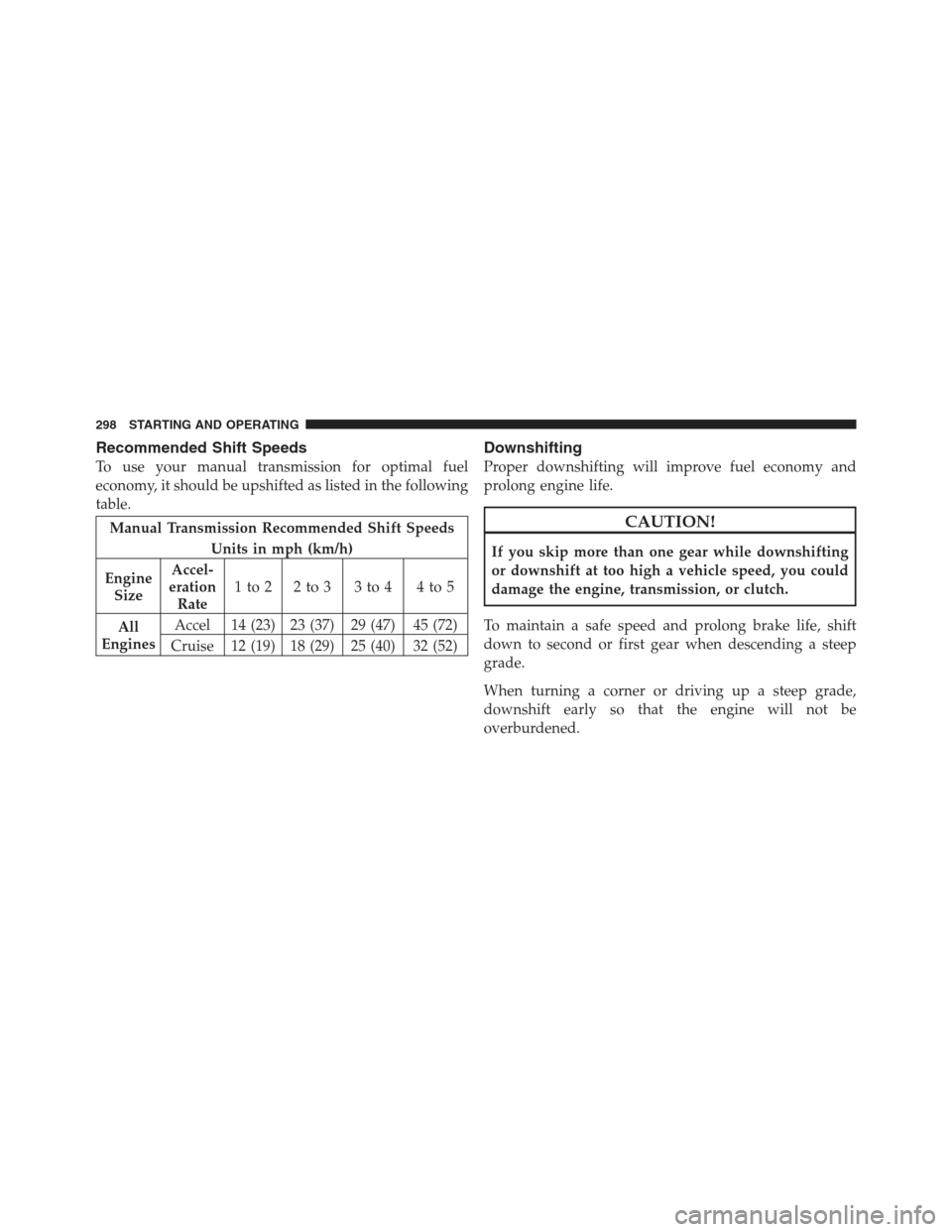
Recommended Shift Speeds
To use your manual transmission for optimal fuel
economy, it should be upshifted as listed in the following
table.
Manual Transmission Recommended Shift SpeedsUnits in mph (km/h)
Engine Size Accel-
eration Rate 1to2 2to3 3to4 4to5
All
Engines Accel 14 (23) 23 (37) 29 (47) 45 (72)
Cruise 12 (19) 18 (29) 25 (40) 32 (52)
Downshifting
Proper downshifting will improve fuel economy and
prolong engine life.
CAUTION!
If you skip more than one gear while downshifting
or downshift at too high a vehicle speed, you could
damage the engine, transmission, or clutch.
To maintain a safe speed and prolong brake life, shift
down to second or first gear when descending a steep
grade.
When turning a corner or driving up a steep grade,
downshift early so that the engine will not be
overburdened.
298 STARTING AND OPERATING
Page 307 of 497

CAUTION!
Towing the vehicle, coasting, or driving for any other
reason with the transmission in NEUTRAL can result
in severe transmission damage. Refer to “Recre-
ational Towing” in “Starting And Operating” and
“Towing A Disabled Vehicle” in What To Do In
Emergencies” for further information.
DRIVE
This range should be used for most city and highway
driving. It provides the best fuel economy. The DRIVE
position provides optimum driving characteristics under
all normal operating conditions.
When frequent transmission shifting occurs (such as
when operating the vehicle under heavy loading condi-
tions, in hilly terrain, traveling into strong head winds, or
while towing heavy trailers), use the AutoStick�mode (if
equipped) to select a lower gear. Under these conditions, using a lower gear will improve performance and extend
transmission life by reducing excessive shifting and heat
buildup.
During sustained high speed driving or trailer towing up
long grades on hot days, the automatic transmission oil
may become too hot. If this happens, the transmission
overheat indicator light will come on, and the vehicle will
slow slightly until the transmission cools down enough
to allow a return to the requested speed. This is done to
prevent transmission damage due to overheating. If the
high speed is maintained, the overheating may reoccur,
as before, in a cyclic fashion.
LOW – IF EQUIPPED
This range should be used for engine braking when
descending very steep grades. In this range, the trans-
mission will downshift for maximum engine braking,
and upshifts will occur only to prevent engine overspeed.
5
STARTING AND OPERATING 305
Page 339 of 497

WARNING! (Continued)
•Unequal tire pressures from one side of the ve-
hicle to the other can cause the vehicle to drift to
the right or left.
•Always drive with each tire inflated to the recom-
mended cold tire inflation pressure.
Economy
Improper inflation pressures can cause uneven wear
patterns to develop across the tire tread. These abnormal
wear patterns will reduce tread life resulting in a need for
earlier tire replacement. Under-inflation also increases
tire rolling resistance resulting in higher fuel
consumption.
Ride Comfort And Vehicle Stability
Proper tire inflation contributes to a comfortable ride.
Over-inflation produces a jarring and uncomfortable
ride.
Tire Inflation Pressures
The proper cold tire inflation pressure is listed on the left
side “B” Pillar or rear edge of the driver’s side door.
Some vehicles may have Supplemental Tire Pressure
Information for vehicle loads that are less than the
maximum loaded vehicle condition. These pressure con-
ditions will be found in the “Supplemental Tire Pressure
Information” section of this manual.
The pressure should be checked and adjusted as well as
inspecting for signs of tire wear or visible damage at least
once a month. Use a good quality pocket-type gauge to
check tire pressure. Do not make a visual judgement
when determining proper inflation. Radial tires may look
properly inflated even when they are under-inflated.
5
STARTING AND OPERATING 337
Page 352 of 497

NOTE:
•The TPMS is not intended to replace normal tire care
and maintenance or to provide warning of a tire failure
or condition.
•The TPMS should not be used as a tire pressure gauge
while adjusting your tire pressure.
•Driving on a significantly under-inflated tire causes
the tire to overheat and can lead to tire failure.
Under-inflation also reduces fuel efficiency and tire
tread life, and may affect the vehicle’s handling and
stopping ability.
•The TPMS is not a substitute for proper tire mainte-
nance, and it is the driver ’s responsibility to maintain
correct tire pressure using an accurate tire gauge, even
if under-inflation has not reached the level to trigger
illumination of the Tire Pressure Monitoring Telltale
Light.
•Seasonal temperature changes will affect tire pressure,
and the TPMS will monitor the actual tire pressure in
the tire.
Base System
This is the TPMS warning indicator located in the
instrument cluster.
The TPMS uses wireless technology with wheel rim
mounted electronic sensors to monitor tire pressure lev-
els. Sensors, mounted to each wheel as part of the valve
stem, transmit tire pressure readings to the Receiver
Module.
NOTE: It is particularly important for you to check the
tire pressure in all of the tires on your vehicle regularly
and to maintain the proper pressure.
The TPMS consists of the following components:
•Receiver Module
350 STARTING AND OPERATING