Page 308 of 429
Always use saf ety chains when you
tow a trailer. Make sure the chains
are secured to the trailer and hitch,
and that they cross under the tongue
and can catch the trailer if it
becomes unhitched. Leave enough
slack to allow the trailer to turn
corners easily, but do not let the
chains drag on the ground.When towing a trailer, we
recommend that you carry a f ull-size
spare wheel and tire for your vehicle
and trailer. See page f or proper
tire size, page f or how to store a
full size wheel and tire, and page
f or inf ormation on changing a
flat tire.
Remember to unhitch the trailer
bef ore changing a f lat. Ask your
trailer sales or rental agency where
and how to store the trailer
Page 309 of 429
�´
Trailer lights and equipment must
comply with f ederal, state, province/
territory, and local regulations.
Check trailer light requirements f or
the areas where you plan to tow, and
use only equipment designed f or
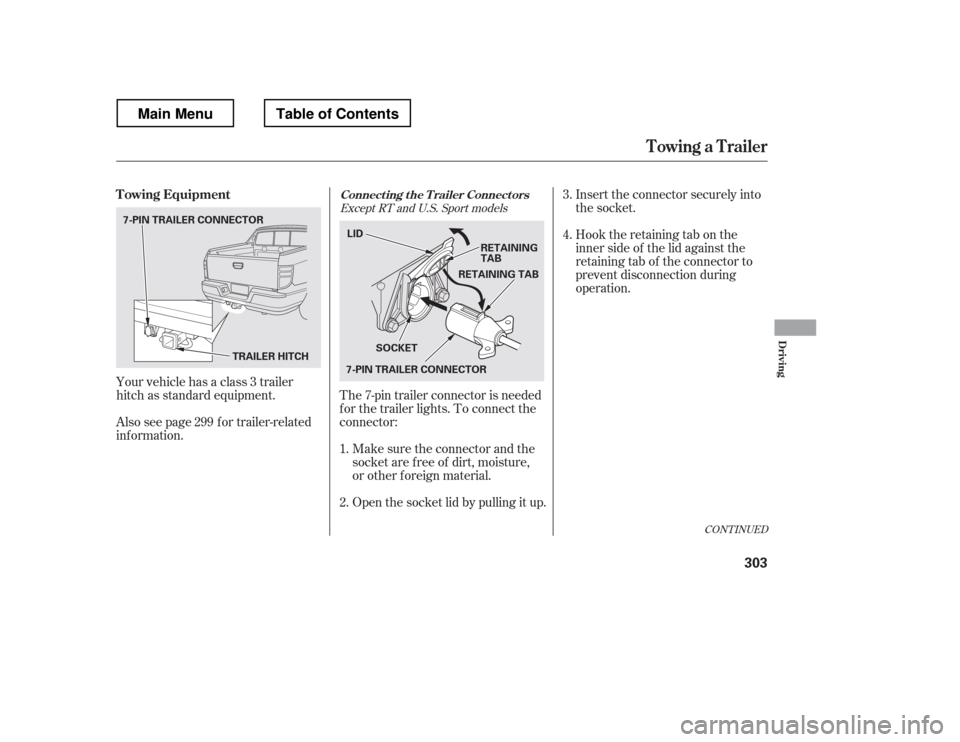
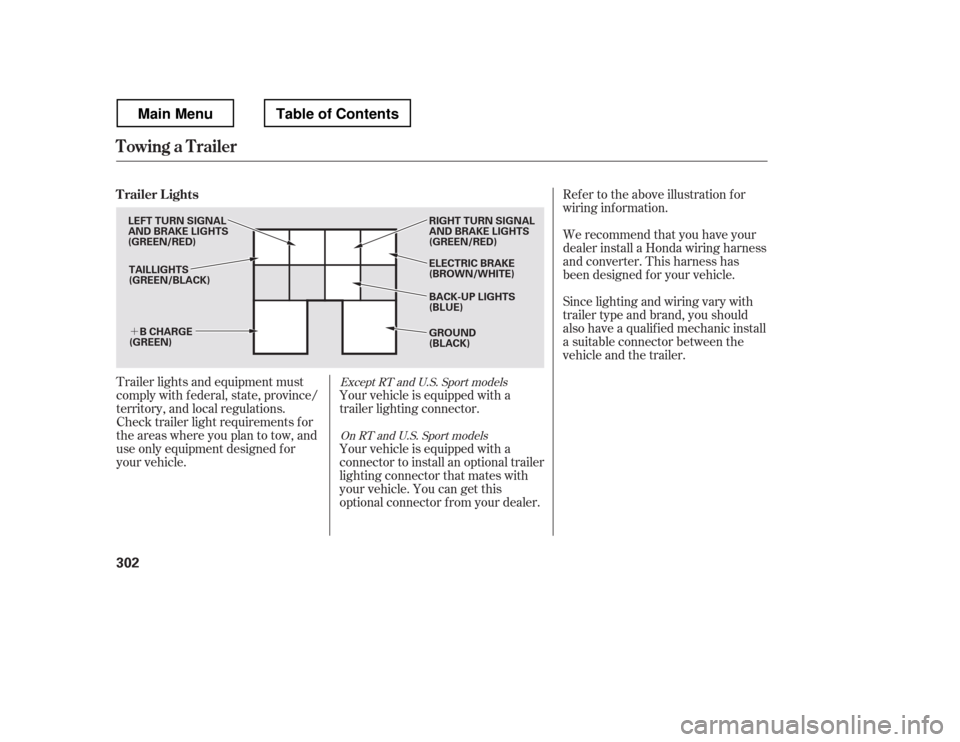
your vehicle.Ref er to the above illustration f or
wiring inf ormation.
We recommend that you have your
dealer install a Honda wiring harness
and converter. This harness has
been designed f or your vehicle.
Your vehicle is equipped with a
trailer lighting connector.
Your vehicle is equipped with a
connector to install an optional trailer
lighting connector that mates with
your vehicle. You can get this
optional connector f rom your dealer. Since lighting and wiring vary with
trailer type and brand, you should
also have a qualif ied mechanic install
a suitable connector between the
vehicle and the trailer.Except RT and U.S. Sport models
On RT and U.S. Sport models
Trailer Lights
Towing a Trailer
302
TAILLIGHTS
(GREEN/BLACK) ELECTRIC BRAKE
(BROWN/WHITE)
RIGHT TURN SIGNAL
AND BRAKE LIGHTS
(GREEN/RED) GROUND
(BLACK)
B CHARGE
(GREEN)
LEFT TURN SIGNAL
AND BRAKE LIGHTS
(GREEN/RED)
BACK-UP LIGHTS
(BLUE)
Main MenuTable of Contents
Page 310 of 429
CONT INUED
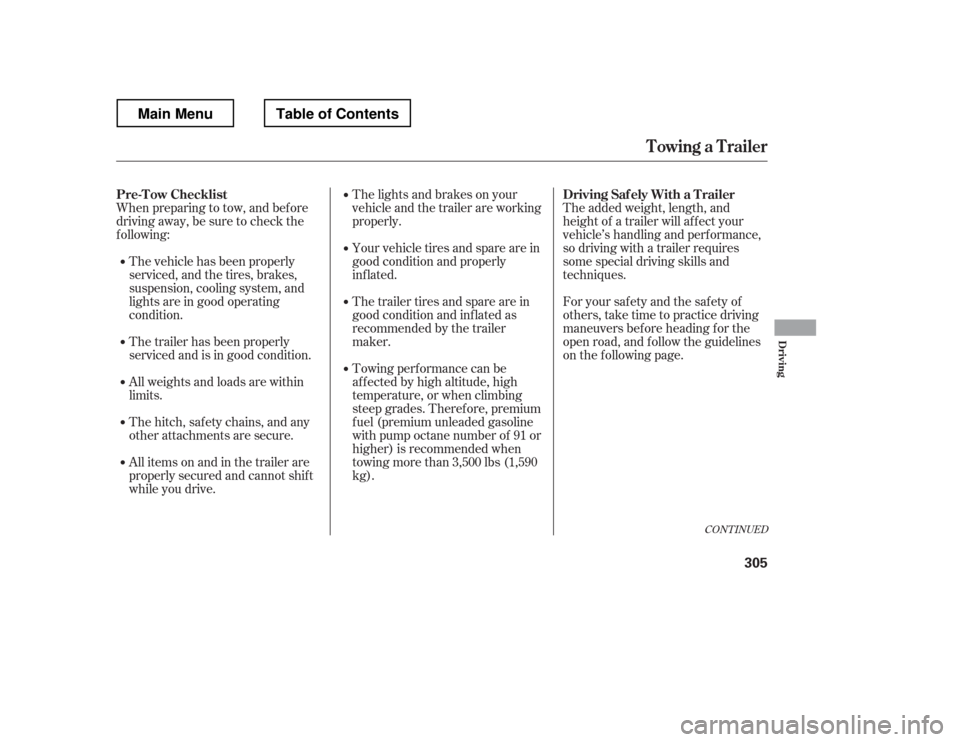
Insert the connector securely into
the socket.
Hook the retaining tab on the
inner side of the lid against the
retaining tab of the connector to
prevent disconnection during
operation.
Your vehicle has a class 3 trailer
hitch as standard equipment. Make sure the connector and the
socketarefreeof dirt,moisture,
or other f oreign material.
Open the socket lid by pulling it up.
Also see page f or trailer-related
inf ormation.
The 7-pin trailer connector is needed
f or the trailer lights. To connect the
connector: 1. 2.3. 4.
299
Except RT and U.S. Sport models
Towing Equipment
Towing a Trailer
Connect ing t he T railer Connect ors
Driving
303
TRAILER HITCH
7-PIN TRAILER CONNECTOR
7-PIN TRAILER CONNECTORLID
RETAINING TAB
SOCKET RETAINING TAB
Main MenuTable of Contents
Page 311 of 429
�´
Ref er to the above illustrations f or
wiring inf ormation.The trailer jumper harness is used to
install the controller f or the electric
trailer brakes. For more inf ormation,
see on page . Insert the trailer brake f use into the
secondary under-hood f use box (see
page ).
300 383
Except RT and U.S. Sport models Except RT and U.S. Sport models
T railer Connect or Socket s T railer Jumper Harness
Trailer BrakesT railer Brake Fuse
Towing a Trailer
304
7-PIN TRAILER SOCKET
SMALL
LIGHT
(GREEN)
BACK LIGHT
(YELLOW)
GROUND
(WHITE) GROUND
(BLACK)
ELECTRIC BRAKE
(BROWN/WHITE)
LEFT
TURN/
STOP
(RED) BRAKE
(20A)
(BLUE)
B
CHARGE
(BLACK)
RIGHT
TURN/
STOP
(BROWN)
ELECTRIC
BRAKE
(BLUE) BRAKE LIGHTS
(SKY BLUE)
Main MenuTable of Contents
Page 312 of 429
The added weight, length, and
height of a trailer will af f ect your
vehicle
Page 313 of 429
Drive slower than normal in all
driving situations, and obey posted
speed limits f or vehicles with trailers.
When towing a f ixed-sided trailer
(e.g., camper), do not exceed 55 mph
(88 km/h). At higher speeds, the
trailer may sway or affect vehicle
handling.
When towing a trailer on level roads
under normal driving conditions, do
not use D3. This will increase the
automatic transmission fluid
temperature and may cause
overheating.With heavy cargo on the pickup bed,
your vehicle has a higher center of
gravity. Drive slowly and cautiously,
and allow more time and distance f or
braking. Loading heavy cargo could
af f ect your vehicle
Page 319 of 429
Use a nylon strap to attach your
vehicle to the recovery vehicle, and
caref ully take out the slack in the
strap. Once the strap is tight, the
recovery vehicle should apply f orce.
Remember that the recovery vehicle
needs good traction to avoid
becoming stuck, too.
You should never use a jack to try to
get unstuck. Your vehicle could
easily slip of f the jack and hurt you
or someone else.You may saf ely tow a trailer of f -road
if you f ollow these guidelines:
Do not exceed the trailer weight
or tongue limits (see page ).
Stay on smooth, level dirt roads,
and avoid driving in hilly terrain.
Allow extra room f or starting,
stopping, and turning.
Slow down if you encounter bumps
or other obstacles. 297
Towing a Trailer Off-Road
Of f -Highway Driving Guidelines
312
Main MenuTable of Contents
Page 344 of 429
�µ�µTheheadlightswereproperlyaimed
when your vehicle was new. If you
regularly carry heavy items on the
pickup bed or pull a trailer,
readjustment may be required.
Adjustmentsshouldbedonebyyour
dealer or other qualif ied technician.
Your vehicle has halogen headlight
bulbs. When replacing a bulb, handle
it by its base, and protect the glass
f rom contact with your skin or hard
objects. If you touch the glass, clean
it with denatured alcohol and a clean
cloth.
The timing belt should be replaced
at the intervals shown in the
Maintenance Minder schedule.
Replace the timing belt every 60,000
miles (100,000 km) if you regularly
drive your vehicle in any of the
f ollowing conditions:
In very high temperatures
(over 110