Page 519 of 681

Because your vehicle rides higher
of f the ground, it has a high center
of gravity that can cause it to roll
over if you make abrupt turns. Utility
vehicles have a signif icantly higher
roll over rate than other types of
vehicles.
To prevent rollovers or loss of
control:Take corners at slower speeds
than you would with a passenger
vehicle.
Avoid sharp turns and abrupt
maneuvers whenever possible. Do not modif y your vehicle in any
way that would raise the center of
gravity.
Do not carry heavy cargo on the
roof .
Your vehicle has higher ground
clearance that allows you to travel
over bumps, obstacles, and rough
terrain. It also provides good
visibility so you can anticipate
problems earlier. Youshoulddothefollowingchecks
and adjustments bef ore you drive
your vehicle.
Make sure all windows, mirrors,
and outside lights are clean and
unobstructed. Remove f rost, snow,
or ice.
Check that the hood is f ully closed.
Visually check the tires. If a tire
looks low, use a gauge to check its
pressure.
Check that any items you may be
carrying are stored properly or
f astened down securely.
Check the seat adjustment (see
page ).
Your vehicle is equipped with a f our-
wheel drive (4WD) system. When
the system senses a loss of front-
wheel traction, it automatically
transf ers some power to the rear
wheels. This gives you better
traction and mobility.
You still need to exercise the same
care when accelerating, steering, and
brakingthatyouwouldinatwo-
wheel drive vehicle. 1. 2. 3. 4.5.
154
See page f or of f -highway driving
guidelines.
4WD models only
552
Driving Guidelines, Preparing to Drive
Driving Guidelines Preparing to Drive
512
Main MenuTable of Contents
Page 528 of 681

If the vehicle is f acing uphill, turn
the f ront wheels away f rom the
curb.
Never park over dry leaves, tall
grass, or other f lammable
materials. The hot three way
catalytic converter could cause
these materials to catch on fire.
Always use the parking brake when
you park your vehicle. Make sure
the parking brake is set f irmly, or
your vehicle may roll if it is parked
on an incline.
Set the parking brake bef ore you put
the transmission in Park. This keeps
the vehicle from moving and putting
pressure on the parking mechanism
in the transmission.
If the vehicle is f acing downhill,
turn the front wheels toward the
curb.
Make sure the moonroof (if
equipped) and the windows are
closed.
Place any packages, valuables, etc.
in the cargo area or take them
with you.
Turn of f the lights.
Make sure the parking brake is
f ully released bef ore driving away.
Driving with the parking brake
partially set can overheat or
damage the rear brakes.
Check the indicator on the
instrument panel to verif y that the
security system is set.
Lock the doors and the tailgate.
Make sure the glass hatch is
closed securely.
Except LX models
Parking T ips
Parking
Driving
521
Main MenuTable of Contents
Page 552 of 681

Always use saf ety chains when you
tow a trailer. Make sure the chains
are secured to the trailer and hitch,
and that they cross under the tongue
and can catch the trailer if it
becomes unhitched. Leave enough
slack to allow the trailer to turn
corners easily, but do not let the
chains drag on the ground.
This device is recommended if your
trailer tends to sway. Your trailer
dealer or rental agency can tell you
what kind of sway control you need
and how to install it.
Use this illustration to identif y each
terminal in the trailer brake
controller connector.
A f actory installed, 4-pin gray
connector is located under the
instrument panel near the top of the
parking brake pedal. This connector
has all of the circuits required to
install most electric trailer brake
controllers. A jumper harness to
adapt your electric trailer brake
controller to the vehicle is included
with the optional Genuine Honda
trailer hitch kit. To obtain a trailer
hitch kit, see your dealer.
Have a qualif ied mechanic install
your trailer brake controller
f ollowing the trailer brake controller
manuf acturer
Page 555 of 681
�´
The 7-pin trailer connector is needed
f or the trailer lights. To connect the
connector:Make sure the connector and the
socketarefreeof dirt,moisture,
or other f oreign material.
Open the socket lid by pulling it up. Ref er to the above illustrations f or
wiring inf ormation.
Insert the connector securely into
the socket.
Hook the retaining tab on the
inner side of the lid against the
retaining tab of the connector to
prevent disconnection during
operation.
3.
1. 2.
On Touring models On Touring models
T railer Connect or Socket s
Connect ing t he T railer Connect ors
Towing a Trailer
548
7-PIN TRAILER SOCKET
SMALL
LIGHT
(GREEN)
LEFT
TURN/
STOP
(RED)
BACK LIGHT
(YELLOW) B
CHARGE
(BLUE)
RIGHT
TURN/
STOP
(WHITE)
ELECTRIC
BRAKE
(BROWN/
WHITE)
GROUND
(BLACK)
7-PIN TRAILER CONNECTOR RETAINING TAB
LID
SOCKET RETAINING TAB
7-PIN TRAILER
CONNECTOR
Main MenuTable of Contents
Page 556 of 681

The lights and brakes on your
vehicle and the trailer are working
properly.
Your vehicle tires and spare are in
good condition and properly
inf lated.
Towing perf ormance can be
af f ected by high altitude, high
temperature, or when climbing
steep grades. Theref ore, premium
f uel (premium unleaded gasoline
with pump octane number of 91 or
higher) is recommended when
towing more than 3,500 lbs (1,590
kg).
The trailer tires and spare are in
good condition and inf lated as
recommended by the trailer
maker.
When preparing to tow, and bef ore
driving away, be sure to check the
f ollowing:
The vehicle has been properly
serviced, and the suspension and
the cooling system are in good
operating condition.
The trailer has been properly
serviced and is in good condition.
All weights and loads are within
limits.
Thehitch,safetychains,andany
other attachments are secure.
Allitemsonandinthetrailerare
properly secured and cannot shif t
while you drive.
The trailer jumper harness is used to
install the controller f or the electric
trailer brakes. For more inf ormation,
see on page .
Insert the trailer brake f use into the
secondary under-hood f use box (see
page ).
544
634
On Touring models
Pre-T ow ChecklistT railer Jumper Harness
T railer Brake FuseTrailer Brakes
Towing a Trailer
Driving
549
BRAKE LIGHTS
(SKY BLUE)
GROUND
(BLACK)
BRAKE
(20A)
(BLUE)
ELECTRIC BRAKE
(BROWN/WHITE)
Main MenuTable of Contents
Page 582 of 681
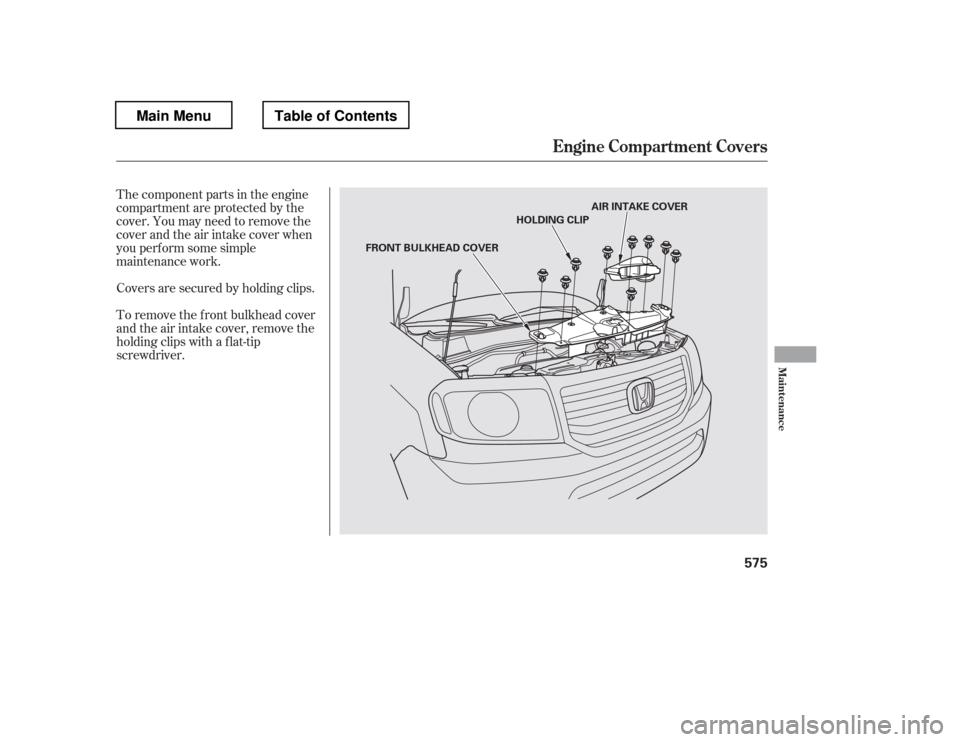
The component parts in the engine
compartment are protected by the
cover. You may need to remove the
cover and the air intake cover when
you perf orm some simple
maintenance work.
To remove the f ront bulkhead cover
and the air intake cover, remove the
holding clips with a f lat-tip
screwdriver.
Covers are secured by holding clips.
Engine Compartment Covers
Maint enance
575
FRONT BULKHEAD COVER
HOLDING CLIP
AIR INTAKE COVER
Main MenuTable of Contents
Page 583 of 681
Reinstall the engine oil f ill cap, and
tighten it securely. Wait a few
minutes, and recheck the oil level on
the engine oil dipstick. Do not f ill
above the upper mark; you could
damage the engine.
Unscrew and remove the engine oil
fill cap on top of the valve cover.
Pour in the oil slowly and caref ully so
you do not spill any. Clean up any
spills immediately. Spilled oil could
damage components in the engine
compartment. Oil is a major contributor to your
engine
Page 589 of 681
Remove the dipstick (yellow loop)
f rom the transmission, and wipe it
with a clean cloth.Insert the dipstick all the way into
the transmission securely as
shown in the illustration.
Remove the dipstick and check
the f luid level. It should be
between the upper and lower
marks.
Check the f luid level with the engine
at normal operating temperature.
Park the vehicle on level ground.
Start the engine, let it run until the
radiator f an comes on, then shut
of f the engine. For accurate
results, wait about 60 seconds (but
no longer than 90 seconds) bef ore
doing step 2.
The transmission should be drained
and ref illed with new f luid when this
service is shown on the inf ormation
display or multi-inf ormation display
(depending on the model). 1.
2.3. 4.
Automatic Transmission Fluid
582
DIPSTICKDIPSTICK
UPPER MARK
LOWER MARK
Main MenuTable of Contents