Page 490 of 681
As required by the FCC:This device complies with Part 15 of theFCC rules. Operation is subject to the
f ollowing two conditions: (1) This device may not cause harmf ul interf erence, and(2) this device must accept any
interf erence received, includinginterf erence that may cause undesiredoperation.
Changes or modif ications not expresslyapproved by the party responsible f or
compliance could void the user
Page 531 of 681
As required by the FCC:This device complies with Part 15 of theFCC rules. Operation is subject to the
f ollowing two conditions: (1) This device may not cause harmf ul interf erence, and(2) this device must accept any
interf erence received, includinginterf erence that may cause undesiredoperation.
Changes or modif ications not expresslyapproved by the party responsible f or
compliance could void the user
Page 537 of 681

Constant application of the brakes
when going down a long hill builds
up heat and reduces their ef f ective-
ness. Use the engine to assist the
brakes by taking your f oot of f the
accelerator and downshif ting to a
lower gear.
Check the brakes after driving
through deep water. Apply the
brakes moderately to see if they f eel
normal. If not, apply them gently and
f requently until they do. Be extra
cautious in your driving.
Your vehicle is equipped with disc
brakes at all f our wheels. A power
assist helps reduce the ef f ort needed
on the brake pedal. The emergency
brake assist system increases the
stopping f orce when you depress the
brake pedal hard in an emergency
situation. The anti-lock brake system
(ABS) helps you retain steering
control when braking very hard.
Resting your f oot on the pedal keeps
the brakes applied lightly, builds up
heat, reduces their ef f ectiveness and
reduces brake pad lif e. In addition,
f uel economy can be reduced. It also
keeps your brake lights on all the
time, conf using drivers behind you.As required by the FCC:
This device complies with Part 15 of theFCC rules. Operation is subject to thef ollowing two conditions: (1) This device
may not cause harmf ul interf erence, and(2) this device must accept anyinterf erence received, includinginterf erence that may cause undesiredoperation.
This device complies with IndustryCanada Standard RSS-210.Operation is subject to the f ollowing twoconditions: (1) this device may not causeinterf erence, and (2) this device mustaccept any interf erence that may cause
undesired operation of the device.
Changes or modif ications not expressly
approved by the party responsible f orcompliance could void the user
Page 547 of 681
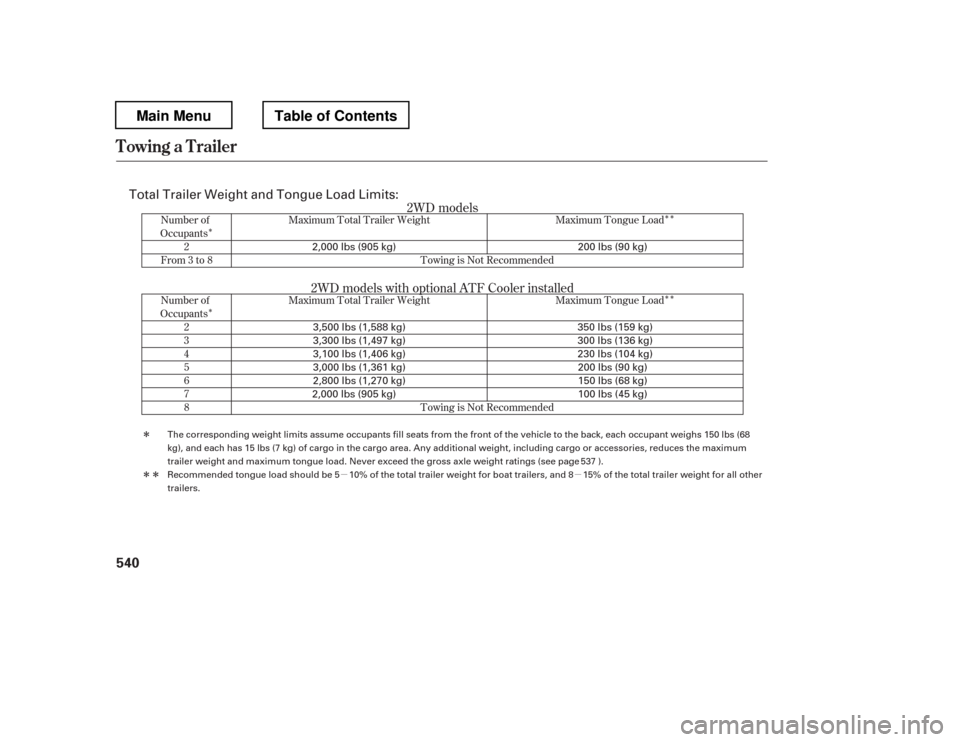
�Î
�Î
�Î�Î �Î�Î
�µ�µ
�Î �Î�Î
Number of
Occupants 2 3 4 5678
Number of
Occupants 2
From 3 to 8 T owing is Not Recommended
T owing is Not Recommended
Maximum T otal T railer Weight Maximum T ongue Load
Maximum T otal T railer Weight Maximum T ongue Load
2WD models
2WD models with optional ATF Cooler installed
Towing a Trailer
540
Total Trailer Weight and Tongue Load Limits:
The corresponding weight limits assume occupants fill seats from the front of the vehicle to the back, eac h occupant weighs 150 lbs (68
kg), and each has 15 lbs (7 kg) of cargo in the cargo area. Any additional weight, including cargo or accessories, reduces the maximum
trailer weight and maximum tongue load. Never exceed the gross axle weight ratings (see page ).
Recommended tongue load should be 5 10% of the total trailer weight for boat trailers, and 8 15% of the total trailer weight for all other
trailers. 537
2,000 lbs (905 kg)
200 lbs (90 kg)
3,500 lbs (1,588 kg)
3,300 lbs (1,497 kg)
3,100 lbs (1,406 kg)
3,000 lbs (1,361 kg)
2,800 lbs (1,270 kg)
2,000 lbs (905 kg) 350 lbs (159 kg)
300 lbs (136 kg)
230 lbs (104 kg)
200 lbs (90 kg)
150 lbs (68 kg)
100 lbs (45 kg)
Main MenuTable of Contents
Page 548 of 681
�µ�µ
�Î �Î�Î
�Î�Î
�ΠMaximum T ongue Load
Number of
Occupants 2 3456 7 8 T owing is Not Recommended
Maximum T otal T railer Weight4WD models
Towing a Trailer
Driving
541
The corresponding weight limits assume occupants fill seats from the front of the vehicle to the back, eac
h occupant weighs 150 lbs (68
kg), and each has 15 lbs (7 kg) of cargo in the cargo area. Any additional weight, including cargo or accessories, reduces the maximum
trailer weight and maximum tongue load. Never exceed the gross axle weight ratings (see page ).
Recommended tongue load should be 5 10% of the total trailer weight for boat trailers, and 8 15% of the total trailer weight for all other
trailers. 537
450 lbs (204 kg)
400 lbs (181 kg)
330 lbs (150 kg)
270 lbs (122 kg)
190 lbs (86 kg)
100 lbs (45 kg)
4,500 lbs (2,041 kg)
4,300 lbs (1,950 kg)
4,100 lbs (1,860 kg)
4,000 lbs (1,814 kg)
3,800 lbs (1,724 kg)
2,000 lbs (905 kg)
Main MenuTable of Contents
Page 553 of 681

�´
Your vehicle is equipped with a
connector to install an optional trailer
lighting connector that mates with
your vehicle. You can get this
optional connector f rom your dealer.
Ref er to the above illustration f or
wiring inf ormation.
Trailer lights and equipment must
comply with f ederal, state, province/
territory, and local regulations.
Check trailer light requirements f or
the areas where you plan to tow, and
use only equipment designed f or
your vehicle.
When towing a trailer, we
recommend that you carry a f ull-size
spare wheel and tire for your vehicle
and trailer. When replacing the
compact spare with a f ull size spare,
remove the plastic spacer (see page
). Store the plastic spacer and
compact spare together. Reinstall
thespacerbeforeonceagainstowing
the compact spare.
See page f or proper tire size,
page f or how to store a f ull size
wheel and tire, and page for
inf ormation on changing a f lat tire.
Remember to unhitch the trailer
bef ore changing a f lat. Ask your
trailer sales or rental agency where
and how to store the trailer
Page 638 of 681
If you cannot drive the vehicle
without f ixing the problem, and you
do not have a spare fuse, take a fuse
of the same rating or a lower rating
from one of the other circuits. Make
sureyoucandowithoutthatcircuit
temporarily (such as the accessory
power socket or radio).
If you replace the blown f use with a
spare f use that has a lower rating, it
might blow out again. This does not
indicate that anything is wrong.
Replace the f use with one of the
correct rating as soon as you can.
Look f or a burned wire inside the
f use. If it is burned out, replace it
withoneof thesparefusesof the
same rating or lower.
Check the smaller f uses in the
under-hood f use boxes and rear
f use box, and all the f uses in the
interior and rear f use boxes by
pulling out each one with the f use
puller provided in the primary
under-hood f use box. 5.
4.
CONT INUED
Fuses
T aking Care of the Unexpected
631
BLOWN
FUSE PULLER
Main MenuTable of Contents
Page:
< prev 1-8 9-16 17-24


