Page 255 of 286
254Handling the Unexpected
OverheatingHow to Handle OverheatingOverheating symptoms are as follows:
•The high temperature indicator comes on or the engine suddenly loses power.
•Steam is coming out of the engine compartment.■
First thing to do
1.Immediately park the vehicle in a safe place.
uMove the shift lever to
(P
and set the parking brake. Turn off all accessories
and turn on the hazard warning lights.
uMove the shift lever to
(N
and set the parking brake. Turn off all accessories
and turn on the hazard warning lights.
2. No steam coming out: Keep the engine running and open the hood.
Steam coming out: Turn off the engine and wait until steam goes away. Then,
open the hood.
1How to Handle Overheating
NOTICEContinuing to drive with the high temperature
indicator on may damage the engine.
3
WARNING
Steam and spray from an overheated
engine can seriously scald you.
Do not open the hood if steam is coming
out.
Automatic transmission modelsManual transmission models
Page 259 of 286

258
uuIndicator, Coming On/BlinkinguIf the Brake System Indicator Comes On
Handling the Unexpected
If the Brake System Indicator Comes On
■
Reasons for the indicator to come on
•The brake fluid is low.
•There is a malfunction in the brake system.
■
What to do when the indicator comes on while driving
Press the brake pedal lightly to check pedal pressure.
•If normal, check the brake fluid level the next time you stop.
•If abnormal, take immediate action. If necessary, downshift the
transmission to slow the vehicle using engine braking.
If the EPS Indicator Comes On
■
Reasons for the indicator to come on
•Comes on when there is a problem with EPS.
•If you depress the accelerator pedal repeatedly to increase the engine
speed while the engine is idling, the indicator comes on, and
sometimes the steering wheel becomes harder to operate.
■
What to do when the indicator comes on
Stop the vehicle in a safe place and restart the engine.
If the indicator comes on and stays on, immediately have your vehicle
inspected by a dealer.
1If the Brake System Indicator Comes On
Have your vehicle repaired immediately.
It is dangerous to drive with low brake fluid. If there
is no resistance from the brake pedal, stop
immediately in a safe place. If necessary downshift
the gears.
If the brake system indicator and ABS indicator come
on simultaneously, the electronic brake distribution
system is not working. This can result in vehicle
instability under sudden braking.
Have your vehicle inspected by a dealer immediately.
U.S.
Canada
1If the EPS Indicator Comes On
NOTICEIf you repeatedly turn the steering wheel at an
extremely low speed, or hold the steering wheel on
the full left or right position for a while, the system
heats up. The system goes into a protective mode,
and limits its performance. The steering wheel
becomes harder and harder to operate. Once the
system cools down, EPS is restored. Repeated
operation under these conditions can eventually
damage the system.
Page 262 of 286

261
uuFusesuFuse Locations
Handling the Unexpected
Located behind the fuse lid. Pull the fuse lid
toward you.
Fuse locations are shown on the label on
the side panel.
Locate the fuse in question by the fuse
number and label number.■
Interior Fuse Box
Fuse Lid
Fuse Label
■
Circuit protected and fuse rating
Circuit Protected
Amps
1
Back Up
10 A
2
TPMS
*
(7.5 A)
3
Driver’s Power Window
20 A
4
−
−
5
Back Up Light
10 A
6
SRS
10 A
7
Transmission SOL
*
(10 A)
8
SRS
7.5 A
9
Fog Light
*
(20 A)
10
A/C
*
7.5 A
11
ABS/VSA
7.5 A
12
ACG
10 A
13
ACC Socket
20 A
14
Key Lock/Radio
7.5 A
15
Daytime Running Light
7.5 A
16
Rear Wiper
10 A
17
Front Passenger’s Power
Window
20 A
18
Rear Passenger’s Side
Power Window
20 A
19
Rear Driver’s Side Power
Window
20 A
20
Fuel Pump
15 A
21
Washer
15 A
22
Meter
7.5 A
23
Hazard
10 A
24
Stop/Horn
10 A
25
−
−
26
LAF
10 A
27
Door Lock Main
*
(30 A)
28
Headlight Main
20 A
29
Small Light
10 A
30
Main Fan Motor
30 A
31
−
−
32
Passenger’s Side Headlight
Low Beam
10 A
33
IG Coil
15 A
34
Driver’s Side Headlight Low
Beam
10 A
35
Door Lock
*
(15 A)
36
Door Lock
*
(15 A)
37
ABS/VSA FSR
30 A
38
Door Lock
*
(15 A)
39
IGP
15 A
40
−
−
41
−
−
42
−
−
Circuit Protected
Amps
* Not available on all models
Page 265 of 286
264Handling the Unexpected
Emergency TowingCall a professional towing service if you need to tow your vehicle.■
Flat bed equipment
The operator loads your vehicle on the back of a truck.
This is the best way to transport your vehicle.
■
Wheel lift equipment
The tow truck uses two pivoting arms that go under the front tires and lift them off
the ground. The rear tires remain on the ground. This is an acceptable way to
tow your vehicle.
1Emergency Towing
NOTICETrying to lift or tow your vehicle by the bumpers will
cause serious damage. The bumpers are not designed
to support the vehicle’s weight.NOTICEImproper towing such as towing behind a
motorhome or other motor vehicle can damage the
transmission.
Never tow your vehicle with just a rope or chain.
It is very dangerous, since ropes or chains may shift
from side to side or break.
Page 266 of 286
Continued
265
uuEmergency Towingu
Handling the Unexpected
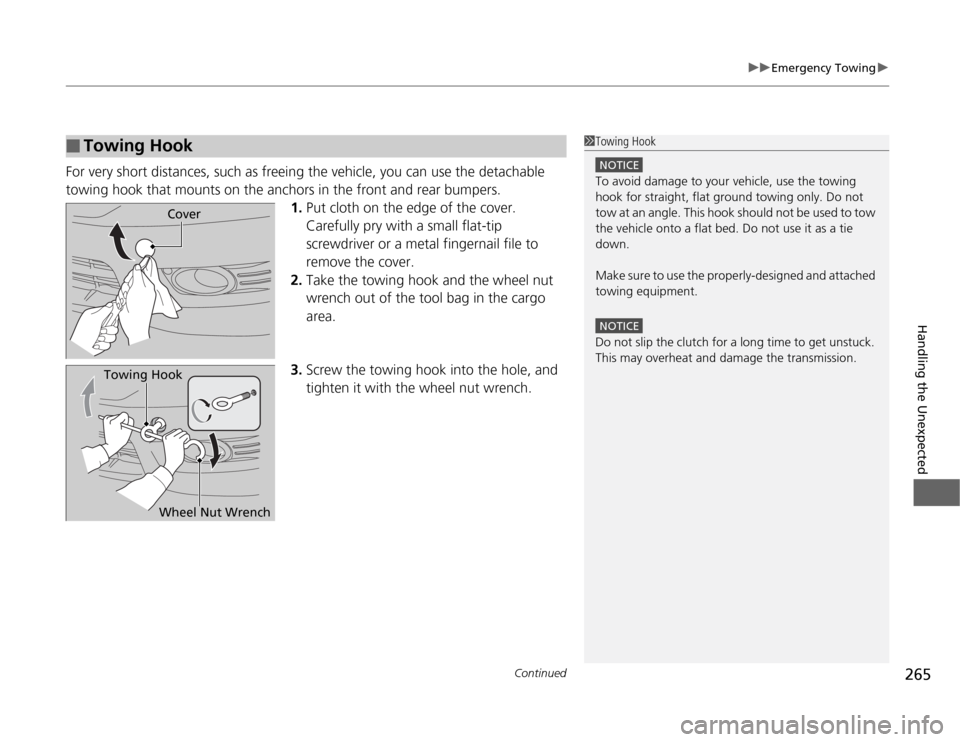
For very short distances, such as freeing the vehicle, you can use the detachable
towing hook that mounts on the anchors in the front and rear bumpers.
1.Put cloth on the edge of the cover.
Carefully pry with a small flat-tip
screwdriver or a metal fingernail file to
remove the cover.
2.Take the towing hook and the wheel nut
wrench out of the tool bag in the cargo
area.
3.Screw the towing hook into the hole, and
tighten it with the wheel nut wrench.■
Towing Hook
1Towing Hook
NOTICETo avoid damage to your vehicle, use the towing
hook for straight, flat ground towing only. Do not
tow at an angle. This hook should not be used to tow
the vehicle onto a flat bed. Do not use it as a tie
down.
Make sure to use the properly-designed and attached
towing equipment.NOTICEDo not slip the clutch for a long time to get unstuck.
This may overheat and damage the transmission.
Cover
Towing Hook
Wheel Nut Wrench
Page 268 of 286
267
Information
This chapter includes your vehicle’s specifications, locations of identification numbers, and other
information required by regulation.
Specifications.................................... 268
Identification Numbers
Vehicle Identification Number (VIN) .. 270
Engine Number and Transmission
Number...................................... 270
Devices that Emit Radio Waves....... 271
Reporting Safety Defects................. 272Emissions Testing
Testing of Readiness Codes.............. 273
Warranty Coverages........................ 275
Authorized Manuals......................... 277
Customer Service Information......... 278
Page 270 of 286
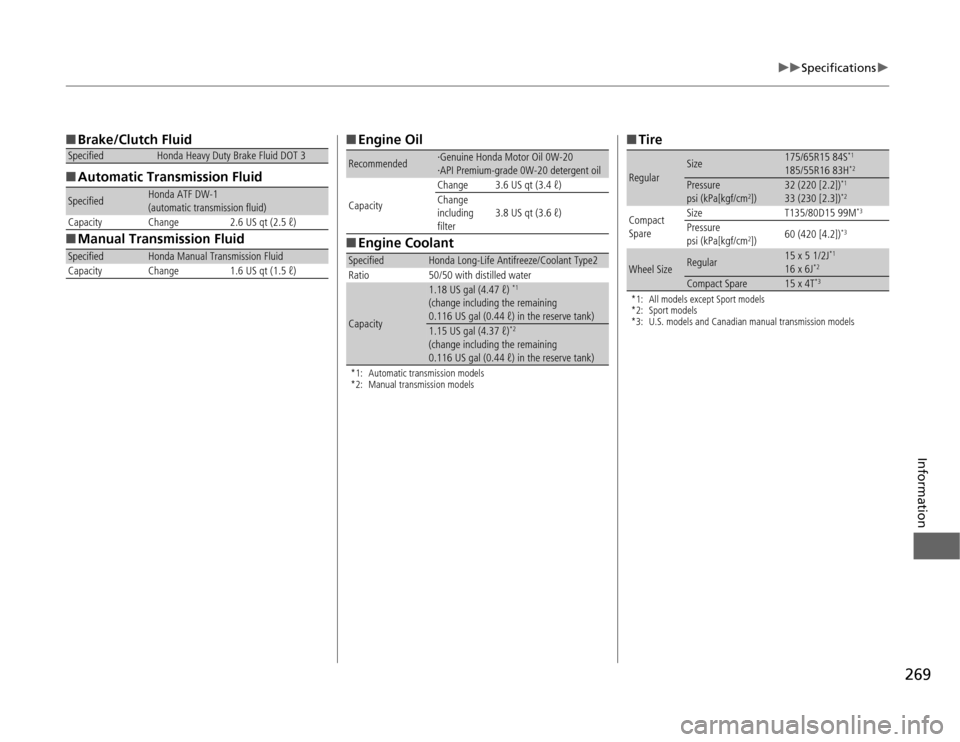
269
uuSpecificationsu
Information
■Brake/Clutch Fluid
■Automatic Transmission Fluid
■Manual Transmission FluidSpecified
Honda Heavy Duty Brake Fluid DOT 3
Specified
Honda ATF DW-1
(automatic transmission fluid)
Capacity Change 2.6 US qt (2.5 ℓ)
Specified
Honda Manual Transmission Fluid
Capacity Change 1.6 US qt (1.5 ℓ)
■Engine Oil
■Engine Coolant*1: Automatic transmission models
*2: Manual transmission modelsRecommended
·Genuine Honda Motor Oil 0W-20
·API Premium-grade 0W-20 detergent oil
CapacityChange 3.6 US qt (3.4 ℓ)
Change
including
filter3.8 US qt (3.6 ℓ)
Specified
Honda Long-Life Antifreeze/Coolant Type2
Ratio 50/50 with distilled water
Capacity
1.18 US gal (4.47 ℓ)
*1
(change including the remaining
0.116 US gal (0.44 ℓ) in the reserve tank)1.15 US gal (4.37 ℓ)
*2
(change including the remaining
0.116 US gal (0.44 ℓ) in the reserve tank)
■Tire*1: All models except Sport models
*2: Sport models
*3: U.S. models and Canadian manual transmission modelsRegular
Size
175/65R15 84S
*1
185/55R16 83H
*2
Pressure
psi (kPa[kgf/cm
2])
32 (220 [2.2])
*1
33 (230 [2.3])
*2
Compact
SpareSize T135/80D15 99M
*3
Pressure
psi (kPa[kgf/cm
2])60 (420 [4.2])
*3
Wheel Size
Regular
15 x 5 1/2J
*1
16 x 6J
*2
Compact Spare
15 x 4T
*3
Page 271 of 286
270Information
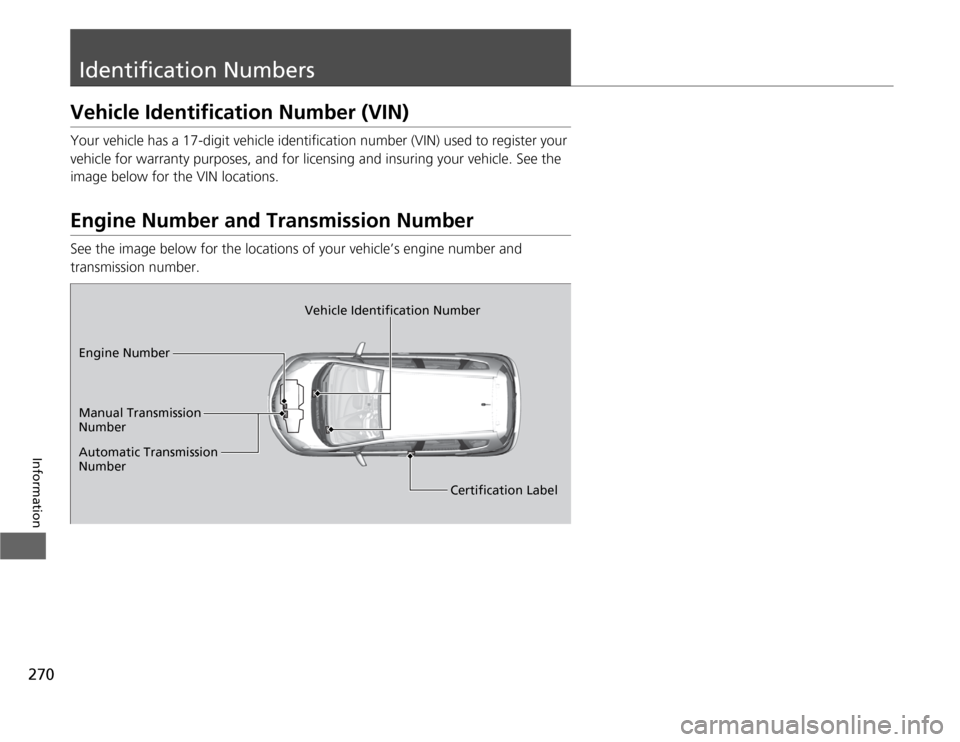
Identification NumbersVehicle Identification Number (VIN)Your vehicle has a 17-digit vehicle identification number (VIN) used to register your
vehicle for warranty purposes, and for licensing and insuring your vehicle. See the
image below for the VIN locations.Engine Number and Transmission NumberSee the image below for the locations of your vehicle’s engine number and
transmission number.
Vehicle Identification Number
Engine Number
Certification Label Manual Transmission
Number
Automatic Transmission
Number