Page 245 of 286

uuIf a Tire Goes FlatuChanging a Flat Tire
*
244Handling the Unexpected
1.Remove the center cap.
2.Place the flat tire face down in the spare tire
well.
3.Remove the spacer cone from the wing
bolt, flip it over, and insert it back on the
bolt. Secure the flat tire with the wing bolt.
4.Securely store the wheel nut wrench and
jack handle bar back in the tool bag. Store
the bag in the center of the flat tire.
5.Store the jack. Turn the jack’s end bracket
to lock it in place.
If you replace a flat tire with the spare tire, the low tire pressure indicator comes on
while you are driving. After driving for a few miles (kilometers), the indicator will go
off and the TPMS indicator comes on, but this is normal.
If you replace the tire with a specified regular tire, the low tire pressure or TPMS
indicator will go off after a few miles (kilometers).
■
Storing the Flat Tire
1Storing the Flat Tire
3
WARNING
Loose items can fly around the interior in a
crash and can seriously injure the
occupants.
Store the wheel, jack, and tools securely
before driving.
For normal tire
For compact spare tire Wing Bolt
Spacer
Cone
Models with aluminum wheelsAll models
■
TPMS and the Spare Tire
1TPMS and the Spare Tire
The system cannot monitor the pressure of the spare
tire. Manually check the spare tire pressure to be sure
that it is correct.
Use TPMS specific wheels. Each is equipped with a
tire pressure sensor mounted inside the tire behind
the valve stem.
U.S. models
Page 246 of 286

245
uuIf a Tire Goes FlatuTemporarily Repairing a Flat Tire
*
Continued
Handling the Unexpected
Temporarily Repairing a Flat Tire
*
If the tire has a large cut or is otherwise severely damaged, you will need to have the
vehicle towed. If the tire only has a small puncture, from a nail for instance, you can
use the tire repair kit so that you can drive to the nearest service station for a more
permanent repair.
If a tire goes flat while driving, grasp the steering wheel firmly, and brake gradually
to reduce speed. Then stop in a safe place.
1.Park the vehicle on firm, level, and non-slippery ground.
2.Put the shift lever in
(P
.
3.Set the parking brake.
4.Turn on the hazard warning lights and turn the ignition switch to LOCK
(0
.
■
Getting Ready to Temporarily Repair the Flat Tire
1Temporarily Repairing a Flat Tire
*
The kit should not be used in the following situations.
Instead, contact a dealer or a roadside assistant to
have the vehicle towed.•The tire sealant has expired.•More than two tires are punctured.•The puncture is greater than 3/16 inch (4 mm) in
diameter.•The tire side wall is damaged or the puncture is
outside the tire tread.•Damage has been caused by driving with the tires
extremely under inflated.•The tire bead is no longer seated.•A rim is damaged.
Do not remove a nail or screw that punctured the
tire. If you remove it from the tire, you may not be
able to repair the puncture using the kit.NOTICEDo not use a puncture-repairing agent other than the
one provided in the kit that came with your vehicle. If
used, you may permanently damage the tire pressure
sensor.
When the puncture is:
Smaller than 3/16 inch
(4 mm)
Larger than 3/16 inch
(4 mm) Kit Use
Yes
No Contact
Area
Instruction
Manual Air Compressor Wheel
Label Sealant Bottle Expiration Date
Speed Limit
Label
* Not available on all models
Page 247 of 286
uuIf a Tire Goes FlatuTemporarily Repairing a Flat Tire
*
246Handling the Unexpected
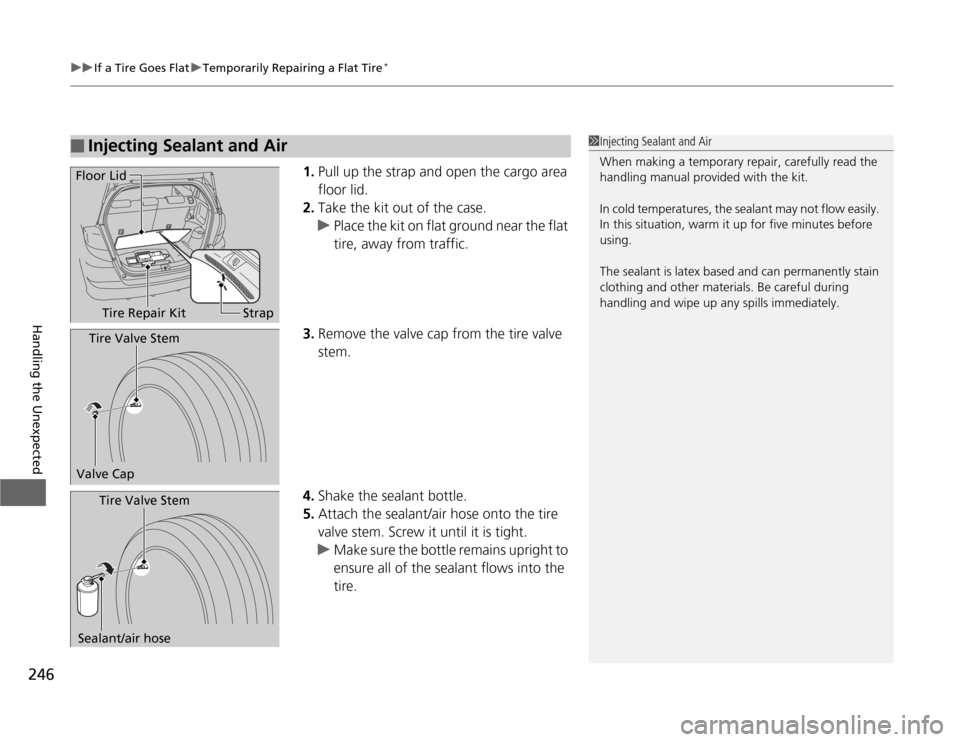
1.Pull up the strap and open the cargo area
floor lid.
2.Take the kit out of the case.
uPlace the kit on flat ground near the flat
tire, away from traffic.
3.Remove the valve cap from the tire valve
stem.
4.Shake the sealant bottle.
5.Attach the sealant/air hose onto the tire
valve stem. Screw it until it is tight.
uMake sure the bottle remains upright to
ensure all of the sealant flows into the
tire.
■
Injecting Sealant and Air
1Injecting Sealant and Air
When making a temporary repair, carefully read the
handling manual provided with the kit.
In cold temperatures, the sealant may not flow easily.
In this situation, warm it up for five minutes before
using.
The sealant is latex based and can permanently stain
clothing and other materials. Be careful during
handling and wipe up any spills immediately.
Floor Lid
Tire Repair Kit Strap
Tire Valve Stem
Valve CapTire Valve Stem
Sealant/air hose
Page 248 of 286
Continued
247
uuIf a Tire Goes FlatuTemporarily Repairing a Flat Tire
*
Handling the Unexpected
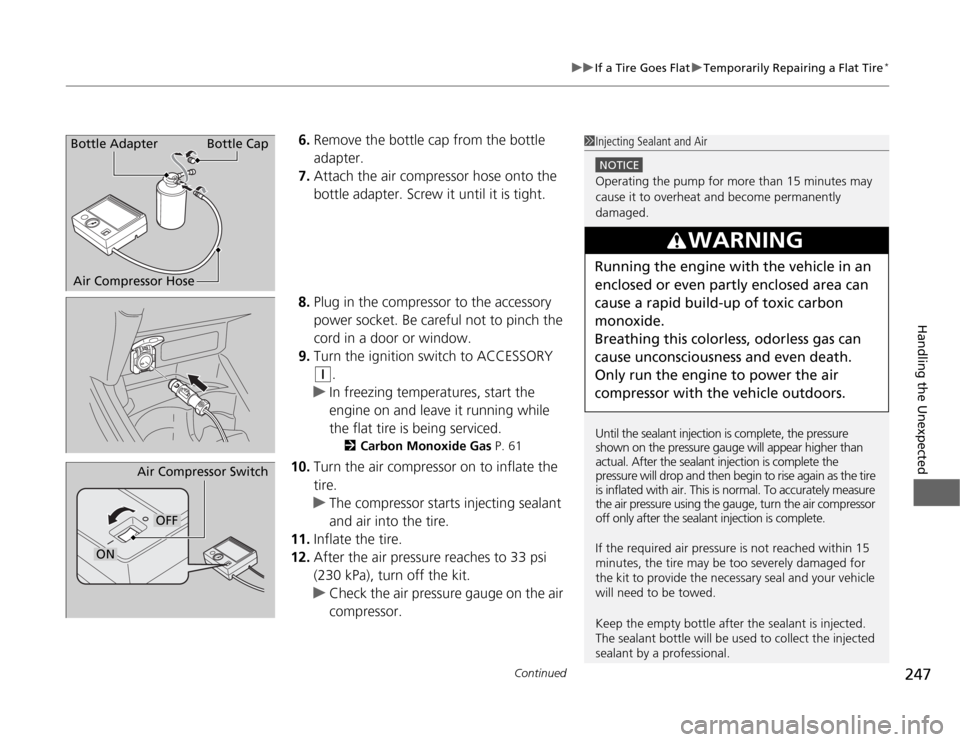
6.Remove the bottle cap from the bottle
adapter.
7.Attach the air compressor hose onto the
bottle adapter. Screw it until it is tight.
8.Plug in the compressor to the accessory
power socket. Be careful not to pinch the
cord in a door or window.
9.Turn the ignition switch to ACCESSORY
(q
.
uIn freezing temperatures, start the
engine on and leave it running while
the flat tire is being serviced.
2Carbon Monoxide Gas P. 61
10.Turn the air compressor on to inflate the
tire.
uThe compressor starts injecting sealant
and air into the tire.
11.Inflate the tire.
12.After the air pressure reaches to 33 psi
(230 kPa), turn off the kit.
uCheck the air pressure gauge on the air
compressor.
1Injecting Sealant and Air
NOTICEOperating the pump for more than 15 minutes may
cause it to overheat and become permanently
damaged.
Until the sealant injection is complete, the pressure
shown on the pressure gauge will appear higher than
actual. After the sealant injection is complete the
pressure will drop and then begin to rise again as the tire
is inflated with air. This is normal. To accurately measure
the air pressure using the gauge, turn the air compressor
off only after the sealant injection is complete.
If the required air pressure is not reached within 15
minutes, the tire may be too severely damaged for
the kit to provide the necessary seal and your vehicle
will need to be towed.
Keep the empty bottle after the sealant is injected.
The sealant bottle will be used to collect the injected
sealant by a professional.
3
WARNING
Running the engine with the vehicle in an
enclosed or even partly enclosed area can
cause a rapid build-up of toxic carbon
monoxide.
Breathing this colorless, odorless gas can
cause unconsciousness and even death.
Only run the engine to power the air
compressor with the vehicle outdoors.
Bottle Adapter
Air Compressor HoseBottle Cap
Air Compressor Switch
OFF
ON
Page 249 of 286
uuIf a Tire Goes FlatuTemporarily Repairing a Flat Tire
*
248Handling the Unexpected
13.Unscrew the sealant/air hose from the tire
valve stem. Reinstall the valve cap.
14.Push the deflate button until the gauge
returns 0 psi.
15.Apply the wheel label to the flat surface of
the wheel.
uThe wheel surface must be clean to
ensure the label adheres properly.
1.Apply the speed limit label to the location
as shown.
2.Drive the vehicle for about 5 minutes.
uDo not exceed 50 mph (80 km/h).
3.Stop the vehicle in a safe place.
Air Pressure Gauge
Deflate Button
Wheel Label
■
Distributing the Sealant in the Tire
1Distributing the Sealant in the Tire
Stop and recheck the air pressure after every 5
minutes of driving as necessary until you reach the
nearest service station where you should have the tire
permanently repaired or replaced.
Speed Limit Label
Page 250 of 286
249
uuIf a Tire Goes FlatuTemporarily Repairing a Flat Tire
*
Handling the Unexpected
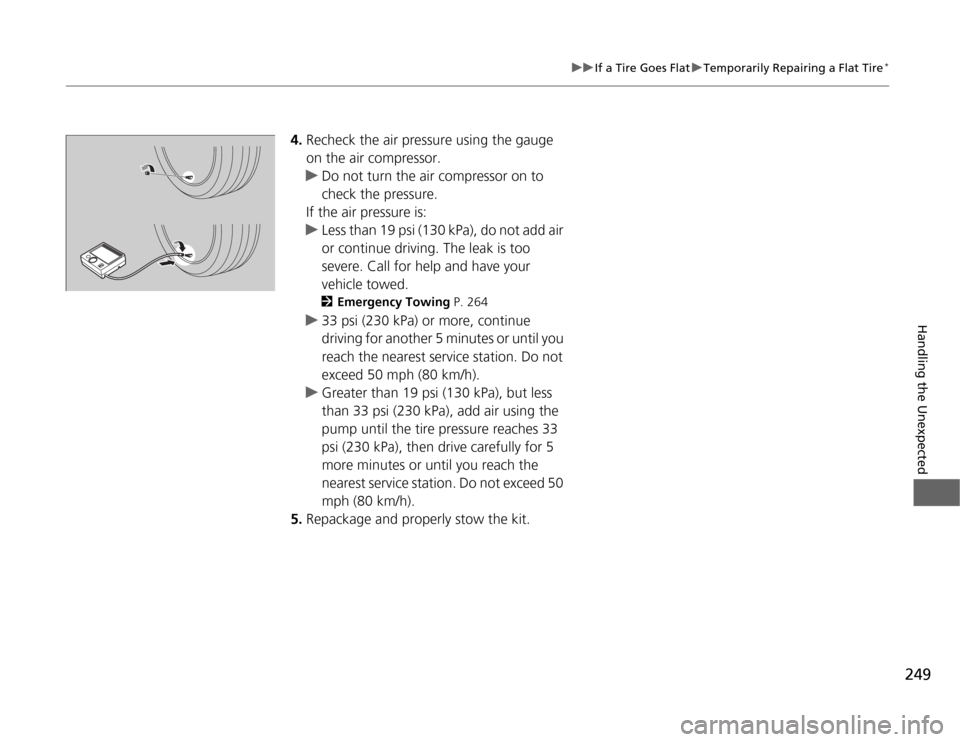
4.Recheck the air pressure using the gauge
on the air compressor.
uDo not turn the air compressor on to
check the pressure.
If the air pressure is:
uLess than 19 psi (130 kPa), do not add air
or continue driving. The leak is too
severe. Call for help and have your
vehicle towed.
2Emergency Towing P. 264
u33 psi (230 kPa) or more, continue
driving for another 5 minutes or until you
reach the nearest service station. Do not
exceed 50 mph (80 km/h).
uGreater than 19 psi (130 kPa), but less
than 33 psi (230 kPa), add air using the
pump until the tire pressure reaches 33
psi (230 kPa), then drive carefully for 5
more minutes or until you reach the
nearest service station. Do not exceed 50
mph (80 km/h).
5.Repackage and properly stow the kit.
Page 260 of 286
259
uuIndicator, Coming On/BlinkinguIf the Low Tire Pressure Indicator Comes On
Handling the Unexpected
If the Low Tire Pressure Indicator Comes On
■
Reasons for the indicator to come on
A tire pressure is significantly low. If the compact spare tire
* is installed,
the indicator stays on for a while, and then goes off.
■
What to do when the indicator comes on
Stop your vehicle in a safe place. Check the tire pressure and adjust the
pressure to the specified level. The specified tire pressure is on a label on
the driver side doorjamb.
If the TPMS Indicator Comes On
■
Reasons for the indicator to come on
•Comes on when there is a problem with the TPMS.
•If the compact spare is installed, the indicator comes on after driving
for a few miles (kilometers).
■
What to do when the indicator comes on
Have the tire inspected by a dealer as soon as possible. If the compact
spare tire has triggered the indicator to comes on, change the tire to a
full size tire. The indicator goes off after a while.
U.S. models
1If the Low Tire Pressure Indicator Comes On
NOTICEDriving on an extremely underinflated tire can cause
it to overheat. An overheated tire can fail. Always
inflate your tires to the prescribed level.
U.S. models* Not available on all models
Page 265 of 286
264Handling the Unexpected
Emergency TowingCall a professional towing service if you need to tow your vehicle.■
Flat bed equipment
The operator loads your vehicle on the back of a truck.
This is the best way to transport your vehicle.
■
Wheel lift equipment
The tow truck uses two pivoting arms that go under the front tires and lift them off
the ground. The rear tires remain on the ground. This is an acceptable way to
tow your vehicle.
1Emergency Towing
NOTICETrying to lift or tow your vehicle by the bumpers will
cause serious damage. The bumpers are not designed
to support the vehicle’s weight.NOTICEImproper towing such as towing behind a
motorhome or other motor vehicle can damage the
transmission.
Never tow your vehicle with just a rope or chain.
It is very dangerous, since ropes or chains may shift
from side to side or break.