Page 257 of 286

256Handling the Unexpected
Indicator, Coming On/BlinkingIf the Low Oil Pressure Indicator Comes On
■
Reasons for the indicator to come on
Comes on when the engine oil pressure is low.
■
What to do as soon as the indicator comes on
1.Immediately park the vehicle in a safe place.
2.If necessary, turn the hazard warning lights on.
■
What to do after parking the vehicle
1.Stop the engine and let it sit for about one minute.
2.Open the hood and check the oil level.
uAdd oil as necessary.
3.Start the engine and check the low oil pressure indicator.
uThe light goes out: Start driving again.
uThe light does not go out within 10 seconds: Stop the engine and
contact a dealer for repairs immediately.
If the Charging System Indicator Comes On
■
Reasons for the indicator to come on
Comes on when the battery is not being charged.
■
What to do when the indicator comes on
Turn off the heating and cooling
* system, rear defogger, and other
electrical systems, and immediately contact a dealer for repairs.
1If the Low Oil Pressure Indicator Comes On
NOTICERunning the engine with low oil pressure can cause
serious mechanical damage almost immediately.1If the Charging System Indicator Comes On
If you need to stop temporarily, do not turn off the
engine. Restarting the engine may rapidly discharge
the battery.
* Not available on all models
Page 258 of 286
257
uuIndicator, Coming On/BlinkinguIf the Malfunction Indicator Lamp Comes On or Blinks
Handling the Unexpected
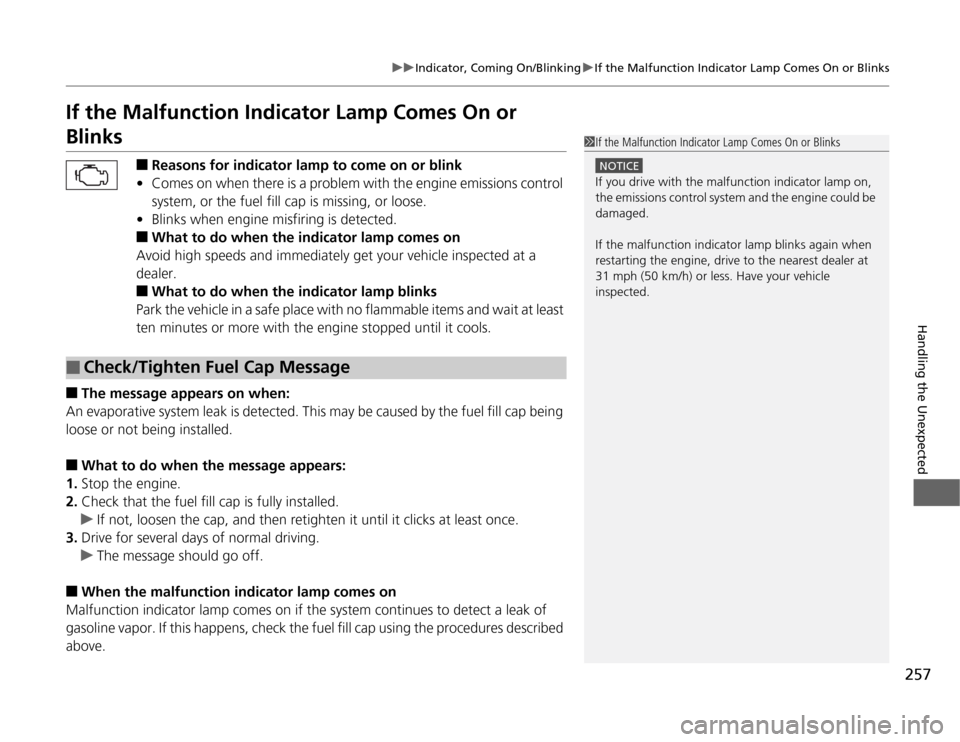
If the Malfunction Indicator Lamp Comes On or Blinks
■
Reasons for indicator lamp to come on or blink
•Comes on when there is a problem with the engine emissions control
system, or the fuel fill cap is missing, or loose.
•Blinks when engine misfiring is detected.
■
What to do when the indicator lamp comes on
Avoid high speeds and immediately get your vehicle inspected at a
dealer.
■
What to do when the indicator lamp blinks
Park the vehicle in a safe place with no flammable items and wait at least
ten minutes or more with the engine stopped until it cools.
■
The message appears on when:
An evaporative system leak is detected. This may be caused by the fuel fill cap being
loose or not being installed.
■
What to do when the message appears:
1.Stop the engine.
2.Check that the fuel fill cap is fully installed.
uIf not, loosen the cap, and then retighten it until it clicks at least once.
3.Drive for several days of normal driving.
uThe message should go off.
■
When the malfunction indicator lamp comes on
Malfunction indicator lamp comes on if the system continues to detect a leak of
gasoline vapor. If this happens, check the fuel fill cap using the procedures described
above.
■
Check/Tighten Fuel Cap Message
1If the Malfunction Indicator Lamp Comes On or Blinks
NOTICEIf you drive with the malfunction indicator lamp on,
the emissions control system and the engine could be
damaged.
If the malfunction indicator lamp blinks again when
restarting the engine, drive to the nearest dealer at
31 mph (50 km/h) or less. Have your vehicle
inspected.
Page 259 of 286

258
uuIndicator, Coming On/BlinkinguIf the Brake System Indicator Comes On
Handling the Unexpected
If the Brake System Indicator Comes On
■
Reasons for the indicator to come on
•The brake fluid is low.
•There is a malfunction in the brake system.
■
What to do when the indicator comes on while driving
Press the brake pedal lightly to check pedal pressure.
•If normal, check the brake fluid level the next time you stop.
•If abnormal, take immediate action. If necessary, downshift the
transmission to slow the vehicle using engine braking.
If the EPS Indicator Comes On
■
Reasons for the indicator to come on
•Comes on when there is a problem with EPS.
•If you depress the accelerator pedal repeatedly to increase the engine
speed while the engine is idling, the indicator comes on, and
sometimes the steering wheel becomes harder to operate.
■
What to do when the indicator comes on
Stop the vehicle in a safe place and restart the engine.
If the indicator comes on and stays on, immediately have your vehicle
inspected by a dealer.
1If the Brake System Indicator Comes On
Have your vehicle repaired immediately.
It is dangerous to drive with low brake fluid. If there
is no resistance from the brake pedal, stop
immediately in a safe place. If necessary downshift
the gears.
If the brake system indicator and ABS indicator come
on simultaneously, the electronic brake distribution
system is not working. This can result in vehicle
instability under sudden braking.
Have your vehicle inspected by a dealer immediately.
U.S.
Canada
1If the EPS Indicator Comes On
NOTICEIf you repeatedly turn the steering wheel at an
extremely low speed, or hold the steering wheel on
the full left or right position for a while, the system
heats up. The system goes into a protective mode,
and limits its performance. The steering wheel
becomes harder and harder to operate. Once the
system cools down, EPS is restored. Repeated
operation under these conditions can eventually
damage the system.
Page 261 of 286
260Handling the Unexpected
FusesFuse LocationsIf any electrical devices are not working, turn the ignition switch to LOCK
(0
and
check to see if any applicable fuse is blown.
Fuse locations are shown on the fuse box cover. Locate the fuse in question by the
fuse number and box cover number.
Pull up the cover by pushing the three tabs as
shown.
Replacement of engine compartment fuses
should be done by a dealer.
■
Circuit protected and fuse rating
■
Engine Compartment Fuse Box
Fuse BoxTab
TabTab
Circuit Protected
Amps
1
Battery
100 A
2
EPS
70 A
3
Horn/Hazard
20 A
Page 264 of 286
263
uuFusesuInspecting and Changing Fuses
Handling the Unexpected
Inspecting and Changing Fuses
1.Turn the ignition switch to LOCK
(0
. Turn
headlights and all accessories off.
2.Check the fuses in the engine
compartment.
uIf the fuse is blown, have it replaced by a
dealer.
3.Inspect the small fuses in the engine
compartment and the vehicle interior.
uIf there is a burned out fuse, remove it
with the fuse puller and replace it with a
new one.
1Inspecting and Changing Fuses
NOTICEReplacing a fuse with one that has a higher rating
greatly increases the chances of damaging the
electrical system.
Replace fuse with a spare fuse of the same specified
amperage.
Confirm the specified amperage using the charts on
P. 260 and P. 261.
There is a fuse puller on the back of the engine
compartment fuse box cover.
Fuse
BlownFuse Puller
Page 268 of 286
267
Information
This chapter includes your vehicle’s specifications, locations of identification numbers, and other
information required by regulation.
Specifications.................................... 268
Identification Numbers
Vehicle Identification Number (VIN) .. 270
Engine Number and Transmission
Number...................................... 270
Devices that Emit Radio Waves....... 271
Reporting Safety Defects................. 272Emissions Testing
Testing of Readiness Codes.............. 273
Warranty Coverages........................ 275
Authorized Manuals......................... 277
Customer Service Information......... 278
Page 269 of 286

268Information
Specifications■Vehicle SpecificationsModel
Honda Fit
No. of Passengers:
Front 2
Rear 3
Total 5
Weights:Gross Vehicle
Weight Rating
U.S.: 3,512 lbs (1,594 kg)
Canada: 1,594 kg
Gross Axle Weight
Rating (Front)
U.S.: 1,921 lbs (872 kg)
Canada: 872 kg
Gross Axle Weight
Rating (Rear)
U.S.: 1,619 lbs (735 kg)
Canada: 735 kg
Air Conditioning:
Refrigerant Type HFC-134a (R-134a)
Charge Quantity 13.1 – 14.8 oz (370 – 420 g)
Lubricant Type SP-10
■Engine Specifications
■Fuel
■Battery
■Washer FluidDisplacement
91.3 cu-in (1,497 cm
3)
Spark PlugsNGK IZFR6K13
DENSO
SKJ20DR-M13
Fuel:
Type
Unleaded gasoline, Pump octane number
of 87 or higher
Fuel Tank Capacity 10.6 US gal (40 ℓ)
Capacity/Type
32AH(5)/40AH(20)
34AH(5)/40AH(20)
Tank Capacity
U.S.: 2.6 US qt (2.5 ℓ)
Canada: 4.8 US qt (4.5 ℓ)
■Light Bulbs*1: Sport models
*2: Not available on all modelsHeadlights (High/Low Beam)
60/55W (HB2)
Fog Lights
*1
55W (H11)
Parking/Side Marker Lights
3.8W (Amber)
Front Turn Signal Lights 21W (Amber)
Brake/Taillights
21/5W
Back-Up Lights 16W
Rear Turn Signal Lights
21W (Amber)
High-Mount Brake Light LED
Rear License Plate Light
5W
Cargo Area Light 5W
Center Console Light
*2
1.4W
Interior Lights
Map Lights
*2
8W
Ceiling Light 8W
Page 270 of 286
269
uuSpecificationsu
Information
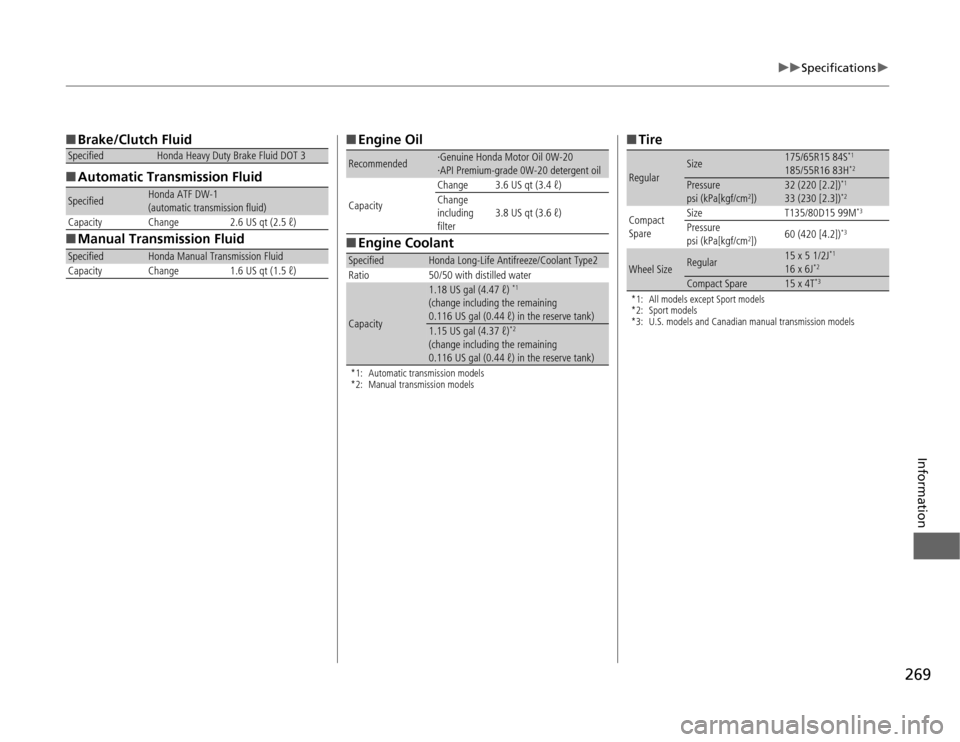
■Brake/Clutch Fluid
■Automatic Transmission Fluid
■Manual Transmission FluidSpecified
Honda Heavy Duty Brake Fluid DOT 3
Specified
Honda ATF DW-1
(automatic transmission fluid)
Capacity Change 2.6 US qt (2.5 ℓ)
Specified
Honda Manual Transmission Fluid
Capacity Change 1.6 US qt (1.5 ℓ)
■Engine Oil
■Engine Coolant*1: Automatic transmission models
*2: Manual transmission modelsRecommended
·Genuine Honda Motor Oil 0W-20
·API Premium-grade 0W-20 detergent oil
CapacityChange 3.6 US qt (3.4 ℓ)
Change
including
filter3.8 US qt (3.6 ℓ)
Specified
Honda Long-Life Antifreeze/Coolant Type2
Ratio 50/50 with distilled water
Capacity
1.18 US gal (4.47 ℓ)
*1
(change including the remaining
0.116 US gal (0.44 ℓ) in the reserve tank)1.15 US gal (4.37 ℓ)
*2
(change including the remaining
0.116 US gal (0.44 ℓ) in the reserve tank)
■Tire*1: All models except Sport models
*2: Sport models
*3: U.S. models and Canadian manual transmission modelsRegular
Size
175/65R15 84S
*1
185/55R16 83H
*2
Pressure
psi (kPa[kgf/cm
2])
32 (220 [2.2])
*1
33 (230 [2.3])
*2
Compact
SpareSize T135/80D15 99M
*3
Pressure
psi (kPa[kgf/cm
2])60 (420 [4.2])
*3
Wheel Size
Regular
15 x 5 1/2J
*1
16 x 6J
*2
Compact Spare
15 x 4T
*3


